Back to all blogs
Spot 30 critical red flags hiring teams miss in remote interviews, including AI cheating, proxy candidates, and interview fraud and learn how to protect interview integrity.
Abhishek Kaushik
Mar 5, 2026
Remote hiring has transformed recruitment but it has also opened the door to new forms of interview fraud and AI-assisted cheating that traditional evaluation methods struggle to detect.
Surveys of hiring professionals report that 59% suspect candidates misrepresent themselves using AI tools or fraudulent tactics in the hiring process, and about 17% have directly encountered deepfake or proxy-assisted interviews.
Companies are also reporting broader patterns of deception, in some studies, up to 72% of recruiters have encountered AI-related job fraud, including fake credentials, fabricated work samples, and even deepfake interview scenarios.
These trends highlight a stark reality that interviews are being gamed at scale, and human interviewers alone often can’t spot when polished answers hide external assistance or even identity fraud.
This blog explores the 30 most commonly missed red flags in remote interviews and why hiring teams need to rethink how interview integrity is evaluated today.
30 Interview Red Flags Hiring Teams Miss
Remote interviews unlocked global hiring at scale but they also quietly broke many of the trust assumptions interviews were built on.
Below are 30 critical red flags in remote interviews that signal potential AI assistance, impersonation, or external help and why hiring teams frequently overlook them.
1. Delayed Responses Followed by Unnaturally Perfect Answers
In remote interviews, response timing matters as much as content.
Why this is a red flag
Suggests off-screen prompting or AI generation
Breaks natural thinking rhythm
Commonly missed because: Interviewers assume nerves or internet lag.
👉 Top Behavioral Signs of Cheating During Remote Interviews
2. Eyes Frequently Shifting Away From the Screen
Subtle but recurring eye movement patterns matter.
Why this is a red flag
Indicates reading from another device or prompt
Often aligns with complex questions
Commonly missed because: Interviewers normalize multitasking in remote calls.

3. Answers That Sound More “Written” Than Spoken
Spoken language has imperfections. Generated responses don’t.
Why this is a red flag
AI-generated responses often have:
Over-structured phrasing
Perfect grammar
Balanced, essay-like flow
Commonly missed because: Polished communication is mistaken for competence.
4. Sudden Spikes in Answer Quality
Not all answers are created equal but dramatic swings are telling.
Why this is a red flag
Suggests selective external help
Indicates lack of consistent skill ownership
Commonly missed because: Interviewers focus on the best answers, not variance.
5. Inability to Rephrase or Simplify an Answer
True understanding survives paraphrasing.
Why this is a red flag
Scripted or AI answers fail when reframed
Indicates memorization, not comprehension
Commonly missed because: Interviewers move on after “good enough” responses.
👉 How to Detect Cheating in a Gmeet Interview
6. Overuse of Generic Frameworks Without Context
Frameworks are useful until they replace thinking.
Why this is a red flag
AI tools default to popular models
Lack of real-world anchoring
Commonly missed because: Framework familiarity is rewarded in interviews.
7. Strong Theoretical Knowledge, Weak Practical Depth
Theory is easier to fake than experience.
Why this is a red flag
AI excels at explaining concepts
Struggles with messy, real-world edge cases
Commonly missed because: Interviewers don’t probe operational details.
8. Inconsistent Voice, Tone, or Vocabulary
Language consistency is a powerful integrity signal.
Why this is a red flag
Switching between personal speech and generated language
Sudden shifts in sophistication
Commonly missed because: Remote interviews reduce sensitivity to delivery changes.
9. Candidate Avoids Screen Sharing or Live Tasks
Resistance to live problem-solving is revealing.
Why this is a red flag
Live tasks reduce ability to use AI assistance
Proxy candidates often avoid exposure
Commonly missed because: Interviewers don’t want to appear “distrustful”.
10. Perfect Answers to Ambiguous Questions
Ambiguity usually produces hesitation.
Why this is a red flag
AI tends to resolve ambiguity confidently
Humans ask clarifying questions
Commonly missed because: Confidence is mistaken for decisiveness.
11. No Visible Thinking Process
Remote interviews hide cognitive effort.
Why this is a red flag
AI provides outputs, not reasoning trails
Real problem-solving shows pauses, corrections
Commonly missed because: Interviewers focus on final answers only.
12. Candidate Performs Better Than Their Resume Suggests
Too good can also be suspicious.
Why this is a red flag
Proxy interviews inflate perceived skill
Resume becomes irrelevant
Commonly missed because: Teams celebrate “hidden gems”.
13. Candidate Performs Worse in Later Rounds
Integrity breaks under continuity.
Why this is a red flag
Different person interviewing
Loss of external support
Commonly missed because: Attributed to fatigue or pressure.
14. Inability to Explain Past Work Without Generalities
AI can summarize not relive experience.
Why this is a red flag
Lack of emotional or contextual detail
No “war stories”
Commonly missed because: Interviewers don’t dig into specifics.
15. Answers That Don’t Match the Question’s Constraints
Constraint handling reveals real thinking.
Why this is a red flag
AI often ignores subtle constraints
External helpers may not hear full question
Commonly missed because: Interviewers don’t enforce constraints strictly.
16. Minimal Clarifying Questions
Curiosity is a human signal.
Why this is a red flag
AI assumes and proceeds
Humans clarify uncertainty
Commonly missed because: Quick answers feel efficient.
17. Mismatch Between Test / Assignment and Interview Discussion
This gap is one of the strongest fraud indicators.
Why this is a red flag
Work may not be their own
AI-generated or outsourced assignments
Commonly missed because: Teams treat assessments and interviews separately.
18. Repeating Common Online Examples Verbatim
AI and coaching reuse the same references.
Why this is a red flag
Identical examples across candidates
No personalization
Commonly missed because: Examples sound “industry standard”.
19. Candidate Rarely Admits Uncertainty
Humans don’t know everything.
Why this is a red flag
AI fills gaps confidently
External helpers smooth over doubt
Commonly missed because: Interviewers reward certainty.
20. Behavioral Answers That Don’t Align With Technical Depth
Cross-signal mismatches matter.
Why this is a red flag
Strong storytelling, weak execution
Polished narratives hiding gaps
Commonly missed because: Behavioral rounds feel safer.
21. Unnatural Pauses Only During Technical Questions
Pattern matters more than isolated moments.
Why this is a red flag
External help triggered selectively
Integrity varies by question type
Commonly missed because: Interviewers don’t track response timing.
22. Candidate Avoids Camera-On Policies or Identity Checks
Identity continuity is foundational.
Why this is a red flag
Enables proxy interviewing
Weakens accountability
Commonly missed because: Fear of harming candidate experience.
23. Answers Mirror Job Description Language Too Closely
AI loves job descriptions.
Why this is a red flag
Low originality
Repackaged text, not experience
Commonly missed because: Alignment is rewarded.
24. Inability to Debug or Critique Their Own Answer
Reflection reveals ownership.
Why this is a red flag
AI-generated answers resist critique
Ownership requires judgment
Commonly missed because: Interviewers rarely revisit answers.
25. Overly Structured STAR Responses Across All Questions
Consistency can be suspicious.
Why this is a red flag
Suggests coaching or scripts
Lacks natural variation
Commonly missed because: Interviewers are trained to expect STAR.
26. Candidate Performs Exceptionally Well in First Round Only
First impressions can be engineered.
Why this is a red flag
Initial round heavily assisted
Later rounds reveal baseline ability
Commonly missed because: Early momentum bias.
27. No Personal Opinions or Trade-Offs
Real work involves judgment.
Why this is a red flag
AI stays neutral
Humans take positions
Commonly missed because: Neutrality feels professional.
28. Difficulty Thinking Under Time Pressure
Time pressure reduces external assistance.
Why this is a red flag
Performance drops sharply
Hesitation increases
Commonly missed because: Interviewers avoid stressing candidates.
29. Multiple Small Inconsistencies Across the Interview
Fraud rarely fails once, it leaks.
Why this is a red flag
Integrity issues show in fragments
Patterns matter more than any single signal
Commonly missed because: Each inconsistency is dismissed in isolation.
30. Interview “Feels Too Smooth”
The most dangerous red flag is comfort.
Why this is a red flag
High-risk interviews often feel flawless
Friction exposes truth
Commonly missed because: Teams equate smoothness with quality.
Remote interviews didn’t just change where we hire, they changed what needs to be evaluated.
High-integrity hiring requires:
Tracking consistency across questions and rounds
Evaluating response patterns, not just responses
Designing interviews that reveal independent thinking
The future of remote hiring is about designing interviews where fraud has nowhere to hide.
Sherlock AI: How It Secures Remote Interviews
Sherlock AI is purpose-built to help hiring teams detect fraud, AI-assisted cheating, and integrity gaps in remote interviews without disrupting the candidate experience.
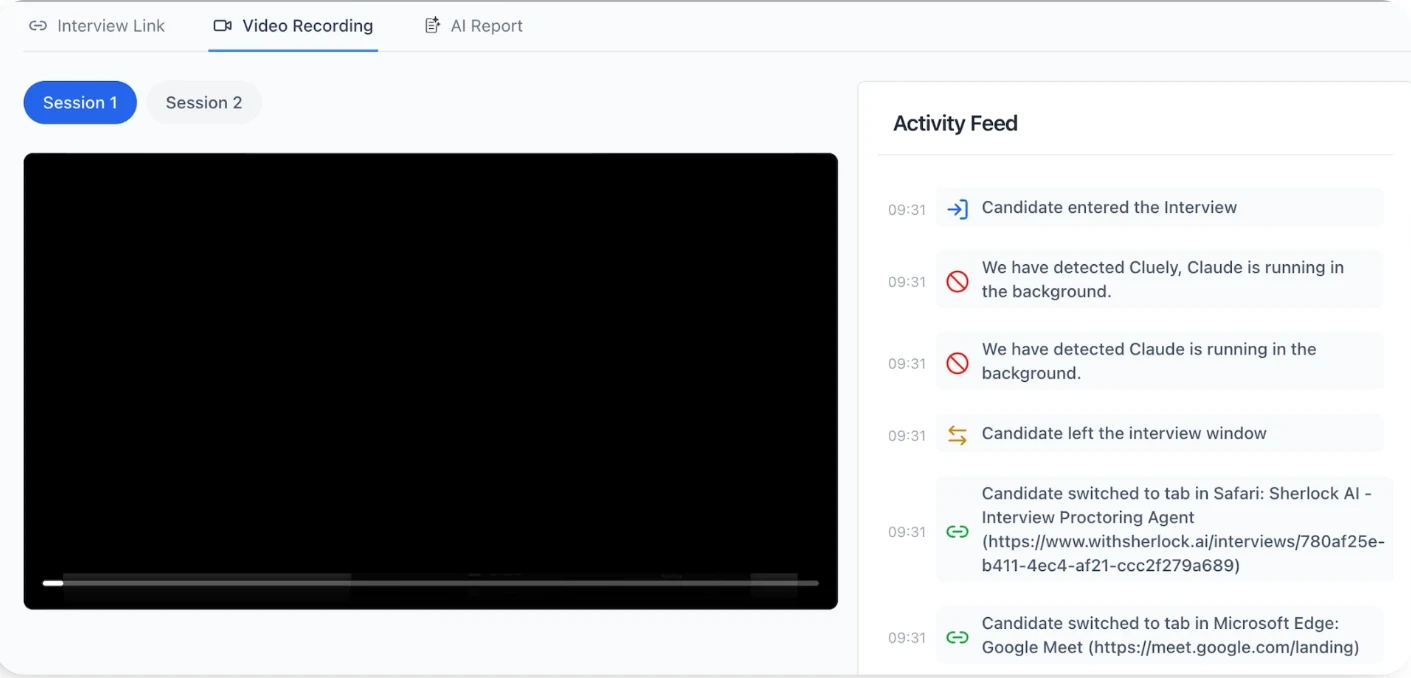
Key features:
AI Fraud Detection – Identifies AI-assisted or scripted responses and sophisticated cheating behavior in live or recorded remote interviews.
Multimodal Integrity Monitoring – Uses device activity, audio cues, and behavioral patterns together to flag unusual interaction patterns beyond simple webcam proctoring.
Real-Time Alerts – Provides interviewers with live alerts on suspicious signals so they can probe further without losing focus on core evaluation.
AI Fluency Observation – When AI tools are permitted, Sherlock assesses how effectively candidates use them instead of just blocking usage.
Automatic Notes & Insights – Captures detailed interview notes and performance insights, helping teams maintain consistent evaluation records.
Cross-Round Detection – Flags inconsistencies across multiple interview rounds, helping uncover proxy candidates or fluctuating integrity signals.
Detects Multiple Cheating Tools – Capable of spotting usage of sophisticated external aids (e.g., AI interview assistants) that would otherwise go unnoticed.
Seamless Integration – Works with popular video platforms and calendars, automatically joining interview meetings to protect integrity with minimal setup.
Sherlock AI turns subtle remote-interview anomalies into actionable integrity insights, helping you focus on candidate ability, not presentation polish.
Conclusion
Remote interviews have made hiring faster and cheating easier. Most interview fraud today doesn’t look suspicious; it looks polished, prepared, and confident.
The red flags discussed in this blog show why relying only on behavioral judgment and gut instinct is no longer enough. Hiring teams need to evaluate consistency, authenticity, and independent thinking and not just good answers.
When interview integrity is built into the process and supported by tools like Sherlock AI, remote interviews become harder to game and easier to trust.