Back to all blogs
Understand time to fill, why it matters in recruitment, how to measure it, and how AI-powered hiring tools help companies reduce hiring time and improve recruitment performance.

Abhishek Kaushik
Jun 2, 2026

Hiring speed has become one of the biggest competitive advantages in recruitment. In a market where top candidates disappear within days, companies that take too long to fill open roles often lose qualified talent to faster competitors. That is why understanding time to fill is critical for recruiters, HR leaders, and hiring managers who want to improve hiring outcomes and reduce recruitment costs.
According to the report from HR drive found that companies took an average of 63.5 days to fill positions in 2025, showing how hiring delays continue to impact organizations globally. SmartRecruiters research also revealed that businesses using AI in recruitment fill vacancies 26% faster than companies that rely on manual hiring processes.
These numbers highlight a growing challenge for talent acquisition teams. A long hiring cycle does not only affect recruiters. It also impacts productivity, employee morale, candidate experience, and revenue growth. Every day a critical role remains open can create operational bottlenecks and increase pressure on existing teams.
This is where modern recruitment technology is changing the game. AI-driven hiring platforms like helps companies streamline candidate sourcing, automate repetitive recruitment tasks, and improve hiring efficiency without sacrificing candidate quality. By reducing delays in screening, scheduling, and communication, organizations can significantly lower their time to fill while creating a better hiring experience for everyone involved.
In this guide, we will cover everything you need to know about time to fill, including its definition, formula, benchmarks, importance, challenges, and proven strategies to reduce it. You will also learn how AI-powered recruitment solutions can help companies hire faster and smarter in today’s competitive talent market.
What Is Time to Fill?
Time to fill is a recruitment metric that measures the total number of days it takes to fill an open position, starting from the moment a job requisition is approved until the candidate accepts the offer or joins the company.
It is one of the most important hiring KPIs because it helps organizations evaluate how efficient and responsive their recruitment process is. A shorter time to fill usually indicates a streamlined hiring strategy, while a longer time to fill may reveal delays, bottlenecks, or talent shortages.
Simple Time to Fill Definition
In simple terms:
Time to fill measures how long it takes to hire someone after a job opening becomes available.
For example, if a company opens a marketing manager position on June 1 and the candidate accepts the offer on June 30, the time to fill is 29 days.
This metric gives HR teams a clear picture of recruitment efficiency and helps them improve workforce planning.
Time to Fill vs Time to Hire
Many recruiters confuse time to fill with time to hire, but they are different recruitment metrics.
Time to Fill
Time to fill measures the entire recruitment timeline:
Job requisition approval
Job posting
Candidate sourcing
Screening
Interviews
Offer acceptance
It focuses on the full hiring process from opening the role to successfully filling it.
Time to Hire
Time to hire measures a smaller part of the recruitment journey. It tracks the number of days between when a candidate enters the hiring pipeline and when they accept the offer.
This metric focuses more on candidate movement and recruitment speed.
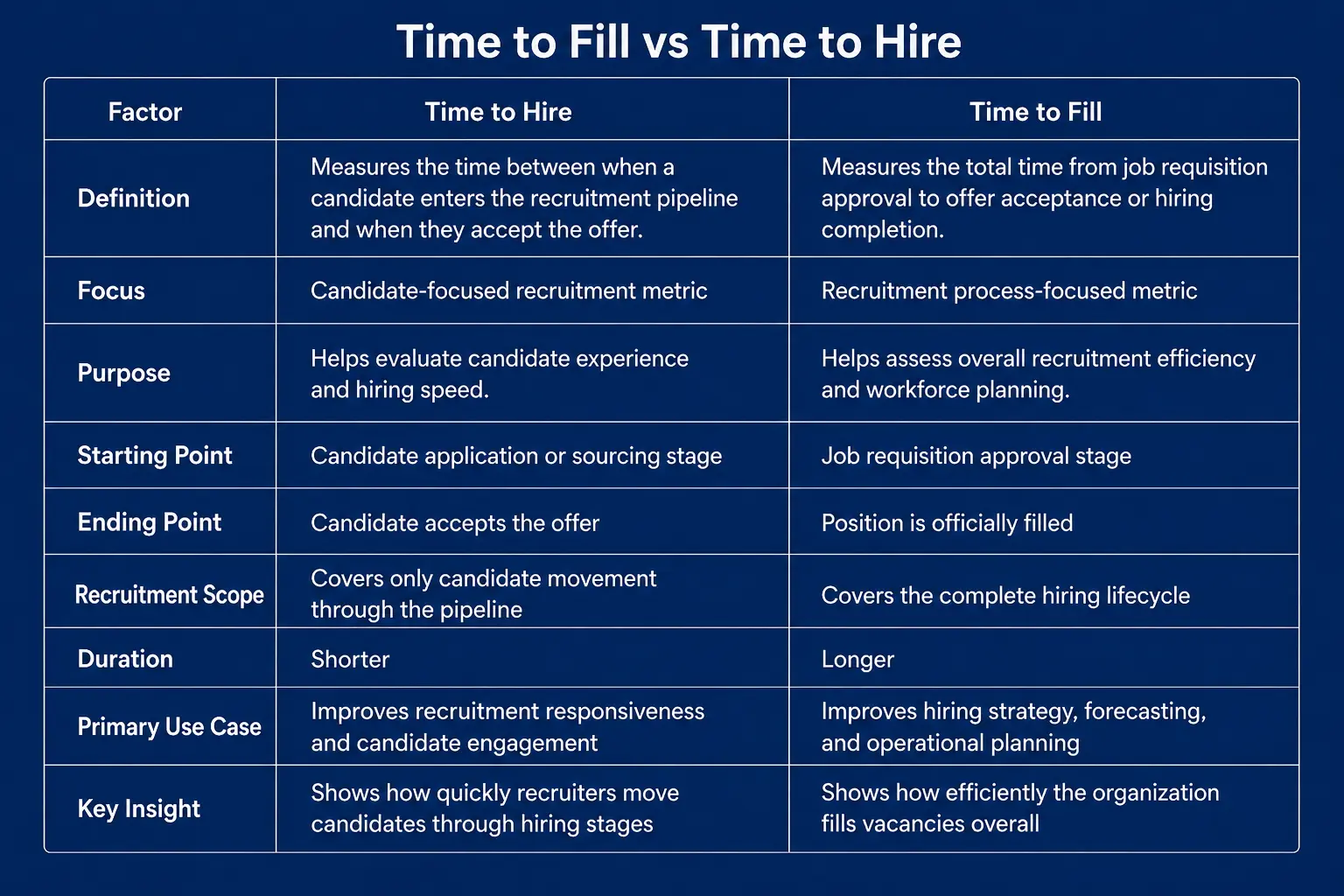
Time to fill identifies overall recruitment efficiency
Time to hire evaluates candidate pipeline speed
Companies that monitor both metrics can better identify delays and improve hiring strategies.
Why Time to Fill Is Important
Time to fill is one of the most important recruitment metrics because it directly impacts hiring efficiency, business productivity, recruitment costs, and candidate experience. A long hiring cycle can slow down business operations, increase employee workload, and cause companies to lose top talent to competitors.
By tracking and improving time to fill, organizations can build a faster, more efficient, and data-driven hiring process.
1. Identifies Recruitment Bottlenecks
A high time to fill often reveals delays and inefficiencies within the hiring process. Recruitment teams can use this metric to identify which stages slow down hiring and create operational bottlenecks.
Common hiring bottlenecks include:
Delayed job approvals
Slow resume screening
Lengthy interview rounds
Poor communication between recruiters and hiring managers
Delayed interview feedback
2. Supports Better Workforce Planning
Time to fill plays a major role in workforce planning and talent forecasting. Long vacancy periods can negatively affect team productivity and business performance.
Tracking this metric helps organizations:
Forecast future hiring needs
Allocate recruitment budgets effectively
Prepare for seasonal hiring demands
Reduce understaffing risks
Improve workforce stability
3. Reduces the Cost of Unfilled Positions
Every vacant position creates direct and indirect business costs. The longer a role stays open, the more expensive it becomes for the organization.
Common costs associated with unfilled positions include:
Lost productivity
Increased overtime expenses
Delayed projects
Lower customer satisfaction
Revenue loss
4. Improves Candidate Experience
Candidates expect a hiring process that is fast, transparent, and well-organized. Slow recruitment cycles often frustrate applicants and increase candidate drop-off rates.
A shorter time to fill helps organizations:
Keep candidates engaged
Improve communication speed
Reduce uncertainty during hiring
Increase offer acceptance rates
Build positive candidate relationships
5. Helps Secure Top Talent Faster
Top candidates are often available for only a short period. Companies with slow recruitment processes frequently lose skilled professionals to faster competitors.
Reducing time to fill allows organizations to:
Engage candidates earlier
Accelerate interview processes
Make faster hiring decisions
Reduce candidate drop-offs
Improve competitive hiring advantage
6. Improves Recruiter Productivity
Recruiters spend a large portion of their time handling repetitive administrative tasks that slow down the hiring process.
These tasks include:
Resume screening
Interview scheduling
Candidate follow-ups
Data entry
Status tracking
7. Enables Data-Driven Recruitment Decisions
Time to fill provides valuable recruitment data that helps HR teams improve hiring strategies and optimize recruitment performance.
Recruiters can analyze:
Which roles take longest to fill
Which departments hire fastest
Which sourcing channels perform best
Which interview stages create delays
Which recruiters close positions more efficiently.
8. Strengthens Employer Branding
A slow or disorganized recruitment process can negatively affect how candidates perceive a company.
Candidates frequently share hiring experiences through:
LinkedIn
Glassdoor
Indeed
Social media platforms
How to Calculate Time to Fill
Tracking time to fill accurately helps organizations measure recruitment efficiency, identify hiring delays, and improve workforce planning. Without proper measurement, it becomes difficult to understand where recruitment bottlenecks exist or how hiring performance changes over time.
The good news is that calculating time to fill is relatively simple.
What Is the Time to Fill Formula?
The standard time-to-fill formula is:
Time to Fill=Date Position Filled−Date Job Requisition Opened\text{Time to Fill} = \text{Date Position Filled} - \text{Date Job Requisition Opened}Time to Fill=Date Position Filled−Date Job Requisition Opened
This calculation measures the total number of days between opening a position and successfully filling it.
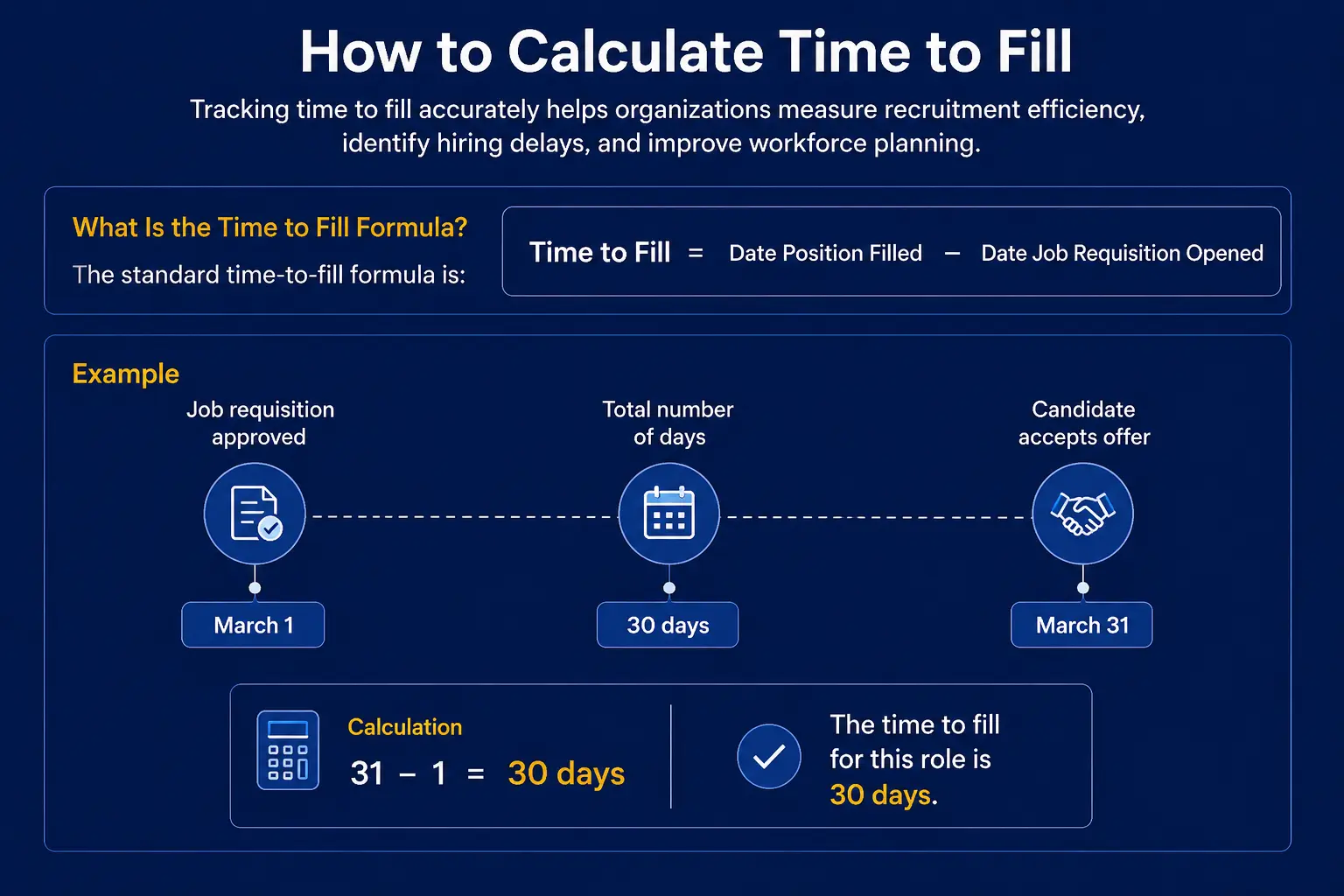
How to Calculate Time to Fill for One Position
Calculating time to fill for a single role helps recruiters evaluate how quickly a specific position was filled.
Step-by-Step Process
Step 1: Identify the Job Opening Date
This is usually the date when:
The job requisition gets approved
The hiring request becomes active
Recruitment officially starts
Step 2: Identify the Hiring Completion Date
This is typically:
The date the candidate accepts the offer
Or the candidate’s joining date, depending on company policy
Step 3: Calculate the Total Days
Subtract the opening date from the hiring completion date.
Example Calculation
Hiring Stage | Date |
|---|---|
Job requisition approved | April 3 |
Job posted | April 5 |
Candidate hired | May 2 |
Time to Fill=29 days\text{Time to Fill} = 29\ \text{days}Time to Fill=29 days
The position took 29 days to fill.
How to Calculate Average Time to Fill
Most organizations hire for multiple positions simultaneously. In this case, tracking the average time to fill provides a broader understanding of overall recruitment performance.
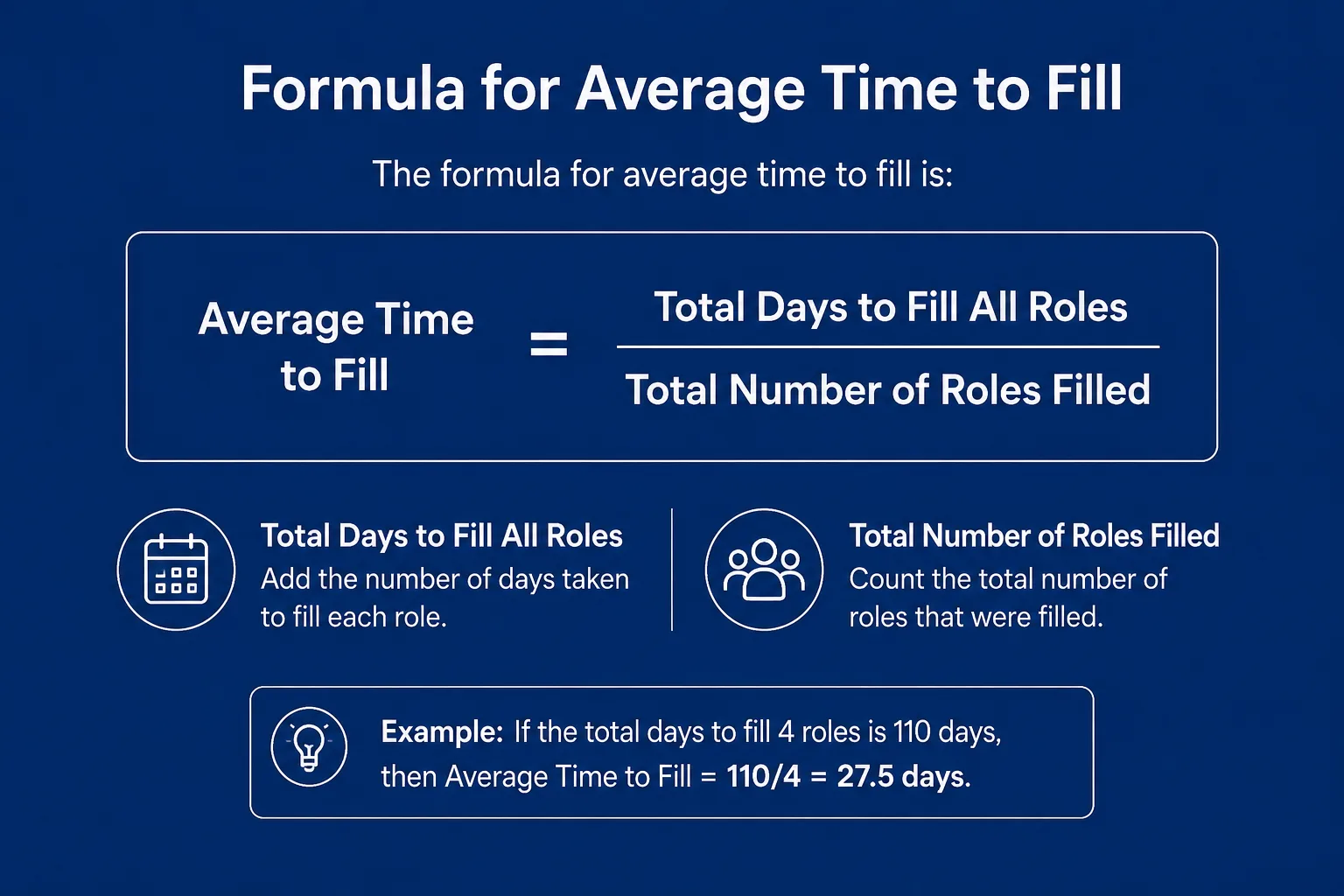
The formula for average time to fill is:
Average Time to Fill=Total Days to Fill All RolesTotal Number of Roles Filled\text{Average Time to Fill} = \frac{\text{Total Days to Fill All Roles}}{\text{Total Number of Roles Filled}}Average Time to Fill=Total Number of Roles FilledTotal Days to Fill All Roles
Example
If the total days to fill 4 roles is 110 days, then below is the calculation for Average time to fill:
Total hiring days:
35+25+20+30=11035 + 25 + 20 + 30 = 11035+25+20+30=110
Average time to fill:
1104=27.5 days\frac{110}{4} = 27.5\ \text{days}4110=27.5 days
The company’s average time to fill is 27.5 days.
What Is Considered a Good Time to Fill in Recruitment?
A good time to fill depends on several factors, including industry, job role, company size, hiring demand, and labor market conditions. There is no universal benchmark that applies to every organization because hiring complexity varies significantly across roles and industries.
For example, hiring an entry-level customer support representative may take only a few weeks, while filling a senior software engineering or executive leadership role can take several months.
Instead of focusing only on generic industry averages, organizations should compare their own recruitment performance over time and identify opportunities for continuous improvement.
Average Time to Fill by Industry
Different industries experience different hiring timelines because of talent availability, skill shortages, and recruitment complexity.
Here are some common time-to-fill benchmarks across industries:
Industry | Average Time to Fill |
|---|---|
Technology | 40 to 60 days |
Healthcare | 45 to 70 days |
Finance | 35 to 55 days |
Manufacturing | 30 to 45 days |
Retail | 20 to 30 days |
Customer Support | 15 to 25 days |
Sales | 25 to 40 days |
Engineering | 50 to 70 days |
Technical and leadership roles usually have longer hiring cycles because they require specialized skills, multiple interview stages, and extensive evaluations.
How to Reduce Time to Fill
Reducing time to fill helps companies hire top talent faster, lower recruitment costs, and improve candidate experience. Here are four highly effective strategies organizations can use to accelerate hiring without compromising candidate quality.
1. Automate Resume Screening with AI
Manual resume screening is one of the biggest recruitment bottlenecks. Recruiters often spend hours reviewing applications, especially during high-volume hiring periods. According to LinkedIn’s Future of Recruiting report, recruiters using AI save up to 20% of their hiring time through automation and smarter candidate matching.
AI-powered recruitment tools help automate:
Resume screening
Candidate matching
Applicant ranking
Shortlisting processes
2. Reduce Unnecessary Interview Rounds
Long interview processes often increase candidate drop-offs and delay hiring decisions.
Companies should focus on:
Structured interviews
Faster feedback cycles
Fewer interview stages
Clear evaluation criteria
3. Build a Strong Talent Pipeline
Waiting until a role opens before sourcing candidates increases time to fill significantly.
Organizations should proactively build talent pipelines through:
Employee referrals
Talent communities
Previous applicants
Passive candidate engagement
Networking events
4. Improve Recruiter and Hiring Manager Collaboration
Poor communication between recruiters and hiring managers is a major cause of hiring delays.
Common problems include:
Delayed interview feedback
Unclear job requirements
Slow approvals
Inconsistent evaluation criteria
Why Time to Fill Is Important: 5 Key Benefits
Time to fill is one of the most important recruitment metrics because it directly affects hiring efficiency, workforce productivity, recruitment costs, and candidate experience. A long hiring cycle can delay business growth, increase pressure on existing employees, and cause organizations to lose qualified candidates to competitors.
Tracking and improving time to fill helps companies build a faster, more scalable, and more efficient recruitment process. Below are five major benefits of monitoring this hiring metric.
1. Identifies Recruitment Bottlenecks
A high time to fill often indicates inefficiencies or delays within the recruitment process. Many organizations experience hiring slowdowns because of manual workflows, delayed approvals, or poor communication between recruiters and hiring managers.
Common recruitment bottlenecks include:
Slow resume screening
Delayed interview scheduling
Multiple approval layers
Long interview processes
Late hiring feedback
Poor coordination between teams
When companies track time to fill consistently, they can identify which stages are causing delays and take corrective action.
Example
If recruiters notice that interview feedback regularly takes several days, they can introduce structured timelines and automated reminders to speed up hiring decisions.
2. Improves Workforce Planning
Vacant positions can create serious operational challenges for businesses. When roles remain open for long periods, existing employees often need to handle additional responsibilities, which can lead to lower productivity and employee burnout.
Tracking time to fill helps organizations:
Forecast hiring timelines more accurately
Prepare for future recruitment needs
Plan hiring budgets effectively
Improve staffing strategies
Reduce operational disruptions
Align hiring with business growth goals
Organizations with predictable recruitment timelines can manage workforce planning more efficiently and reduce the risks associated with understaffing.
Example
A rapidly growing company can use historical time-to-fill data to begin recruitment earlier for critical roles and avoid project delays during expansion.
3. Reduces the Cost of Vacant Positions
Every unfilled position creates financial costs for an organization. According to the Society for Human Resource Management (SHRM), the average cost per hire is approximately $4,700, while the indirect costs of vacant positions can be significantly higher due to lost productivity and operational inefficiencies. The longer a role stays vacant, the more revenue, productivity, and business opportunities a company may lose.
Some of the most common costs associated with open positions include:
Lost productivity
Increased overtime expenses
Delayed project completion
Lower customer satisfaction
Increased recruiter workload
Revenue loss in customer-facing roles
Reducing time to fill helps businesses minimize these costs and maintain smoother day-to-day operations.
Example
Leaving a sales role vacant for several weeks can directly impact revenue generation and customer acquisition targets.
4. Improves Candidate Experience
Today’s candidates expect recruitment processes to be fast, transparent, and well-organized. Long hiring timelines often frustrate applicants and increase the likelihood of candidate drop-offs.
Companies that reduce time to fill often provide a much smoother and more professional candidate experience.
Strong candidate experiences help organizations:
Improve employer branding
Increase offer acceptance rates
Build stronger talent pipelines
Attract higher-quality applicants
Strengthen long-term hiring reputation
Example
Candidates are more likely to accept offers from organizations that communicate consistently and make hiring decisions quickly.
5. Helps Secure Top Talent Faster
Top candidates rarely stay available for long. Skilled professionals often receive multiple job offers within a short time, especially in competitive industries like technology, healthcare, engineering, and cybersecurity.
Organizations with slow hiring processes risk losing highly qualified candidates to faster competitors.
Reducing time to fill allows businesses to:
Engage candidates earlier
Accelerate interview processes
Reduce candidate drop-offs
Improve hiring competitiveness
Fill critical positions faster
Increase offer acceptance rates
Fast hiring processes can become a major competitive advantage in talent acquisition.
Example
AI-powered recruitment platforms like help companies automate candidate screening, improve candidate matching, and accelerate recruitment workflows, enabling recruiters to secure top talent faster while reducing manual effort.
How Sherlock AI Helps Reduce Time to Fill
Reducing time to fill requires more than faster hiring decisions. Recruitment teams also need tools that eliminate manual work, improve hiring accuracy, and streamline interview workflows.
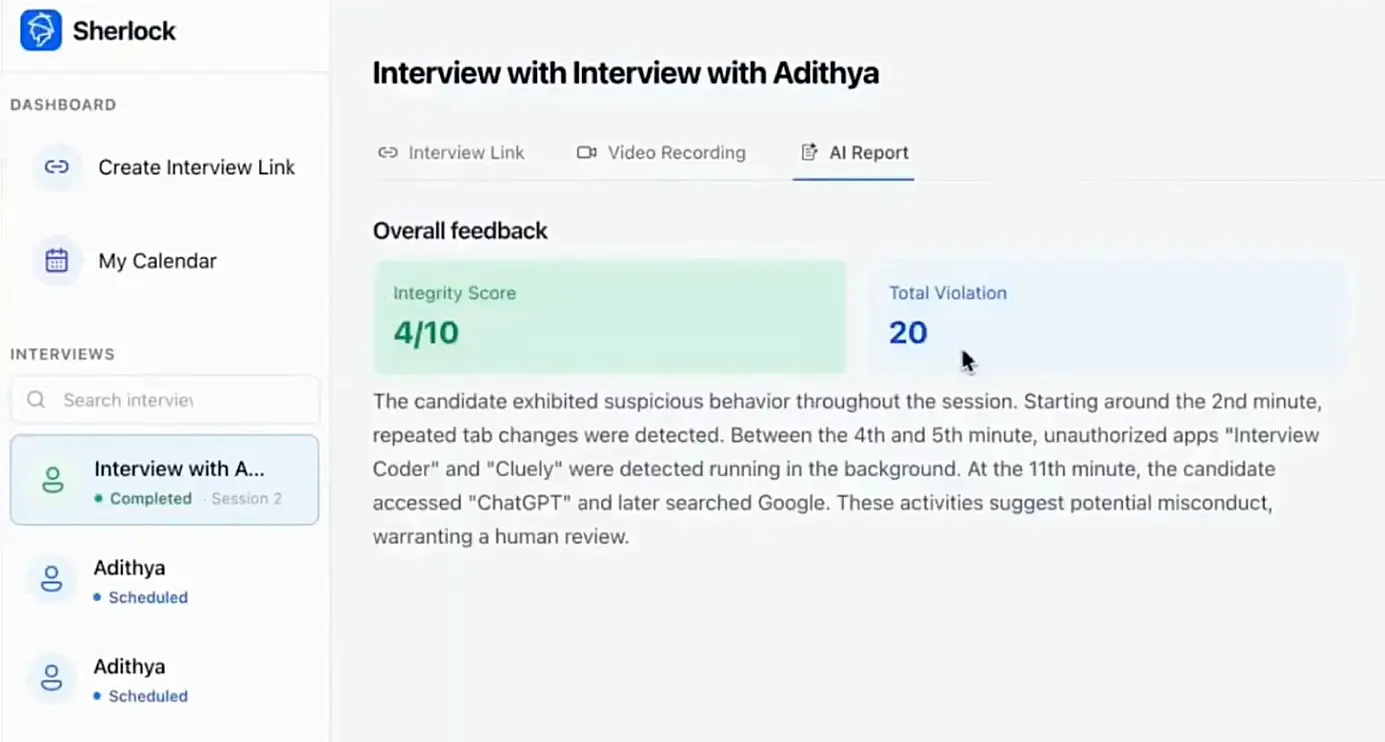
Sherlock AI is designed to improve recruitment efficiency through AI-powered interview intelligence, fraud detection and ai-assisted interview cheating. These features help recruiters reduce delays, improve candidate experience, and make hiring decisions faster.

AI Fraud Detection
Sherlock AI helps recruiters detect AI-assisted cheating, impersonation, and suspicious behavior during remote interviews.
The platform monitors:
Deepfake fraud
AI-assisted responses
Candidate behavior anomalies
Device activity during interviews
AI Fluency Observation
Sherlock AI evaluates how candidates use AI tools during interviews and assessments.
This feature helps recruiters:
Understand candidate AI fluency
Evaluate practical AI usage
Identify authentic problem-solving skills
Assess real-world candidate capabilities
Automated Interview Notes and Insights
Manual note-taking often slows down interview evaluations and feedback collection. Sherlock AI automatically generates interview notes and insights, helping recruiters and hiring managers review candidate performance faster.
This helps teams:
Reduce administrative work
Speed up evaluation processes
Improve collaboration
Make quicker hiring decisions
Real-Time Commentary and Alerts
Sherlock AI provides real-time interview alerts and commentary when suspicious activity is detected during virtual interviews.
This allows recruiters to:
Monitor interview integrity
Identify unusual candidate behavior instantly
Maintain secure hiring standards
Reduce manual interview monitoring effort
Smart Interview Scheduling
Scheduling delays are one of the biggest causes of high time to fill. Sherlock AI simplifies interview coordination through calendar integrations with:
Google Calendar
Apple Calendar
Outlook Calendar
Video Interview Integrations
These integrations allow companies to conduct seamless remote interviews while maintaining interview security and candidate monitoring capabilities. Sherlock AI integrates with:
Zoom
Google Meet
Microsoft Teams
Advanced AI Detection Technology
Below advanced monitoring system helps organizations maintain interview integrity while improving recruitment confidence and hiring quality.Sherlock AI uses multimodal AI detection to analyze
Behavioral patterns
Audio signals
Device activity
Candidate interaction patterns
Build a Faster and Smarter Hiring Process
Time to fill is no longer just a recruitment KPI. It has become a critical business metric that directly affects hiring success, operational efficiency, candidate experience, and overall company growth. Organizations that take too long to fill positions often struggle with productivity gaps, increased hiring costs, employee burnout, and lost access to top talent.
By tracking and optimizing time to fill, companies can identify recruitment bottlenecks, improve workforce planning, strengthen employer branding, and create a more efficient hiring process. However, reducing hiring timelines is not simply about moving faster. The real goal is to build a recruitment strategy that balances speed, quality, and candidate experience.
This is where AI-powered recruitment technology is transforming modern hiring. Platforms like Sherlock AI help organizations improve recruitment efficiency through features such as AI Fraud Detection, AI Fluency Observation, Automated Interview Notes, Real-Time Commentary and Alerts, Smart Interview Scheduling, and advanced interview monitoring capabilities. These help recruiters reduce manual effort, improve interview integrity, accelerate hiring decisions, and streamline remote hiring workflows.
As competition for skilled talent continues to increase, companies that adopt smarter and more data-driven recruitment processes will be better positioned to hire top candidates faster and stay ahead in today’s competitive talent market.