Back to all blogs
A complete guide to interview-to-hire ratio, including hiring benchmarks, calculation methods, recruiting challenges, interview statistics, and practical ways to improve hiring speed and candidate quality.

Abhishek Kaushik
Jun 2, 2026
Hiring teams today are under pressure to move faster without sacrificing candidate quality. Yet many companies still interview far too many candidates before making a successful hire. That is exactly why the interview-to-hire ratio has become one of the most important recruitment metrics for modern talent acquisition teams.
The interview-to-hire ratio measures how many interviews a company conducts before hiring one candidate. A high ratio often signals inefficiencies in sourcing, screening, or interview processes. A lower and healthier ratio usually indicates that recruiters are attracting better-fit candidates and evaluating them more effectively.
These numbers reveal a bigger problem. Companies are not just losing time. They are losing qualified candidates because their hiring funnels are inefficient.
That is where measuring the interview-to-hire ratio becomes critical.
For recruitment teams, this metric helps identify hiring bottlenecks, improve recruiter efficiency, reduce hiring costs, and shorten time-to-fill. For organizations using AI-powered hiring tools like Sherlock AI, it can also help detect whether interview processes are actually identifying genuine, qualified candidates or simply filtering too late in the funnel.
By the end, you will understand how to use this recruiting metric to build a faster, smarter, and more accurate hiring process.
This data-driven guide breaks down the latest U.S. job interview statistics for 2024 and 2025, covering interview timelines, applicant-to-interview ratios, interview formats, AI adoption in hiring, candidate experience, and screening practices. All statistics are sourced from authoritative research and industry benchmarks, making this resource useful for employers, recruiters, HR leaders, and job seekers who want to understand how hiring really works today.
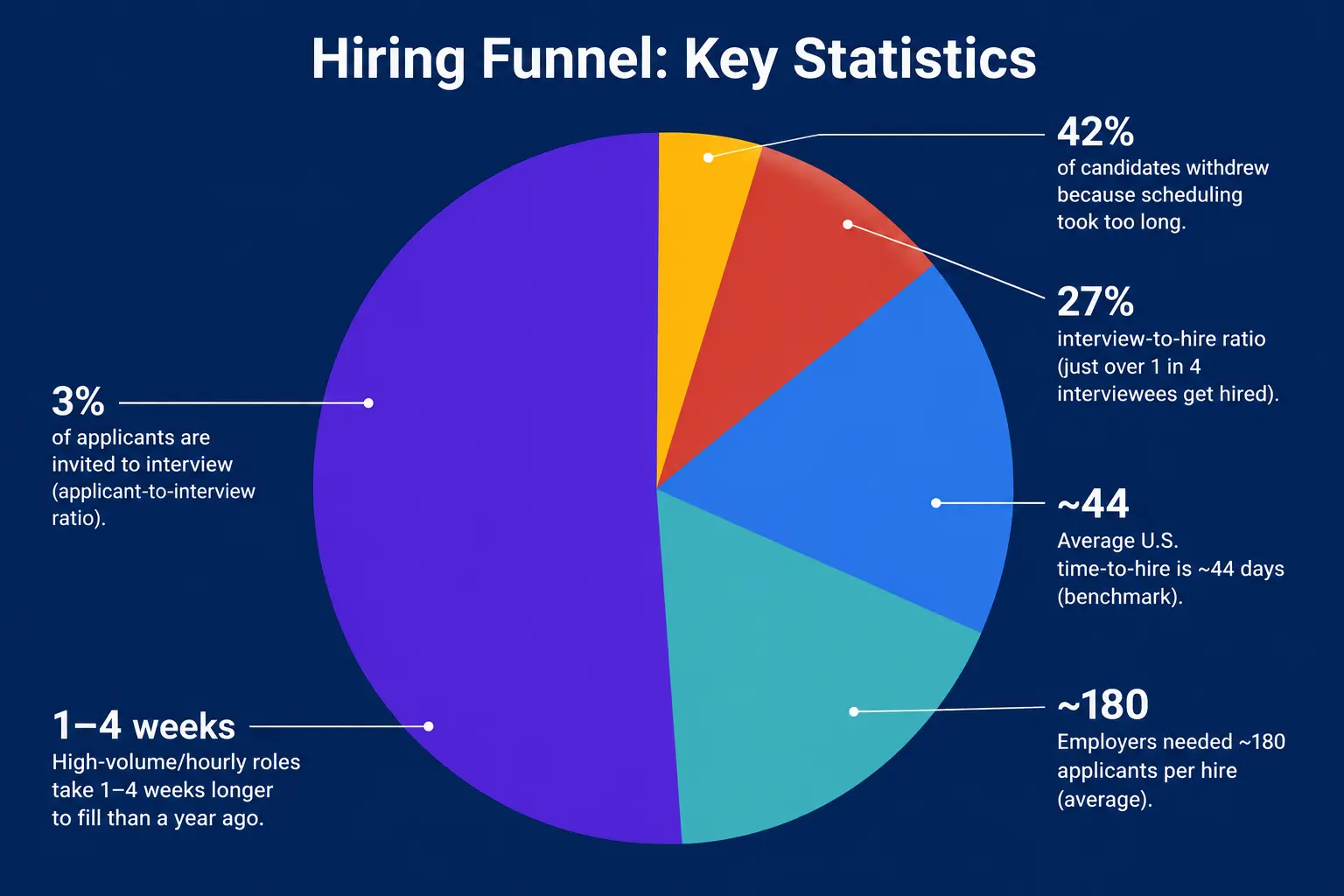
Only 3% of applicants are invited to interview (applicant-to-interview ratio).
27% interview-to-hire ratio (just over 1 in 4 interviewees get hired).
Employers needed ~180 applicants per hire (average).
Average U.S. time-to-hire is ~44 days (benchmark).
High-volume/hourly roles take 1–4 weeks longer to fill than a year ago.
42% of candidates withdrew because scheduling took too long.
What Is Interview-to-Hire Ratio?
The interview-to-hire ratio is a recruiting metric that measures the number of candidates interviewed before one candidate is successfully hired.
In simple terms, it shows how efficient your hiring process is at identifying qualified candidates early in the recruitment funnel.
Interview-to-Hire Ratio Definition
The interview-to-hire ratio compares:
Total number of interviews conducted
Total number of successful hires made
Recruiters and HR teams use this metric to understand whether their sourcing, screening, and interviewing processes are producing high-quality candidates.
For example, if a company interviews 20 candidates and hires 2 people, the interview-to-hire ratio is 10:1. This means the company interviewed 10 candidates for every successful hire.
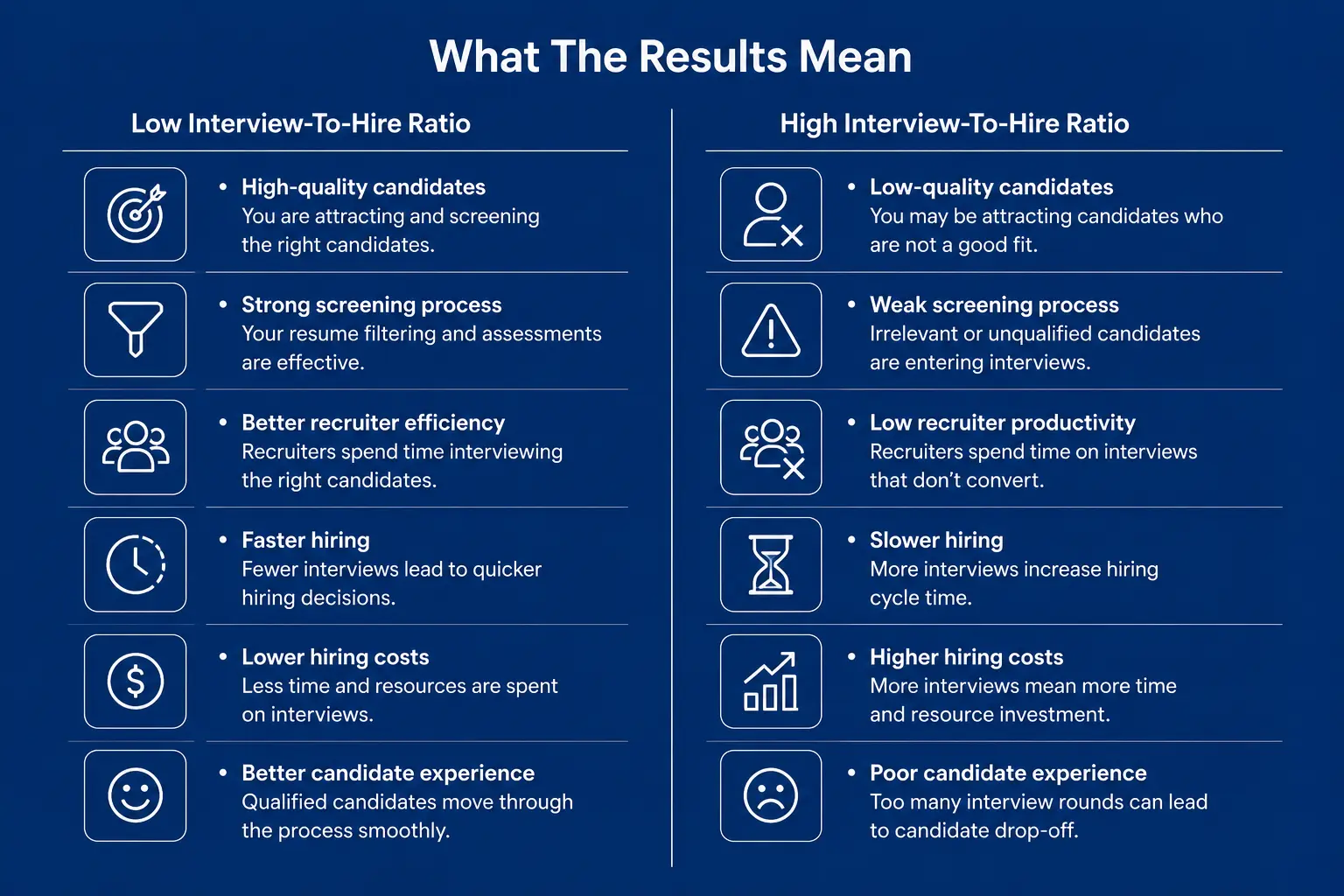
A lower ratio usually indicates a more efficient hiring process because recruiters are bringing stronger candidates into interviews. A higher ratio may suggest issues such as:
Poor candidate sourcing
Weak resume screening
Unclear job descriptions
Ineffective interviews
Misalignment between recruiters and hiring managers
Because of this, the interview-to-hire ratio is often considered one of the most important recruiting efficiency metrics.
What Is a Good Interview-To-Hire Ratio?
A good interview-to-hire ratio depends on several factors, including industry, job seniority, hiring volume, role complexity, and candidate availability. However, most recruitment experts consider a ratio between 3:1 and 10:1 to be healthy for many positions.
This means companies typically conduct between 3 and 10 interviews to make one successful hire.
Here is a general benchmark recruiters often use:
Interview-To-Hire Ratio | What It Usually Indicates |
|---|---|
1:1 to 2:1 | Screening may be too restrictive or talent pool too small |
3:1 to 5:1 | Strong hiring efficiency and quality sourcing |
6:1 to 10:1 | Common for mid-level and competitive roles |
10:1+ | Potential inefficiencies in sourcing or screening |
While a lower ratio may seem ideal, an extremely low ratio is not always a positive sign. If recruiters only interview one or two candidates before making a hire, the company may not be evaluating enough talent options. This can increase the risk of poor hiring decisions.
On the other hand, a very high ratio often signals inefficiencies in the recruitment funnel.
Interview-To-Hire Ratio By Industry
Interview-to-hire ratios vary significantly across industries because every sector faces different hiring challenges, skill shortages, and candidate availability. Industries that require specialized technical expertise or leadership experience often conduct more interviews before making a successful hire, while high-volume hiring sectors usually maintain lower ratios due to standardized hiring processes and larger candidate pools.
Here are common interview-to-hire ratio benchmarks across industries:
Industry | Average Interview-To-Hire Ratio |
|---|---|
Software & SaaS | 8:1 to 12:1 |
Healthcare | 6:1 to 10:1 |
Retail & Hospitality | 3:1 to 5:1 |
Finance & Banking | 5:1 to 8:1 |
Manufacturing | 4:1 to 6:1 |
Sales & Customer Support | 4:1 to 7:1 |
Executive & Leadership Hiring | 10:1+ |
Technology companies often experience higher interview-to-hire ratios because technical assessments, coding evaluations, and multiple stakeholder interviews are common in the hiring process. Healthcare organizations face hiring challenges due to licensing requirements and talent shortages, while executive hiring typically involves extensive evaluation cycles and leadership assessments.
Understanding industry-specific benchmarks helps recruiters evaluate whether their hiring funnel is operating efficiently compared to market standards.
Key Factors That Influence Interview to Hire Ratio
Several factors directly impact your interview to hire ratio and determine how efficiently your hiring process converts candidates into successful hires. Understanding these elements helps recruiters identify bottlenecks, reduce unnecessary interviews, and improve overall hiring outcomes.
1. Accuracy of Job Descriptions
Clear and detailed job descriptions help attract candidates who closely match the required skills, experience, and responsibilities of the role. When job expectations are vague or incomplete, recruiters often receive a large number of unqualified applications, increasing the number of interviews required before making a successful hire. Well-optimized job descriptions improve candidate quality, reduce screening time, and create a more efficient hiring pipeline.
2. Effectiveness of Pre-screening Processes
Strong pre-screening processes help recruiters identify qualified candidates before they enter the interview stage. Resume reviews, initial screening calls, and skill assessments reduce the chances of unsuitable candidates progressing through the hiring funnel. Effective screening methods improve shortlist quality, save recruiter time, and help organizations make faster hiring decisions.
3. Role Complexity and Seniority Level
Highly specialized and senior-level positions typically require more interviews before a hiring decision is made. Leadership roles, technical positions, and niche skill-based jobs often involve multiple stakeholders, detailed assessments, and deeper evaluation processes. Entry-level roles generally have lower interview-to-hire ratios because the talent pool is broader and hiring requirements are less complex.
4. Candidate Market Conditions
Market demand and talent availability significantly influence interview-to-hire ratios. In competitive industries where skilled professionals are limited, recruiters may need to interview more candidates before finding suitable talent. Sectors such as artificial intelligence, SaaS, cybersecurity, and healthcare often experience higher interview-to-hire ratios due to increasing competition for experienced candidates.
5. Recruitment Team Alignment
Alignment between recruiters and hiring managers plays a major role in hiring efficiency. When both teams are unclear about role requirements, ideal candidate profiles, or evaluation criteria, unsuitable candidates may progress through multiple interview rounds unnecessarily. Regular communication and clearly defined hiring expectations help reduce interview volume and improve hiring accuracy.
6. Employer Brand and Candidate Experience
Companies with strong employer branding and positive candidate experiences usually attract more qualified applicants and achieve better hiring outcomes. Slow communication, unclear processes, or delayed feedback can cause strong candidates to withdraw from the hiring process, forcing recruiters to conduct additional interviews. A smooth and transparent recruitment experience improves candidate engagement and overall hiring efficiency.
7. Interview Process Structure
Structured interview processes help organizations evaluate candidates more consistently and make faster hiring decisions. Standardized interview questions, evaluation scorecards, and skill-based assessments reduce bias and improve decision-making accuracy. Companies with unstructured hiring workflows often experience unnecessary interview rounds, inconsistent feedback, and lower recruitment efficiency.
8. Use of Recruitment Technology
Recruitment technology helps companies streamline hiring workflows and improve overall recruitment performance. Automation tools reduce manual screening effort, accelerate candidate evaluation, and improve hiring speed. Data-driven hiring systems also help recruiters identify qualified candidates more efficiently and optimize the overall recruitment process.
How To Calculate Interview-To-Hire Ratio
Calculating interview-to-hire ratio is simple, but the insights it provides can significantly improve recruitment performance.
The formula measures how many interviews your company conducts before making one successful hire.
Interview-To-Hire Ratio Formula
Interview-to-Hire Ratio=Total Number of Interviews ConductedTotal Number of Hires Made\text{Interview-to-Hire Ratio} = \frac{\text{Total Number of Interviews Conducted}}{\text{Total Number of Hires Made}}Interview-to-Hire Ratio=Total Number of Hires MadeTotal Number of Interviews Conducted
The result is usually expressed as a ratio such as:
3:1
5:1
10:1
This means the company interviewed 3, 5, or 10 candidates to make one hire.
Step-By-Step Process To Calculate Interview-To-Hire Ratio
Step 1: Count Total Interviews Conducted
First, determine how many candidates were interviewed during a specific hiring period.
This can include:
Phone screening interviews
Technical interviews
Panel interviews
Final-round interviews
Most companies count unique candidates interviewed rather than the total number of interview rounds.
For example:
Candidate A attends 3 interview rounds
Candidate B attends 2 interview rounds
This is usually counted as 2 interviewed candidates, not 5 interviews.
Step 2: Count Total Successful Hires
Next, count the number of candidates who accepted offers and joined the company successfully.
Do not include:
Rejected offers
Withdrawn candidates
Pending hires
Only completed hires should be included in the calculation.
Step 3: Apply The Formula
Suppose your company interviewed 24 candidates and hired 4 employees.
The calculation would be:
244=6:1\frac{24}{4} = 6:1424=6:1
This means your company interviewed 6 candidates for every successful hire.
Calculation Example
A company interviewed 15 candidates for a sales executive role and hired 3 candidates successfully.
Using the formula:
153=5:1\frac{15}{3} = 5:1315=5:1
The interview-to-hire ratio is 5:1.
This means the company interviewed 5 candidates to make 1 successful hire.
Why Interview-To-Hire Ratios Inflate
A high interview-to-hire ratio is often a warning sign that something in the hiring process is not working efficiently.
When recruiters consistently interview too many candidates before making a hire, hiring costs increase, decision-making slows down, and candidate experience suffers.
Understanding why interview-to-hire ratios inflate helps organizations identify hiring bottlenecks and improve recruitment efficiency.
1. Poor Job Descriptions
Unclear or overly broad job descriptions attract irrelevant applicants.
If recruiters fail to define:
Required skills
Experience level
Responsibilities
Technical expectations
Salary range
the hiring funnel fills with unqualified candidates.
This forces recruiters to spend more time screening and interviewing applicants who are not the right fit.
2. Misalignment Between Recruiters And Hiring Managers
Recruiters and hiring managers must align early in the hiring process.
Misalignment often happens around:
Required skills
Candidate seniority
Budget expectations
Interview criteria
Role responsibilities
When expectations are unclear, hiring managers reject more candidates during interviews, increasing the overall ratio.
3. Too Many Interview Rounds
Some companies create unnecessarily long interview processes.
For example:
Multiple technical rounds
Repetitive interviews
Excessive stakeholder approvals
Duplicate assessments
Long interview cycles reduce hiring efficiency and increase candidate drop-off.
Top candidates may also accept competing offers before your process finishes.
4. Poor Sourcing Channels
Not all sourcing channels deliver high-quality candidates.
If recruiters depend heavily on low-conversion job boards or untargeted applications, interview quality decreases.
High-performing recruiting teams usually combine:
Employee referrals
AI sourcing tools
Talent databases
Niche hiring platforms
Structured outbound recruiting
to improve candidate quality before interviews begin.
5. Unstructured Interviews
Unstructured interviews often produce inconsistent hiring decisions.
Structured interviews improve consistency by using:
Standardized questions
Defined scorecards
Clear evaluation criteria
Skills-based assessment frameworks
Different interviewers may evaluate candidates differently, creating confusion and unnecessary rejection cycles.
6. Unrealistic Hiring Expectations
Some organizations search for “perfect candidates” who match every possible requirement.
This often leads to:
Endless interviews
Delayed hiring decisions
Candidate rejection overload
Increased recruiter workload
In competitive hiring markets, overly strict expectations can significantly inflate interview-to-hire ratios.
How To Improve Interview-To-Hire Ratio
Improving interview-to-hire ratio requires optimizing every stage of the recruitment funnel, from sourcing and screening to interviews and final hiring decisions.
The goal is not simply to reduce interviews. The goal is to ensure that the right candidates reach the interview stage in the first place.
Organizations with strong hiring systems consistently achieve lower interview-to-hire ratios because they focus on candidate quality, structured evaluation, and faster decision-making.
1. Write Clear And Specific Job Descriptions
Job descriptions directly impact the quality of applicants entering your hiring funnel.
Vague job posts attract irrelevant candidates, which increases screening workload and unnecessary interviews.
Strong job descriptions should clearly define:
Core responsibilities
Required skills
Years of experience
Must-have qualifications
Salary expectations
Technical requirements
Interview process overview
Clearer expectations improve applicant quality and reduce mismatch during interviews.
2. Strengthen Candidate Screening
Strong screening processes prevent unqualified candidates from entering interview stages.
Recruiters should combine:
Resume filtering
Skills assessments
Pre-screening questions
Candidate scoring systems
Structured recruiter screening calls
This helps hiring teams focus only on verified and qualified candidates.
3. Standardize The Interview Process
Unstructured interviews often produce inconsistent hiring decisions.
Structured interviews improve hiring efficiency by ensuring every candidate is evaluated using the same criteria.
Best practices include:
Standard interview scorecards
Skills-based evaluation frameworks
Consistent interview questions
Defined hiring criteria
Objective scoring systems
Structured interviews reduce bias and improve candidate comparison accuracy.
4. Align Recruiters And Hiring Managers Early
One of the biggest hiring inefficiencies comes from poor alignment between recruiters and hiring managers.
Before sourcing begins, both teams should align on:
Candidate profile
Technical expectations
Salary range
Required experience
Interview stages
Hiring timeline
Strong alignment reduces rejection rates during interviews.
5. Reduce Unnecessary Interview Rounds
Long hiring processes often decrease conversion rates.
Candidates may lose interest, accept competing offers, or drop out entirely.
Companies should regularly audit their hiring process to remove:
Duplicate interviews
Repetitive assessments
Excessive stakeholder approvals
Low-value interview rounds
In many cases, fewer but more structured interviews produce better hiring outcomes.
6. Use Data To Identify Hiring Bottlenecks
Recruitment metrics help companies understand where candidates are dropping out.
Important hiring metrics include:
Interview-to-hire ratio
Time-to-hire
Offer acceptance rate
Candidate drop-off rate
Source-to-hire conversion
Recruiter response time
Tracking these metrics over time helps teams continuously improve recruitment efficiency.
7. Improve Candidate Experience
Candidates evaluate employers just as much as employers evaluate candidates.
Poor communication, delayed feedback, and long hiring timelines reduce candidate engagement.
To improve candidate experience:
Respond quickly
Provide interview updates
Simplify scheduling
Reduce delays between rounds
Maintain transparent communication
Better candidate experience often leads to stronger offer acceptance rates and faster hiring cycles.
8. Invest In Recruitment Technology
Modern recruitment technology helps automate repetitive hiring tasks and improve decision-making accuracy.
AI-driven hiring platforms can assist with:
Resume screening
Candidate ranking
Skill matching
Fraud detection
Interview analytics
Automated scheduling
Hiring workflow management
Sherlock AI help companies streamline candidate evaluation while reducing interview fraud and improving overall hiring quality.
9. Continuously Optimize Hiring Strategies
Recruitment markets change constantly.
What works today may not work six months later.
High-performing recruiting teams continuously:
Review hiring data
Optimize sourcing channels
Improve interview frameworks
Analyze recruiter performance
Adjust hiring strategies based on results
Continuous optimization is essential for maintaining a healthy interview-to-hire ratio over time.
How High Interview-To-Hire Ratios Slow Down Hiring
High interview-to-hire ratios often indicate that companies are spending too much time interviewing candidates who are ultimately not selected. This slows down the hiring process, increases recruiter workload, and creates delays in decision-making.
According to recent hiring statistics, the average time-to-fill has reduced from 48 days to 41 days as companies actively try to remove hiring delays and streamline interviews. However, despite these improvements, 52% of companies still say their interview process is too long.
Long hiring cycles also reduce recruiter productivity because teams spend excessive time coordinating interviews, collecting feedback, and repeating evaluations instead of focusing on qualified candidates.
High interview-to-hire ratios can lead to:
Slower hiring decisions
Higher recruitment costs
Candidate drop-offs
Interview fatigue for hiring managers
Loss of top talent to faster competitors
This is why modern recruiting teams increasingly focus on improving screening quality, reducing unnecessary interview rounds, and accelerating hiring decisions to improve overall recruitment efficiency.
Common Mistakes Recruiters Make When Tracking Interview-To-Hire Ratio
Many companies track interview-to-hire ratio incorrectly, which can lead to misleading hiring insights and poor recruitment decisions. Understanding these common mistakes helps organizations measure hiring efficiency more accurately.
1. Counting Interview Rounds Instead Of Unique Candidates
Some companies count every interview round separately instead of counting individual candidates interviewed. This artificially inflates the ratio and creates inaccurate hiring data.
2. Ignoring Rejected Offers
A candidate accepting an offer is different from simply receiving one. Recruiters should only include completed hires in the final calculation.
3. Comparing Different Roles Together
Interview-to-hire ratios vary significantly by role type, seniority, and industry. Combining entry-level and executive hiring metrics often produces misleading benchmarks.
4. Measuring Very Short Time Periods
Tracking recruitment metrics over extremely short periods may create inaccurate conclusions due to limited hiring data.
5. Focusing Only On Lowering Ratios
A lower ratio is not always better. Interviewing too few candidates may reduce hiring quality and limit talent evaluation.
6. Ignoring Candidate Quality
Hiring efficiency should not come at the expense of long-term employee performance or retention.
7. Failing To Track Source Performance
Without analyzing sourcing channels, recruiters cannot identify which platforms consistently deliver high-quality candidates.
Avoiding these mistakes helps organizations build more accurate recruitment reporting systems and improve hiring decisions over time
Other Recruiting Metrics To Track Alongside Interview-To-Hire Ratio
While interview-to-hire ratio is an important hiring metric, it should not be tracked in isolation.
High-performing recruitment teams analyze multiple recruiting metrics together to understand the complete health of their hiring funnel.
Tracking additional recruitment KPIs helps companies identify bottlenecks, improve candidate quality, reduce hiring costs, and optimize overall recruiting performance.
1. Time-To-Hire
Time-to-hire measures how long it takes for a candidate to move through the recruitment process after entering the hiring funnel.
It usually starts from the moment a candidate applies or is sourced until the offer is accepted.
A long time-to-hire often indicates:
Too many interview rounds
Delayed feedback cycles
Slow approvals
Poor scheduling coordination
Reducing time-to-hire improves candidate experience and helps companies secure top talent faster.
2. Time-To-Fill
Time-to-fill measures the total time required to fill an open position.
Unlike time-to-hire, this metric begins when the job opening is created and ends when a candidate joins the company.
It helps organizations understand overall hiring efficiency and workforce planning effectiveness.
3. Offer Acceptance Rate
Offer acceptance rate measures how many candidates accept job offers compared to the total offers released.
Formula
Offer Acceptance Rate=Offers AcceptedTotal Offers Released×100\text{Offer Acceptance Rate} = \frac{\text{Offers Accepted}}{\text{Total Offers Released}} \times 100Offer Acceptance Rate=Total Offers ReleasedOffers Accepted×100
Low acceptance rates may indicate:
Salary mismatch
Weak employer branding
Slow hiring process
Poor candidate experience
Strong market competition
4. Candidate Drop-Off Rate
Candidate drop-off rate tracks how many applicants leave the hiring process before completion.
Common reasons include:
Long interview processes
Lack of communication
Delayed feedback
Complicated assessments
Better competing offers
A high drop-off rate often signals poor candidate experience.
5. Source-To-Hire Conversion Rate
This metric measures which sourcing channels generate the highest-quality hires.
Common sourcing channels include:
Job boards
Employee referrals
LinkedIn recruiting
Career websites
Recruitment agencies
Campus hiring
Tracking source performance helps recruiters invest in channels that deliver stronger hiring outcomes.
6. Cost-Per-Hire
Cost-per-hire measures the total recruitment cost required to hire one employee.
This may include:
Recruiter salaries
Job advertising spend
Recruitment software
Agency fees
Interview coordination costs
Assessment expenses
High interview-to-hire ratios often increase cost-per-hire significantly.
7. Quality-Of-Hire
Quality-of-hire evaluates the long-term success of new employees.
This metric may include:
Performance ratings
Retention rate
Productivity
Manager satisfaction
Cultural fit
Hiring quickly means little if employee quality remains poor.
8. Recruiter Productivity
Recruiter productivity measures how effectively recruiters manage hiring activities.
Key indicators include:
Number of hires
Interview conversion rate
Time-to-fill performance
Candidate response rate
Hiring manager satisfaction
Strong recruiter productivity often correlates with healthier interview-to-hire ratios.
How Sherlock AI Helps Companies Build Faster And More Reliable Hiring Processes
Modern recruitment teams face growing challenges such as interview fraud, fake candidates, lengthy screening cycles, and inconsistent hiring decisions. These problems increase interview-to-hire ratios and slow down recruitment efficiency.
This is where Sherlock AI helps organizations strengthen interview integrity and improve hiring reliability through AI-powered fraud detection and interview intelligence.

1. AI Fraud Detection
Sherlock AI detects suspicious activity during remote interviews, including:
AI-assisted cheating
Deepfake candidates
Proxy interviews
Off-screen assistance
Unnatural response patterns
This helps recruiters identify fraudulent behavior in real time during interviews.
2. Real-Time Interview Monitoring
Sherlock provides live monitoring and alerts during interviews through:
Real-time commentary
Suspicious activity alerts
Attention and behavior monitoring
Response timing analysis
Interview integrity tracking
This allows interviewers to focus on candidate evaluation while the platform monitors interview authenticity.
3. Identity And Presence Verification
Sherlock AI helps verify candidate authenticity through:
Continuous identity verification
Detection of multiple faces or voices
Identity consistency checks
Proxy participation alerts
Presence verification during interviews
These features help ensure the person attending the interview is the actual candidate.
4. AI Fluency Observation
When organizations allow AI usage during interviews or problem-solving rounds, Sherlock AI evaluates:
How candidates use AI tools
Contextual AI awareness
AI-assisted reasoning quality
Candidate interaction with AI systems
Responsible AI usage patterns
This helps companies assess both technical capability and AI fluency.
5. Automated Interview Intelligence
Sherlock AI also improves hiring workflows through:
Automated interview notes
Structured interview summaries
Competency coverage tracking
Interview documentation
Audit-ready hiring records
This reduces manual note-taking while improving interview consistency and hiring transparency.
Building A Smarter And More Efficient Hiring Funnel
Interview-to-hire ratio is more than just a recruitment metric. It reflects how effectively a company converts interviews into successful hires. A healthy ratio usually indicates strong candidate sourcing, effective screening processes, structured interviews, and faster hiring decisions. In contrast, a high interview-to-hire ratio often points to inefficiencies such as poor candidate screening, unclear hiring expectations, lengthy interview cycles, or weak alignment between recruiters and hiring managers.
As recruitment becomes more competitive, companies can no longer depend entirely on traditional hiring methods. Organizations that consistently monitor hiring metrics, improve candidate evaluation processes, and optimize interview workflows are better positioned to reduce hiring delays and improve recruitment efficiency.
Modern hiring teams are also increasingly using AI-driven recruitment technologies to strengthen interview integrity, reduce fraudulent candidate activity, improve hiring consistency, and streamline decision-making across the recruitment funnel.
Ultimately, the goal is not simply to reduce the number of interviews conducted. The real objective is to create a smarter and more efficient hiring process where every interview has a higher chance of leading to the right hire. Companies that continuously improve their hiring systems will be better prepared to scale recruitment efficiently while maintaining strong hiring quality.