Back to all blogs
Remote interview cheating is harder to spot than ever. Understand the subtle behavioral patterns that signal dishonesty in virtual interviews.

Abhishek Kaushik
Jan 12, 2026
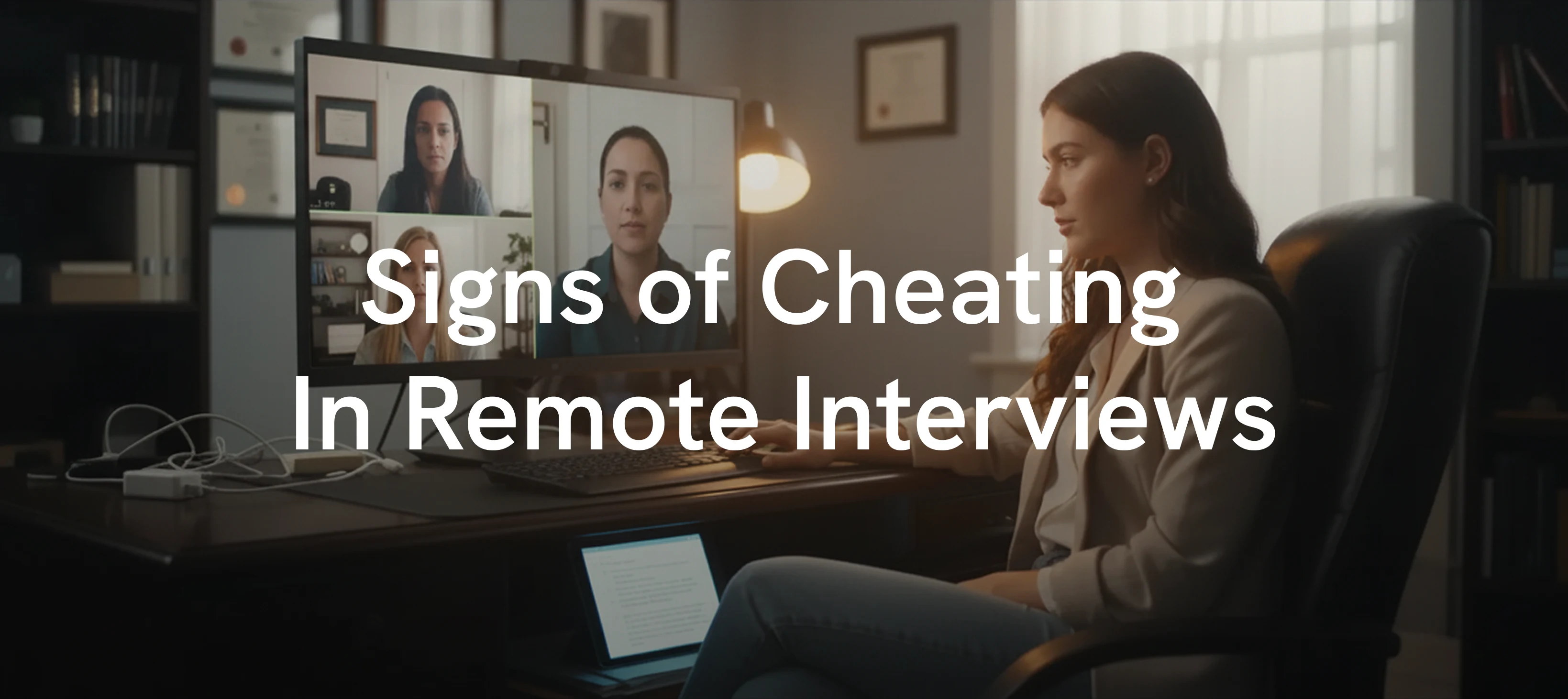
Remote interviews have transformed hiring, making it faster, more flexible, and more global. But they’ve also introduced a growing challenge: cheating during remote interviews.
While traditional interview fraud relied on obvious cues, modern cheating is subtle. Candidates may use hidden prompts, external assistance, or AI-generated answers, all while appearing calm and confident on screen. In fact, research shows that a significant portion of job seekers admit to cheating at some point during the hiring process, with around 71% admitting to cheating behaviors such as using unauthorized help during assessments or interviews.
This is where behavioral analysis, powered by AI, becomes critical.
In this blog, we’ll explore the top behavioral signs of cheating during remote interviews, why they matter, and how platforms like Sherlock AI help organizations detect dishonesty in real time without disrupting the candidate experience.
Why Behavioral Signs Matter More Than Tools
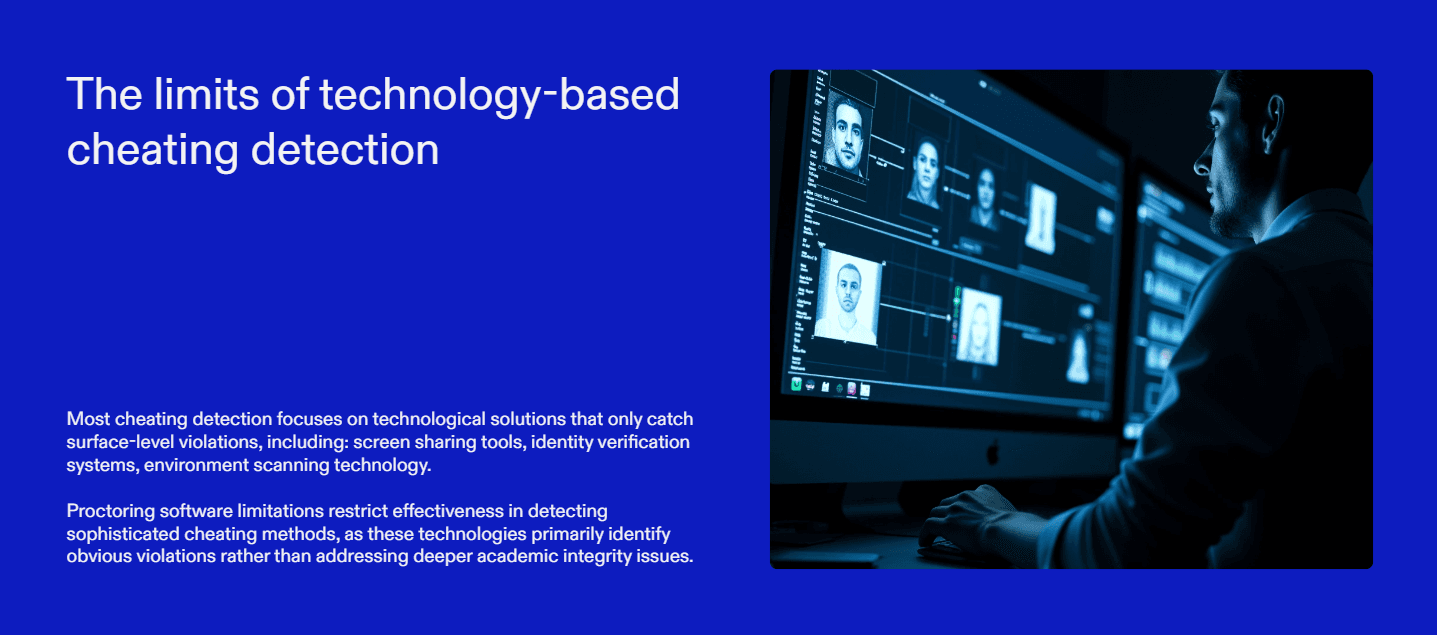
Most cheating detection content focuses on technology: screen sharing, identity checks, or environment scans. But these methods only catch surface-level violations.
Behaviour, on the other hand, is harder to fake consistently.
When candidates rely on notes, AI tools, or external help, it affects how they:
Look at the screen
Respond to questions
Maintain communication consistency
Handle cognitive pressure
These changes form patterns and patterns reveal intent.
1. Repeated Off-Screen Eye Focus Before Answering
In a natural interview, candidates briefly think and then answer. When cheating is involved, eye movement often becomes purpose-driven.
Candidates may repeatedly look in the same off-screen direction just before speaking. This usually happens before technical or experience-based questions and disappears during casual conversation.
This behaviour suggests the candidate is checking something external notes, prompts, or another screen rather than recalling information naturally.
2. Time Gaps That Don’t Match Question Difficulty
Delays are normal. What’s not normal is when the delay doesn’t match the question.
Examples:
Long pauses before simple questions
Immediate answers to complex ones
Consistent waiting time before every response
These timing patterns often indicate the candidate is reading, waiting for help, or generating answers externally. In live remote interviews, this is often the first visible clue that a candidate might be leaning on real-time AI or off-screen help.
Behavioral analysis looks at response timing across the interview, not isolated pauses.
3. Sudden Changes in Language Quality
One of the clearest behavioral signals appears in language.
A candidate might:
Start with average, conversational answers
Suddenly shift to polished, structured, jargon-heavy responses
Then revert back again later
This inconsistency often points to prepared or AI-assisted answers mixed with spontaneous ones.
The issue isn’t strong communication, it’s uneven communication.
4. Difficulty Explaining Their Own Answers
Cheating often shows up during follow-ups.
Candidates may give confident initial responses but struggle when asked:
“Why did you choose that approach?”
“What challenges did you face?”
“Can you explain that in simpler terms?”
When answers are externally sourced, candidates can repeat them, but can’t expand or personalize them naturally.
This gap between surface-level answers and deeper explanation is a strong authenticity indicator.
You’ll see the same pattern in candidates using scripted or AI-generated answers they didn’t actually think through.
5. Repetitive Clarification as a Stalling Technique
Clarifying a question once is reasonable. Doing it repeatedly especially for straightforward questions is often a time-buying behavior.
Common patterns include:
Asking for repetition even when audio is clear
Restating the question out loud before answering
Requesting clarification only on certain question types
These behaviors often align with moments where external assistance is being used.
6. Behavioral Stress That Appears Selectively
Nervousness alone doesn’t indicate cheating. What matters is when stress appears.
Candidates may show signs of cognitive overload only during:
Technical questions
Resume-based questions
Scenario or problem-solving questions
This selective stress filler words, self-corrections, strained delivery often reflects mental multitasking, not lack of confidence.
7. Resume Confidence vs Interview Control Mismatch
One of the strongest behavioral signs is a disconnect between what a candidate claims and how they perform live.
Examples include:
Strong resumes but shallow real-time reasoning
High-level answers without practical grounding
Inability to clearly describe personal contributions
This mismatch doesn’t require surveillance to detect only behavioral consistency checks across questions. It’s one of the clearest interview integrity signals in remote hiring, because it shows whether live performance actually matches what’s on paper.
Why Most Interviewers Miss These Signals
Humans are good at judging individuals but poor at spotting patterns across time, especially in high-volume hiring.
Interviewers:
Focus on answers, not behavioral trends
Miss micro-inconsistencies
Are influenced by confidence and presentation
This is where behavioral intelligence becomes valuable.
Human Review vs AI Behavioral Detection
Human Interviewers | AI Behavioral Analysis (Sherlock AI) |
|---|---|
Subjective judgment | Objective pattern recognition |
Fatigue & bias | Consistent evaluation |
Misses micro-signals | Detects subtle inconsistencies |
One interview view | Cross-interview behavioral learning |
The strongest hiring processes combine human judgment with AI-powered behavioral intelligence.
How Sherlock AI Helps Detect Cheating Ethically
Sherlock AI doesn’t rely on intrusive surveillance. Instead, it focuses on:
Behavioral consistency
Cognitive effort patterns
Authenticity signals over time
This ensures:
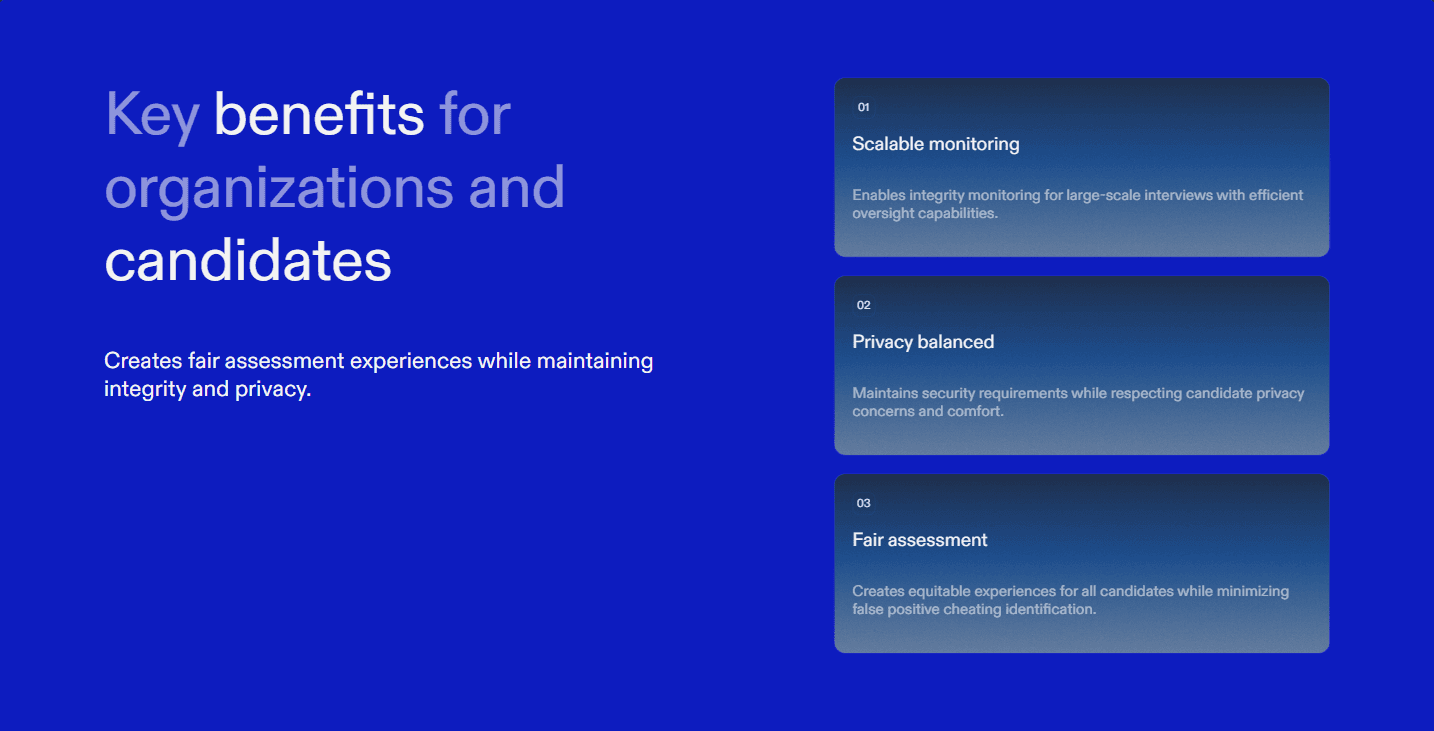
✅ Fair candidate experience
✅ Reduced false positives
✅ Scalable interview integrity
Best Practices to Reduce Cheating in Remote Interviews
1. Use Behavior-Focused Questions
Behavior-focused questions make it harder for candidates to rely on prepared or AI-generated answers because they require personal reasoning, context, and reflection.
Instead of asking questions that can be easily searched or scripted, interviewers should ask candidates to explain:
How they approached a problem
Why they chose a specific solution
What trade-offs or challenges they faced
These questions reveal how candidates think, not just what they know.
Example:
Instead of asking “What is your experience with cloud migration?”
Ask: “Walk me through how you handled the most challenging part of your last cloud migration project.”
Candidates using external help often struggle to maintain natural flow when explaining personal decision-making.
2. Combine AI Insights with Human Judgment
AI is most effective when it supports interviewers, not replaces them. AI can detect patterns across timing, language, and behavior, while humans provide context and judgment.
AI highlights unusual trends; interviewers decide whether they indicate cheating, nervousness, or misunderstanding.
This approach avoids over-penalizing candidates for natural behavior while still catching assisted responses.
Example:
AI flags that a candidate consistently pauses longer before technical questions.
The interviewer follows up with deeper questions to assess whether the knowledge is genuine.
3. Avoid Relying on Single Signals
Cheating is rarely proven by a single action. A long pause, a glance away, or a clarification request on its own doesn’t mean much.
What matters is repetition and consistency:
Does the behavior occur only during certain question types?
Does it repeat throughout the interview?
Does it align with changes in answer quality?
Evaluating behavior holistically reduces false positives.
Example:
A candidate occasionally pauses normal.
But when every pause is followed by perfectly structured answers only for technical questions, it becomes a meaningful pattern.
4. Choose Behavioral Authenticity Over Surveillance
Traditional proctoring tools rely on screen monitoring, room scans, or constant observation. These methods often:
Create candidate discomfort
Raise privacy concerns
Still miss subtle cheating
Behavioral authenticity focuses on how candidates respond, not how closely they are watched.
Platforms like Sherlock AI analyze behavioral consistency, response timing, and communication patterns instead of invasive surveillance making cheating harder while preserving candidate trust.
Example:
Rather than forcing screen sharing, Sherlock AI detects whether a candidate’s language, timing, and explanation depth remain consistent throughout the interview.
Conclusion
As remote interviews become the norm, cheating methods continue to grow more subtle and sophisticated. Relying on surveillance-heavy tools or isolated signals is no longer enough and often comes at the cost of candidate trust and fairness.
The future of interview integrity lies in behavioral authenticity. By focusing on how candidates think, respond, and remain consistent under real-time questioning, hiring teams can identify genuine talent with greater confidence.
Sherlock AI enables this shift by combining ethical AI with behavioral intelligence helping organizations detect cheating patterns accurately, reduce false positives, and scale remote hiring without compromising the candidate experience. The result is a hiring process built on trust, fairness, and real skill not assisted performance.