Back to all blogs
Mobile AI tools are helping candidates cheat in remote interviews. Explore detection strategies, behavioral warning signs, and how Sherlock AI ensures fair, authentic hiring.

Abhishek Kaushik
Feb 11, 2026
Remote interviews opened the door to global hiring. They also opened the door to a new kind of interview cheating that most teams are not prepared for.
Today, candidates can use mobile AI assistants running on a second device to generate real time answers during interviews. These tools listen, transcribe, and respond within seconds. From the interviewer’s perspective, the candidate just sounds unusually polished. Recent industry research shows that interview cheating is no longer rare. In an analysis of nearly 20,000 AI-assisted interviews, over 38% of candidates were flagged for cheating behavior, with technical roles showing cheating rates as high as 48%.
Traditional proctoring and trust based interviews were not designed for this. Preventing mobile AI assistance now requires a mix of policy, interview design, behavioral detection, and purpose built technology.
This guide breaks down exactly how to do it.
The Mobile AI Interview Problem Every Hiring Leader Is Starting to Notice
Recruiters used to worry about candidates getting help from a friend off camera. That risk has evolved.
Now the “helper” is an AI running on a phone just outside the webcam frame.
Common ways candidates use mobile AI during interviews include:
Placing a phone beside their laptop where the camera cannot see it
Using voice AI tools that listen to the interviewer and generate suggested answers
Reading AI generated responses from a second screen while pretending to think
Getting live coding help through AI copilots on another device
Because this assistance happens off screen and off platform, most interview tools cannot detect it. The result is a growing number of candidates who appear highly capable in interviews but underperform once hired.
Preventing this requires moving beyond basic video calls and static questions.
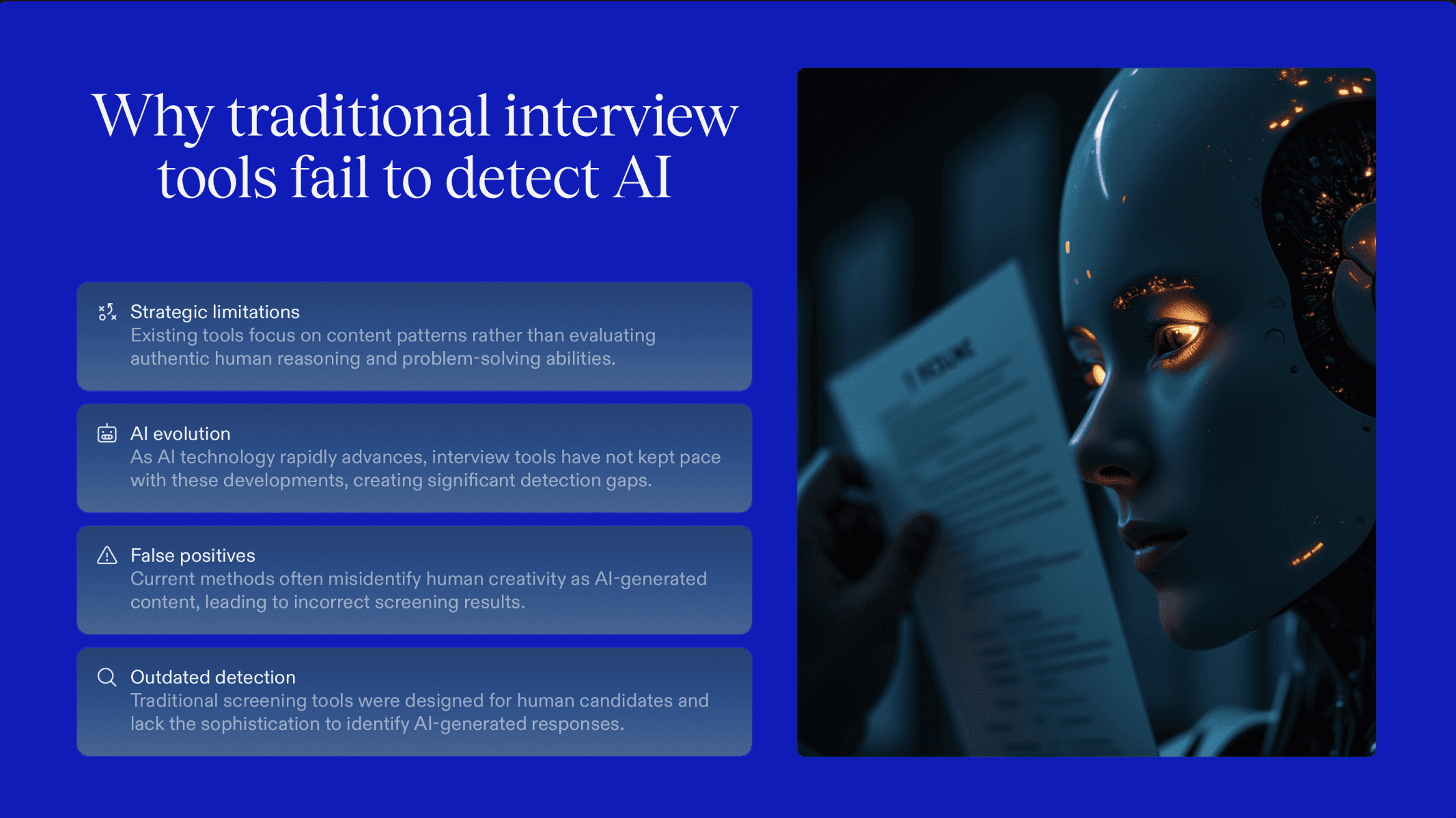
Why Traditional Interview Controls No Longer Work
Many companies try to solve this problem using simple rules:
“No phones allowed”
“Please keep your camera on”
“Do not use AI tools”
The issue is not policy. The issue is enforcement and detection.
A candidate can agree to all rules and still use a mobile AI assistant without being obvious. Standard video platforms do not track off screen device use, eye movement patterns, or behavioral inconsistencies that suggest external assistance.
This is why preventing mobile AI support now requires layered defenses, not just guidelines.
Read more: Top Behavioral Signs of Cheating During Remote Interviews
Environmental and Technical Controls That Actually Help
Basic video calls were built for meetings, not for high integrity hiring. If you want to reduce mobile AI assistance, you need more visibility, more signals, and more structure than standard interview setups provide.
These controls do not work alone. They work best as part of a layered defense strategy.
1. Full Screen Monitoring
Requiring candidates to share their entire screen, not just a single window, adds an important layer of transparency and helps you detect suspicious activity during interviews, a key tactic in preventing real-time AI answer copilots in interviews.
This helps you:
Spot browser tabs running AI chat tools
Notice copy paste behavior from external sources
Detect use of hidden overlays or prompt windows
Identify suspicious switching between tabs during questions
While this does not fully prevent mobile based AI help, it eliminates one of the easiest cheating paths and forces candidates to rely on more complex workarounds, which often introduce detectable behavioral signals.
2. Continuous Video Observation
Video is not just for confirming identity. It is a behavioral signal source.
Interviewers should be trained to look for patterns, not isolated moments.
Key indicators include:
Repeated glances to the same off screen location, often where a phone may be placed
Long pauses followed by highly structured, unusually polished answers
Lip movement or eye tracking that suggests silent reading before speaking
Minimal natural thinking behavior such as hesitation, reformulation, or verbal processing
On their own, these signals can be ambiguous. But when they appear consistently, especially alongside perfect responses, the likelihood of external assistance increases.
The challenge is that human interviewers are already multitasking. They are listening, evaluating, and asking follow ups. Subtle behavioral cues are easy to miss without structured support.
3. Audio Environment Awareness
Mobile AI tools often rely on capturing the interviewer’s voice through a secondary device.
Pay attention to:
Faint notification sounds, typing, or taps that do not match visible activity
Slight audio delays that suggest the candidate is waiting for processed output
Unusual rhythm where the candidate rarely interrupts, asks for clarification, or thinks out loud
These patterns may indicate the candidate is receiving assistance in the background rather than engaging naturally in conversation.
4. Structured Recording for Post Interview Review
Recording interviews in high quality video creates an audit trail that can be reviewed when concerns arise.
Post interview review allows teams to:
Rewatch response timing patterns
Observe consistent eye movement direction
Compare claimed expertise with spontaneous follow up performance
Validate whether suspicious behavior was a one off moment or a repeated pattern
Without recordings, many integrity concerns rely on memory and subjective impressions. Structured review adds accountability and consistency.
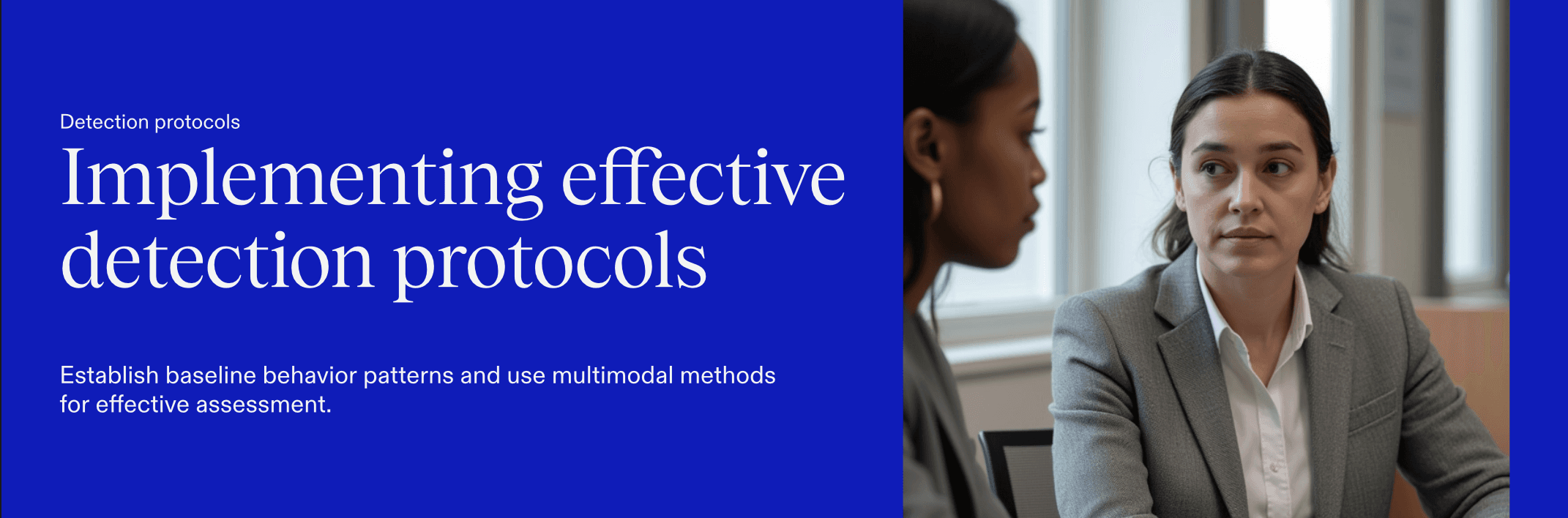
Behavioral Red Flags of Mobile AI Assistance
Even with well designed interviews, detection still plays a critical role. Mobile AI tools leave behavioral footprints. The key is to look for patterns, not one off moments.
Below is a structured breakdown of the most common signals.
1. Response Timing Irregularities
AI assisted answers often introduce unnatural rhythm into conversation, revealing subtle signs of external assistance.
What to watch for
A consistent 2 to 5 second pause before most answers
Delays that occur even for simple or personal questions
Sudden shift from silence to a long, highly organized response
Why this matters
Candidates using mobile AI are often waiting for the tool to process the question and generate a response. Natural thinkers show varied pacing. AI assisted candidates often show repeated, uniform delays.
2. Eye and Attention Patterns
Visual behavior can reveal divided attention betwen the interviewer and a hidden device.
What to watch for
Repeated glances to the same off screen location
Eyes moving side to side as if reading text
Looking down toward a desk or lap right before answering
Limited natural eye contact during complex responses
Why this matters
Candidates using a phone for AI support typically place it just outside the camera frame. Their gaze often returns to that location before delivering answers.
3. Language That Sounds Generated, Not Lived
AI produces clean, structured language. Real experiences are usually messier.
What to watch for
Answers that sound like textbook definitions instead of personal stories
Overuse of frameworks without real world detail
Perfectly structured responses that lack emotion, uncertainty, or nuance
Vague outcomes with strong buzzwords but few specifics
Why this matters
Candidates speaking from experience naturally include context, tradeoffs, and imperfections. AI generated answers often sound impressive but generic.
4. Low Adaptability to Follow Up Questions
AI performs best on complete questions. It struggles in unpredictable, multi turn dialogue.
What to watch for
Strong initial answer followed by weaker, vague follow ups
Difficulty when asked to clarify specific details
Inconsistent timelines or changing facts in the same story
Trouble answering “why” or “what would you change” questions
Why this matters
When candidates rely on AI, the first response may be polished, but deeper probing exposes gaps. The story may not hold up under pressure.
5. Skill–Performance Mismatch
There is often a gap between how a candidate talks and how they perform live.
What to watch for
Confident explanations of advanced topics but hesitation on basic practical questions
Strong theoretical answers but weak real time problem solving
Smooth communication paired with difficulty in unscripted tasks
Why this matters
AI can help candidates describe expertise. It cannot help them demonstrate it in real time, especially during interactive or technical exercises.
6. Conversation Flow That Feels “Too Perfect”
Natural conversations include interruptions, corrections, and thinking out loud.
What to watch for
Very few filler words or self corrections
Long monologues that sound pre written
Little spontaneous clarification or back and forth
Why this matters
AI generated responses tend to be overly polished and linear. Human thinking is usually more dynamic and imperfect.
Read More: Tools to Detect AI Fraud During Online Interviews in 2026
How Sherlock AI Helps Prevent Mobile AI Assistance
Sherlock AI is built specifically to address the growing risk of real time AI support during remote interviews. It strengthens interview integrity by adding a layer of behavioral and interaction analysis that traditional video platforms do not provide.
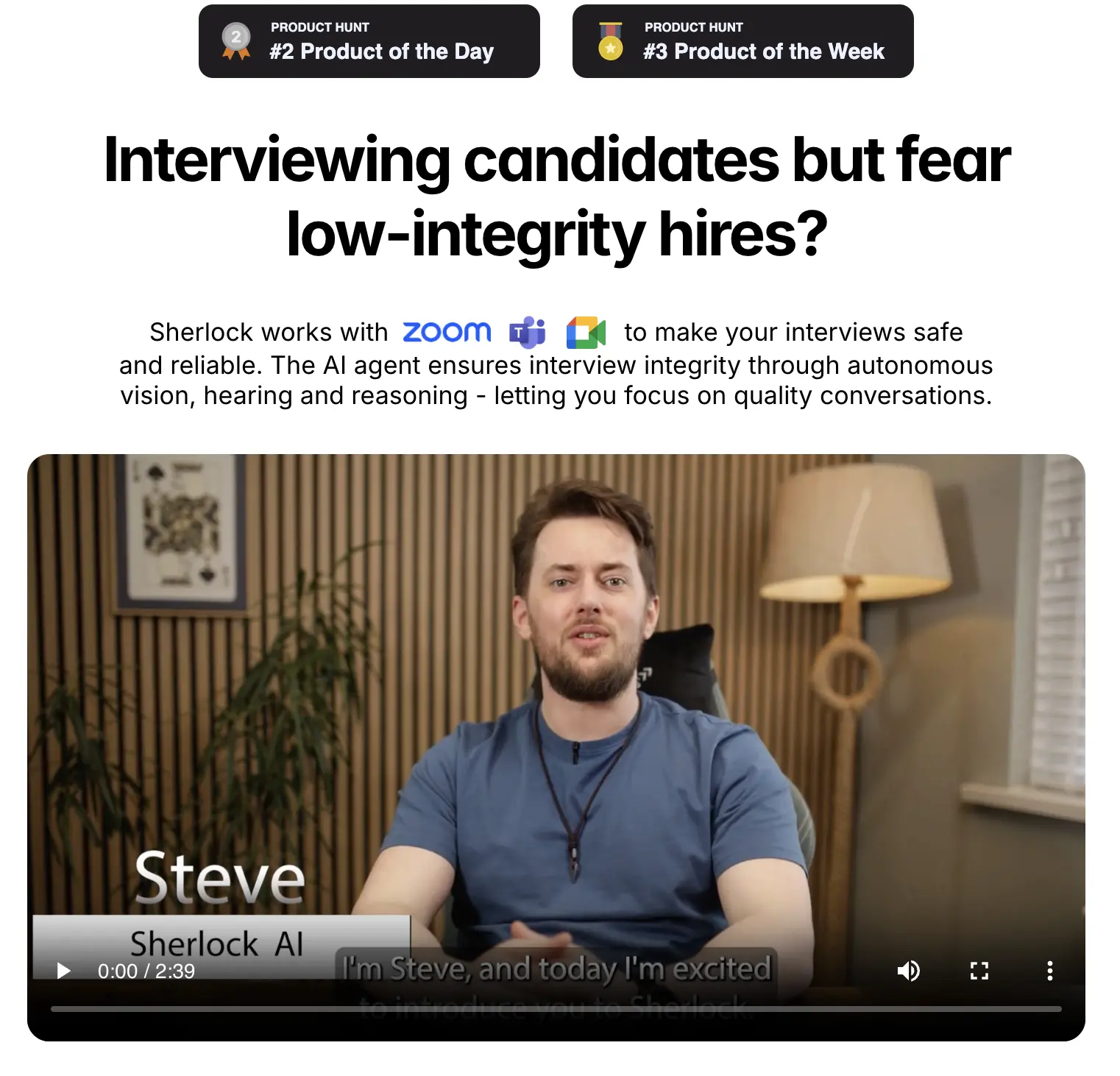
Here is how Sherlock AI supports fair, unaided interviews:
Detects Unnatural Response Patterns
Sherlock AI analyzes response timing across the interview to identify patterns that may indicate candidates are waiting for external AI generated answers rather than responding naturally.Identifies Attention and Engagement Irregularities
By examining visual and interaction signals, Sherlock AI helps surface cases where a candidate’s focus appears divided, which can be consistent with off screen device use.Flags Behavioral Inconsistencies
When answer sophistication, communication style, and interactive depth do not align, Sherlock AI highlights these inconsistencies so recruiters can review the interview more closely.Supports Evidence Based Interview Review
Instead of relying only on memory or intuition, hiring teams get structured integrity insights that can be reviewed alongside interview recordings and evaluator feedback.Scales Interview Integrity Across Hiring Teams
Individual interviewers may miss subtle red flags, especially during long or back to back interviews. Sherlock AI brings consistency by applying the same behavioral analysis across all interviews.Protects Against Secondary Device Assistance
Mobile AI tools operate outside the main interview platform, making them hard to detect manually. Sherlock AI focuses on the behavioral footprints such tools leave behind, helping teams identify risk even when the device itself is not visible.Strengthens Confidence in Hiring Decisions
By combining skill evaluation with interview integrity signals, Sherlock AI helps organizations make decisions based on a candidate’s genuine, unaided performance rather than a potentially AI assisted interaction.
As mobile AI tools become more common, ensuring interview authenticity is no longer optional. Sherlock AI helps companies stay ahead of this shift by making modern interview risks visible and manageable.
The Future of Fair Interviews Is Proactive, Not Reactive
Mobile AI assistance is not a temporary issue. It is changing how candidates present themselves in interviews, often with real time support that is invisible to recruiters. Policies and intuition alone are no longer enough, and standard video platforms were never designed to detect this kind of risk.
Fair hiring now requires a proactive approach that combines smarter interview design, awareness of behavioral signals, and technology built specifically for interview integrity. Sherlock AI helps teams move beyond guesswork by identifying patterns that may indicate external assistance, so hiring decisions are based on a candidate’s genuine, unaided ability.