Back to all blogs
Explore tools to detect AI fraud during online interviews in 2026. Learn how recruiters identify AI assisted cheating, proxy interviews, and fake candidates.

Abhishek Kaushik
Jan 29, 2026
Remote interviews have become the standard for global hiring, but they have also created new vulnerabilities that traditional interview processes were never designed to handle.
Today, candidates can use real time AI generated answers, invisible interview copilots, external coaching, and even proxy interviewers while appearing confident and authentic on camera. Industry reports indicate that 59% of managers suspect candidates are using AI to misrepresent themselves, and 31% have interviewed someone later found to be using a false identity.
Detecting AI fraud during online interviews requires a fundamentally different approach than traditional interview monitoring. Modern interview fraud is designed to look natural. Candidates using AI assistance often appear confident, fluent, and well prepared, making it difficult for interviewers to rely on intuition alone.
As AI tools become more accessible and harder to detect, hiring fraud has shifted from obvious misconduct to subtle manipulation of responses, reasoning, and identity. To protect hiring quality, organizations now require specialized tools that can detect AI fraud during online interviews without relying solely on surveillance or manual judgment.
Tools Built to Detect AI Fraud During Online Interviews
Below are the tools built specifically to detect AI fraud during online interviews, helping organizations protect hiring quality, reduce fraud risk, and make confident hiring decisions in an AI driven hiring environment.
1. Sherlock AI

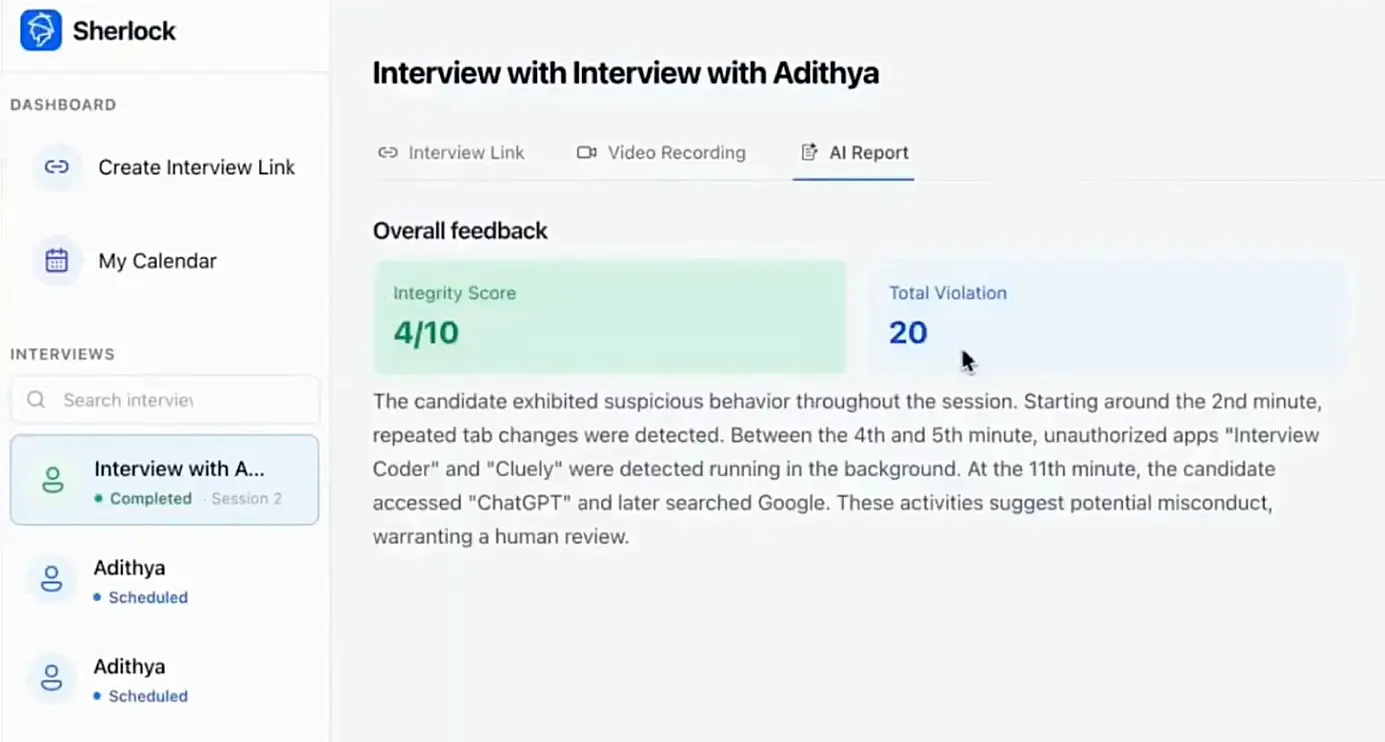
Sherlock AI is designed to detect authenticity risks in online interviews by analyzing how candidates think, reason, and communicate rather than focusing on device surveillance. It identifies AI assisted, scripted, or non authentic behavior by evaluating cognitive and behavioral signals across interview stages.
Sherlock AI is particularly effective against advanced AI cheating methods that sound natural, adapt in real time, and leave no visible traces on the candidate’s screen.
Key features
Analyzes reasoning flow to determine whether answers evolve naturally or follow AI generated patterns
Evaluates response structure to detect overly polished, generic, or scripted answers
Identifies AI assisted and externally coached responses by assessing depth and specificity
Compares communication style, tone, and confidence across interview rounds
Detects proxy interviews and impersonation through interaction pattern analysis
Flags identity continuity risks when behavioral signals do not match earlier interviews
Provides contextual and explainable risk insights rather than binary pass or fail decisions
Enables recruiter review and human judgment to reduce false positives
Designed to be bias aware and candidate friendly without invasive monitoring
2. InterviewGuard
InterviewGuard focuses on real time detection of AI assisted fraud during live online interviews by monitoring unauthorized AI usage and interview manipulation as it happens.
Key features
Detects real time usage of AI tools and invisible interview copilots
Identifies proxy interview risks during live interview sessions
Flags deepfake and synthetic identity signals
Provides instant alerts to recruiters without interrupting interviews
Supports integration with common video interview platforms
3. Hyproctor
Hyproctor operates at the desktop level, making it effective at detecting AI cheating tools that remain hidden from browser based monitoring.
Key features
Detects hidden AI applications running in the background
Identifies suspicious system processes and unauthorized software
Flags remote desktop usage and virtual machines
Monitors system level behavior throughout the interview
Effective for high risk and technical interview scenarios
4. InterviewShield
InterviewShield combines behavioral observation with system monitoring to detect sophisticated interview cheating methods.
Key features
Monitors screen activity and application usage during interviews
Tracks eye movement to detect off screen prompting
Analyzes voice patterns for signs of coaching or assistance
Detects second device and external input behavior
Flags inconsistencies between observed behavior and spoken responses
5. CheatProof.ai
CheatProof.ai specializes in detecting AI assisted answers, particularly in coding and problem solving interviews.
Key features
Analyzes response timing to identify real time AI assistance
Flags AI generated or heavily assisted coding solutions
Detects unusual interaction patterns during technical interviews
Supports live and asynchronous interview formats
Provides signals for recruiter review rather than automated rejection
6. Screentro.ai
Screentro.ai focuses on identifying behavioral cues commonly associated with real time coaching and external assistance.
Key features
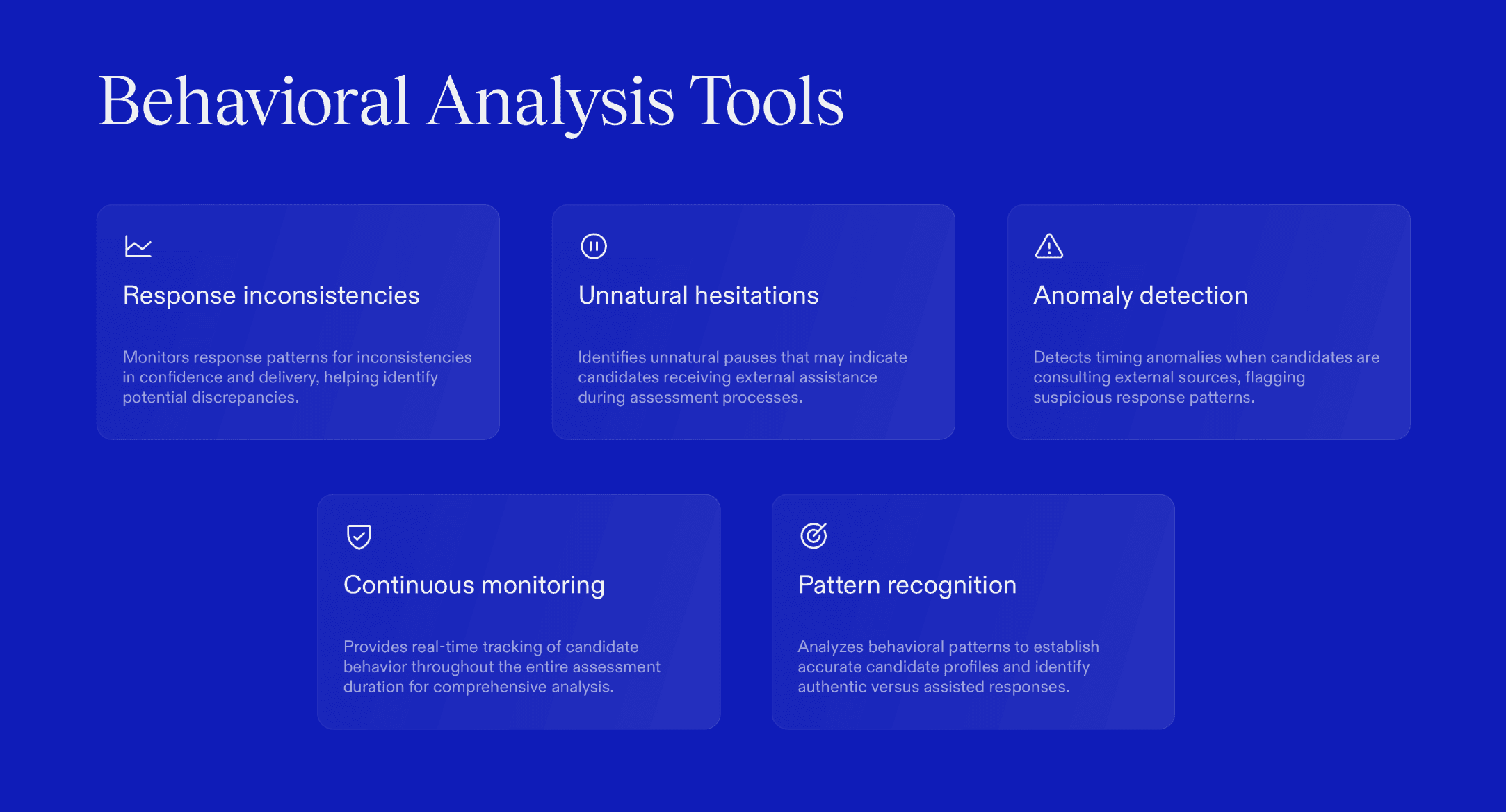
Detects abnormal eye movement and gaze behavior
Monitors background audio for coaching cues
Identifies behavioral inconsistencies during responses
Flags suspicious pauses and response delays
Helps identify real time external help during interviews
Conclusion
AI has fundamentally changed the nature of interview fraud. As candidates gain access to more advanced AI tools, detecting fraud requires more than surface level monitoring or manual intuition. Organizations must adopt tools that understand both technical misuse and behavioral authenticity.
Tools built specifically to detect AI fraud during online interviews, especially when combined with behavioral and reasoning based platforms like Sherlock AI, allow recruiters to scale remote hiring with confidence.
By using a layered and explainable approach, organizations can protect hiring quality, reduce risk, and ensure that the best candidates succeed based on genuine ability.