Back to all blogs
Learn how to detect OfferGoose and prevent AI-assisted cheating in interviews. Discover key signs, risks, and smarter strategies to ensure fair and accurate hiring.

Abhishek Kaushik
Apr 23, 2026
AI is rapidly transforming hiring, but not always in ways recruiters expect. Tools like OfferGoose are changing how candidates approach interviews, introducing new challenges for hiring teams focused on fairness, authenticity, and accurate evaluation.
OfferGoose is an AI-powered interview copilot that provides real-time answers during interviews. It works through screen overlays or secondary devices, helping candidates respond instantly with structured and polished answers. While this can improve confidence and communication during practice, its use in live interviews raises serious concerns.
When candidates rely on AI in real time, recruiters may end up evaluating generated responses instead of actual ability. This creates a gap between perceived performance and real capability, making it harder to make informed hiring decisions. Cheating attempts in hiring assessments increased from 16% to 35% in one year, driven largely by AI tools. 39% of candidates use AI during the job application process, including generating answers for assessments and interviews.
For teams hiring at scale, even a small number of such cases can impact overall hiring quality and long-term performance. This makes it essential for organizations to rethink how they assess candidates in an AI-driven hiring landscape.
In this guide, we break down how to detect OfferGoose in interviews and how to prevent its misuse using smarter, AI-driven strategies
What is OfferGoose?
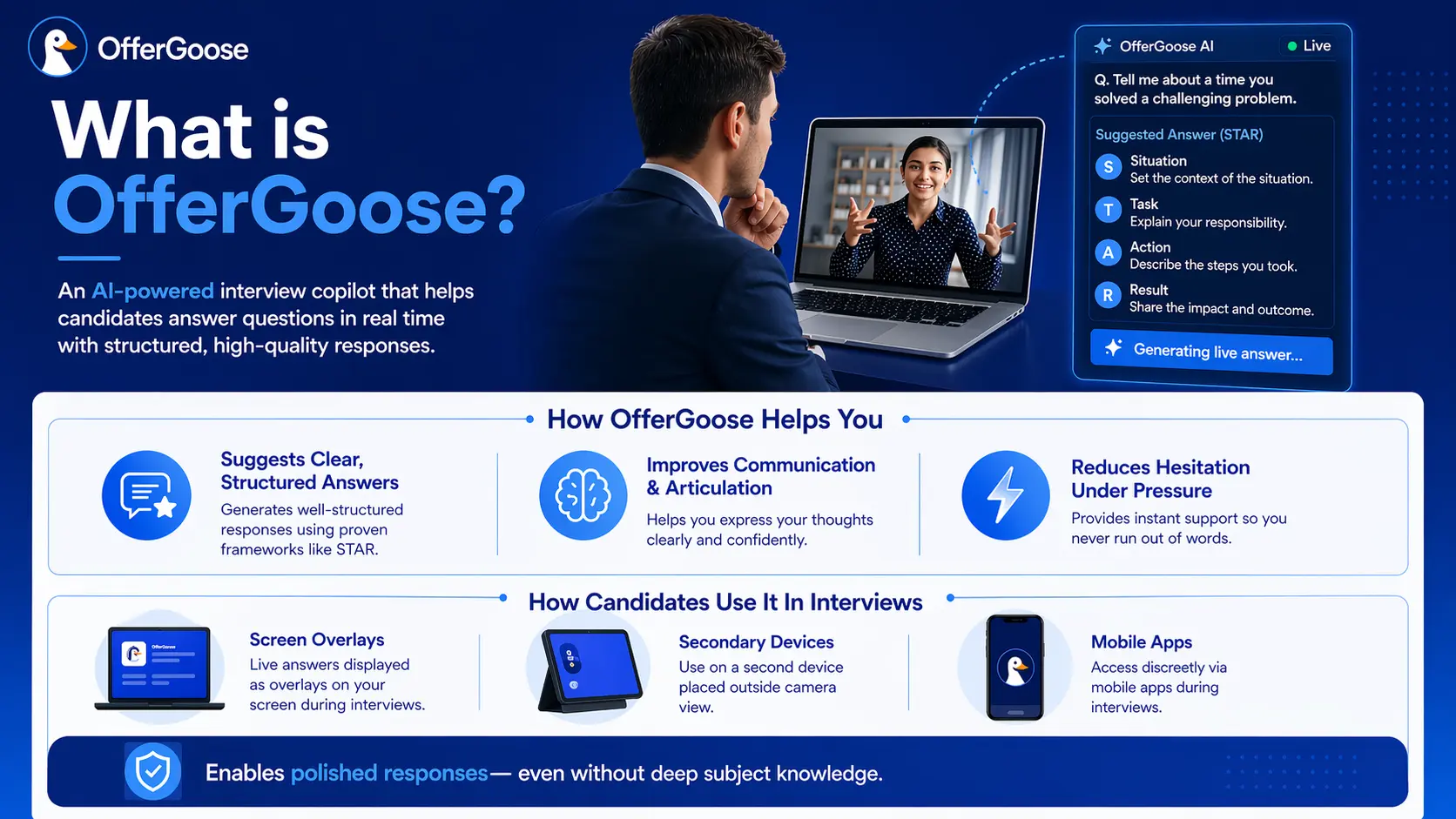
OfferGoose is an AI-powered interview copilot that helps candidates answer questions in real time. It generates structured responses during live interviews, often using proven frameworks like STAR.
It is designed to:
Suggest clear and well-structured answers
Improve communication and articulation
Reduce hesitation during high-pressure interviews
How Candidates Use It in Interviews
Candidates may use OfferGoose as a live support tool through:
Screen overlays that display generated answers
Secondary devices placed outside camera view
Mobile apps used discreetly during interviews
This allows them to respond quickly with polished answers, even without deep subject knowledge.
👉 OfferGoose is just one example. Discover how Cluely AI is being used in interviews and how to detect it effectively.
Why OfferGoose is Hard to Detect
OfferGoose and similar AI interview copilots are intentionally designed to operate in the background. Unlike traditional cheating methods, they leave little to no obvious trace, making detection significantly more challenging for recruiters.
1. Built for Subtle, Real-Time Assistance
Modern AI tools do not require screen takeover, browser plugins, or visible software installations.
They work quietly in parallel with the interview, allowing candidates to:
Receive answers in real time
Maintain a natural interview flow
Avoid triggering basic monitoring mechanisms
As a result, recruiters often have limited visibility into whether responses are genuinely human or AI-assisted.
2. Multiple Access Points Outside Recruiter Visibility
Candidates can use different setups that remain invisible during interviews:
Secondary screens placed just outside the camera’s field of view
Mobile devices positioned below or beside the laptop
Tablet or split-screen setups that are not shared during screen sharing
These setups ensure that AI assistance stays completely hidden from the interviewer. To better understand how recruiters can detect hidden AI tools during interviews, it is important to go beyond visible setups and analyze subtle behavioral and environmental signals.
3. Invisible to Standard Screen Sharing
Even when screen sharing is enabled, these tools often remain undetected because:
Overlay tools may not appear in shared screens
External devices are completely outside digital monitoring scope
Recruiters only see a limited portion of the candidate’s environment
This creates a blind spot in traditional virtual interviews.
4. Minimal Behavioral Disruption
Unlike obvious cheating, AI copilots are designed to mimic natural interaction patterns.
Candidates can:
Maintain steady communication
Deliver structured responses smoothly
Avoid abrupt or suspicious actions
This reduces the chances of raising immediate red flags.
5. Hard to Differentiate from Well-Prepared Candidates
One of the biggest challenges is that AI-assisted responses often resemble well-prepared answers.
This makes it difficult to distinguish between:
A genuinely prepared candidate
A candidate relying on real-time AI support
Without deeper probing, both can appear equally strong on the surface.
6. Limitations of Traditional Interview Methods
Most interview processes are not designed to detect AI assistance.
Common gaps include:
Reliance on visual observation alone
Lack of behavioral signal tracking
Static and predictable question formats
No mechanism to detect response generation delays
OfferGoose is hard to detect because it operates outside the boundaries of traditional interview monitoring.
To effectively identify such tools, organizations need to move beyond surface-level observation and adopt behavior-driven, adaptive interview strategies. To understand how modern interview monitoring builds trust in hiring decisions, it is important to rethink how monitoring goes beyond simple observation and focuses on authenticity and consistency.
Key Signs of OfferGoose Usage in Interviews
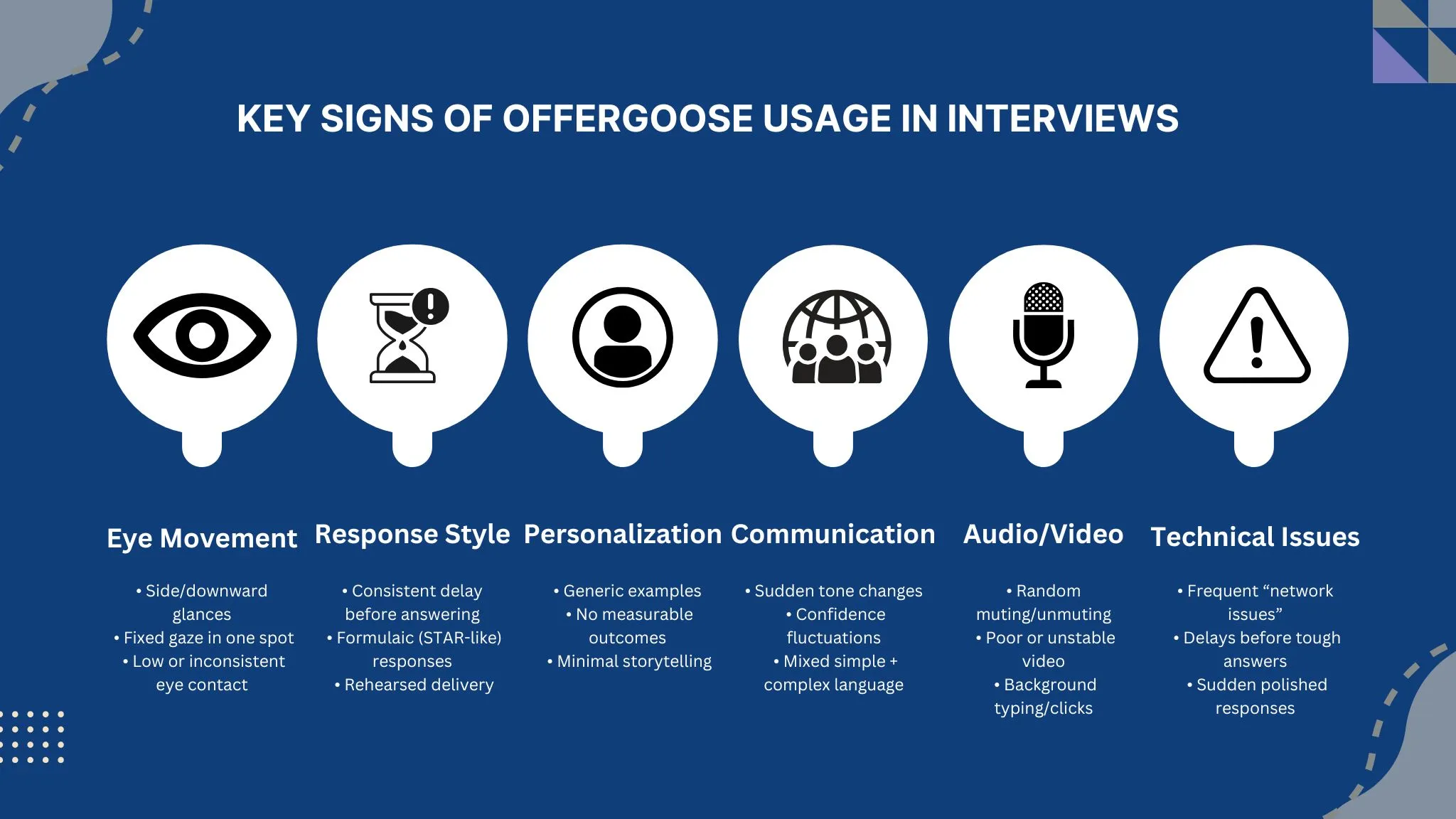
Detecting OfferGoose requires recruiters to move beyond obvious cheating signals and focus on subtle behavioral patterns. These indicators often show up in how candidates respond, communicate, and handle the flow of the interview.
1. Unusual Eye Movement Patterns
Candidates may repeatedly glance at the same off-camera spot, suggesting they are reading AI-generated responses in real time. This pattern is often consistent and differs from natural thinking or recall behavior.
What to watch for:
Frequent side or downward glances
Fixed gaze toward one specific area
Reduced or inconsistent eye contact
2. Delayed but Highly Structured Responses
There is often a noticeable pause before the candidate begins answering, followed by a well-structured and polished response. These answers may sound too perfect or formulaic, lacking the natural imperfections of real-time thinking.
What to watch for:
Consistent delay before answering
Answers that follow rigid frameworks like STAR
Overly polished or rehearsed delivery
3. Lack of Personalization in Answers
AI-assisted responses are usually broad and technically correct but lack real-life depth or specificity. They often miss personal experiences, detailed examples, or unique insights that reflect genuine expertise.
What to watch for:
Generic examples that apply to any candidate
Limited context, outcomes, or measurable impact
Minimal personal storytelling
4. Inconsistent Communication Style
Candidates may show sudden shifts in tone, vocabulary, or confidence levels across different questions. This inconsistency can indicate a switch between natural responses and AI-assisted answers.
What to watch for:
Sudden changes in speaking style or clarity
Fluctuations in confidence or pace
Unnatural mix of simple and highly technical language
5. Suspicious Audio or Video Behavior
Certain audio and video patterns may indicate the use of external tools or devices. These behaviors are often subtle but can signal attempts to manage or hide AI assistance.
What to watch for:
Random muting or unmuting
Unexplained poor or fluctuating video quality
Background typing, clicking, or delayed reactions
6. Conveniently Timed Technical Issues
Candidates may report connectivity or system issues at critical moments to gain time for AI-generated responses. These interruptions are often followed by unusually structured or improved answers.
What to watch for:
Frequent claims of lag or network problems
Pauses before answering complex questions
Sudden recovery with polished responses
No single signal confirms the use of OfferGoose, but a combination of these patterns can strongly indicate AI-assisted behavior. Recruiters should focus on identifying consistent trends rather than isolated incidents to make more accurate assessments.
The Real Risk for Hiring Teams
OfferGoose introduces a hidden layer into interviews. Recruiters may think they are evaluating a candidate’s thinking ability, but in reality, they are assessing an AI system.
This leads to:
Mis-hires with inflated perceived skills
Poor on-the-job performance
Increased attrition and rehiring costs
Loss of trust in the hiring process
For high-volume hiring, even a small percentage of such cases can significantly impact business outcomes.
Why Traditional Interviews Are No Longer Enough
Traditional interview methods were not designed to handle real-time AI assistance. Static question sets and unstructured conversations are easy for AI tools like OfferGoose to navigate, making it difficult to assess genuine candidate ability.
As a result, recruiters risk evaluating polished responses instead of real skills.
Key Gaps in Traditional Interviews
Predictable question formats
Repetitive and commonly used questions can be easily answered using AI-generated responses, reducing their effectiveness in evaluating true capability.Lack of behavioral insights
Most interviews rely on surface-level observation and fail to capture deeper behavioral signals that indicate external assistance.No real-time detection mechanisms
Traditional setups do not track response delays, eye movement patterns, or communication inconsistencies.
What Modern Hiring Requires
To stay ahead, hiring teams need to evolve their approach with:
Adaptive interview frameworks that reduce predictability
Behavioral intelligence to identify subtle anomalies
Real-time signal analysis to detect AI-assisted responses
This shift is critical to ensure that hiring decisions are based on authentic candidate performance.
How Sherlock AI Helps You Stay Ahead
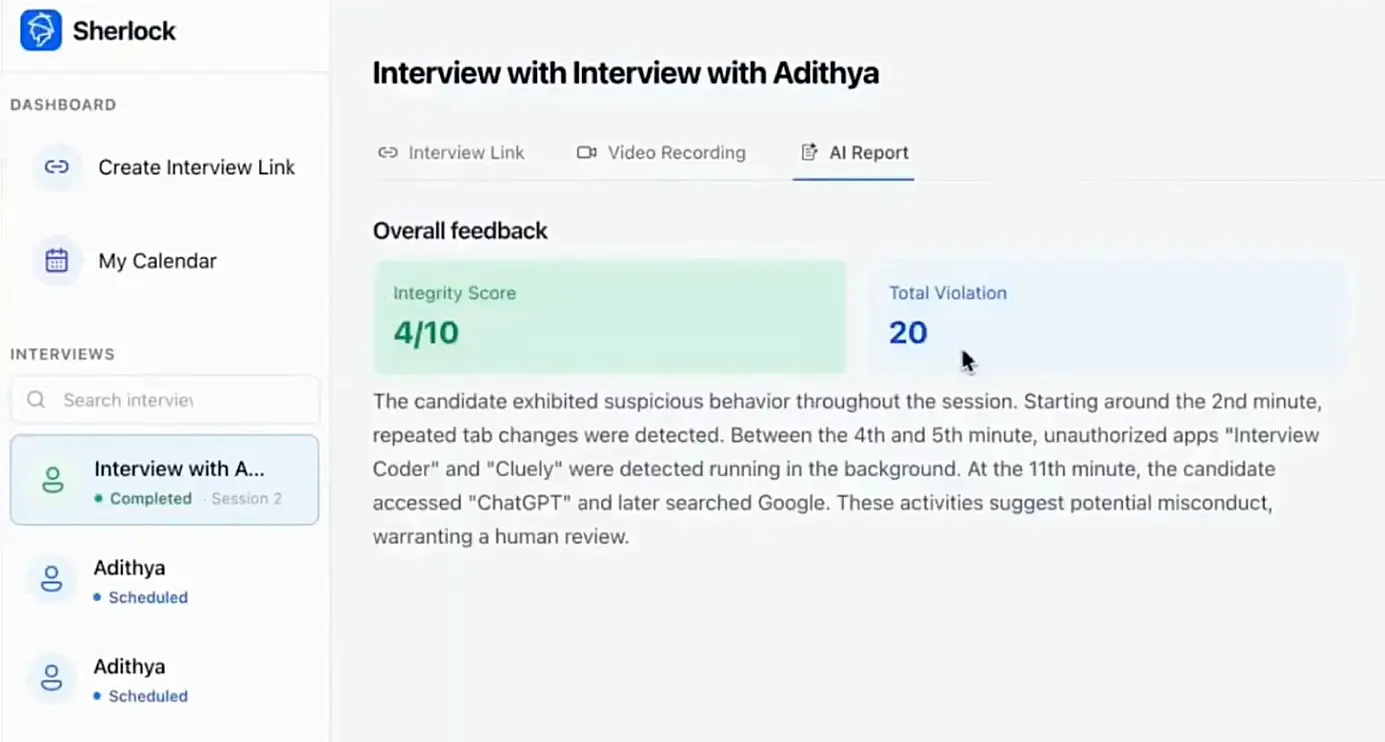
Sherlock AI is purpose-built to detect and prevent AI-assisted interview manipulation while maintaining a seamless candidate experience. It enables hiring teams to move from intuition-based decisions to data-driven evaluation.
What Sherlock AI Enables
Identify real-time behavioral anomalies
Sherlock AI continuously analyzes behavioral signals during live interviews, such as eye movement, response timing, and interaction patterns. This helps recruiters detect subtle deviations that are often missed in manual evaluations. Over time, these insights create a more consistent and objective assessment framework.Detect AI assistance signals
The platform surfaces patterns that indicate the possible use of interview copilots or external tools. It goes beyond obvious cues by identifying inconsistencies in response structure, delivery, and timing. This allows recruiters to make more confident decisions without relying on guesswork.Generate structured interview insights
Sherlock AI converts interview data into clear, standardized reports that are easy to review and compare. These insights help hiring teams align on candidate evaluation and reduce subjective bias. It also ensures that every interview has documented, defensible feedback.Improve hiring accuracy at scale
By combining behavioral analysis with structured evaluation, Sherlock AI reduces the chances of mis-hires. It enables teams to maintain consistency across high-volume hiring without compromising quality. This leads to better long-term hiring outcomes and stronger team performance.Enable fair and unbiased evaluations
Sherlock AI brings objectivity into the interview process by focusing on measurable signals rather than subjective impressions. This helps reduce unconscious bias and ensures candidates are assessed on actual performance. As a result, organizations can build more diverse and high-quality teams.Strengthen interview integrity and compliance
The platform helps organizations maintain transparent and standardized interview processes across teams and regions. With consistent monitoring and documented insights, companies can ensure fairness while staying aligned with internal hiring policies. This becomes especially important in high-stakes or regulated hiring environments.
Final Thoughts
OfferGoose reflects a broader shift in how AI is shaping the hiring process. While these tools can be valuable for interview preparation and skill-building, their use during live interviews introduces a layer of risk that recruiters cannot overlook. When candidates rely on real-time AI assistance, it becomes difficult to distinguish between genuine ability and generated responses, leading to potential gaps in evaluation and hiring accuracy.
The goal is not to restrict the use of AI, but to ensure that it does not compromise fair and accurate assessment. Organizations need to move toward more structured, adaptive interview methods that focus on real thinking, problem-solving, and communication. By combining better interview design with behavioral analysis, teams can reduce dependency on surface-level responses and make more confident hiring decisions.
This is where Sherlock AI becomes essential. By detecting behavioral anomalies and identifying patterns that indicate AI-assisted responses, it helps recruiters make data-driven decisions without disrupting the candidate experience. As AI continues to evolve, adopting tools like Sherlock AI will be critical for maintaining interview integrity, reducing hiring risks, and building high-performing teams.