Back to all blogs
Discover how to detect Cluely in interviews and prevent unfair advantages while evaluating true candidate skills.

Abhishek Kaushik
Jan 7, 2026
Interviews are designed to understand how a candidate thinks, explains decisions, and solves problems. When they work well, the interviewer hears the candidate’s own reasoning, not a rehearsed script.
However, that dynamic is rapidly shifting. Tools like Cluely can listen to an interview as it happens and suggest answers in real time. While a question is being asked, the AI generates structured responses and talking points for the candidate to use. What sounds like a thoughtful answer may not be the candidate’s thinking at all.
Leading employers like Amazon have already taken the step of explicitly banning the use of AI assistance during live job interviews, warning recruiters that candidates caught using generative AI tools for real‑time answers may be disqualified because such tools give applicants an “unfair advantage” and obscure their true abilities.
As these tools become more common, interviews become harder to trust. In fact, 1 in 5 U.S. professionals admit to secretly using AI during job interviews, with 55 % agreeing it’s becoming the norm rather than an exception. To keep interviews fair and meaningful, teams need better ways to detect and prevent live AI assistance like Cluely.
What Is Cluely?
Cluely is a real-time assistance tool that listens to live conversations and suggests what a person should say next. It is designed to work during calls, meetings, and interviews, not before them, and is one example of the cheating patterns now emerging in remote interviews.
In an interview, Cluely listens to the interviewer’s questions as they are asked. It then generates suggested responses that the candidate can read or paraphrase while speaking. These responses often include:
Structured answers to behavioral and technical questions
Follow-up points to sound more thorough and confident
Clear phrasing that removes pauses, uncertainty, or gaps
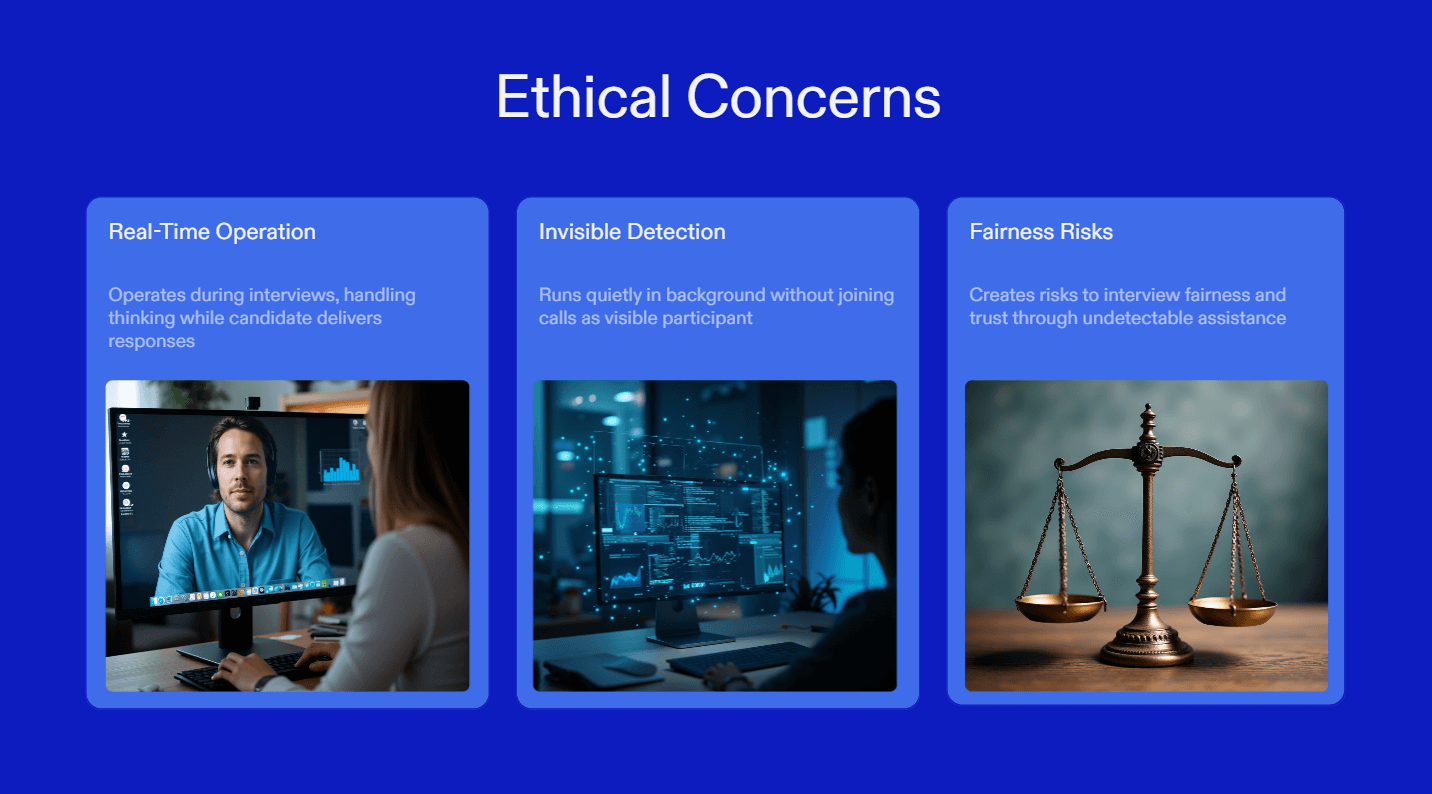
Cluely is not an interview preparation tool. It operates during the interview itself, handling the thinking in real time while the candidate delivers the output.
Because Cluely runs quietly in the background and does not join the call as a visible participant, interviewers usually have no clear way to know it is being used. This makes Cluely difficult to detect and creates a real risk to interview fairness and trust, especially in video interviews where most signals are already compressed into a small frame
How Candidates Use Cluely to Cheat During Live Interviews
Candidates do not use Cluely to look things up. They use it to replace their thinking in real time. The tool listens to the interview and generates answers while the conversation is still unfolding.
Candidates typically use Cluely in three ways during live interviews:
1. Replacing Real-Time Thinking With Pre-Packaged Answers
During the interview, Cluely listens to each question and generates a complete response before the candidate finishes speaking. The candidate then reads or paraphrases the output.
This is why answers often:
Sound polished even when the question is unexpected
Follow familiar interview structures instead of natural recall
Avoid pauses, uncertainty, or incomplete thoughts
For hiring teams, this creates a false signal. The candidate appears articulate and prepared, but the interview no longer reflects how they think under pressure or ambiguity.
2. Handling Follow-Up Questions Without Owning the Experience
The real damage happens after the first answer. When interviewers probe deeper, Cluely fills in details the candidate does not actually own.
Common patterns include:
Expanded explanations that add length, not insight
Tradeoffs described at a high level, without personal judgment
Decisions framed as obvious or risk-free
Interviewers often mistake this for strong experience. In reality, the AI is generating safe, generic reasoning that sounds correct but is not grounded in real decisions.
3. Masking Weak Judgment and Inexperience
Cluely is especially effective at hiding what interviews are meant to expose.
It helps candidates:
Avoid admitting uncertainty or mistakes
Smooth over gaps in knowledge
Maintain confidence even when discussing unfamiliar problems
As a result, weak decision-makers pass interviews designed to filter them out. The cost shows up later as slow execution, poor ownership, and decision paralysis on the job. These failures look very similar to the mis-hire patterns companies report when AI-driven interview fraud goes undetected.
Cluely succeeds because many interview systems reward the exact behaviors AI is best at generating. Until interviews are redesigned to test real judgment and ownership, tools like Cluely will continue to pass candidates who should not be hired.
Interview Questions That Expose Cluely-Generated Answers
Cluely performs best when questions are predictable and answers can be structured cleanly. It struggles when candidates must reason out loud, recall personal judgment, or adapt in real time.
These question patterns work best when they sit inside a clear, written policy on how AI can and cannot be used in interviews.
The following question types consistently expose AI-assisted answers:
1. Ownership-Forcing Questions
Start by removing the ability to hide behind teams or outcomes.
Ask questions like:
“What decisions did you personally make in that situation?”
“What part of this work would have failed if you had not been there?”
“What did you choose not to do, and why?”
Real candidates can point to specific calls they made. Cluely-generated answers stay high-level. They describe roles, not decisions. When pressed, the candidate often repeats the same points with different wording.
2. Decision Path Questions
Instead of asking what happened, ask how the decision formed.
Examples:
“Walk me through what you were thinking at the moment you made that choice.”
“What options did you seriously consider and reject?”
“What information were you missing at the time?”
AI answers describe outcomes cleanly. Human answers reveal uncertainty, internal debate, and imperfect information. When Cluely is in use, these questions produce longer responses without deeper reasoning.
3. Constraint-Change Questions
Mid-answer, change the conditions and see what happens.
Try:
“What would you do if the deadline were cut in half?”
“How would your decision change if you had no support from that team?”
“What if the risk tolerance were lower?”
Cluely struggles to adapt smoothly. The response often resets, sounds generic, or ignores the new constraint. Real candidates adjust naturally because they understand the original decision.
4. Mistake and Regret Questions
Ask about failure, not success.
Examples:
“What do you think you got wrong in that situation?”
“What decision would you make differently today?”
“What feedback did you initially disagree with?”
AI avoids self-critique. It produces safe reflections with no real cost or tension. Candidates using Cluely often struggle to describe mistakes without turning them into strengths.
5. Time-Boxed Reasoning Questions
Limit time to think and respond.
For example:
“Take 30 seconds and tell me how you would approach this problem.”
“Answer without structuring it. Just talk me through your thinking.”
Cluely relies on generation time and structure. When speed and raw reasoning matter, AI-assisted answers lose coherence or depth.
Can Cluely AI Be Detected?
Cluely AI is not easily detectable in standard live interviews, especially when only traditional methods are used, but with tools like Sherlock AI, detection becomes significantly more reliable.
Approach | Can it detect Cluely AI? | How it works |
|---|---|---|
Traditional interviews | No | Relies on interviewer observation such as response flow and answer quality |
Video platforms (Zoom, Meet, Teams) | No | Do not monitor background tools or how responses are generated |
Yes | Analyzes behavioral patterns, response timing, and interaction signals to identify potential AI assistance |
In most cases, standard interview setups do not provide enough visibility to detect tools like Cluely AI. As a result, candidates may use AI assistance without clear indication.
With additional visibility into response patterns and interaction signals, Sherlock AI helps organizations move toward more reliable and consistent interview evaluations.
How Sherlock AI Detects Cluely Cheating
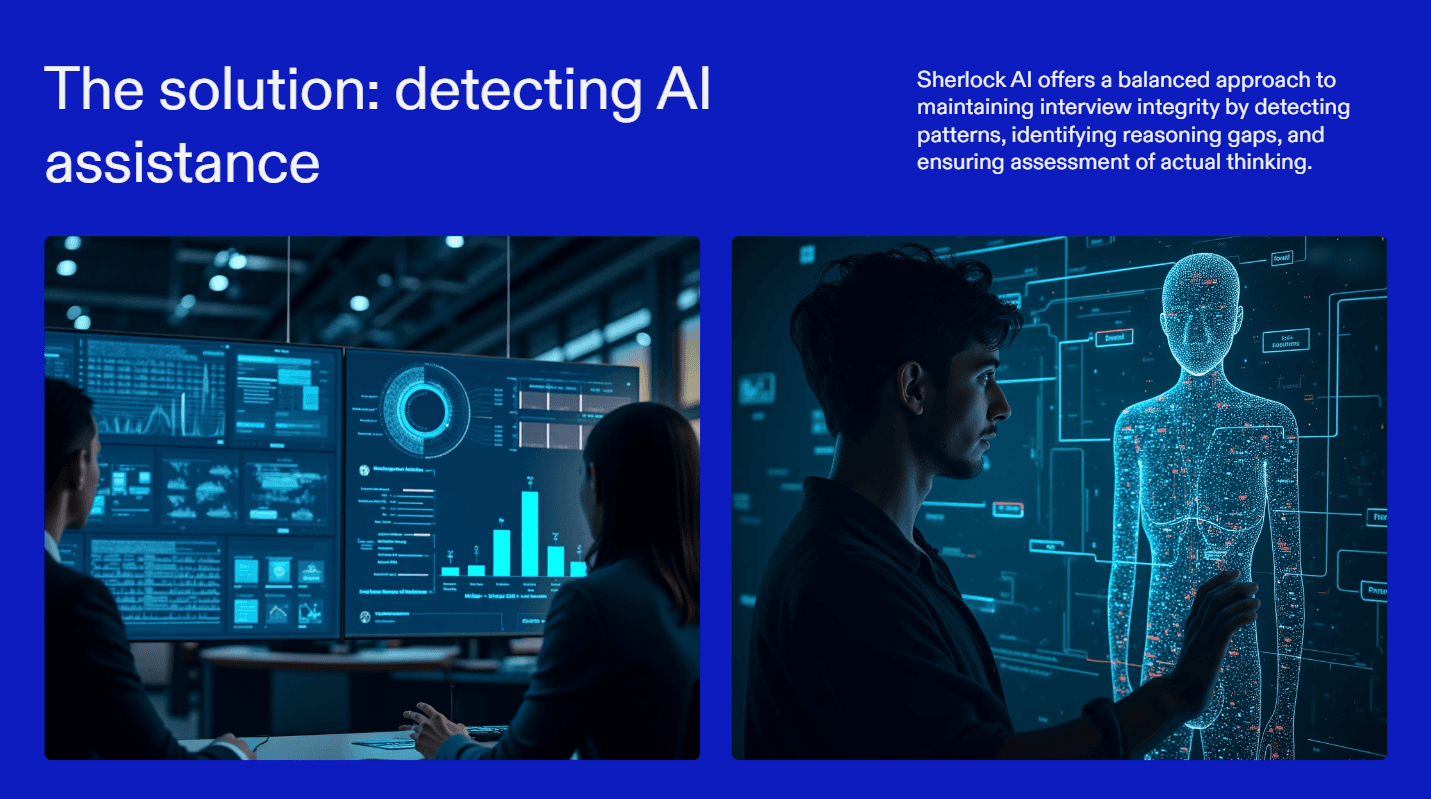
Sherlock AI uses behavior‑based detection approach to spot when candidates are relying on live AI assistance like Cluely in interviews. Instead of surface checks or simple rule triggers, it analyzes patterns that indicate unnatural interaction, AI dependence, or external assistance, even if the candidate tries to hide it.

1. Observing Real-Time Behavior
Sherlock AI monitors multiple signals simultaneously to see how candidates respond during the interview:
Pauses, timing, and speech rhythm
Voice patterns and fluency
Subtle behavioral cues such as eye movement and micro-pauses
Why it matters: Cluely-generated answers often show unnatural pacing or timing inconsistencies. Real human reasoning is rarely perfectly uniform under pressure.
2. Analyzing Interaction Patterns
Sherlock looks beyond the words to how candidates engage:
Changes in response speed when questions shift
Overly smooth or rehearsed speech patterns
Discrepancies between the candidate’s behavior and the expected flow of conversation
Why it matters: Candidates using Cluely may respond too quickly or too confidently to complex questions. Sherlock flags these patterns to highlight potential AI assistance.
3. Checking Continuity and Ownership
Sherlock verifies that the same person is consistently providing answers throughout the interview:
Compares behavioral patterns from start to finish
Looks for signs of off-camera prompts or proxy assistance
Confirms that reasoning is internally consistent across questions
Why it matters: Cluely can supply answers, but it cannot replicate the candidate’s personal judgment or continuous behavior. Discrepancies reveal potential external help.
4. Detecting Anomalies in Reasoning
Instead of relying on simple rules, Sherlock examines reasoning patterns:
Consistency of logic across different questions
Depth and structure of decision-making explanations
Repetition or formulaic responses that don’t match real human thinking
Why it matters: AI-generated answers may appear polished but often lack the natural variation of genuine reasoning. Sherlock highlights these anomalies.
5. Providing Contextual Insights in Real Time
Sherlock gives interviewers actionable signals, not accusations:
Flags potential AI-assisted answers during the conversation
Highlights areas where reasoning or ownership may be weak
Helps interviewers ask follow-up questions to confirm true understanding
These signals also feed into structured, reviewable AI interview notes that help panels align, collaborate, and defend hiring decisions with confidence.
Why it matters: Immediate, context-driven insights allow interviewers to probe further and make better decisions, rather than relying on gut feeling or retroactive review.
Key Takeaway: Sherlock AI does not replace human judgment. It amplifies visibility into reasoning, ownership, and consistency, exposing when polished answers may be AI-assisted. This allows teams to focus on real thinking and decision-making, even in interviews increasingly influenced by tools like Cluely.
Rethinking Interview Fairness in the Age of Live AI
Live AI tools like Cluely are changing interviews. Answers that sound confident and polished may no longer reflect the candidate’s true reasoning. This puts fairness and trust in the hiring process at risk.
Traditional interviews often reward delivery over decision-making. That means strong candidates who rely on AI can appear better than they are, while honest candidates may be undervalued. The result: costly hiring mistakes and lost trust in the process.
To maintain fairness, interviews must focus on what AI cannot replicate:
Personal ownership of decisions
Real-time reasoning under pressure
Adaptability when situations change
Consistent logic across questions
Sherlock AI helps hiring teams detect Cluely assistance without accusations. It highlights reasoning gaps, ownership inconsistencies, and unusual interaction patterns, ensuring interviews measure actual thinking, not AI polish.