Back to all blogs
Explore how Sherlock AI detects AI interview cheating, deepfake impersonation, and voice cloning threats that traditional monitoring tools fail to identify.
Abhishek Kaushik
Feb 10, 2026
Remote hiring has transformed how companies access talent, but it has also exposed a major weakness in traditional interview monitoring methods. As AI tools like interview sidekicks, real-time answer generation, deepfake video, and voice cloning become widely available, legacy interview supervision can no longer guarantee interview integrity.
According to surveys- 59% of employers suspect candidates are using AI or deceptive tactics to misrepresent themselves during the hiring process, and only 19% feel confident they can detect fraudulent applicants with their current tools. Study highlights, during video interviews, job seekers report receiving answers via text (44%), being fed answers from someone present during the virtual interview (44%), lying about their background or experience (63%), and having someone else complete the entire interview (15%).
This is where platforms like Sherlock AI redefine how interviews are protected.
In this article, we compare Sherlock AI vs traditional interview monitoring, explain why old approaches are failing, and show how modern interview integrity requires autonomous AI, not human observation.
What Is Sherlock AI?
Sherlock AI is an interview integrity platform built specifically to combat AI-driven hiring fraud.
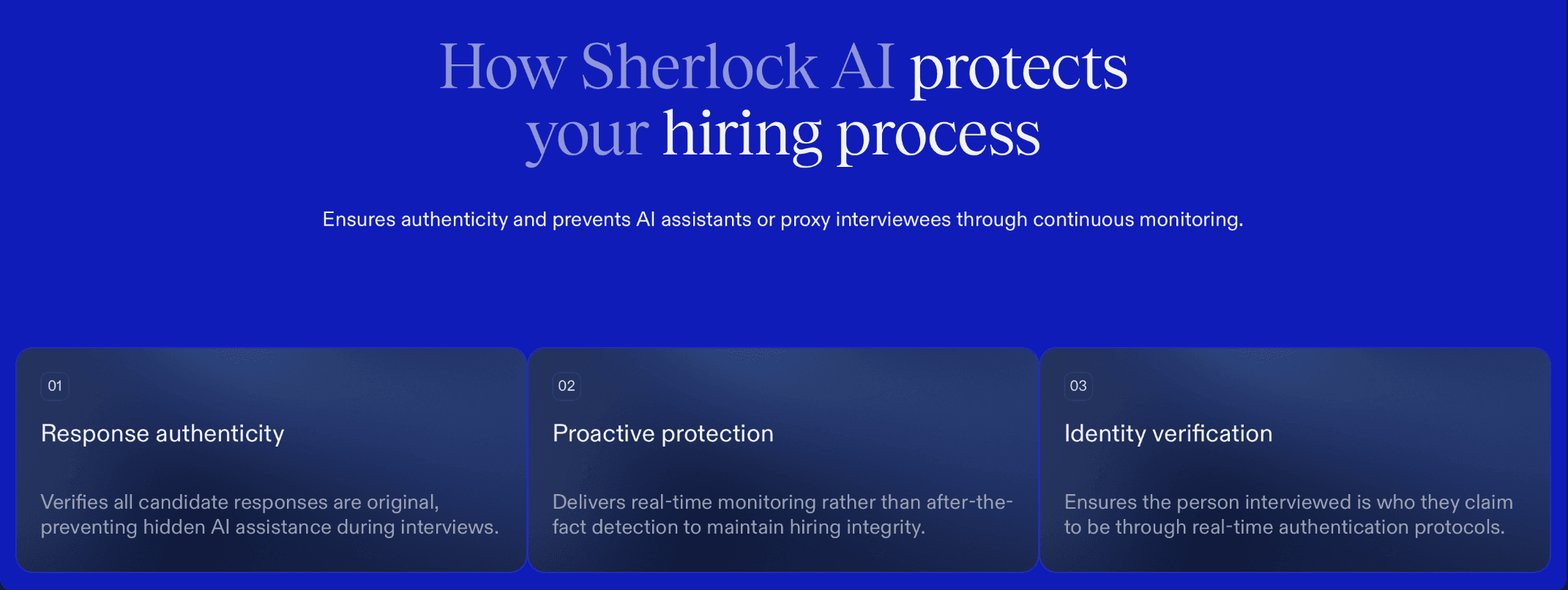
Unlike traditional monitoring, Sherlock AI uses autonomous intelligence that continuously verifies:
Who the candidate is
Whether responses are genuine
Whether external assistance or impersonation is occurring
Sherlock AI operates during the interview, not after it.
What Is Traditional Interview Monitoring?
Traditional interview monitoring refers to manual or rule-based methods used to supervise interviews. These approaches were designed for a pre-AI world and typically include:
Human interviewers observing candidates on video calls
Basic webcam or screen recording tools
Browser restrictions or tab-switch detection
Interview proctoring checklists
Post-interview reviews or audits
These methods assume that cheating or impersonation is visible, obvious, and static. That assumption no longer holds.
The New Threat Landscape Traditional Monitoring Cannot Handle
Modern interview fraud is no longer manual, obvious, or static. It is AI-powered, adaptive, and designed to operate in real time without leaving visible traces. Traditional interview monitoring tools were built to catch rule violations. Today’s fraud techniques are engineered to look natural, human, and compliant.
Recruiters now face a fundamentally different risk environment.
1. Interview Sidekick and Real-Time AI Coaching Tools
AI interview sidekicks provide candidates with instant prompts, structured answers, coding logic, and behavioral responses while the interview is happening. These tools do not require screen sharing or obvious browser activity. Many operate through:
Secondary devices placed outside the webcam view
Earbuds or bone-conduction audio
Background mobile apps synchronized with the interview
Off-screen AI copilots responding in milliseconds
Traditional monitoring relies on visible cues like eye movement, tab switching, or screen recording. AI coaching tools are built specifically to bypass these signals. As a result, candidates appear confident, fluent, and well-prepared, even when the responses are not their own.
To an interviewer, the performance looks legitimate. To traditional monitoring tools, nothing looks wrong.
2. Voice Cloning and AI Voice Assistance
Voice-based fraud has advanced far beyond prerecorded audio.
Modern AI voice systems can now:
Clone a person’s voice using minimal sample data
Generate natural speech with correct pacing, tone, and emotion
Respond dynamically to questions in real time
Mask latency and artifacts that older detection methods relied on
In some cases, candidates use AI voice enhancement tools that subtly modify or assist speech without fully replacing it. This makes detection nearly impossible through human listening or basic audio checks.
Traditional monitoring tools treat voice as trusted input. They lack the ability to analyze vocal fingerprints, response timing anomalies, or synthesized speech markers. As a result, AI-generated or assisted speech passes as human conversation.
3. Deepfake Video Impersonation
Live deepfake technology has evolved to the point where real-time facial substitution is stable, expressive, and responsive. These are not prerecorded videos. They are live overlays that track facial movement, eye contact, and expressions with high accuracy.
This enables scenarios such as:
One person speaking while another person’s face appears on screen
Identity switching between interview stages
High-skill proxies appearing as the actual candidate
Stolen or purchased identities being reused across interviews
Traditional interview monitoring assumes that webcam presence equals identity verification. But webcams only confirm that a face is present, not whose face it is or whether it is authentic.
Without continuous identity validation and deepfake detection, impersonation goes completely unnoticed.
4. Proxy Interviewing and Identity Substitution
Proxy interviewing is no longer limited to obvious handoffs or awkward transitions. With AI assistance, proxy candidates can now:
Maintain consistent behavior across long interviews
Use AI tools to simulate the original candidate’s background
Pass technical and behavioral rounds without suspicion
Hand off post-hire responsibilities to the real candidate
Traditional monitoring does not track identity continuity across interview rounds. It does not verify that the same individual appears in screening, technical, and final interviews.
As long as the interview session looks normal, the system assumes authenticity.
Why Traditional Monitoring Cannot Adapt
The core limitation of traditional interview monitoring is that it is surface-level and reactive.
It looks for rule violations instead of intent
It checks compliance instead of authenticity
It relies on static signals in a dynamic threat environment
It assumes humans can visually detect AI-driven behavior
Modern interview fraud operates below the surface, blending into natural human interaction. By the time anomalies are noticed, the damage is already done.
How Sherlock AI Detects What Traditional Tools Miss
Traditional interview monitoring tools record what happens. Sherlock AI interprets what happens.
Sherlock AI is purpose-built to tackle the new wave of interview cheating powered by artificial intelligence. As candidates gain access to real-time coaching tools, deepfake technology, and voice synthesis, protecting hiring integrity requires more than observation. It requires intelligent, continuous analysis.
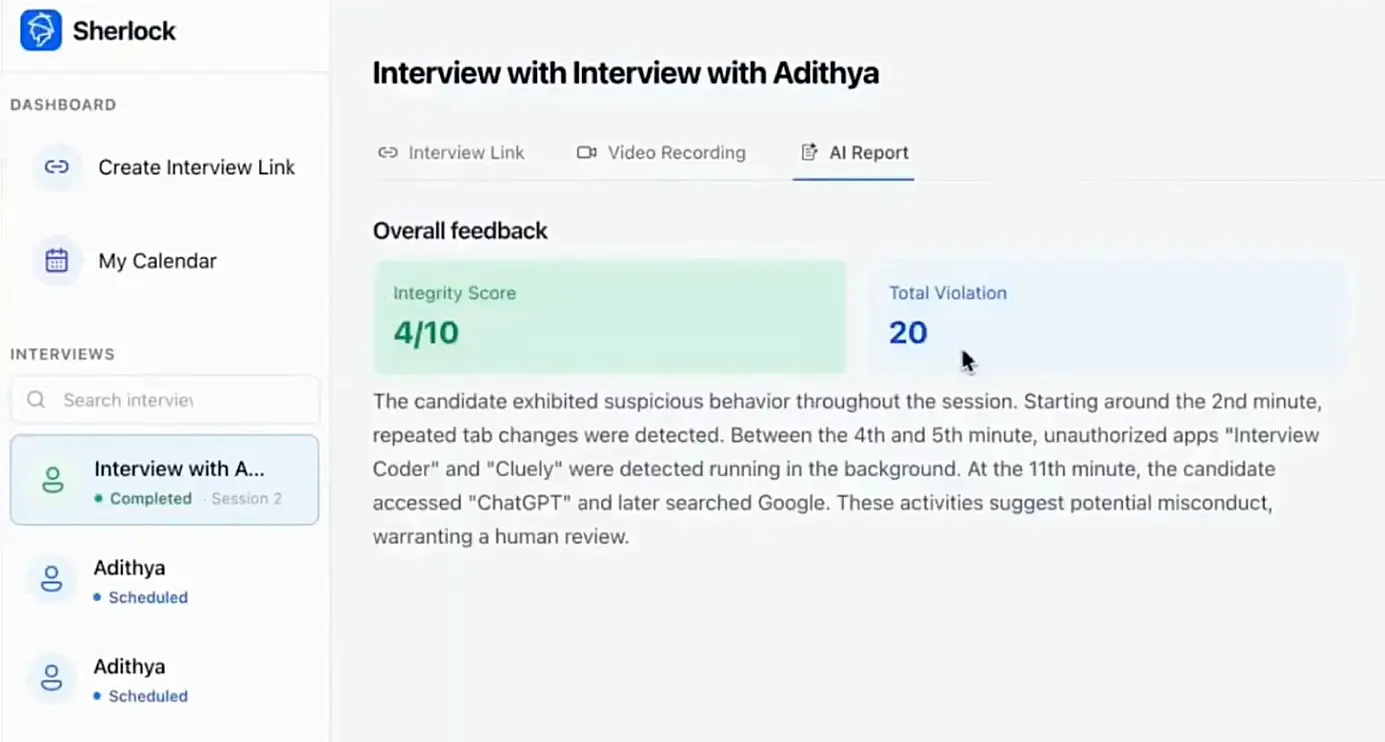
Sherlock AI combines real-time monitoring with advanced behavioral and media forensics to uncover signals that human interviewers and legacy systems simply cannot detect. It surfaces hidden AI assistance, synthetic speech, identity manipulation, and other integrity risks as they happen, not after the damage is done.
Core Capabilities of Sherlock AI
Real-time interview protection
Sherlock AI monitors interviews live to identify AI sidekick usage, deepfake impersonation, and off-screen assistance. Suspicious signals are detected during the conversation, allowing teams to act immediately.Behavioral intelligence analysis
The system evaluates how answers are formed, not just what is said. It flags unnatural response timing, overly structured answers, and inconsistencies between claimed experience and demonstrated knowledge.Advanced voice and video verification
Sherlock AI analyzes vocal patterns, speech dynamics, facial consistency, and visual artifacts to detect synthetic voices, altered speech, and manipulated video streams.Hidden tool and environment awareness
Beyond the visible screen, Sherlock AI identifies signs of background AI tools, secondary devices, or unauthorized digital assistance that traditional monitoring cannot see.Clear, recruiter-ready reporting
After each interview, hiring teams receive structured integrity insights, risk indicators, and supporting evidence. This makes decision-making more confident, consistent, and defensible.
Sherlock AI does not replace recruiters or interviewers. Instead, it strengthens their ability to evaluate candidates fairly by ensuring the person being assessed is authentic and unaided. The result is a hiring process built on trust, verified skill, and real human capability.
Sherlock AI vs Traditional Interview Monitoring
Capability | Traditional Monitoring | Sherlock AI |
|---|---|---|
Real-time fraud detection | Limited or none | Yes |
AI sidekick detection | No | Yes |
Deepfake video detection | No | Yes |
Voice cloning detection | No | Yes |
Proxy interview detection | Rarely | Yes |
Identity continuity checks | No | Yes |
Autonomous decision making | No | Yes |
Scales across interviews | Poorly | Easily |
Why Real-Time Detection Matters
Post-interview audits only tell you that something went wrong. They do not prevent the wrong hire.
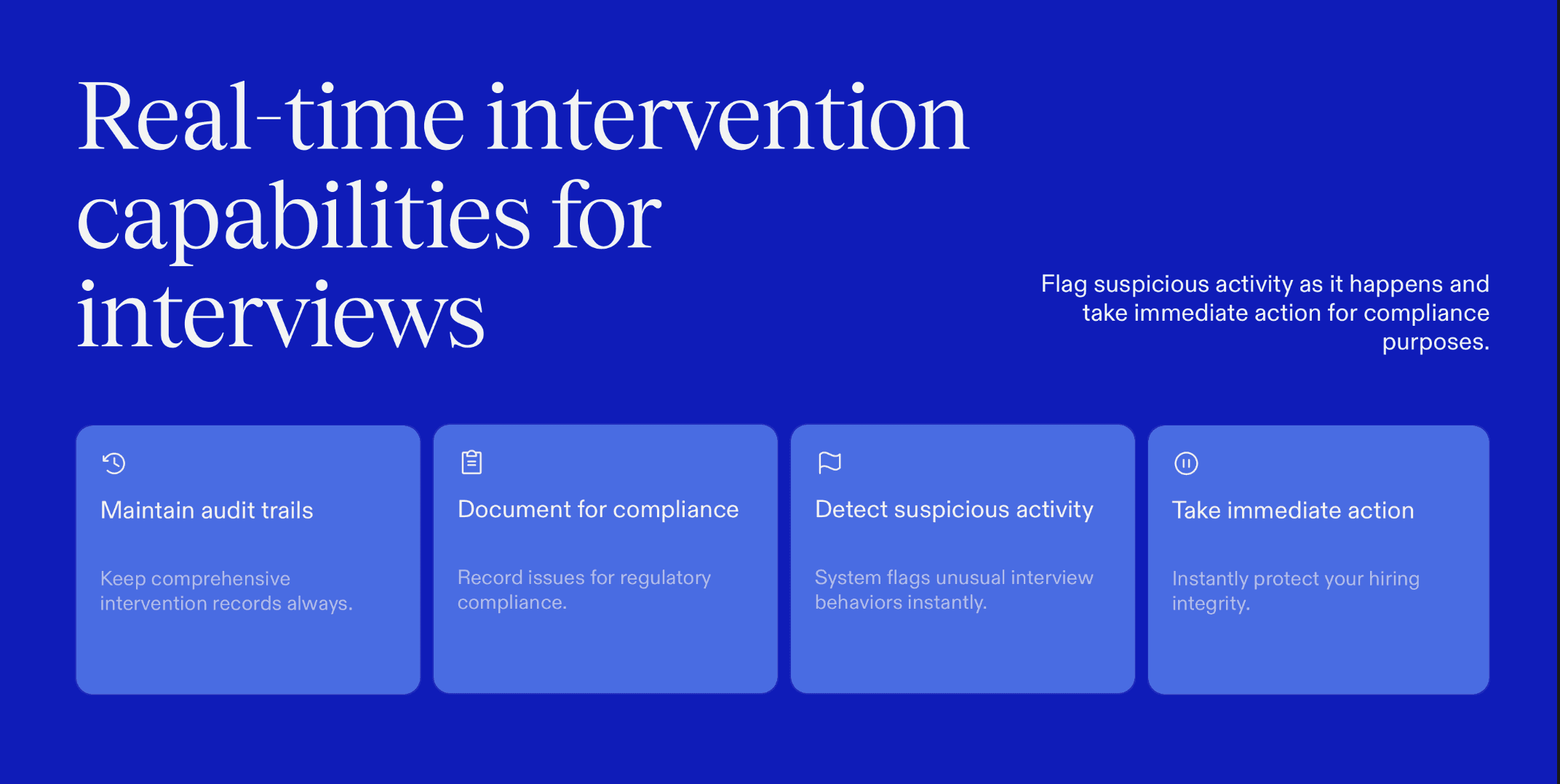
Sherlock AI intervenes during the interview, enabling hiring teams to:
Flag suspicious sessions instantly
Pause or invalidate compromised interviews
Maintain compliance and audit trails
Protect hiring credibility
Traditional monitoring simply does not operate at this level.
Final Thoughts
Traditional interview monitoring belongs to an earlier era of hiring. Today’s threats are real time, adaptive, and powered by artificial intelligence.
Sherlock AI vs traditional interview monitoring is not an upgrade comparison. It is a paradigm shift.
If interview integrity matters to your organization, relying on human observation and static rules is no longer enough.
Sherlock AI ensures that the person you interview is the person you hire, every time.