Back to all blogs
Deepfake voices are disrupting hiring. Learn real risks, red flags, detection methods, and how HR teams can protect interviews from AI-generated voice fraud.

Abhishek Kaushik
Nov 27, 2025
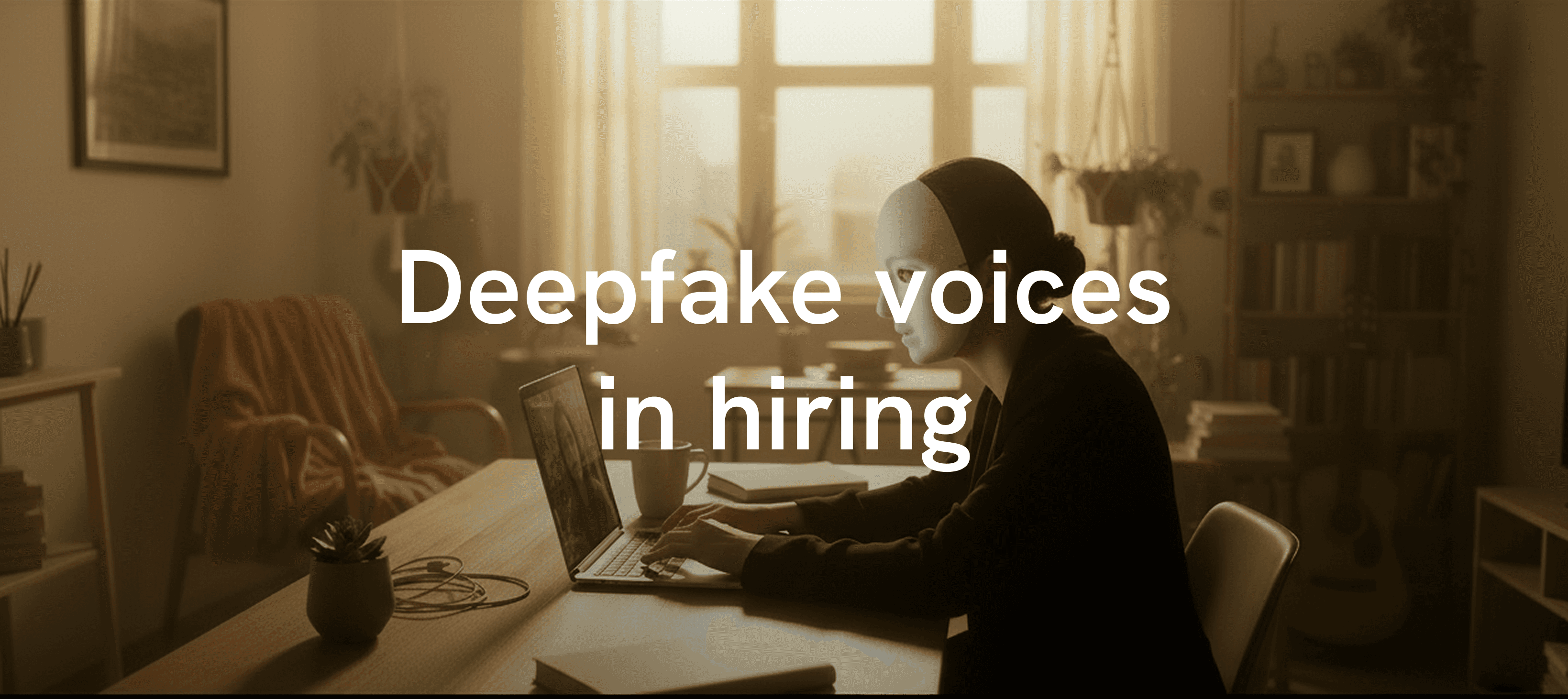
Voice cloning models can now produce real-time speech that matches tone, pacing, accent, and emotional modulation. This technology was first used for accessibility applications and media dubbing. It is now being used to impersonate candidates during interviews, enabling someone else to answer while sounding like the applicant.
The concern is not just impersonation. Voice cloning can mask hesitation, smooth out struggling phrasing, and create the appearance of confidence or fluency that does not match actual skill.
Security researchers in early 2025 demonstrated real-time voice cloning pipelines that require only 20 to 40 seconds of reference audio to generate convincing live speech.
How Deepfake Voices Appear in Interviews
Most deepfake voice usage follows these patterns:
Real candidate present, but speech masked to hide discomfort or language proficiency gaps.
Proxy candidate speaking, but voice cloned to resemble the original applicant.
Text-to-speech answer relay, where typed or whispered suggestions are instantly converted into speech.
These workflows are increasingly accessible through consumer-level tools.
Why Visual Identity Checks Are Not Enough
If a platform verifies only camera presence and not speech-behavior identity, a deepfake voice can pass without friction.
This is why interview intelligence tools now analyze:
Response timing
Latency in conversational turn-taking
Phonetic micro-variation
Stress-induced cadence changes
Ability to re-explain concepts in new framing
Real reasoning exhibits variation. Deepfake relay systems often cannot adapt to unpredictable follow-ups.
Linguistic variability under conceptual constraint is a strong indicator of real cognitive authorship.
How Platforms Like Sherlock AI Respond
Sherlock AI does not attempt to “recognize” voices. Instead, it verifies thinking and authorship:
Check Type | What It Detects |
|---|---|
Reasoning continuity | Whether explanations match the candidate’s stated background |
Fluency variation | Whether speech adjusts when context shifts |
Concept re-anchoring | Ability to rebuild explanations in different language |
Reverse reasoning | Ability to explain decisions backward |
This approach remains fair to neurodivergent and multilingual candidates because it focuses on thought, not accent, tone, or confidence.
Audit Log Field Guide
What Hiring Leaders, Security Teams, and Legal Must Be Able to Trace
Interview platforms generate sensitive data. To maintain trust, legal defensibility, and internal accountability, the platform must provide audit logs that trace how data was accessed and how decisions were made.
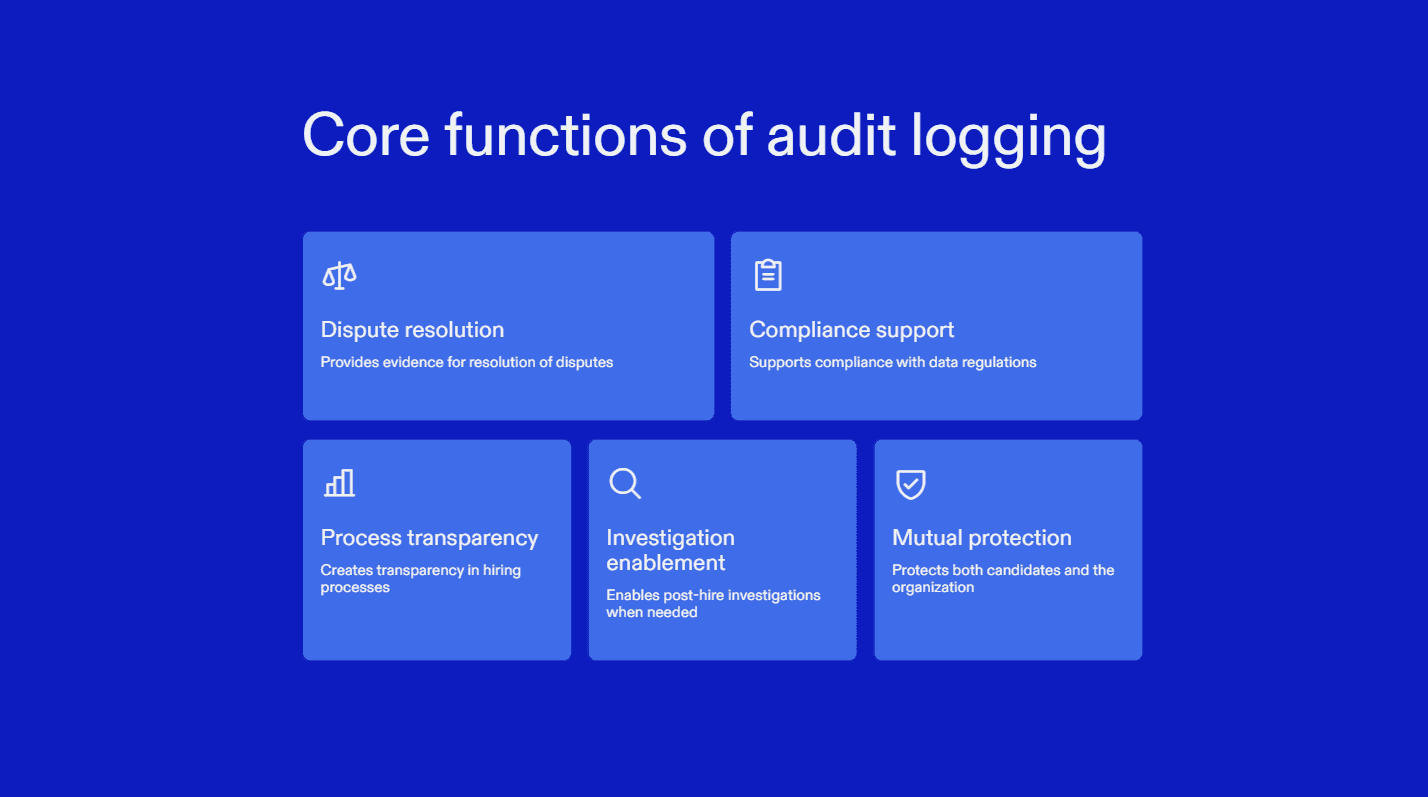
Audit logs are not for monitoring employees. They exist to support compliance, post-hire investigations, and dispute resolution.
What an Audit Log Must Record
Action | Why It Matters |
|---|---|
Who accessed an interview recording | Prevents unauthorized viewing |
Which notes were generated and when | Supports decision transparency |
Edits to scorecards or comments | Ensures evaluations reflect real-time judgment, not retrospection |
Exports or downloads | Tracks external data movement |
Permission changes | Prevents hidden privilege escalation |
In multiple employment dispute cases from 2024 and 2025, lack of audit trails made hiring decisions legally indefensible.
Audit Log Format Requirements
Audit logs should contain:
Timestamp
Actor identity (mapped to SSO user)
Object affected (interview, scorecard, export event)
What changed
Previous value (if applicable)
IP or session metadata
This allows legal and compliance teams to reconstruct decision progression without guesswork.
How Sherlock AI Handles Audit Logging
Sherlock AI logs:
Every access of interview summaries, notes, and recordings
Scorecard submissions and revisions
Export and share actions
Role or permission updates
Retention policy edits
Logs are retained in secure, hashed storage and can be exported to SIEM tools.
This supports:
SOC2 Type II controls
GDPR access accountability
Internal compliance reviews
External audits
Closing Insight
Both topics come down to one principle:
Hiring must measure real skill, expressed by the real candidate, recorded in a traceable and defensible way.
Deepfake voices test identity. Audit logs protect trust.
Sherlock AI’s advantage is that it reinforces authentic thinking and documented fairness simultaneously.