Back to all blogs
Explore everything you need to know about remote proctoring, how it works, and how it ensures secure, cheat-proof online exams. Learn about its types and key features.
Abhishek Kaushik
May 18, 2026
Remote work and online education have completely transformed how assessments are conducted. From university exams to technical hiring interviews, everything is now happening online. While this shift has made assessments more accessible and scalable, it has also introduced serious challenges around credibility, fairness, and cheating. Large-scale analysis found that 6.6% of online exams had confirmed cheating incidents, which is 14 times higher than pre-pandemic levels.
Without proper monitoring, online exams can be vulnerable to impersonation, external assistance, and even the use of advanced AI tools. This makes it difficult for organizations to trust the results and confidently evaluate candidates.
A large-scale review found that 54.7% of students admitted cheating in online exams, compared to 29.9% before the pandemic.
Remote proctoring solves this problem by creating a secure and controlled virtual testing environment. Using technologies like video monitoring, screen tracking, and artificial intelligence, it ensures that candidates follow the rules and complete assessments honestly.
Today, remote proctoring is not just a support tool but a critical component for any organization conducting online exams, certifications, or hiring processes at scale. As digital assessments continue to grow, the demand for accurate, scalable, and intelligent proctoring solutions is also increasing rapidly.
What is Remote Proctoring?
Remote proctoring is a technology-driven method used to monitor candidates during online exams or assessments to ensure fairness, authenticity, and integrity.
It enables candidates to take exams from any location while being supervised through a combination of video monitoring, audio tracking, screen recording, and artificial intelligence. This setup recreates a controlled exam environment without requiring a physical test center.
Unlike traditional invigilation, remote proctoring not only observes candidates but also analyzes their behavior. It can detect patterns such as unusual eye movement, background disturbances, multiple faces, or attempts to access unauthorized resources.
This makes remote proctoring a critical solution for organizations that want to scale online assessments without compromising trust.
Key Features of Remote Proctoring
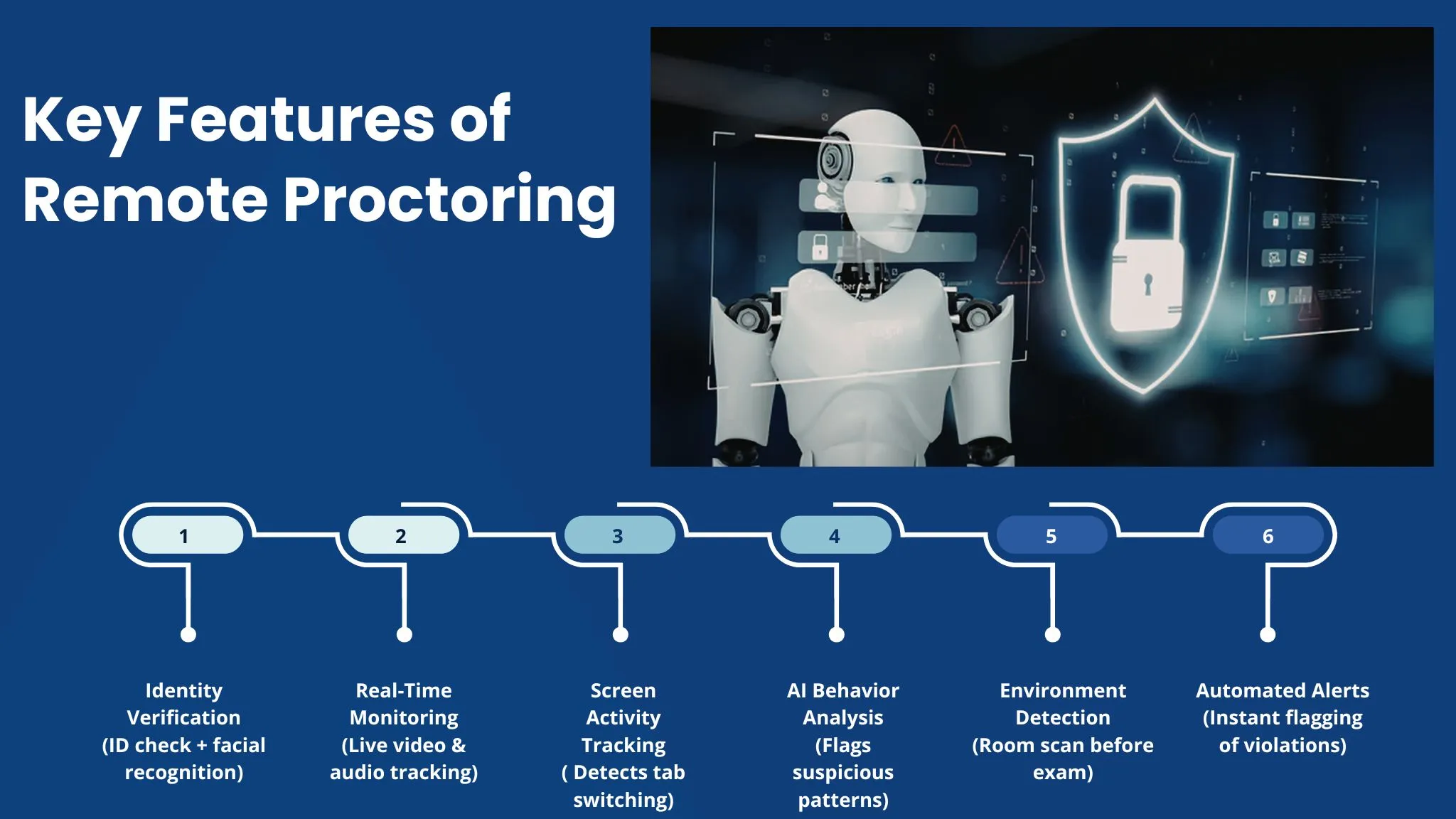
Remote proctoring combines multiple technologies and capabilities to ensure secure, fair, and scalable online assessments. These features work together to create a controlled testing environment similar to traditional exam settings.
Identity Verification: Remote proctoring systems use advanced methods like government ID checks, facial recognition, and liveness detection to ensure that the right candidate is taking the exam, preventing impersonation.
Real-Time Monitoring: Continuous monitoring through webcam and microphone allows proctors or AI systems to track candidate behavior and detect suspicious activities during the exam.
Screen Activity Tracking: The system monitors on-screen actions such as tab switching, copy-paste attempts, and access to unauthorized applications to ensure exam compliance.
AI-Based Behavior Analysis: Artificial intelligence analyzes patterns like eye movement, head position, and response behavior to identify anomalies and flag potential cheating attempts.
Environment Detection: Candidates are required to scan their surroundings before the exam to ensure no unauthorized materials, devices, or individuals are present, maintaining a controlled testing environment.
Automated Flagging and Alerts: The system automatically detects and flags suspicious activities in real time, helping organizations quickly identify and review potential violations.
What are the Different Types of Remote Proctoring?
Remote proctoring can be implemented in different ways depending on the level of security, scalability, and human involvement required. Each type is designed to meet specific assessment needs.
1. Live Online Proctoring
Live online proctoring involves a human proctor monitoring candidates in real time through webcam and audio feeds. The proctor observes the candidate throughout the exam and can immediately intervene if any suspicious behavior is detected. This may include issuing warnings, asking for additional environment checks, or pausing or terminating the exam.
This method closely replicates a traditional exam environment, where an invigilator actively supervises candidates to ensure compliance with rules.
Key Points
Real-time monitoring by a human proctor
Immediate intervention in case of suspicious activity
High level of control and accuracy
Suitable for high-stakes exams
Requires more resources and scheduling
Live online proctoring is ideal for critical assessments where strict supervision and instant action are necessary to maintain exam integrity.
2. Record and Review Proctoring
Record and review proctoring captures the entire exam session, including video, audio, and screen activity, which is later reviewed by human proctors. AI systems may flag suspicious segments, allowing reviewers to focus only on important moments instead of analyzing the full recording.
This method provides flexibility, as the review process can be done after the exam without requiring real-time monitoring.
Key Points
Exam sessions are recorded for later review
AI flags suspicious activities for faster evaluation
No need for live monitoring
More flexible and scalable than live proctoring
Results may be delayed due to manual review
Record and review proctoring offers a balance between flexibility and human validation, making it suitable for medium-scale assessments.
3. Automated Proctoring
Automated proctoring uses artificial intelligence to monitor and evaluate candidates without human involvement. The system analyzes multiple data points such as eye movement, head position, screen activity, and background noise to detect suspicious behavior.
It automatically flags actions like tab switching, looking away frequently, or unusual audio patterns, making it a highly scalable solution for large-scale exams.
Key Points
Fully AI-driven monitoring system
Detects behavior using predefined rules and patterns
Highly scalable for large candidate volumes
Cost-effective compared to human proctoring
May generate false positives if not optimized
Automated proctoring is best for large-scale assessments where efficiency, speed, and cost savings are the top priorities.
4. AI-Powered Remote Proctoring
AI-powered remote proctoring is the most advanced form of proctoring that goes beyond basic automation. It combines multiple signals such as behavioral patterns, communication cues, environmental context, and system-level activity to detect complex cheating methods.
Unlike traditional systems, it understands intent rather than just actions. It can identify impersonation, coordinated cheating, and even the use of real-time AI tools during exams or interviews.
This approach is especially valuable in modern hiring environments where candidates may use advanced tools to bypass traditional monitoring systems.
Key Points
Multi-signal analysis for deeper insights
Detects advanced cheating methods and hidden assistance
Identifies use of AI tools during assessments
Reduces false positives with contextual understanding
Scalable and highly accurate
AI-powered remote proctoring is the most reliable and future-ready solution, offering advanced intelligence and accuracy for modern assessment needs.
Read More: Top 10 AI Tools that Detect Cheating in Live Interviews
What is the Importance of Remote Proctoring?
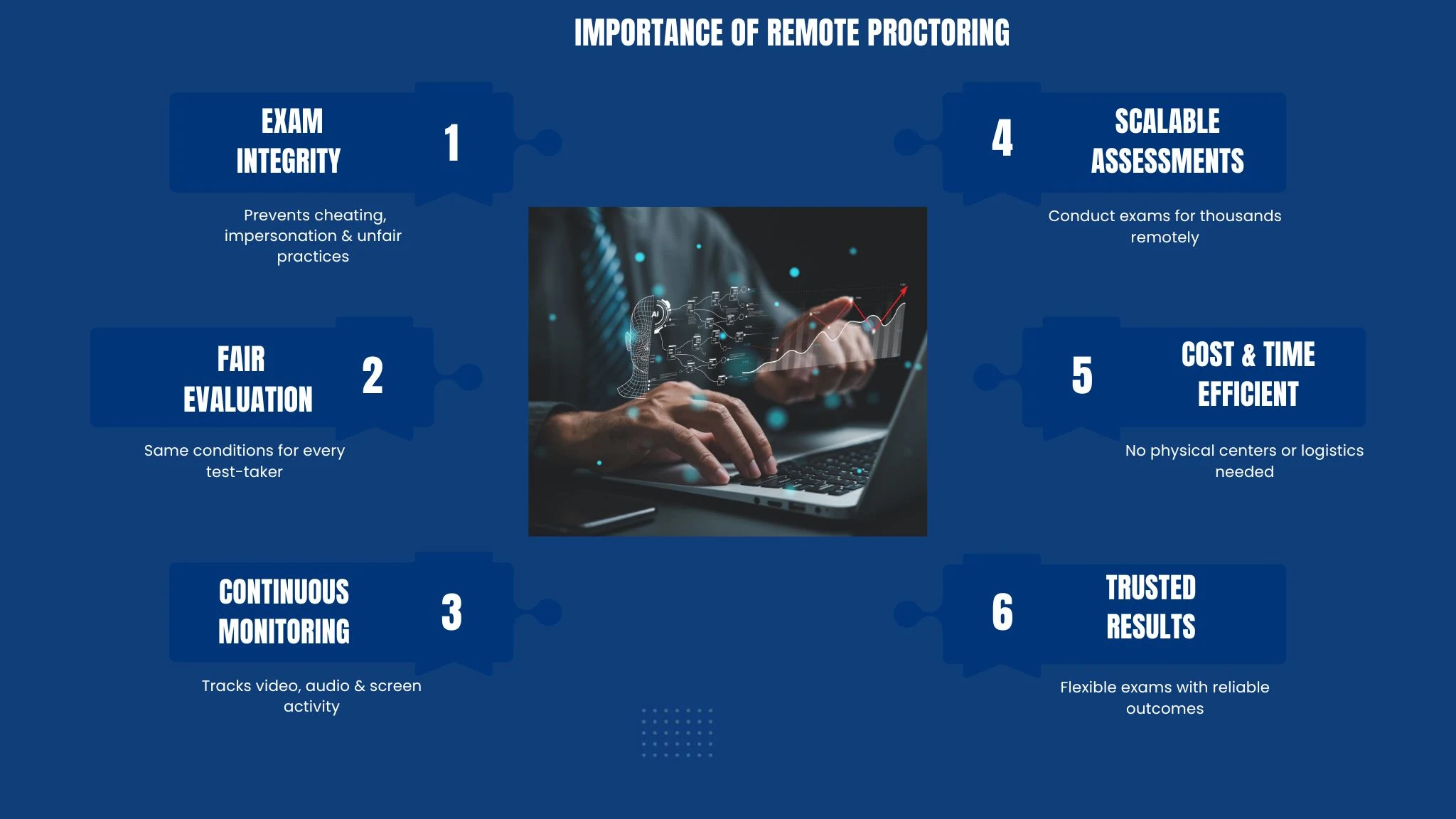
As assessments move online, maintaining trust and fairness becomes a major challenge. Without proper monitoring, online exams are vulnerable to cheating, impersonation, and external assistance. Remote proctoring plays a critical role in solving these challenges by creating a secure and controlled testing environment.
Ensures Fairness and Prevents Cheating
One of the primary reasons organizations adopt remote proctoring is to maintain exam integrity. It helps detect and prevent unfair practices such as impersonation, use of unauthorized resources, or receiving external help during the exam.
By continuously monitoring candidates through video, audio, and screen activity, remote proctoring ensures that every candidate is evaluated under the same conditions. This creates a level playing field and improves the credibility of results.
Enables Scalable Assessments
Conducting exams for a large number of candidates can be challenging with traditional methods. Remote proctoring removes this limitation by allowing organizations to conduct assessments at scale without the need for physical test centers.
Whether it is a university exam or a hiring assessment, thousands of candidates can be monitored simultaneously using AI-driven systems, making the process efficient and scalable.
Reduces Costs and Operational Effort
Traditional exam setups require physical infrastructure, invigilators, and logistics management, all of which can be expensive and time-consuming. Remote proctoring eliminates these requirements by digitizing the entire process.
Organizations can significantly reduce costs related to venues, staffing, and administration while still maintaining high levels of security and monitoring.
Improves Accessibility for Candidates
Remote proctoring makes it easier for candidates to participate in exams from any location. This is especially beneficial for remote learners, working professionals, and international candidates who may not have access to physical test centers.
It also provides flexibility in scheduling, allowing candidates to take exams at convenient times without compromising security.
Builds Trust in Assessment Results
For both organizations and institutions, the reliability of assessment results is crucial. Remote proctoring ensures that results accurately reflect a candidate’s performance by minimizing the chances of malpractice.
This builds confidence among employers, educators, and stakeholders, making the evaluation process more trustworthy and transparent.
Supports Modern Hiring and Online Education
With the rise of remote work and digital learning, traditional methods of conducting exams are no longer sufficient. Remote proctoring supports modern workflows by enabling secure online assessments, virtual interviews, and certification programs.
It integrates seamlessly with digital platforms, making it an essential tool for organizations adapting to a remote-first environment.
Overall, remote proctoring is not just a monitoring tool but a foundational technology that ensures fairness, scalability, and trust in today’s digital assessment landscape.
How Does Remote Proctoring Work?
Remote proctoring works by combining identity verification, environment checks, continuous monitoring, and intelligent analysis to ensure that candidates complete online exams fairly and without external assistance.
Here is a step-by-step breakdown of how the process works:
1. Candidate Authentication
The process begins with verifying the identity of the candidate.
Candidates are required to upload a government-issued ID, which is matched with their live image using facial recognition. Advanced systems also use liveness detection to ensure that the person is physically present and not using a photo or pre-recorded video.
Some platforms continue to verify identity throughout the exam to prevent impersonation at any stage.
2. Environment and System Check
Before the exam starts, candidates must show their surroundings using their webcam.
This includes scanning the room, desk, and workspace to confirm that no unauthorized materials or devices are present. At the same time, the system checks the candidate’s device for restricted applications, multiple screens, or virtual machines.
In many cases, a secure browser is used to block tab switching and restrict access to external websites.
3. Real-Time Monitoring
During the exam, the system continuously monitors the candidate using multiple inputs.
The webcam tracks facial expressions, eye movement, and head position. The microphone captures background sounds to detect conversations or external help. Screen activity is recorded to ensure that candidates are not switching tabs or accessing unauthorized resources.
This monitoring can be done by human proctors, AI systems, or a combination of both.
4. AI-Based Detection and Flagging
Artificial intelligence analyzes the collected data in real time to identify suspicious behavior.
It detects patterns such as frequent looking away from the screen, unusual pauses, multiple faces in the frame, or background voices. Each suspicious activity is flagged and categorized based on risk level.
Advanced systems can also detect more complex behaviors like hidden assistance or the use of external tools.
5. Reporting and Review
After the exam is completed, a detailed report is generated.
This report includes flagged events, timestamps, session recordings, and an overall integrity score. Human reviewers or automated systems evaluate these insights to determine whether any violations occurred.
Organizations can then make fair and informed decisions based on this data.
How Sherlock AI is Redefining Remote Proctoring
As online assessments evolve, traditional proctoring methods are no longer enough to detect sophisticated cheating techniques. Modern candidates can use hidden assistance, external collaboration, or even real-time AI tools to bypass basic monitoring systems.
This is where Sherlock AI stands out.
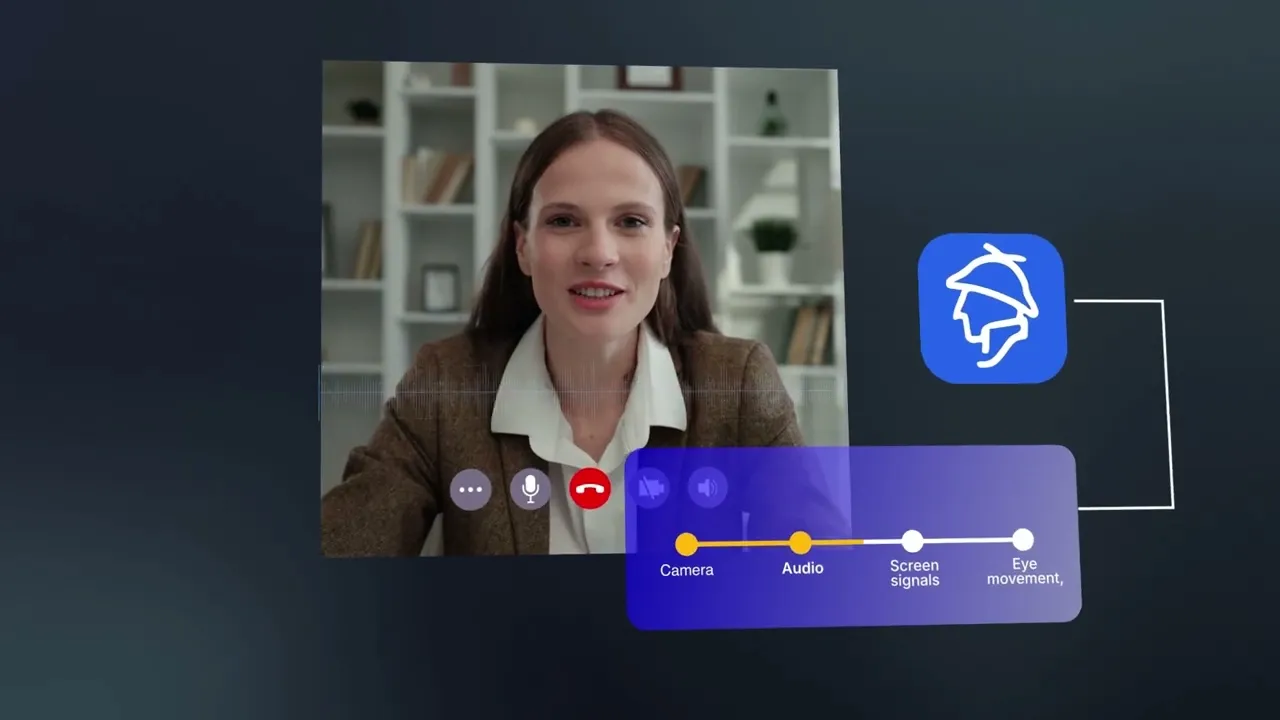
Sherlock AI goes beyond traditional remote proctoring by using multi-signal intelligence to detect not just actions, but intent. It combines behavioral analysis, communication signals, and system-level data to provide a deeper and more accurate understanding of candidate activity.
Key Features of Sherlock AI
Multi-signal fraud detection: Sherlock AI analyzes multiple data points such as behavioral patterns, environmental signals, and interaction cues to detect impersonation, hidden assistance, and suspicious activity with high accuracy.
Detection of AI copilots: Sherlock AI can identify the use of real-time AI tools such as Cluely and Parakeet AI during interviews and assessments, helping organizations prevent AI-assisted cheating.
Real-time interview monitoring: The platform continuously monitors candidates during live interviews without interrupting the experience, ensuring seamless yet secure evaluation.
Advanced behavioral intelligence: Sherlock AI tracks subtle indicators like hesitation patterns, response timing, and interaction inconsistencies to detect anomalies that traditional systems often miss.
System-level signal analysis: It monitors system activity to detect unauthorized tools, external devices, or hidden applications running in the background.
Accurate risk scoring and insights: Sherlock AI provides detailed reports with risk scores, flagged events, and actionable insights, enabling faster and more confident decision-making.
Why Sherlock AI is Better Than Traditional Proctoring Tools
Traditional proctoring tools often rely on surface-level monitoring, which can result in false positives or missed fraud signals. Sherlock AI takes a more intelligent approach by combining multiple signals and contextual analysis.
This results in:
Higher accuracy in fraud detection
Reduced false positives
Better candidate experience
Stronger trust in assessment outcomes
Future of Remote Proctoring
Remote proctoring is evolving quickly as online assessments become the standard across education and hiring. What began as basic video monitoring is now transforming into a more intelligent and data-driven approach to ensuring integrity.
In the coming years, remote proctoring will increasingly rely on AI-powered behavioral analysis to understand patterns, context, and intent. This will help reduce false positives while improving the accuracy of detecting genuine misconduct.
Another key development is the use of multi-signal intelligence. Modern systems will combine video, audio, screen activity, and system-level data to create a more complete and reliable view of candidate behavior during assessments.
As the use of AI tools grows, detecting AI-assisted cheating will become a major focus. Advanced platforms like Sherlock AI are already leading this shift by identifying the use of real-time AI copilots and hidden assistance during interviews.
There will also be a stronger emphasis on candidate experience, privacy, and transparency. Organizations will need to balance security with fairness by ensuring candidates are informed and comfortable with how monitoring is conducted.