
Back to all blogs
Explore the top remote hiring best practices in 2026, including virtual interviews, candidate verification, AI-powered recruitment security, onboarding strategies, and how Sherlock AI helps to prevent hiring fraud.

Abhishek Kaushik
Jun 29, 2026
Remote hiring is reshaping how organizations build teams in 2026. Businesses are no longer restricted by location when searching for skilled professionals. From startups to global enterprises, companies are adopting virtual recruitment strategies to attract candidates across different regions, time zones, and countries.
The rise of distributed workforces has significantly increased the demand for remote recruitment. According to a global study, over 35,000 remote employment contracts across 143 countries revealed continued expansion in cross-border hiring, particularly for technology, cybersecurity, AI, and digital operations roles.
Although remote recruitment opens access to a broader talent network, it also creates new operational and security challenges for recruiters. Hiring teams today must deal with fake identities, AI-assisted interview malpractice, proxy candidates, fabricated resumes, and skill misrepresentation during virtual assessments and online interviews.
Because of these risks, organizations are moving beyond traditional hiring workflows and investing in more secure recruitment frameworks. Modern remote hiring now requires structured interview processes, intelligent candidate screening, identity authentication, technical skill validation, and continuous interview monitoring to ensure recruitment accuracy.
In this guide, we will cover the most effective remote hiring best practices in 2026, including how to build a scalable recruitment strategy, improve virtual candidate evaluation, conduct secure remote interviews, streamline onboarding, and create a reliable global hiring process for long-term business growth.
Why Remote Hiring Is a Game-Changer for Business Growth
Why limit your hiring efforts to one city or region when skilled professionals are available worldwide? In 2026, remote hiring has become a powerful growth strategy for businesses looking to build scalable, flexible, and high-performing teams.
Relying only on local talent pools can slow down hiring and reduce access to specialized skills. Remote hiring allows organizations to connect with qualified candidates across different countries, industries, and time zones. The best candidate for a role may not always be located near your office, and modern businesses are increasingly recognizing the value of global recruitment.
Remote hiring also helps companies build more diverse teams with broader perspectives, stronger collaboration, and improved innovation. Businesses with distributed teams are often better equipped to adapt to changing market demands and support global operations more efficiently.
Beyond talent access, remote hiring can also reduce operational expenses related to office space, travel, relocation, and physical interview processes. Companies can instead invest in better hiring technologies, employee development, and workforce expansion.
Another major advantage is flexibility. Today’s professionals actively look for remote and flexible work opportunities, making remote hiring an important factor in attracting and retaining top talent. Candidates prefer organizations that offer convenient hiring experiences, virtual interviews, and location-independent work environments.
However, as remote recruitment grows, businesses must also address challenges such as candidate impersonation, proxy interviews, AI-assisted cheating, and hiring fraud. This is why organizations are increasingly adopting secure hiring technologies to strengthen candidate verification, interview integrity, and recruitment security in virtual hiring environments.
Remote Hiring Best Practices to Follow While Hiring Remotely
Remote hiring requires more than simply conducting interviews online. Companies need a structured approach that helps them attract qualified candidates, maintain hiring accuracy, improve candidate experience, and reduce recruitment risks in virtual environments.
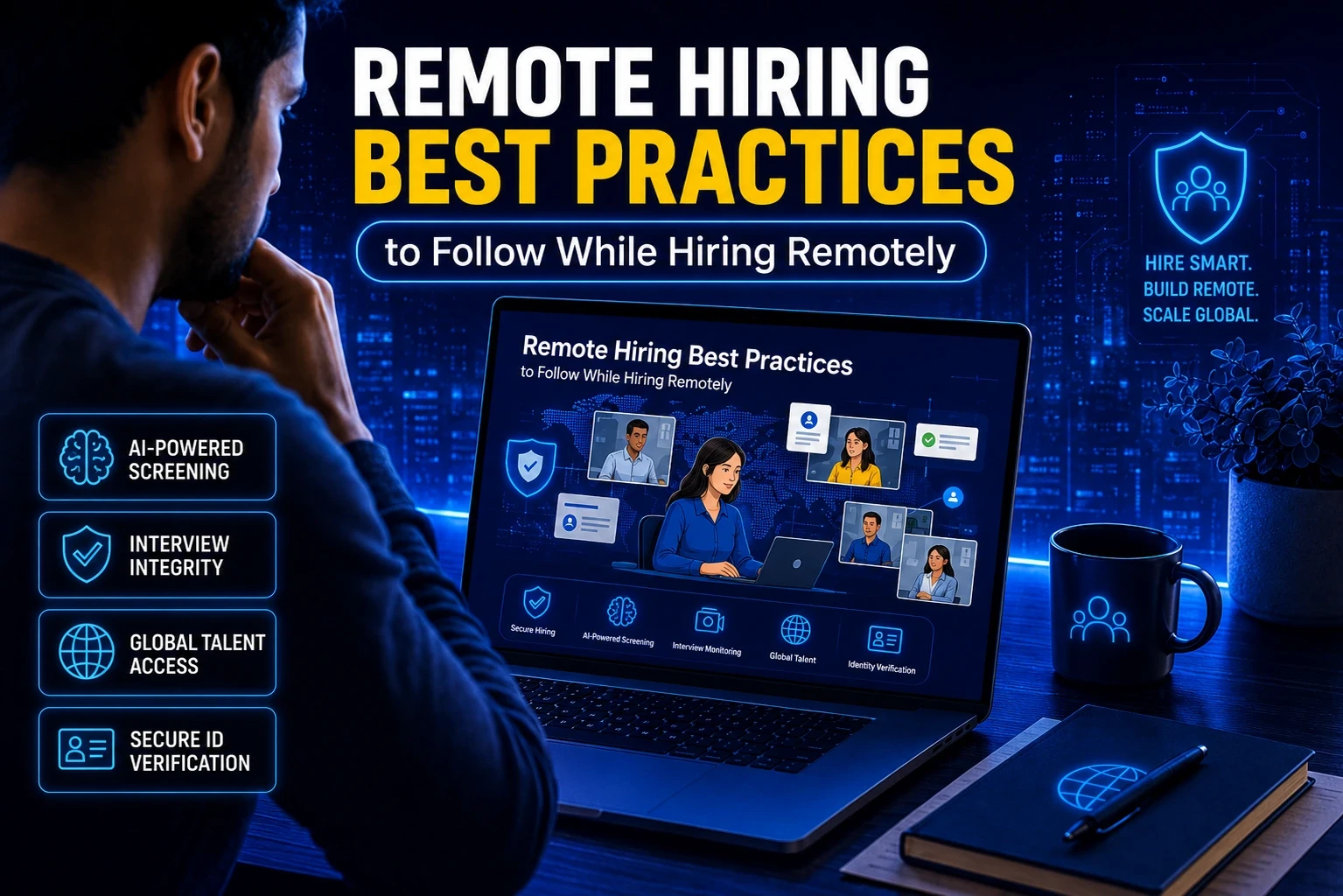
As remote recruitment continues to grow in 2026, organizations are increasingly adopting modern hiring strategies, AI-powered screening tools, secure interview systems, and streamlined onboarding processes to build reliable distributed teams. Following the right remote hiring best practices can help businesses improve recruitment efficiency, strengthen hiring decisions, and create scalable remote workforce models.
Below are some of the most effective remote hiring best practices companies should follow while hiring remotely.
1. Create a Well-Structured Remote Hiring Strategy
Remote hiring becomes more effective when companies follow a clearly planned recruitment process. Without a structured strategy, businesses may face inconsistent interviews, communication gaps, delayed hiring decisions, and poor candidate experiences.
Organizations should establish a step-by-step hiring workflow that includes candidate sourcing, resume screening, technical assessments, virtual interviews, verification checks, and onboarding. A standardized process helps recruiters and hiring managers stay aligned while improving hiring accuracy.
Structured remote recruitment strategies also help businesses:
Reduce time-to-hire
Improve collaboration between hiring teams
Maintain consistent candidate evaluation
Minimize recruitment errors
Scale hiring operations more efficiently
2. Write Clear and Detailed Remote Job Descriptions
Job descriptions play a major role in attracting qualified remote candidates. Generic or unclear postings can lead to irrelevant applications and mismatched expectations during the hiring process.
Remote job descriptions should clearly explain responsibilities, required qualifications, communication expectations, work schedules, and collaboration methods. Candidates should fully understand how the remote role operates before applying.
Clear job postings help businesses:
Attract relevant applicants
Improve application quality
Reduce screening time
Increase candidate transparency
Improve hiring efficiency
3. Expand Your Talent Search Beyond Local Markets
One of the biggest advantages of remote hiring is access to global talent. Restricting hiring to local regions can limit access to specialized skills and experienced professionals.
Remote recruitment allows companies to source candidates from different cities, countries, and time zones based on skill compatibility rather than geographical location.
Global hiring helps organizations:
Access specialized talent faster
Build diverse teams
Support international operations
Improve workforce flexibility
Reduce talent shortages
4. Use AI-Powered Interview Proctoring Tools like Sherlock AI
Remote hiring in 2026 requires more than basic applicant tracking systems and video interviews. Companies now need AI-powered recruitment technologies that can improve hiring accuracy, strengthen interview integrity, and reduce recruitment fraud risks during virtual hiring.
Traditional hiring workflows often struggle to identify fake candidates, proxy interviews, AI-assisted cheating, and identity manipulation in remote environments. This is why organizations are increasingly adopting intelligent hiring platforms like Sherlock AI to secure and optimize remote recruitment processes.
Sherlock AI helps businesses strengthen remote hiring through:
AI-powered candidate identity verification
Interview impersonation detection
AI copilot and external assistance monitoring
Real-time interview integrity analysis
Recruitment fraud prevention
Secure virtual interview monitoring
Using AI-powered hiring intelligence systems helps organizations improve recruitment accuracy, reduce manual verification efforts, and build more reliable remote hiring workflows.
Book a demo today with Sherlock AI to build secure, scalable, and reliable remote hiring workflows for your organization. |
5. Conduct Structured Virtual Interviews
Virtual interviews should follow a consistent and standardized format to ensure fair candidate evaluation. Unstructured interviews often create inconsistent hiring decisions and make it difficult to compare applicants accurately.
Organizations should prepare predefined interview questions, evaluation criteria, and scorecards for interview panels.
Structured interviews help businesses:
Improve candidate comparison
Reduce hiring bias
Standardize evaluations
Improve interview consistency
Strengthen hiring decisions
6. Verify Candidate Identity Before Assessments and Interviews
Candidate impersonation and proxy interviews are becoming major concerns in remote hiring. Businesses must verify that the actual applicant is attending interviews and completing assessments.
Secure identity verification systems help organizations maintain hiring integrity and reduce recruitment fraud risks.
Identity verification systems help companies:
Prevent proxy interviews
Detect fake candidates
Improve recruitment security
Strengthen hiring accuracy
Maintain interview integrity
7. Assess Both Technical and Remote Work Skills
Remote employees need more than technical expertise. They must also demonstrate communication abilities, self-management skills, accountability, and collaboration capabilities within distributed teams.
Hiring processes should evaluate both role-specific competencies and remote work readiness during interviews and assessments.
This helps organizations:
Identify remote-ready candidates
Improve employee productivity
Strengthen team collaboration
Reduce onboarding challenges
Improve long-term retention
8. Maintain Fast and Transparent Communication
Candidates expect regular updates and clear communication throughout the hiring process. Delayed responses and unclear timelines can negatively impact candidate experience and employer branding.
Organizations should maintain transparent communication regarding interview schedules, hiring stages, assessment results, and final decisions.
Strong communication practices help businesses:
Improve candidate engagement
Increase interview participation
Build employer trust
Reduce candidate drop-offs
Improve offer acceptance rates
9. Use Secure Interview Monitoring Systems
Remote interviews are increasingly exposed to AI-assisted cheating, external assistance, and interview malpractice. Businesses need systems that help identify suspicious interview behavior during virtual hiring.
AI-powered interview monitoring solutions can detect unusual activities and improve recruitment integrity.
Secure interview monitoring helps organizations:
Detect AI-assisted cheating
Identify suspicious interview behavior
Prevent external assistance
Reduce hiring fraud risks
Improve hiring reliability
10. Streamline Remote Onboarding Processes
Hiring does not end after the offer letter is accepted. Remote onboarding plays a major role in helping new employees integrate successfully into distributed teams.
Companies should provide digital onboarding materials, training resources, communication guidelines, and collaboration processes to support remote employees from day one.
Effective onboarding helps businesses:
Improve employee engagement
Accelerate productivity
Strengthen remote collaboration
Reduce early attrition
Improve employee experience
11. Align Recruiters and Hiring Managers
Strong collaboration between recruiters and hiring managers is essential for successful remote hiring. Misalignment can create inconsistent evaluations, delays, and poor hiring decisions.
Organizations should establish shared hiring criteria, interview scorecards, and evaluation guidelines before starting recruitment.
Alignment between hiring teams helps businesses:
Improve hiring consistency
Reduce recruitment delays
Strengthen candidate evaluations
Improve communication
Support faster hiring decisions
12. Continuously Improve Your Remote Hiring Strategy
Remote hiring trends, technologies, and candidate expectations continue to evolve rapidly. Businesses should regularly evaluate recruitment performance and identify areas for improvement.
Organizations should analyze:
Time-to-hire metrics
Candidate experience
Interview performance
Recruitment challenges
Hiring success rates
Continuous optimization helps businesses build scalable, secure, and efficient remote hiring processes for long-term growth.
Implementing these remote hiring best practices can help organizations build stronger, more secure, and more efficient recruitment processes in virtual hiring environments. Businesses that combine structured hiring workflows, transparent communication, candidate verification, and AI-powered recruitment technologies will be better positioned to attract top talent and scale remote teams successfully in 2026 and beyond.
How Sherlock AI Helps To Build Secure Remote Hiring
Remote hiring has helped businesses access global talent faster, but it has also increased challenges such as proxy interviews, fake candidates, AI-assisted cheating, and interview malpractice. Traditional hiring systems often struggle to identify these issues during virtual recruitment.
Sherlock AI helps organizations secure remote hiring workflows through advanced interview intelligence, candidate verification, and AI-powered monitoring capabilities built specifically for modern virtual recruitment environments.
Candidate Identity Verification
Sherlock AI helps recruiters verify candidate identity before and during interviews to ensure the correct individual is participating in the hiring process. This reduces the risk of fake candidates, identity manipulation, and unauthorized interview participation.
This helps organizations:
Verify candidate authenticity
Reduce identity fraud risks
Prevent fake candidate participation
Improve recruitment reliability
Strengthen hiring accuracy
Proxy Interview Detection
Proxy interviews have become a major challenge in remote hiring, especially for technical and high-volume recruitment. Sherlock AI helps detect situations where another individual attempts to attend interviews on behalf of the actual candidate.
Its intelligent interview monitoring capabilities help businesses:
Detect proxy interview attempts
Identify suspicious interview behavior
Maintain interview authenticity
Reduce hiring malpractice
Protect recruitment integrity
AI Copilot Detection
Candidates increasingly use AI copilots and external AI tools during online interviews and coding assessments. Sherlock AI helps organizations identify potential AI-assisted interview activities that may affect hiring accuracy.
This enables recruiters to:
Detect AI-assisted cheating
Improve assessment reliability
Strengthen technical evaluations
Maintain fair interview practices
Make confident hiring decisions
Deepfake Detection During Interviews
As AI-generated identity manipulation becomes more advanced, recruiters face increasing risks from deepfake-based interview fraud. Sherlock AI helps identify suspicious visual inconsistencies and interview authenticity concerns during virtual hiring processes.
This helps businesses:
Detect deepfake interview attempts
Improve interview security
Reduce identity manipulation risks
Strengthen candidate validation
Maintain hiring integrity
Interview Intelligence and Monitoring
Sherlock AI provides advanced interview intelligence capabilities that help organizations monitor virtual interviews more effectively. Its system analyzes candidate behavior and interview activities to improve transparency and remote hiring reliability.
This helps companies:
Improve interview visibility
Detect unusual interview patterns
Strengthen remote hiring security
Improve recruiter confidence
Maintain interview integrity
Modern remote recruitment requires secure and scalable systems that maintain trust throughout the hiring process. Sherlock AI helps organizations combine recruitment efficiency with interview integrity, allowing businesses to build safer and more reliable remote hiring workflows.
Companies using Sherlock AI can improve hiring accuracy, strengthen recruitment security, and confidently hire remote talent at scale.
Conclusion
Remote hiring has become a critical part of modern recruitment strategies in 2026. Businesses are no longer limited by geography when searching for skilled professionals, allowing organizations to build diverse, flexible, and globally distributed teams more efficiently than ever before.
However, successful remote hiring requires more than virtual interviews and online job postings. Companies need structured recruitment processes, clear communication, secure candidate verification systems, standardized evaluations, and reliable hiring technologies to maintain hiring accuracy and improve candidate experience.
As remote recruitment continues to evolve, challenges such as proxy interviews, AI-assisted cheating, fake candidates, and interview fraud are becoming increasingly common. Organizations that fail to address these risks may struggle with poor hiring decisions and reduced workforce reliability.
Platforms like Sherlock AI help businesses strengthen remote hiring through AI-powered candidate identity verification, proxy interview detection, AI copilot monitoring, deepfake detection, and interview integrity solutions designed specifically for virtual recruitment environments.
By combining efficient hiring strategies with advanced recruitment security technologies, businesses can build secure, scalable, and high-performing remote teams while improving hiring confidence in 2026 and beyond.