Back to all blogs
Discover how Sherlock AI identifies AI generated interview responses and real time external assistance to protect the integrity of remote hiring.

Abhishek Kaushik
Feb 11, 2026

In the age of remote work and digital hiring, interviews are now happening online more than ever. With this shift comes a new challenge. Some candidates use AI tools to answer questions in real time. This can hide their real thinking and skill level. Sherlock AI is built to solve this problem. It detects AI interview cheating with accuracy and transparency.
Sherlock AI is an interview proctoring platform built for the modern hiring landscape, where cheating no longer looks like cheating. It helps organizations detect interview fraud such as impersonation, real-time external assistance, and scripted or misrepresented responses that are difficult to identify using traditional interview methods. One industry survey found that 31 % of hiring managers have interviewed candidates who later turned out to be using a false identity or proxy, and about 35 % confirmed someone other than the listed applicant participated in a virtual interview.
Sherlock AI is used by organizations across engineering, finance, healthcare, data, and IT functions that rely on remote interviews and require strong assurance of interview authenticity.
In this blog we explain how Sherlock AI works and why it is the right choice for fair interviews.
The Rise of AI Assistance in Interviews
Artificial intelligence has made everyday tasks easier. From writing emails to solving complex problems, AI tools can help in many ways. But in job interviews, especially live coding and technical interviews, using AI to answer questions can give an unfair advantage.
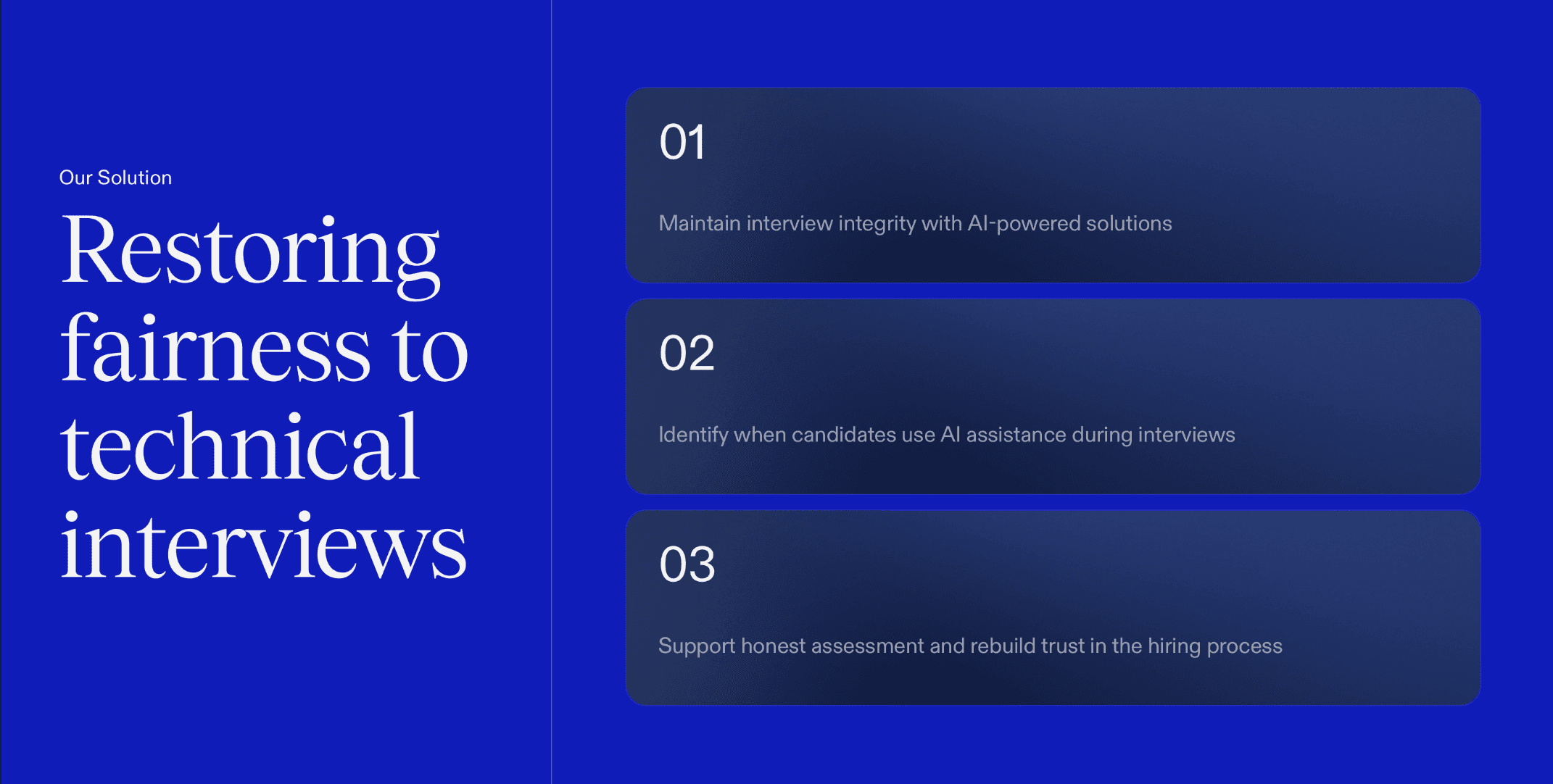
This creates three problems:
Employers do not get a real picture of a candidate ability.
Honest candidates are unfairly compared with those using AI.
The hiring process loses trust.
Sherlock AI brings fairness back to the interview experience.
What Makes Sherlock AI Different
Sherlock AI is designed to detect patterns that show when a candidate is relying on AI. The system does more than look at surface level text. It analyzes behavior, timing, response patterns and more.
Here are the key areas Sherlock AI focuses on:
1. Behavior Pattern Tracking
When a human solves a problem, their behavior follows a natural pattern. This includes thinking time, typing rhythm, how errors are corrected, and how answers evolve. AI generated responses often look different in these areas. Sherlock AI tracks these actions to spot signs of AI use.
2. Timing and Latency Analysis
How long does it take a candidate to answer a question? Does the response appear within a time window that makes sense for human thinking? If the timing is unusually fast or too consistent, it may indicate AI influence. Sherlock AI measures timing closely to find these patterns.
3. Response Style Recognition
AI text and code have specific stylistic traits. Sherlock AI uses advanced models to recognize these traits. Without ever storing personal information, Sherlock AI compares the answer style to learned human writing and coding patterns. If a response is far outside normal human range, it is flagged for further review.
4. Context Consistency Checks
Often AI generated content includes phrasing that is too formal or structured. Sometimes the technical details are too polished. Sherlock AI checks consistency with the type of question asked. When answers seem out of sync with the interview stage or complexity level, Sherlock AI flags these for deeper analysis.
👉 How Recruiters Can Detect AI Copilot Usage in Interviews
What Makes Sherlock AI Different From Traditional Interview Security Tools
Traditional Proctoring Tools | Sherlock AI |
|---|---|
Focus on detecting specific cheating methods | Focuses on verifying real thinking and real skill |
Built as a checklist of known threats | Built on human cognitive and behavioral signals |
Needs constant updates when new cheating tactics appear | Works even against new and unknown cheating methods |
Tries to block access to outside help | Analyzes what happens after help reaches the candidate |
Detects devices, apps, or suspicious activity | Detects mismatches between stimulus and human response patterns |
Focuses on the environment around the candidate | Focuses on the thinking process inside the candidate |
Reactive approach that follows cheating trends | Future resistant design that does not rely on trend tracking |
Why This Difference Matters
Even the most advanced cheating method still depends on a human delivering the final answer. A candidate can only receive information through their senses, and their brain must convert that information into speech, typing, or problem solving.
Sherlock AI evaluates that conversion process.
If the behavioral and cognitive signals do not match authentic real time reasoning, Sherlock AI highlights the risk. That makes it the final layer of defense that protects interview integrity, regardless of how cheating evolves.

How Sherlock AI Helps in Detection of Hidden Real Time Interview Assistance Tools
Sherlock AI helps organizations surface the use of hidden real time interview assistance systems, including tools such as Cluely, Parakeet AI type platforms, and other emerging AI interview copilots.
It does this by focusing on how answers are produced, not just what software might be running.
How Sherlock AI detects this type of assistance:
Monitors response timing patterns
Identifies answers that appear at speeds or with consistency that do not match natural human thinking under interview conditions.Analyzes answer construction behavior
Evaluates how responses are formed, including structure, flow, and progression, to detect signs of externally generated content being relayed.Tracks interaction and hesitation signals
Human problem solving typically includes pauses, revisions, and visible thinking moments. A lack of these signals can indicate assisted responses.Evaluates stimulus to response alignment
Measures how naturally a candidate processes a question and turns it into an answer. Mismatches may suggest that the response originated outside the candidate’s own reasoning.Looks for cognitive load inconsistencies
Flags situations where the complexity or polish of an answer does not align with the candidate’s real time interaction patterns.Works independently of specific tools
Even if a candidate uses tools like Cluely, Parakeet AI type systems, or brand new platforms, the behavioral signals involved in relaying AI generated answers remain detectable.
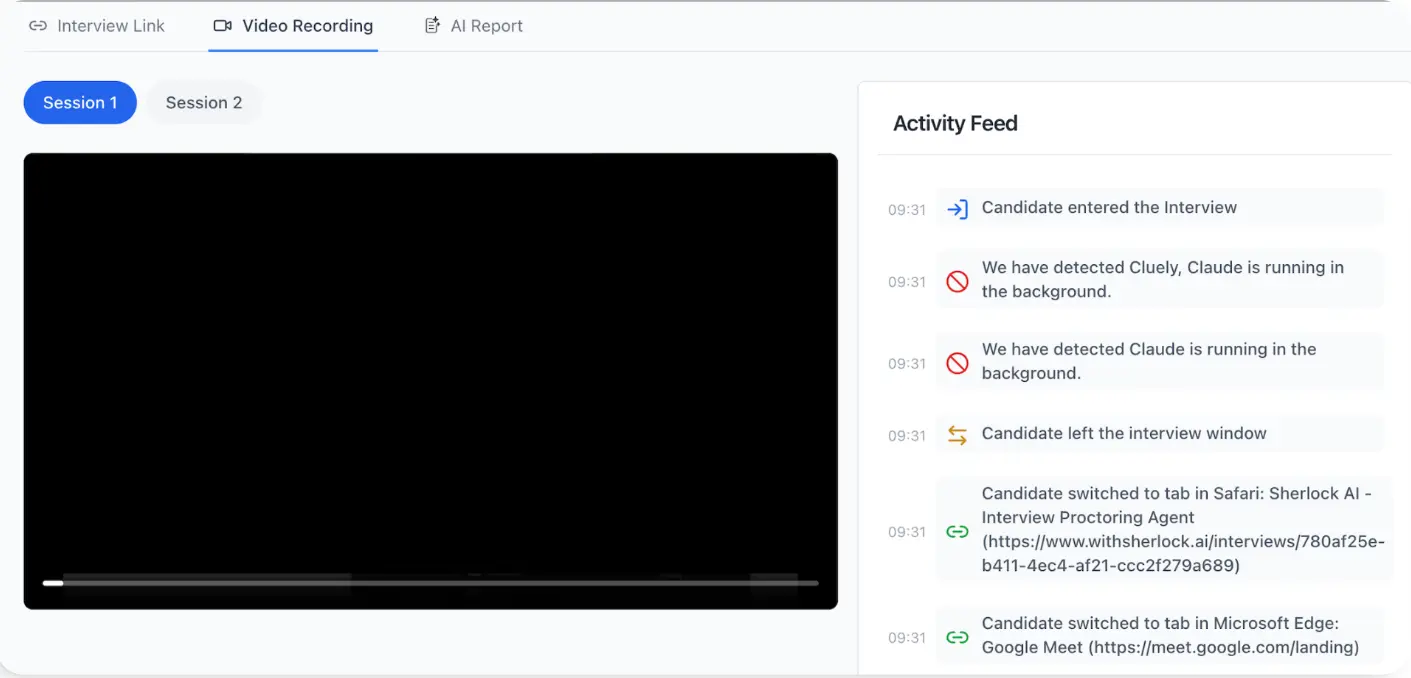
By grounding detection in behavioral and cognitive patterns, Sherlock AI can surface risk linked to hidden live assistance tools while remaining resilient to new technologies that continue to enter the market.
Sherlock AI Does Not Replace Interviewers
Sherlock AI is designed to support interviewers, not replace them. It strengthens human judgment by adding objective signals where traditional interviews fall short.
Interviewers remain in control
Sherlock AI does not make hiring decisions. Final evaluation and judgment always stay with the interviewer or hiring team.No automated pass or fail outcomes
The platform surfaces risk signals and behavioral insights rather than issuing binary decisions about candidates.Enhances human intuition with data
Sherlock AI complements interviewer experience by highlighting patterns that are difficult to observe in real time.Does not interfere with interview flow
Interviews run naturally. Sherlock AI analyzes behavior in the background without disrupting conversation or problem solving.Supports fair and consistent evaluations
By providing objective signals, Sherlock AI helps reduce bias and guesswork, especially in high volume or distributed hiring.Designed for collaboration, not automation
The system works as an assistive layer that empowers interviewers to ask better follow up questions and make informed decisions.Respects candidate privacy
Sherlock AI focuses on behavioral signals related to interview integrity and does not collect unnecessary personal data.
Sherlock AI exists to protect the integrity of interviews while preserving the human element that makes great hiring decisions possible.
Conclusion
AI has transformed the way we work and learn, but hiring still depends on one critical factor. Human ability. Interviews exist to understand how candidates think, reason, and respond in real time. When AI replaces that process, hiring decisions become less reliable and less fair.
Sherlock AI restores confidence in remote interviews by focusing on how answers are produced, not just how polished they appear. By detecting AI interview cheating, impersonation, and hidden real time assistance with precision, Sherlock AI helps organizations make decisions based on authentic skill.
As AI tools continue to evolve, interview integrity cannot depend on static rules or tool specific detection. It requires a deeper understanding of human behavior and cognition. Sherlock AI provides that final layer of assurance, ensuring that remote hiring remains fair, trustworthy, and scalable.
Fairness matters. Trust matters. Sherlock AI delivers both.