Back to all blogs
Interview sidekick fraud threatens hiring quality and compliance. Explore real-time detection and prevention strategies.

Abhishek Kaushik
Feb 9, 2026
Remote hiring has transformed how companies access talent, but it has also introduced a new and serious risk. Candidates are no longer interviewing alone. Many are now using an interview sidekick, including real time AI assistants, hidden collaborators, or external tools that feed answers during live interviews. In some surveys of interviewers, 81 percent believe AI-assisted cheating is occurring, with about 31 percent reporting they have caught a candidate using AI to cheat during an interview.
For hiring teams, this is not a minor integrity issue. It directly affects hiring quality, compliance, and long term business performance. If organizations cannot verify that a candidate is answering independently, the interview loses its purpose entirely.
This guide explains what interview sidekick fraud is, how it shows up during interviews, the red flags recruiters should watch for, and how platforms like Sherlock AI help detect and prevent it in real time.
What Is Interview Sidekick?
Interview Sidekick is a category of AI tools that listens to interview questions and provides real-time responses or prompts to the candidate.
These tools can:
Transcribe interviewer questions instantly
Generate structured answers in real time
Suggest behavioral responses using STAR frameworks
Provide technical explanations or system design guidance
The interviewer hears a fluent answer, but the candidate may be reading or listening to AI-generated content.
Why Interview Sidekick Usage Is Increasing
Several trends have accelerated interview sidekick adoption, including advances in generative AI and deepfake voice cloning technologies that enable candidates to receive real-time assistance or even impersonate identities during live interviews..
AI tools now generate complete, well-structured answers in seconds during live conversations
Remote interviews reduce environmental visibility and control
Competitive job markets push candidates to seek unfair advantages
Many interview formats reward polished delivery over real reasoning
Together, these factors make interview sidekicks easy to use and hard to catch.
How to Detect Interview Sidekick Usage During Live Interviews
Detecting interview sidekicks requires shifting focus from what candidates say to how they think, adapt, and own decisions.
1. Watch for Unnatural Response Timing
Interview sidekick usage often affects timing.
Common indicators include:
Consistently polished answers with no thinking pauses
Delays that feel mechanical rather than reflective
Identical response cadence across very different questions
Real candidates vary in rhythm. AI-assisted responses tend to normalize it.
2. Probe for Ownership and Personal Judgment
Interview sidekicks struggle when candidates must own decisions.
Ask questions such as:
What decision did you personally make?
What would have failed without your involvement?
What did you intentionally choose not to do?
AI-assisted answers stay high-level. When pressed, candidates repeat concepts instead of revealing judgment.
3. Change Constraints Mid-Answer
Sidekicks perform poorly when conditions change unexpectedly.
Try:
What would you do if the timeline were cut in half?
How would this change with fewer resources?
What if risk tolerance were much lower?
Real candidates adapt naturally. Interview sidekick responses often reset or ignore the new constraint.
4. Ask About Mistakes and Regret
Interview sidekicks avoid real failure.
Ask:
What do you think you got wrong?
What decision would you reverse today?
What feedback was hardest to accept?
AI produces safe reflections. Genuine candidates reveal tension, tradeoffs, and learning moments.
5. Use Time-Boxed Reasoning Prompts
Limit thinking time.
Examples include:
Take 30 seconds and talk through how you would approach this
Answer without structuring your response
Interview sidekicks rely on generation time and structure. When speed and raw reasoning matter, AI assistance becomes obvious.
How to Prevent Interview Sidekick Usage Before It Happens
Detection is necessary, but prevention is more effective. Strong prevention reduces both the opportunity and the incentive to rely on interview sidekicks.
1. Design Interviews That Test Thinking, Not Delivery
Predictable questions invite external assistance.
Prevention starts with:
Decision-focused prompts
Open-ended reasoning questions
Realistic constraints and ambiguity
When interviews test judgment, sidekicks lose effectiveness.
2. Set Clear Authenticity Expectations
Candidates are less likely to cheat when authenticity is explicit.
Make it clear that:
Live assistance is monitored
Independent reasoning is required
Integrity matters in evaluation
This alone deters a large portion of misuse.
3. Force Ownership Through Progressive Questioning
Interview sidekicks perform best on single, isolated questions. They struggle when questions build on each other.
Prevention improves when interviewers:
Ask layered follow-up questions that depend on earlier answers
Reference specific details the candidate mentioned previously
Revisit earlier decisions from a different angle later in the interview
This forces continuity of thought. Candidates relying on external assistance often lose coherence when required to maintain ownership across time.
4. Reduce Question Predictability Across Interviews
When interview questions are widely known or reused, candidates can prepare sidekick prompts in advance.
Prevention requires variation.
Teams should:
Rotate interview questions frequently
Customize questions based on the candidate’s background
Avoid publishing full interview formats externally
Unpredictable interviews increase the cognitive load on sidekicks and reduce their effectiveness.
5. Introduce Real-Time Problem Framing
Instead of asking candidates to solve fully defined problems, ask them to define the problem first.
Examples include:
What information would you ask for before solving this?
How would you break this problem down?
What assumptions would you challenge first?
Interview sidekicks generate solutions well. They struggle when asked to frame problems using personal judgment.
6. Limit Multi-Tasking Opportunities
Sidekick usage often depends on second screens, hidden devices, or parallel workflows.
Prevention improves when:
Candidates are asked to share screens during technical interviews
Interviewers occasionally request visual confirmation of focus
Interview formats discourage switching contexts
These steps do not eliminate cheating, but they significantly increase friction.
7. Use Consistent Interviewer Training
Even strong processes fail without consistent execution.
Prevention works best when interviewers are trained to:
Recognize behavioral inconsistencies
Ask follow-ups that test ownership
Slow down interviews when answers seem overly polished
Well-trained interviewers reduce reliance on gut feeling and apply integrity checks evenly.
8. Signal Integrity Technology Early in the Process
Candidates are less likely to use interview sidekicks when they know verification exists.
Prevention increases when:
Interview integrity tools are mentioned in interview guidelines
Candidates are informed that authenticity is evaluated in real time
Expectations are communicated before interviews begin
Transparency shifts behavior before misuse occurs.
9. Align Interviews With On-the-Job Reality
Interview sidekicks succeed when interviews test performance rather than decision-making.
Prevention improves when interviews reflect real work.
This includes:
Evaluating how candidates handle uncertainty
Testing prioritization and tradeoffs
Assessing how candidates explain decisions to others
When interviews mirror real responsibilities, external assistance becomes less useful.
Why Strong Prevention Protects Hiring Outcomes
Interview sidekicks undermine fairness, hiring quality, and trust. Prevention ensures that interviews reward genuine capability rather than artificial fluency.
Organizations that invest in prevention:
Reduce false positives in hiring
Protect honest candidates
Improve long-term performance outcomes
Preserve confidence in remote hiring
Prevention is not about policing candidates. It is about restoring interviews as a reliable signal of real thinking.
Read more: How to Prevent Cheating With AI During The Hiring Process

AI Cheating Tools vs. Sherlock AI’s Protection
Aspect | AI Cheating Tools | Sherlock AI |
|---|---|---|
Primary Purpose | Help candidates generate answers during live interviews | Protect interview integrity by verifying real thinking |
Role in Interviews | Actively participate on the candidate’s behalf | Observe and analyze behavior without interfering |
Timing of Use | Operate in real time during the interview | Operates in real time alongside the interview |
Focus Area | Output quality and response structure | Behavior, reasoning, ownership, and consistency |
Thinking Replacement | Replace or supplement candidate thinking | Exposes whether thinking is genuine |
Response Style | Polished, structured, and generic | Evaluates natural variation and human reasoning |
Adaptability | Struggles with constraint changes and follow-ups | Detects inconsistency when conditions change |
Ownership Signals | Avoids personal accountability | Highlights ownership and decision-making depth |
Detection Capability | Designed to evade human observation | Designed to detect AI-assisted behavior patterns |
Impact on Hiring | Increases false positives and weak hires | Reduces hiring risk and false positives |
Transparency | Hidden from interviewers | Provides clear, contextual insights to interviewers |
Outcome | Interviews become unreliable signals | Interviews remain trustworthy and fair |
How Sherlock AI Detects and Prevents Interview Sidekick Usage
Sherlock AI prevents interview sidekick usage by making real thinking visible during live interviews. It focuses on behavior, continuity, and reasoning integrity rather than static rules or post-interview review.
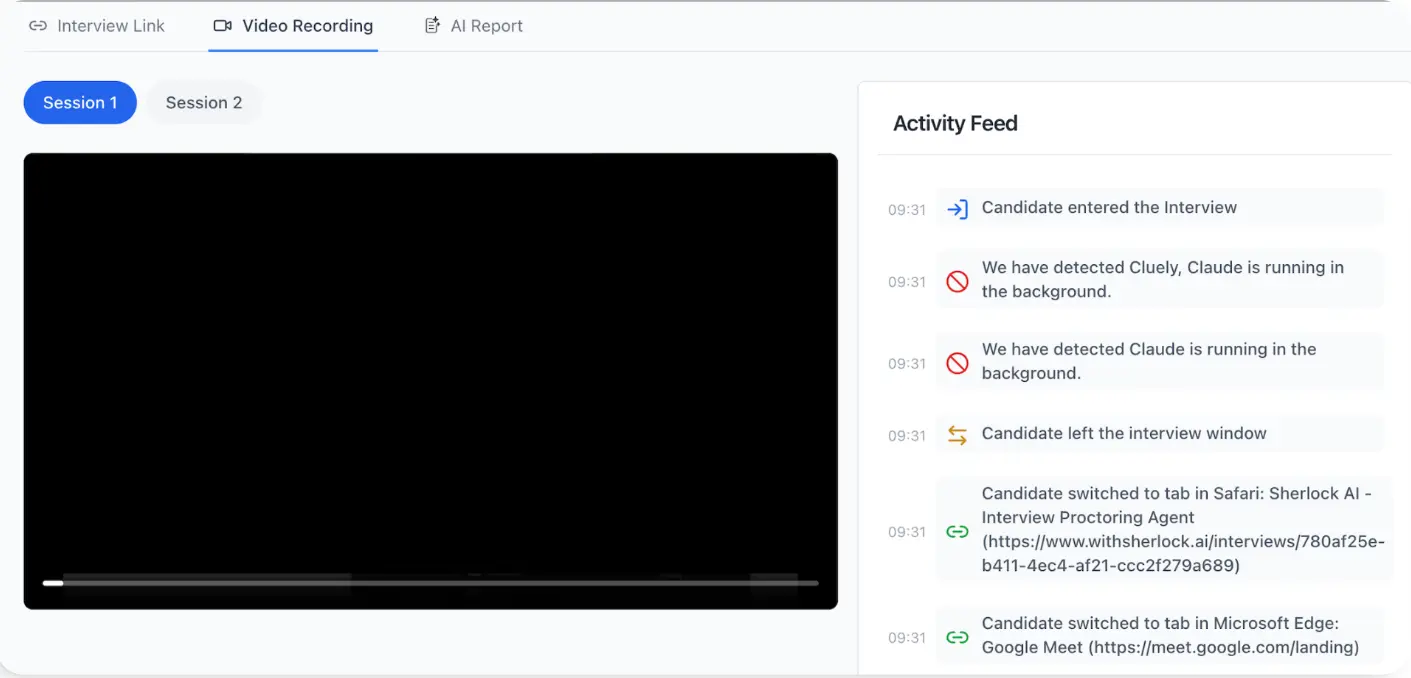
Below is how Sherlock AI operates at each layer of the interview.
Layer 1: Behavioral Signals
What Sherlock AI observes
Response timing and pacing
Speech rhythm and fluency changes
Eye movement, pauses, and micro-behaviors
What this reveals
Interview sidekicks introduce artificial consistency. Human cognition fluctuates under pressure. When responses remain uniformly polished, Sherlock flags a potential integrity risk.
Layer 2: Interaction Dynamics
What Sherlock AI evaluates
Response speed as question complexity changes
Confidence alignment with the difficulty of the prompt
Structure applied to open-ended questions
What this reveals
AI-assisted responses follow predictable interaction patterns. Sherlock AI detects when conversational flow stops behaving naturally.
Layer 3: Ownership Continuity
What Sherlock AI validates
Behavioral consistency across the interview timeline
Signs of off-screen prompts or external input
Logical continuity between related answers
What this reveals
Sidekicks can generate answers but cannot maintain continuous personal judgment across multiple decision points.
Layer 4: Reasoning Authenticity
What Sherlock AI analyzes
Repetition of reasoning templates
Formulaic explanations
Polished answers without depth or personal framing
What this reveals
Authentic reasoning shows variation, tradeoffs, and uncertainty. AI-generated reasoning removes these human signals.
Layer 5: Interviewer Enablement
What Sherlock AI provides
Live signals when sidekick usage may be present
Context on where ownership appears weak
Guidance on where deeper probing is needed
What this enables
Interviewers can intervene immediately, adapt questioning, and validate authenticity before decisions are made.
Final Thoughts
Interview sidekick usage is not a hypothetical risk. It is already reshaping how interviews function and what they measure. As real-time AI assistance becomes more accessible, traditional interview formats are losing their ability to distinguish genuine capability from artificial fluency.
Detection alone is no longer enough. Hiring teams must redesign interviews, set clear integrity expectations, and use real-time verification to ensure that the person answering is the person being evaluated.
Organizations that take interview integrity seriously gain more than fraud prevention. They make better hires, protect fair candidates, and restore trust in remote hiring at scale.
Sherlock AI exists to make real thinking visible again. By focusing on behavior, reasoning, and ownership in real time, it helps teams hire for judgment, not generated answers.
When interviews reflect real thinking, hiring works the way it was meant to.