Back to all blogs
Learn how to prevent AI cheating in hiring by designing better interviews, spotting assisted behavior, and protecting fair, reliable evaluations.

Abhishek Kaushik
Jan 9, 2026
AI use in hiring is not black and white. Not every use of AI should be treated as cheating, and drawing this line clearly is essential for fair evaluation.
Acceptable AI assistance typically happens outside the interview or assessment itself. Candidates may use AI to prepare for interviews, improve their résumé language, or practice explaining their experience. In these cases, AI acts as a learning aid, not a substitute for the candidate’s own thinking.
AI misuse occurs when tools replace the candidate’s reasoning during evaluation. This includes AI generating answers in real time during interviews, writing code during live technical rounds, or producing responses that the candidate cannot explain or adapt.
A report found that about 20% of professionals admit to having used AI during job interviews, and many employers already consider such use problematic because it undermines true skills assessment. At this point, the interview stops measuring the candidate and starts measuring the tool.
Stages in Hiring Process Vulnerable to AI Misuse
AI misuse can appear at almost every stage of hiring. The risk increases when evaluation relies on polished output instead of real thinking. In practice, it shows up as different cheating patterns at screenings, take-homes, live interviews, and trial work.
Understanding how misuse shows up at each stage helps teams interpret signals correctly and design better checks.
1. Online screenings and assessments
Many screening tests are taken remotely and without supervision. This makes them easy to assist with external tools.
How misuse shows up:
Unusually high scores compared to later performance
Fast completion with little variance in answers
Correct answers without clear understanding
Inconsistent results across similar questions
Most screenings focus on correctness, not reasoning. When AI can generate answers instantly, the test stops measuring baseline skill.
Impact on hiring: Screening loses its purpose as a filter. Weak candidates move forward, while strong candidates may not stand out.
2. Take-home assignments
Take-home work is one of the most misused stages. AI can generate complete solutions, documentation, and even explanations.
How misuse shows up:
High-quality submissions with shallow understanding
Clean code or writing that candidates cannot explain
Difficulty answering follow-up questions
Inability to modify or extend the work
Take-home tasks are unsupervised and often predictable. AI performs well when given time and context.
Impact on hiring: Teams treat take-home work as proof of ability. When the work is not the candidate’s own, this creates false confidence and leads to poor on-the-job performance.
3. Live interviews
Live interviews were once considered safe from cheating. That is no longer true. Today, most of the subtle AI misuse shows up here, especially in remote video calls.
How misuse shows up:
Delayed responses to simple questions
Polished answers that break under follow-up
Weak explanations of decisions
Trouble adapting when questions change
Some tools can listen to questions and suggest answers in real time. Others assist with coding or explanation in the background.
Impact on hiring: The interview no longer reflects how the candidate thinks. Decision-making, judgment, and adaptability are masked.
4. Trial projects or paid tasks
Trial work is often seen as the closest test of real performance. It is still vulnerable when done asynchronously.
How misuse shows up:
Strong output with little personal reasoning
Generic approaches that lack context
Limited ownership of decisions
Difficulty explaining priorities and trade-offs
When work is done independently, candidates can rely on tools for planning, execution, and refinement.
Impact on hiring: Teams may overestimate readiness and independence. This leads to slower ramp-up and increased management overhead after hiring.
AI misuse does not always mean bad intent. But when multiple stages rely on distorted signals, hiring decisions become unreliable. Each of these stages has its own failure modes when AI steps in for the candidate.
👉 How to Prevent Cheating With AI During The Hiring Process
Designing Hiring Processes to Reduce AI Advantage
The goal is not to fight AI with rules. The goal is to design interviews and assessments that reward real thinking. When the process measures reasoning, judgment, and adaptability, AI becomes far less useful.
Evaluate reasoning, not just final output
Strong candidates can explain how they think, not just what they produce.
How to do this:
Ask candidates to walk through their approach step by step
Pause them mid-answer and ask why they chose that path
Focus on assumptions, not conclusions
Ask what they would do differently with more time
AI can generate polished answers quickly. It struggles when asked to explain personal reasoning, uncertainty, and judgment in real time.
What to watch for:
Clear structure in thinking
Comfort explaining partial answers
Willingness to admit trade-offs or gaps
Use adaptive and dynamic questions
Static questions are easy to prepare for and easy to assist with. Adaptive questions are not.
How to do this:
Change constraints after the candidate starts answering
Introduce new information mid-problem
Ask follow-up questions based on their specific response
Shift from theory to application without warning
AI tools rely on stable prompts. When the conversation changes direction, assisted answers often break down.
What to watch for:
Ability to adjust quickly
Logical consistency under change
Clear prioritization when conditions shift
Focus on decision-making and trade-offs
Real work is rarely about perfect answers. It is about choosing between imperfect options.
How to do this:
Present two competing solutions and ask which they would choose
Ask what they would optimize for and what they would sacrifice
Discuss real constraints like time, cost, or risk
Ask how they would explain the decision to stakeholders
AI often produces balanced, generic responses. It struggles to reflect personal judgment shaped by experience.
What to watch for:
Strong opinions with clear reasoning
Awareness of consequences
Practical, experience-based thinking
Reduce predictability in assessments
Predictable formats are easier to game. Variety creates stronger signals.
How to do this:
Rotate question formats across interviews
Avoid publicly searchable prompts
Mix discussion, problem-solving, and critique
Use partial or incomplete information
AI performs best when patterns are known. Unpredictable structure forces candidates to rely on their own thinking.
What to watch for:
Comfort with ambiguity
Ability to ask clarifying questions
Logical progression without a script
When interviews reward thinking over polish, AI stops being an advantage. Strong candidates stand out more clearly, and hiring decisions become more reliable.
The strongest teams treat this as a hiring-system design problem, not just an interview-script tweak.
Role of Proctoring and Detection Tools
Even well-designed interviews break down at scale. When teams run dozens of interviews each week, subtle AI use is easy to miss. Monitoring and detection tools exist to surface what human interviewers cannot reliably track in real time.
The goal is not to catch candidates in a single moment. It is to restore trust in interview signals.
Behavioral and pattern-based detection in real interviews
AI assistance rarely looks like obvious cheating. In practice, it shows up as patterns that repeat across questions.
What hiring teams actually see:
Candidates pausing longer than expected on simple clarifications
Answers that suddenly become clearer or more structured after silence
Strong final responses paired with weak explanations
Difficulty continuing when asked to modify an answer
Attention shifting off-screen during key questions
Individually, these moments seem harmless. Across an interview, they form a pattern.
Why humans miss this: Interviewers are focused on listening, evaluating, and keeping the conversation flowing. Tracking timing, consistency, and behavioral shifts manually is unreliable.
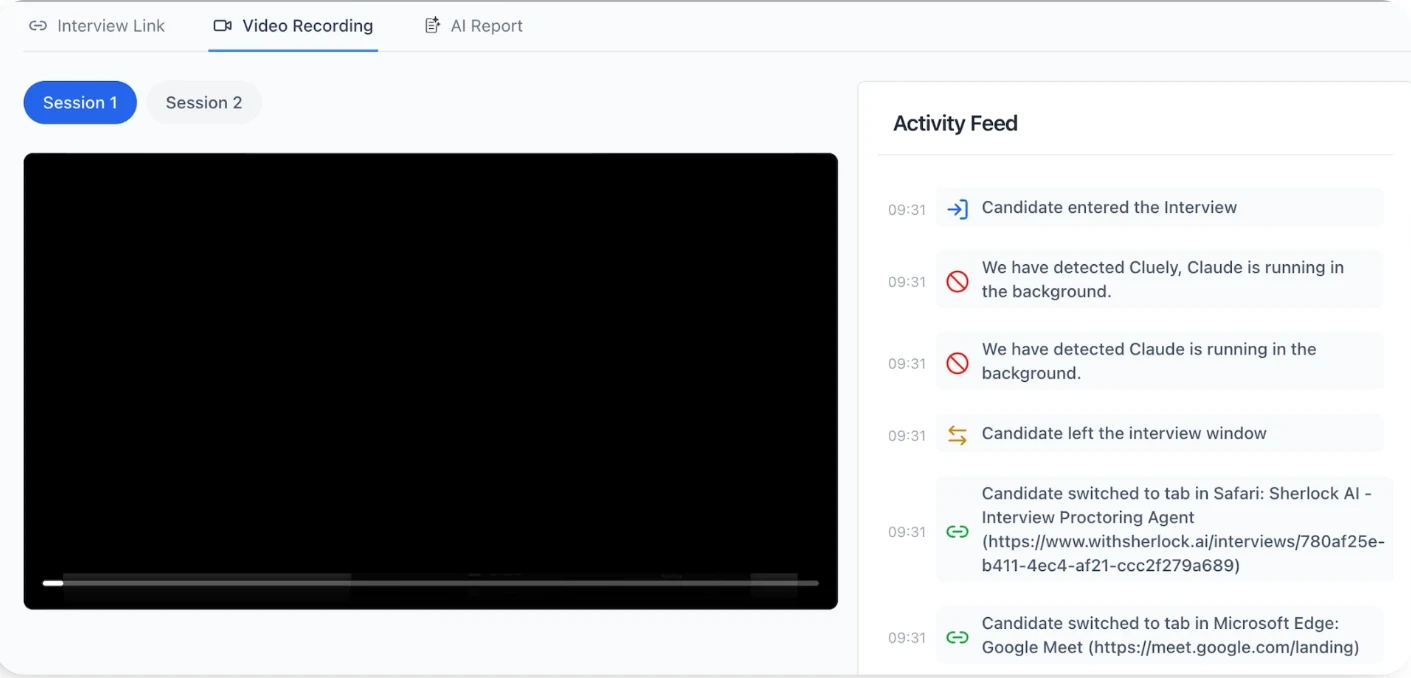
This is where pattern-based systems add value. Tools like Sherlock AI continuously observe timing, response flow, and background activity so interviewers can focus on judgment instead of detection.
Background applications and hidden assistance
One of the hardest challenges today is AI tools running silently in the background.
Real-time answer generators listening to interview audio
Coding assistants active during live technical rounds
Voice-to-text tools feeding prompts to external systems
Screen-based copilots that never appear on camera
These tools are invisible to interviewers.
Sherlock AI addresses this by detecting suspicious background activity alongside behavioral signals. This combination is critical. Behavior alone can be ambiguous. Background context makes patterns clearer.
Balancing accuracy, privacy, and candidate trust
Monitoring only works when candidates feel respected.
What effective teams do:
Explain monitoring upfront in simple language
Focus on behavior and system activity, not personal data
Avoid recording more than necessary
Apply the same standards to every candidate
Sherlock AI is built around this balance. It avoids intrusive controls and focuses on signals relevant to interview integrity.
The limits of hard blocking in real hiring environments
Many companies try to block tabs, lock browsers, or restrict applications.
What happens in practice:
Candidates use secondary laptops, tablets, or phones
Blocking tools create technical failures during interviews
Senior candidates push back on intrusive controls
False positives damage trust and candidate experience
Hard blocking assumes cheating is visible and preventable with restrictions. In reality, modern AI assistance is subtle and external.
Detection tools should guide interviews, not replace them
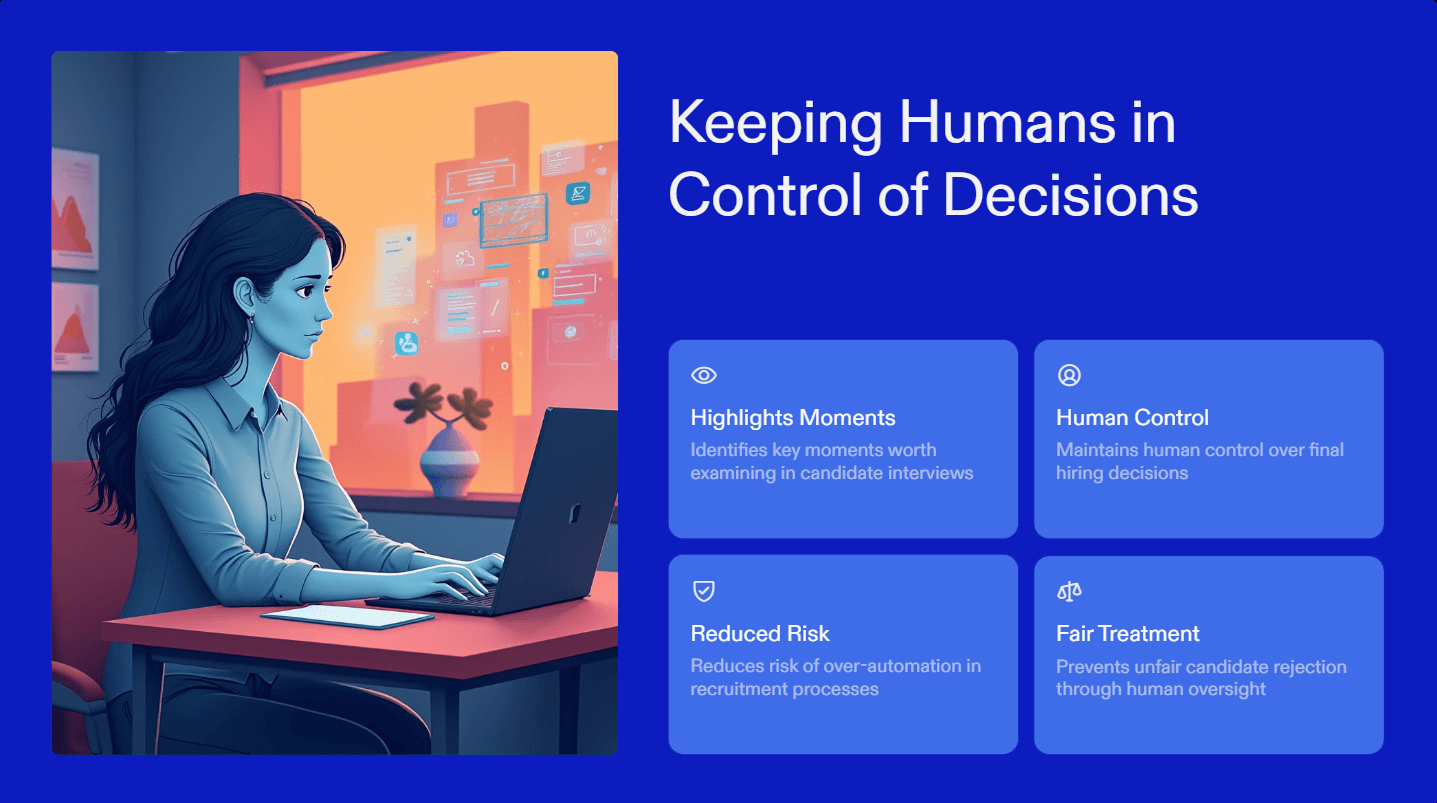
Good detection tools do not make hiring decisions. They improve interviewer awareness.
How this works in real interviews:
A flagged pause prompts a follow-up question
A reasoning mismatch leads to deeper probing
Repeated signals trigger a second interviewer’s review
Patterns across rounds influence final confidence
Sherlock AI is designed around this workflow. It highlights moments worth examining while keeping humans in control of decisions. This approach avoids over-reliance on automation and reduces the risk of unfair rejection.
Conclusion
AI is now part of the hiring landscape. The real risk is not that candidates use AI, but that hiring teams mistake assisted performance for real capability.
Preventing AI-driven cheating does not require stricter rules or heavier controls. It requires better signal design. Interviews and assessments must reward reasoning, judgment, and adaptability rather than polished output. When processes are designed this way, most AI misuse loses its advantage on its own.
At the same time, process design alone is not enough. In real hiring environments, subtle AI assistance is easy to miss, especially at scale. Monitoring and detection tools provide the visibility interviewers need to interpret performance accurately and ask better follow-up questions.
The strongest hiring systems combine three things: thoughtful interview design, trained human judgment, and behavioral detection that works quietly in the background. This approach protects fairness for honest candidates and restores confidence in hiring decisions.
Explore: How Sherlock AI protects your hiring process from AI fraud.