Back to all blogs
Learn how to detect and prevent Final Round AI and other AI-assisted cheating in remote interviews. Discover how Sherlock ensures interview integrity and fair hiring.

Abhishek Kaushik
Jan 7, 2026
Remote interviews have become the standard for modern hiring, but they’ve also introduced a new challenge. Recent industry research shows that nearly half of employers report candidates using AI during interviews, and around 20–27% of job seekers admit to relying on AI tools when responding to interview questions. In some cases, employers even suspect AI-assisted cheating in up to 81% of candidate interactions.
AI-powered interview assistants like FinalRound AI are now being used by candidates to generate real-time answers during live interviews. While these tools claim to “support” candidates, they significantly distort a recruiter’s ability to evaluate genuine skills, thinking, and communication.
For hiring teams, the problem is no longer just cheating, it’s undetectable cheating. This blog explores how to detect and prevent FinalRound AI in interviews, why traditional methods fall short, and how intelligent platforms like Sherlock AI are redefining interview integrity.
What Is Final Round AI?
FinalRound AI is a real-time interview assistant designed to listen to interview questions and generate suggested responses instantly. It often operates discreetly through browser tabs, external devices, or hidden windows, making it difficult for interviewers to notice during live conversations.
In remote setups, that behavior sits alongside other discreet cheating methods like off-screen devices and background tools.
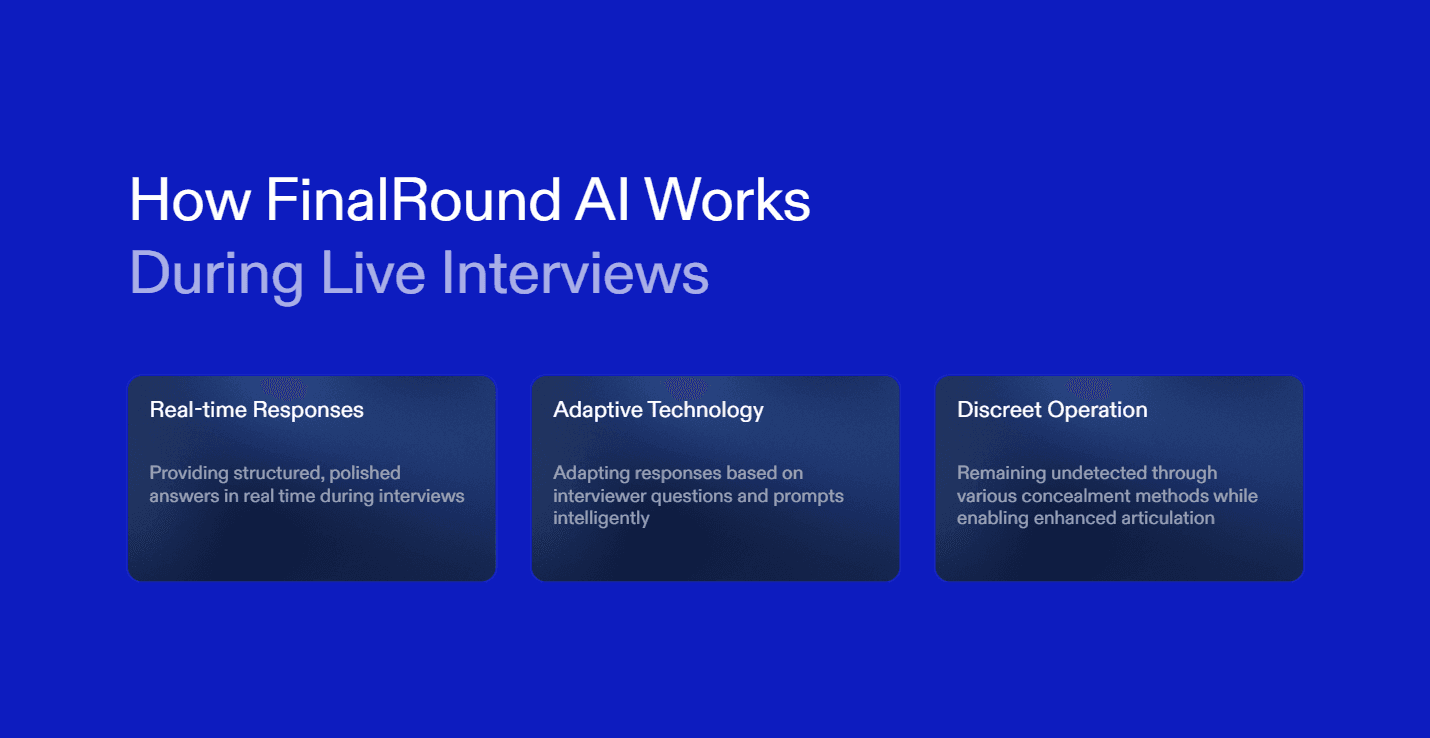
Unlike traditional preparation tools, FinalRound AI actively participates in the interview by:
Providing structured, polished answers in real time
Adapting responses based on interviewer prompts
Remaining hidden from basic screen or webcam monitoring
This creates a scenario where candidates appear confident and articulate without demonstrating their actual skills.
Why Is Final Round AI Hard to Detect?
Detecting FinalRound AI is challenging because it does not rely on obvious cheating signals. Candidates may not switch tabs, glance away, or behave suspiciously on camera. Instead, AI assistance happens quietly in the background.
Key reasons it’s hard to detect:
AI responses appear natural and fluent
Minimal visible behavioral cues
Works alongside normal interview tools
Can run on secondary devices or hidden windows
As a result, manual observation and simple proctoring tools are often ineffective. AI assistance is only one part of the problem. There are multiple forms of cheating in remote interviews that recruiters need to be aware of when evaluating candidates.
Why Traditional Interview Monitoring Falls Short
Many organizations rely on basic safeguards such as webcam monitoring, screen sharing, or interviewer intuition. These controls were built for simple remote setups, not for modern interview security where AI tools and impersonation are real risks.
Common limitations include:
No analysis of behavioral response patterns
No audio or environment intelligence
Over-reliance on interviewer judgment
Reactive rather than real-time detection
To truly detect and prevent Final Round AI in interviews, a smarter, AI-driven approach is required.
Read more: AI Interview Cheating vs Traditional Interview Cheating
Can Final Round AI Be Detected?
While AI tools like Final Round AI are becoming more advanced, their detectability depends entirely on the interview setup and technology being used.
Approach | Can it detect Final Round AI? | How it works |
|---|---|---|
Traditional interviews | No | Relies on interviewer observation such as pauses, confidence, and answer quality |
Video platforms (Zoom, Meet, Teams) | No | Do not monitor background applications or AI tools used during the interview |
Yes | Detects behavioral patterns, monitors activity signals, and flags potential AI assisted responses |
In most cases, traditional interviews and standard video platforms are not designed to detect AI assistance, which allows tools like Final Round AI to go unnoticed.
Sherlock AI fills this gap by providing real time visibility into candidate behavior and interaction patterns, helping recruiters identify AI assisted responses and ensure fair and authentic hiring decisions.
How Sherlock AI Detects Final Round AI in Interviews
Sherlock AI is designed specifically to address the challenges posed by real-time AI interview assistants. Instead of relying on single signals, Sherlock AI uses multi-layered intelligence to identify suspicious behavior.
1. Behavioral Pattern Analysis
Sherlock AI evaluates how candidates reason, respond, and adapt. Inconsistencies between question complexity and response structure are flagged for review.
2. Audio and Environment Monitoring
Subtle audio cues-such as delayed responses, external voice inputs, or unnatural pauses can indicate AI assistance.
3. Device and Activity Awareness
Sherlock AI monitors activity beyond basic screen sharing to identify hidden external inputs or secondary device usage.
4. Real-Time Alerts
Hiring teams receive instant signals when suspicious patterns emerge, allowing interviews to remain fair and focused.
This approach ensures detection without disrupting the candidate experience.
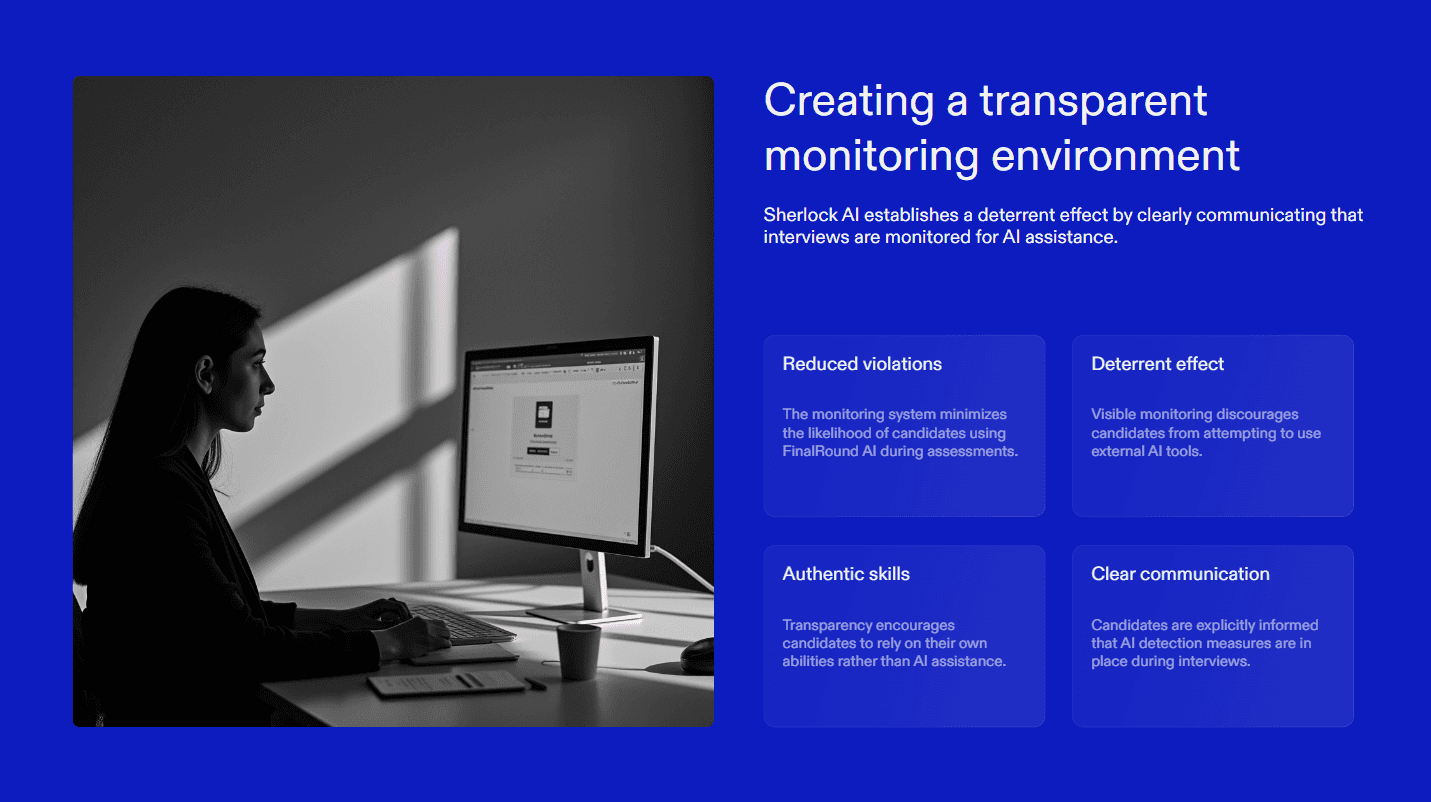
How Sherlock AI Prevents AI-Assisted Cheating
Detection alone is not enough. Prevention is equally critical.
Sherlock AI prevents FinalRound AI usage by:
Creating a deterrent effect through transparent monitoring
Reducing opportunities for hidden AI assistance
Encouraging authentic, skill-based responses
Supporting interviewers with real-time insights
By combining prevention with detection, Sherlock AI helps organizations maintain trust throughout the hiring process.
Best Practices to Strengthen AI Detection in Interviews
Technology works best when paired with smart interview design. To further prevent AI-assisted cheating:
Ask follow-up questions that require contextual reasoning
Use scenario-based and problem-solving questions
Evaluate how candidates explain their thinking, not just the final answer
Look for consistency across multiple responses
These practices complement Sherlock AI’s intelligence and reduce false positives.
The Future of Interviews: Authenticity Over Automation
AI will continue to influence hiring but authenticity must remain the foundation of interviews. Tools like FinalRound AI blur the line between preparation and misrepresentation, making it harder for companies to hire with confidence.
To detect and prevent FinalRound AI in interviews, organizations need adaptive, intelligent solutions that understand human behavior-not just surface activity. Sherlock AI enables fair evaluation, protects interview integrity, and ensures hiring decisions are based on real talent.
Conclusion
Detecting and preventing FinalRound AI in interviews is no longer optional, it’s essential. As AI-assisted cheating becomes more sophisticated, hiring teams must move beyond basic monitoring and adopt intelligent, behavior-driven solutions.
Sherlock AI empowers organizations to identify hidden AI assistance, prevent misuse, and confidently assess candidates based on genuine skills. In a world where AI can simulate competence, Sherlock AI helps hiring teams find the real thing.