Back to all blogs
Learn AI interview cheating signs recruiters often miss and how to detect inconsistencies in candidate responses, behavior, and identity to ensure fair and reliable hiring.
Abhishek Kaushik
Mar 5, 2026
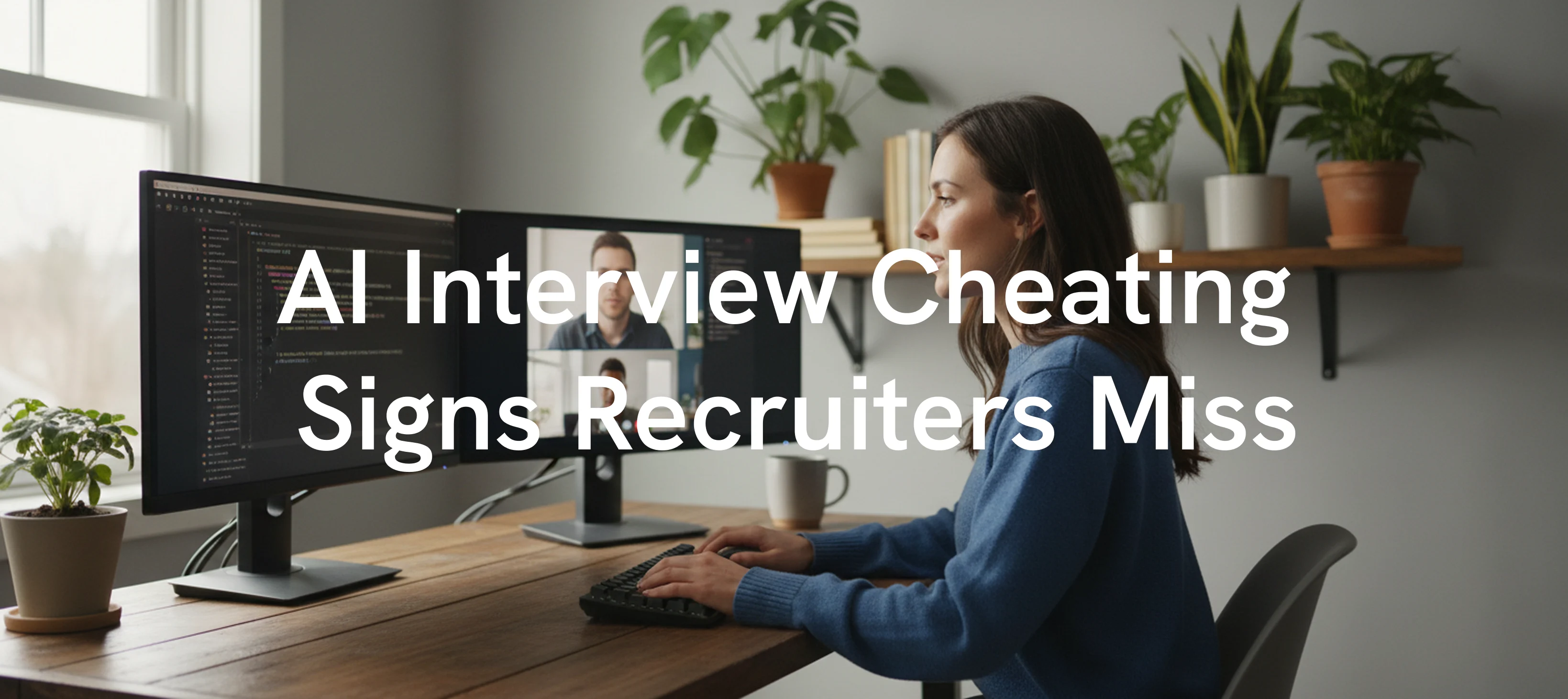
As companies accelerate remote hiring and rely heavily on virtual interview tools, candidates are increasingly turning to generative AI, deepfake tech, and hidden assistance tools during live interviews, often without recruiters realizing it. According to recent industry data, 59% of managers suspect candidates have used AI tools to misrepresent themselves, while 35% say someone other than the listed applicant participated in a virtual interview.
Despite the scale of the problem, only 19% of hiring teams feel confident their current processes would catch a fraudulent candidate. This gap costs time, money, and quality hires. If recruiters can’t recognize the subtle signs of AI-driven deception, fraudulent candidates slip through, genuine candidates get overlooked, and company performance suffers as a result.
AI Interview Cheating Signs Recruiters Miss
Modern interviews are no longer just about evaluating skills, they’re about ensuring authenticity. With AI tools and proxy candidates becoming more accessible, recruiters face the hidden challenge of identifying subtle signs of cheating. Many warning signals go unnoticed, but spotting them early can save hiring teams from costly mistakes.
Here are 8 AI interview cheating signs recruiters often miss, explained in detail:
1. Overly Polished or Scripted Responses
Candidates using AI often provide answers that are flawless but unnatural. Indicators include:
Perfect grammar and structure – answers sound “too professional” for the candidate’s background.
Textbook explanations – lacks personal context or unique insights.
No minor mistakes or hesitations – real people usually pause, rephrase, or stumble slightly when thinking aloud.
Overly polished answers may hide gaps in real understanding or experience. Recruiters may unconsciously equate polish with skill, but it could mask AI assistance.
2. Sudden Vocabulary or Skill Jumps
AI tools can make candidates appear more knowledgeable than they are. Signs include:
Unexplained jumps in technical complexity – suddenly using advanced jargon that wasn’t present in prior rounds.
Inconsistent skill demonstration – strong performance in one area but weak in others where similar skills are required.
Out-of-place references or examples – mentioning frameworks, tools, or concepts unfamiliar to the candidate’s stated experience.
Recruiters often assume knowledge is uniform across rounds, but abrupt skill spikes can indicate external help.
Read more: How to Detect Cheating in a Zoom Interview
3. Weak Follow-Up Reasoning
While AI can generate complete answers, candidates may struggle when asked to think critically. Look for:
Difficulty explaining “why” or “how” – they know the answer but can’t justify it.
Repeating AI-generated phrases verbatim – lacks personal interpretation.
Inability to handle hypothetical scenarios – AI answers are static; humans can adapt thinking on the fly.
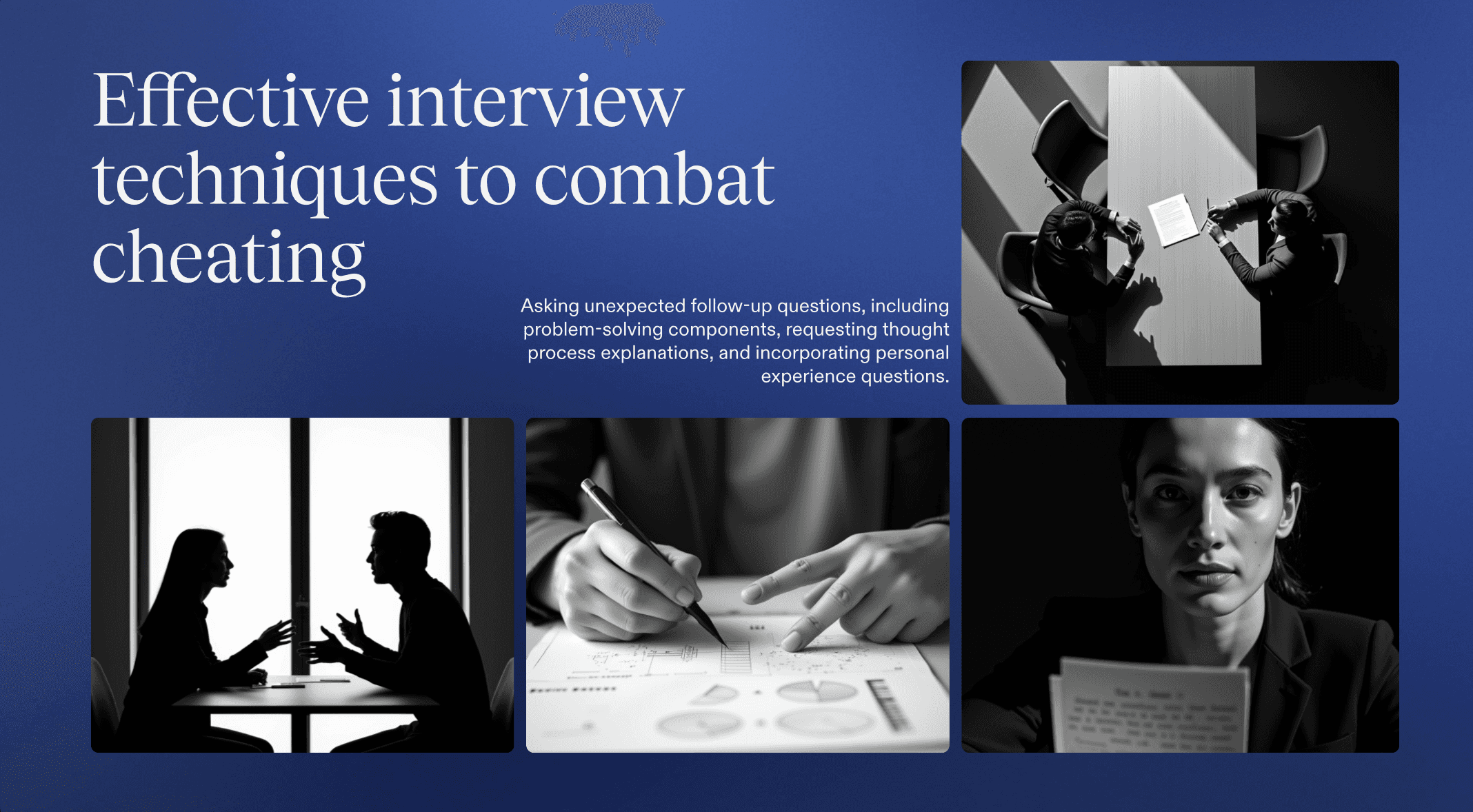
Follow-up questioning exposes the difference between genuine understanding and AI-assisted answers.
4. Unnatural Response Timing
Timing can reveal hidden assistance:
Responses that are too fast – cut-and-paste answers or memorized AI output.
Long delays – reading or generating AI responses mid-interview.
Inconsistent pacing – fast in some questions, slow in others, without clear reasoning.
Recruiters often focus on content, not timing. Small delays or unnatural speed can be early signs of external support.
5. Behavioral Inconsistencies
AI or proxies may introduce subtle behavior changes across rounds:
Tone and energy shifts – highly confident one day, robotic the next.
Variations in engagement – inconsistent eye contact, gestures, or enthusiasm.
Mismatch between verbal and non-verbal cues – overly calm delivery when answering complex questions.
Behavioral inconsistencies can indicate that someone other than the candidate is providing responses.
6. Mismatched Assessment vs Interview Performance
When written assessments don’t align with live interviews, suspicion is warranted:
High assessment scores but poor live explanations
Advanced coding or problem-solving online but struggles verbally
Skills demonstrated inconsistently across platforms
Recruiters often trust assessment results, but mismatches reveal potential AI use or proxy candidates.
7. Camera or Microphone Avoidance
Physical visibility matters for integrity:
Frequent requests to keep cameras off
Poor angles or partial visibility – hides identity or proxy participation
Inconsistent audio cues – delays, echo, or unnatural voice modulation
Avoidance may indicate an attempt to conceal identity, a proxy candidate, or AI-assisted communication.
8. Identity & Continuity Gaps Across Rounds
Cheating often shows up as inconsistencies over multiple interview stages:
Different communication styles in each round
Sudden shifts in confidence or expertise
Skills shown in assessments not matching live interactions
Modern recruitment evaluates candidates across multiple stages. Continuity gaps signal that the person appearing in one stage may not be the same in another or that external assistance is involved.
AI-assisted cheating is subtle, sophisticated, and increasingly common. By being vigilant about these 8 signs, recruiters can:
Identify inconsistencies before hiring decisions are made
Protect the integrity of assessments and interviews
Ensure new hires genuinely possess the skills they claim
Awareness, combined with purpose-built tools that track candidate behavior and continuity, is essential to maintaining fair and reliable hiring outcomes.
Sherlock AI: The Solution to AI-Assisted Interview Cheating
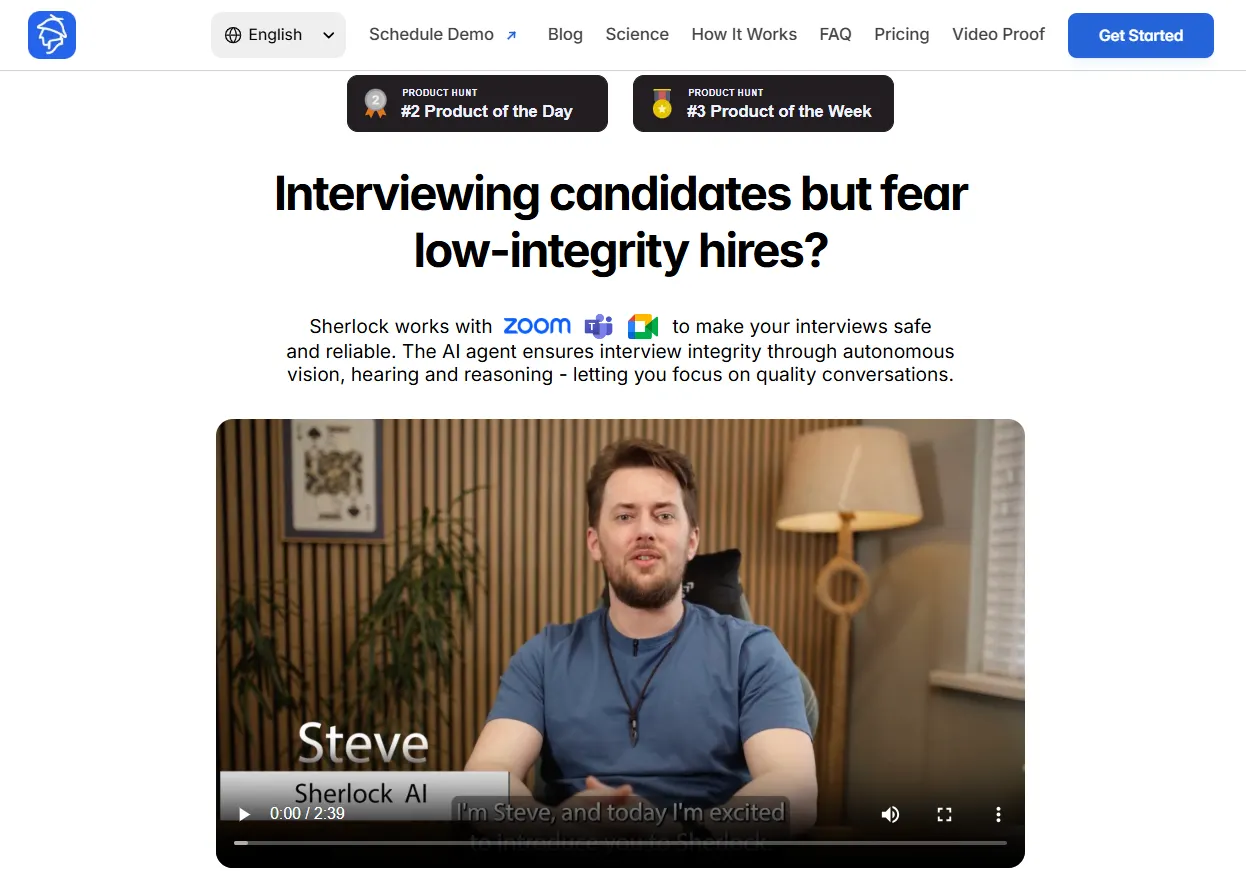
Sherlock AI is a purpose-built solution designed to protect interview integrity from start to finish. Sherlock AI doesn’t just flag suspicious behavior; it actively ensures trust, continuity, and authenticity across every stage of the hiring process.
Here’s how Sherlock AI addresses the cheating signs recruiters often miss:
1. Real‑Time AI Fraud Detection
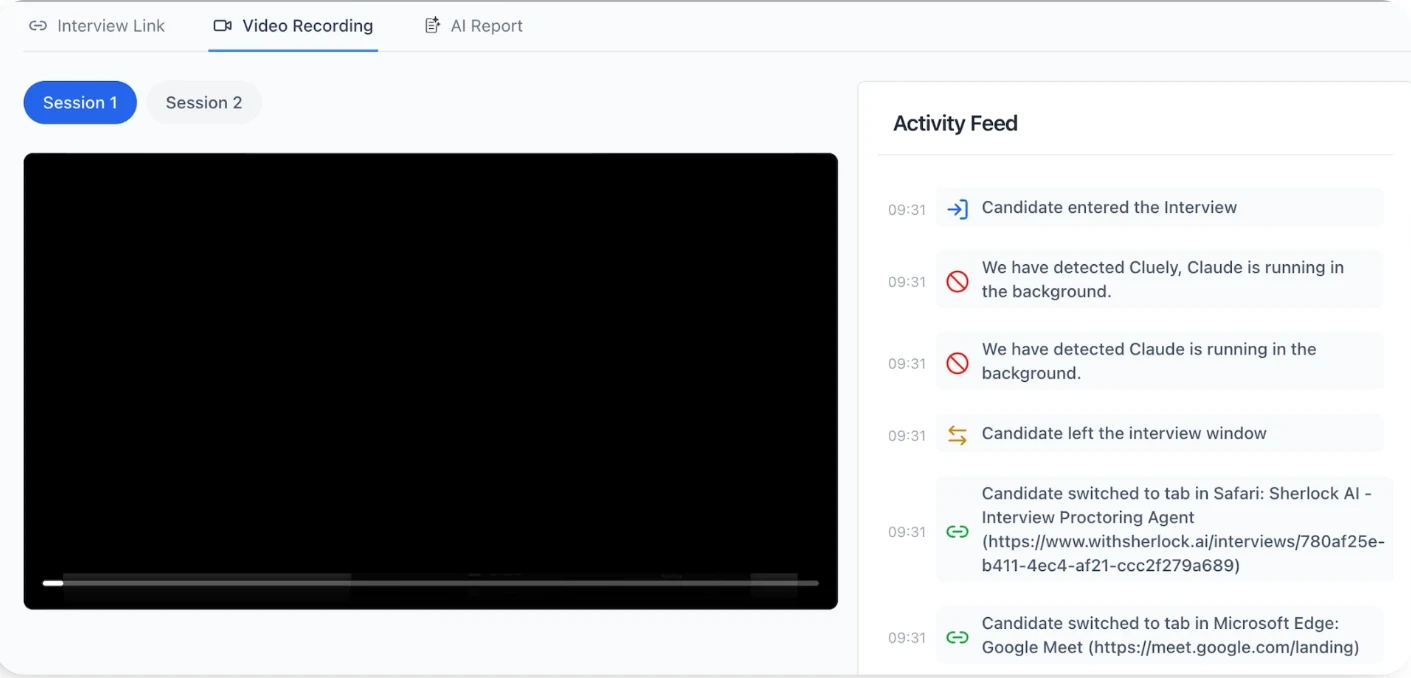
Sherlock AI continuously monitors interviews using deep learning models that combine audio, visual, behavior, and system signals in real time.
Detects AI‑assisted responses and deepfake behavior during the session
Flags anomalies without waiting for post‑interview analysis
Helps interviewers stay focused while Sherlock silently checks integrity
2. Multimodal Behavioral & Context Monitoring
Rather than relying on single signals like eye movement, Sherlock AI fuses multiple data types to detect cheating patterns more reliably:
Device cues (e.g., hidden screens, multiple input devices)
Audio inconsistencies (e.g., unusual background voices or prompts)
Candidate behavior patterns (e.g., response timing, pauses and clarity shifts)
3. Seamless Calendar & Meeting Integration
Sherlock AI integrates with calendar systems like Google Calendar, Apple Calendar and Outlook so you can:
Automatically secure scheduled interviews
Generate protected meeting links
4. Real‑Time Alerts & Interview Commentary
During interviews, Sherlock AI provides:
Live alerts to interviewers when suspicious behavior is detected
Contextual notes tied to specific moments
5. Automated Notes & Interview Insights
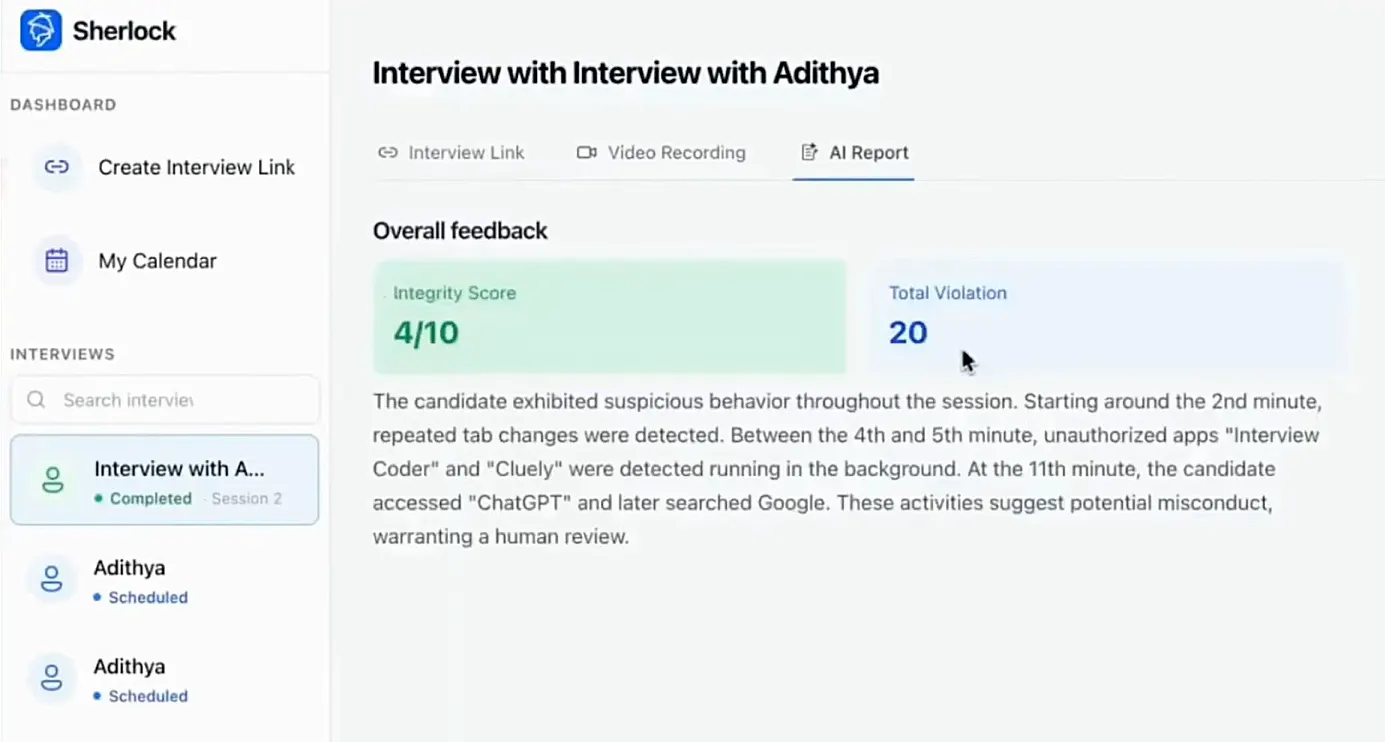
Sherlock AI captures detailed, structured notes automatically so you can:
Review candidate reasoning trails later
Compare performance across interviews without manual note‑taking
Build consistent evaluation records for debriefs or audits
6. Respectful, Non‑Intrusive Detection Philosophy
Sherlock AI is built around a trust‑first design that:
Avoids invasive surveillance or browser lockdowns
Works in the background without disrupting candidates
Focuses on signals that help interviewers ask smarter follow‑ups
Supports fairness and transparency in evaluations
In a world where polished answers can be AI‑assisted or rehearsed, Sherlock AI offers a contextual, real‑time, and human‑centered solution that protects your hiring quality without slowing your process.
Conclusion
AI-assisted cheating and proxy candidates are real challenges in modern interviews, especially for remote and high-volume hiring. Subtle signs like overly polished answers, sudden skill jumps, unnatural response timing, or continuity gaps often go unnoticed, leaving recruiters at risk of hiring unqualified candidates.
Purpose-built solutions like Sherlock AI close this gap by providing real-time monitoring, behavioral insights, identity verification, and contextual alerts, all while preserving a fair candidate experience. With Sherlock, recruiters gain the confidence to focus on what truly matters: evaluating genuine skills, potential, and fit, rather than worrying about hidden fraud.