Back to all blogs
Explore the top 15 remote proctoring tools for secure remote hiring. Compare features, proctoring methods, and find the right solution to maintain candidate integrity.

Abhishek Kaushik
Apr 30, 2026

Remote assessments are now a standard part of hiring. But keeping them fair and secure is still a challenge, especially when interviews and tests happen without any in-person supervision. It becomes difficult to verify who is actually taking the test and whether outside help or unfair practices are involved.
Remote proctoring tools help teams handle this. They monitor candidates during interviews and assessments, verify identity, and flag suspicious behavior in real time. Many also record sessions and track activity to give recruiters better visibility into what actually happened.
Choosing the right tool can make a big difference in maintaining candidate integrity without adding friction to the experience. Here are 15 remote proctoring tools that teams use to run secure and reliable hiring processes.
Top 15 Remote Proctoring Tools
Each of these tools offers a different approach to proctoring, from AI-led monitoring to live invigilation. The right choice depends on your hiring needs, scale, and the level of control you want during assessments.
Sherlock AI
Sherlock AI is built specifically for remote interviews, where verifying candidate authenticity is often the biggest challenge. It acts as an AI proctor that monitors interviews in real time and helps detect cheating without interrupting the flow of the conversation.

It uses a multimodal approach, combining video, audio, and behavioral signals to identify suspicious patterns during interviews. Instead of relying on basic rule-based flags, it analyzes how candidates interact and detects when behavior appears assisted or unnatural.
Key features:
AI copilot and live assistance detection: Identifies when candidates are using AI copilots or receiving live external help during interviews by analyzing response patterns and timing anomalies.
Proxy and impersonation detection: Flags cases where another person may be assisting or replacing the candidate using face mismatch, voice inconsistency, and behavioral signals.
Deepfake detection: Detects synthetic video or audio manipulation to prevent candidates from using deepfake tools to fake identity or presence.
Multimodal monitoring: Combines video, audio, screen behavior, and interaction signals to build a more complete view of candidate activity.
Real-time alerts during interviews: Notifies interviewers instantly when suspicious behavior is detected, allowing immediate follow-up or intervention.
Post-interview integrity reports: Provides detailed breakdowns of flagged moments, including timestamps and explanations for easier review and decision-making.
Behavioral pattern analysis: Goes beyond rule-based flags by analyzing how candidates think, respond, and interact to detect unnatural or assisted behavior.
AI fluency assessment (optional): Differentiates between genuine candidate responses and AI-generated answers, especially in environments where AI use may be partially allowed.
Session recording and audit trails: Captures interview sessions with contextual metadata so teams can revisit and validate decisions when needed.
Seamless integration with interview workflows: Works alongside common video interview tools without disrupting the candidate experience or requiring complex setup.
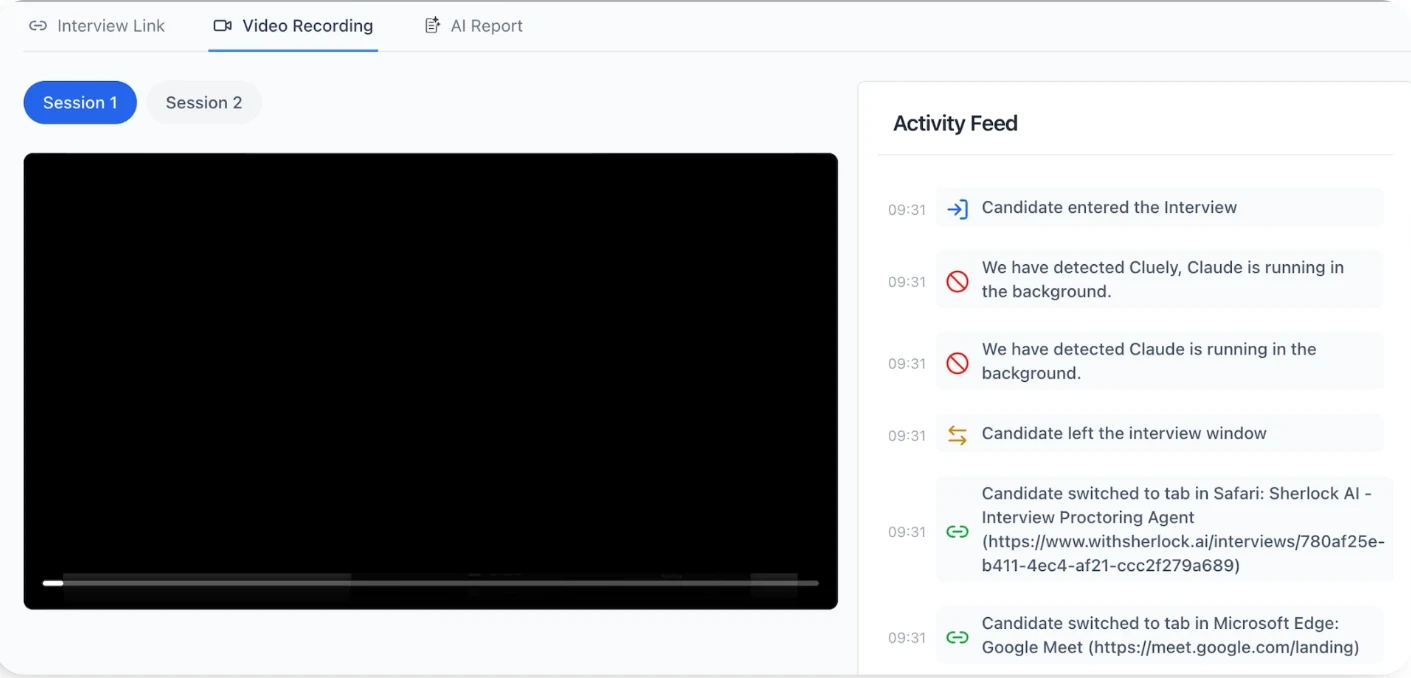
Sherlock AI is a strong fit for teams that want deeper visibility into candidate behavior without adding friction to the interview process. It works in the background so recruiters can stay focused on evaluating candidates.
👉 Explore How Sherlock AI Stops Invisible Interview Cheating
2. Talview
Talview is a remote proctoring platform designed for online assessments and certifications. It combines AI-based automation with live proctoring and review workflows to support different levels of exam monitoring.
Key features:
AI and live proctoring modes: Supports automated, live, and record-and-review proctoring based on assessment needs.
Advanced identity verification: Uses facial recognition, ID checks, and voice matching to detect impersonation and proxies.
Secure browser and environment controls: Restricts candidate actions and ensures a controlled test environment.
AI flagging and integrity scoring: Tracks behavior during the test and generates an integrity score with flagged events for review.
3. Honorlock
Honorlock is a remote proctoring tool built for online exams, combining automated monitoring with human review when needed. It focuses on maintaining exam integrity while minimizing interruptions during the test.
Key features:
AI + live proctoring (pop-in model): AI monitors sessions and alerts a human proctor only when suspicious behavior is detected.
AI tool and chatbot blocking: Prevents the use of AI tools, chatbots, and external assistance during exams.
Browser lockdown and controls: Blocks websites, applications, and shortcuts like copy-paste during tests.
Cell phone and device detection: Detects the presence and usage of unauthorized devices like phones and tablets.
4. Mercer | Mettl
Mercer | Mettl is a remote proctoring and assessment platform designed for hiring, certification, and academic exams. It offers a mix of AI-based monitoring and human proctoring with strong control over test environments.
Key features:
AI-based proctoring with automated flags: Monitors video and audio feeds to detect suspicious activity.
Live and record-and-review proctoring: Supports real-time human invigilation as well as post-exam session reviews.
Secure browser with lockdown controls: Restricts navigation, copy-paste, and external applications during tests.
Dual camera and environment monitoring: Uses additional camera inputs to capture a wider view of the candidate’s surroundings.
5. Examity
Examity is a remote proctoring platform focused on online exams, combining live proctors with automated monitoring and flexible security levels. It allows organizations to choose how strictly exams are monitored based on their needs.
Key features:
Live, automated, and hybrid proctoring: Supports different proctoring levels, from AI-based monitoring to fully live human proctors.
Identity verification and authentication: Verifies candidates before exams using ID checks and pre-exam validation steps.
Flexible security configurations: Lets teams customize rules, security levels, and exam conditions for different use cases.
Session recording and audit review: Records exam sessions and uses auditors to review flagged incidents before sharing results.
6. Proctorio
Proctorio is a remote proctoring tool for online exams that focuses on automated monitoring with configurable security settings. It allows institutions to control how exams are recorded, verified, and restricted based on their requirements.
Key features:
AI-based behavior monitoring: Detects suspicious activity by analyzing video, audio, and device behavior during exams.
Customizable recording options: Records video, audio, screen, and web activity with flexible configuration settings.
Identity verification controls: Uses facial recognition, ID checks, and other verification methods to confirm test-taker identity.
Browser lockdown and restrictions: Prevents actions like opening new tabs, copying content, or accessing external resources.
7. ExamSoft
ExamSoft is a digital assessment platform with built-in remote proctoring through tools like ExamMonitor and ExamID. It focuses on secure exam delivery, offline testing, and post-exam review workflows.
Key features:
AI + human-reviewed proctoring: Records video and audio during exams and flags anomalies for human review.
Identity verification (ExamID): Confirms candidate identity using facial capture before the exam begins.
Video, audio, and screen monitoring: Continuously records candidate activity throughout the exam session.
Offline exam capability with secure upload: Allows exams to run without internet and uploads encrypted data after completion.
8. Proctortrack
Proctortrack is a remote proctoring tool designed for online exams, using a mix of AI monitoring, identity verification, and secure browser controls. It supports automated, live, and hybrid proctoring models depending on exam requirements.
Key features:
AI-based monitoring with behavior tracking: Detects suspicious activity using video, audio, and system-level signals during exams.
Continuous identity verification: Uses facial recognition and biometric checks like ID and knuckle scans to prevent impersonation.
Automated flags with review dashboard: Generates flagged incidents, timestamps, and integrity scores for post-exam review.
Flexible proctoring modes: Supports automated, live, and hybrid proctoring for different exam types and scale.
9. Examus
Examus is an AI-based remote proctoring tool focused on automated behavior analysis during online exams. It uses computer vision and behavioral tracking to monitor candidate activity and flag violations.
Key features:
AI-based behavior and emotion analysis: Tracks gaze, facial expressions, and attention levels to detect suspicious patterns.
Face recognition and identity verification: Uses facial recognition to confirm candidate identity and detect impersonation.
Detection of multiple people and absence: Flags if another person appears or if the candidate leaves the frame during the exam.
Screen activity and tab switch detection: Monitors screen sharing, tab changes, and use of secondary monitors.
10. Proctor360
Proctor360 is a remote proctoring platform designed for online exams, combining AI monitoring with live proctoring and multi-camera setups. It focuses on giving full visibility into the test environment, including beyond the standard webcam view.
Key features:
AI, live, and hybrid proctoring: Supports automated monitoring, live proctors, and flexible combinations based on exam needs.
360-degree environment monitoring: Uses a 360° camera headset to capture the entire testing space and eliminate blind spots.
Multi-camera setup (including mobile as second camera): Adds additional camera angles to monitor surroundings and detect off-screen assistance.
Identity verification and automated check-in: Verifies candidates before the test using ID checks and automated onboarding workflows.
11. OnVUE
OnVUE is an online proctoring solution by Pearson VUE that allows candidates to take exams remotely while being monitored in real time. It combines AI-based monitoring with live proctor supervision to maintain exam security.
Key features:
Live + AI proctoring: Combines human proctors with AI monitoring to supervise candidates during exams.
Identity verification and check-in: Uses ID verification, facial capture, and a 360° room scan before the exam starts.
Secure exam environment controls: Requires a clean desk, single screen, and restricted device usage during the test.
Screen, audio, and video monitoring: Records and monitors candidate activity throughout the session for integrity checks.
12. Questionmark
Questionmark is an assessment and proctoring platform designed for certifications, hiring, and education. It offers flexible proctoring options with a focus on secure exam delivery and scalable assessment workflows.
Key features:
Live, AI, and record-and-review proctoring: Supports live proctors, automated monitoring, and recorded sessions for later review.
Identity verification and environment checks: Verifies candidates and inspects their surroundings before and during the exam.
Secure browser and lockdown controls: Restricts access to external resources and keeps candidates within the test environment.
AI-based flagging and session review: Flags suspicious activity and allows reviewers to analyze recorded sessions.
13. DigiProctor
DigiProctor is an AI-based remote proctoring and digital exam platform designed for both academic and corporate assessments. It combines automated monitoring with human oversight and supports end-to-end exam workflows.
Key features:
AI + human proctoring modes: Supports automated, AI-assisted, and fully live proctoring depending on exam requirements.
Continuous identity verification: Uses facial recognition and periodic face matching to detect impersonation during the test.
Secure browser and deep system monitoring: Locks down browsers and scans system-level activity to detect unauthorized tools or virtual environments.
Video, audio, and screen monitoring: Records webcam, microphone, and screen activity to track candidate behavior throughout the session.
14. TestDome
TestDome is an online testing platform focused on pre-employment assessments with built-in anti-cheating measures. It is designed for hiring workflows rather than full-scale exam proctoring.
Key features:
Anti-cheating safeguards: Includes measures like question randomization, time limits, and plagiarism detection.
Webcam snapshots during tests: Captures periodic images to monitor candidate presence.
Copy-paste and tab switch detection: Flags suspicious actions like switching tabs or copying answers.
Skill-based assessments and coding tests: Offers ready-to-use tests across technical and non-technical roles.
Automated scoring and reports: Generates instant results and performance insights for recruiters.
15. PSI Bridge
PSI Bridge is a remote proctoring platform designed for high-stakes exams, offering live and recorded proctoring with strong identity verification and security controls. It is commonly used for certification and academic testing.
Key features:
Advanced identity verification and biometrics: Uses ID checks, facial recognition, and behavioral signals to prevent impersonation.
Secure browser with lockdown controls: Requires a dedicated browser that blocks external apps, tabs, and unauthorized activity.
360° environment and device checks: Includes room scans and system checks before the exam to ensure a compliant setup.
Custom reports and analytics: Provides detailed reports, flagged events, and audit trails for post-exam review.
Conclusion
Remote proctoring tools have become essential for running secure online assessments, but the right choice depends on how you balance security, candidate experience, and scale. Some tools focus on strict exam controls, while others are built for real-time interview integrity and detecting modern risks like AI assistance and proxies.
As remote hiring continues to evolve, choosing a tool that goes beyond basic monitoring and actually helps you understand candidate behavior will make a meaningful difference in maintaining trust in your process.