Back to all blogs
Deepfake interview fraud is rising in remote hiring. Learn the key warning signs, detection techniques, and prevention strategies to protect your hiring process.
Abhishek Kaushik
Jun 9, 2026
Remote hiring has created new efficiencies in recruitment, but it has also introduced a fast-growing threat: deepfake interview fraud. What once sounded like a cybersecurity problem reserved for movies is now affecting recruiters, HR leaders, and security teams across industries. Fraudulent candidates are using AI-generated video, voice cloning, proxy interview tactics, and real-time answer assistance to bypass traditional hiring processes.
The scale of the problem is growing rapidly. According to Gartner, by 2028, one in four job candidates globally could be fake. Meanwhile, a Checkr survey revealed that only 19% of employers felt extremely confident in their ability to detect hiring fraud.
This shift is not just an HR issue. It is a security and operational risk. Fake candidates can gain access to company systems, steal sensitive data, deploy malware, or create compliance liabilities. CNBC recently reported that companies hiring remote workers are increasingly facing AI-generated applicants using fabricated identities, fake IDs, and deepfake video technology during interviews.
The biggest challenge is that modern deepfake interviews are increasingly difficult to detect through human judgment alone. Traditional interview processes were designed around trust and conversation, not identity verification and forensic analysis.
In this guide, we’ll examine how deepfake interview fraud works, the warning signs recruiters and hiring managers should watch for, how AI-assisted impersonation tactics are evolving in 2026, and the most effective strategies organizations can use to detect and prevent fraudulent hires before they become costly security incidents.
What Are Deepfake Interviews?
Deepfake interviews are fraudulent job interviews in which candidates use AI to manipulate, conceal, or fabricate their identity during the hiring process. These interviews can involve AI-generated video, cloned voices, proxy interviewers, or real-time AI assistance designed to deceive recruiters and hiring managers.
In most cases, the goal is simple: secure a job under false pretenses.
A deepfake candidate may appear on camera using face-swapping software that overlays another person’s face in real time. Others use voice cloning tools to mimic speech patterns and accents. Some applicants use hidden AI copilots to generate real-time responses during technical and behavioral interviews. In more advanced fraud cases, one person attends the interview while another person eventually performs the actual job after hiring.
This problem has accelerated because remote hiring has become standard across industries. Virtual hiring environments make identity deception significantly easier to execute and harder to detect than traditional in-person interviews.
How to Detect Deepfake Interviews
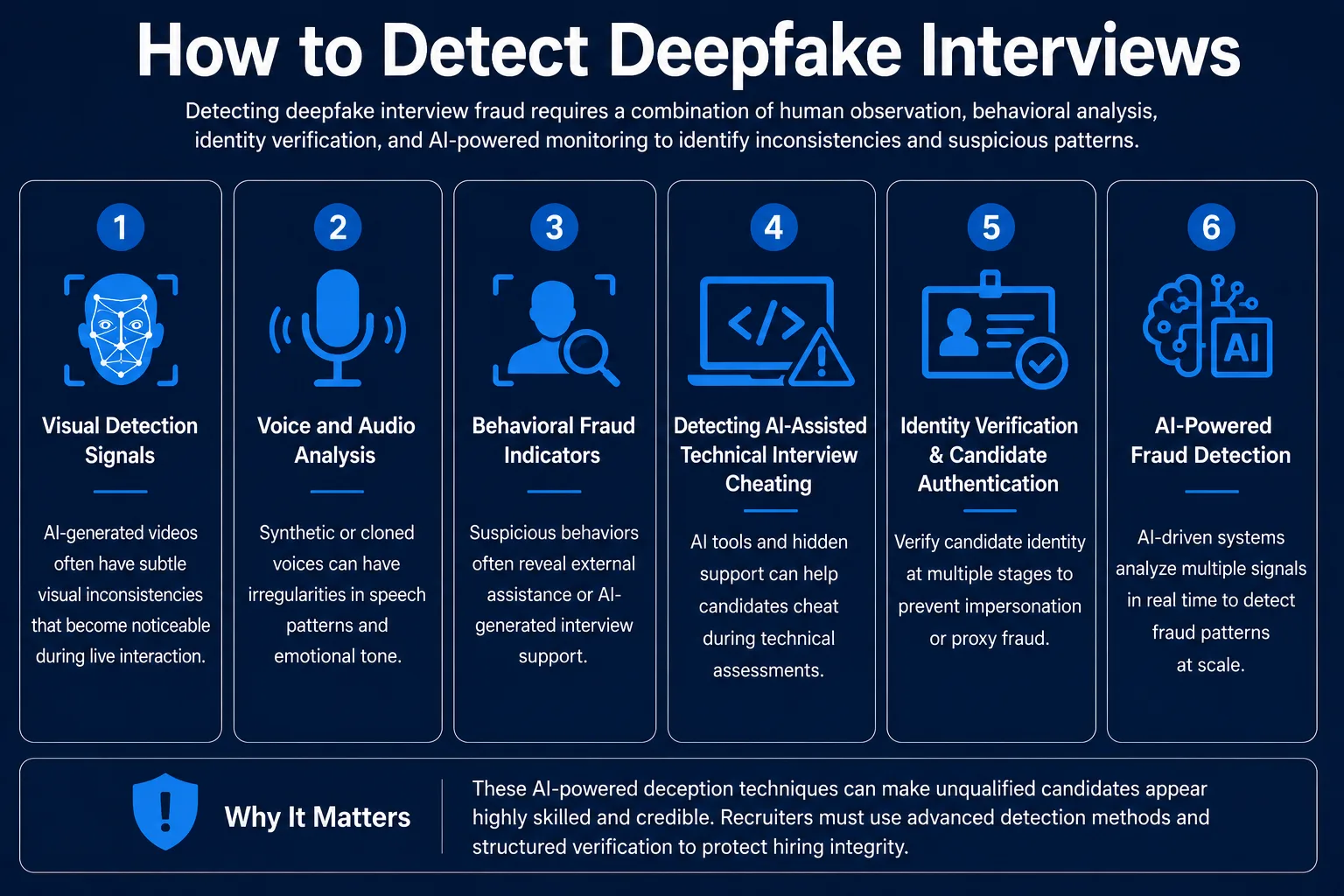
Detecting deepfake interview fraud requires more than recruiter intuition. Modern AI-powered deception tools can manipulate video, clone voices, generate interview responses in real time, and even enable proxy candidates to impersonate qualified professionals during remote interviews. As these techniques become more sophisticated, organizations need structured detection methods that combine human observation, identity verification, behavioral analysis, and AI-powered monitoring.
The most effective deepfake interview detection strategies focus on identifying inconsistencies across video, audio, behavior, communication patterns, and technical interactions throughout the hiring process.
Visual Detection Signals
AI-generated video manipulation often leaves behind subtle visual inconsistencies that become more noticeable during live interaction. Recruiters should pay close attention to how candidates move, react, and appear on camera throughout the interview.
Common visual warning signs include:
Lip movements that do not fully align with speech
Blurred jawlines, facial edges, or hairlines
Flickering or distortion during head movement
Inconsistent facial lighting compared to the surrounding environment
Unnatural blinking patterns or stiff facial expressions
Temporary glitches when the candidate turns quickly or gestures
These anomalies may appear briefly, especially when deepfake software struggles to render facial movements in real time.
Voice and Audio Analysis
Voice cloning technology has improved rapidly, but synthetic audio systems can still produce detectable irregularities during live conversations. Recruiters should monitor speech consistency, emotional variation, and response timing carefully.
Potential indicators of AI-generated or manipulated audio include:
Robotic or overly smooth speech delivery
Emotionally flat or unnatural vocal tone
Delayed responses before answers begin
Audio distortion during longer explanations
Sudden changes in pronunciation, tone, or accent
Mismatched facial expressions and vocal emotion
Candidates using voice cloning tools may also struggle during spontaneous discussions or follow-up questioning.
Behavioral Fraud Indicators
Behavioral analysis is one of the most effective ways to identify AI-assisted interview fraud. Even when video and audio manipulation appear convincing, suspicious interaction patterns often reveal external assistance or synthetic behavior.
Recruiters should watch for:
Frequent off-screen eye movement
Repeated attention shifts toward secondary devices
Long pauses before answering technical questions
Overly polished or scripted responses
Difficulty handling unexpected follow-up questions
Inconsistent confidence levels during conversation
Responses that sound technically accurate but lack practical depth
Candidates relying on AI copilots often perform well on predictable questions but struggle when conversations become dynamic or unscripted.
Detecting AI-Assisted Technical Interview Cheating
Technical interviews are increasingly targeted by candidates using hidden AI coding assistants or external support systems. Fraudulent candidates may submit correct solutions while lacking the ability to explain their reasoning or problem-solving process.
Signs of AI-assisted technical cheating may include:
Perfect code quality paired with weak verbal explanations
Delayed responses during live coding exercises
Excessive copy-paste behavior
Difficulty modifying their own solution during follow-up questions
Suspicious screen-sharing interruptions
Hidden browser or application switching
Inconsistent technical depth throughout the interview
Live collaborative problem-solving exercises are often more effective than static assessments for identifying genuine expertise.
Identity Verification and Candidate Authentication
Many deepfake interview attempts involve fake identities, proxy candidates, or impersonation fraud. Organizations should verify candidate authenticity throughout the hiring process rather than relying on a single verification step.
Effective identity verification methods include:
Government-issued ID validation
Live selfie authentication
Facial matching across interview stages
Real-time liveness detection
Device and browser consistency checks
Verification during onboarding and final interviews
Continuous verification helps prevent situations where one individual attends interviews while another person joins after hiring.
Using AI-Powered Interview Fraud Detection
As deepfake technology evolves, manual detection alone is becoming increasingly unreliable. Many organizations are now adopting AI-powered interview monitoring platforms to identify fraud indicators at scale during remote hiring.
Modern interview intelligence systems can analyze:
Facial consistency and rendering anomalies
Voice synchronization patterns
Behavioral irregularities
Suspicious response timing
AI-generated speech behavior
External device usage indicators
Interview interaction consistency
Platforms like Sherlock AI help recruiters identify suspicious candidate behavior in real time while maintaining a smooth and secure remote hiring experience.
Why Deepfake Interviews Are Increasing in Remote Hiring
Remote hiring has become the standard for many organizations because it allows companies to recruit talent faster and from a global talent pool. However, this shift has also created new vulnerabilities in the hiring process. Unlike in-person interviews, remote interviews rely heavily on webcams, digital identities, and online communication tools, making it easier for fraudsters to manipulate their appearance, voice, or credentials using AI-powered technology. Deepfake software, proxy interviews, and AI-generated responses are now being used to bypass recruiter verification and secure remote job opportunities fraudulently.
Another reason deepfake interview fraud is increasing is the rapid accessibility of generative AI tools. Today, anyone with basic technical knowledge can access face-swapping applications, voice cloning platforms, and real-time AI assistants at low cost. As remote hiring continues to scale across industries like technology, finance, and customer support, organizations are struggling to distinguish genuine candidates from AI-assisted impostors. Many hiring teams still depend on manual observation during interviews, which makes detecting sophisticated deepfake manipulation increasingly difficult.
According to Statista, confidence in detecting deepfakes remains a major concern across organizations worldwide. Between February 2024 and February 2025:
71% of employees said they were confident in recognizing deepfake identity documents
Only 69% of employees felt confident identifying audio deepfakes
Around 74% of security officers reported confidence in detecting deepfake threats
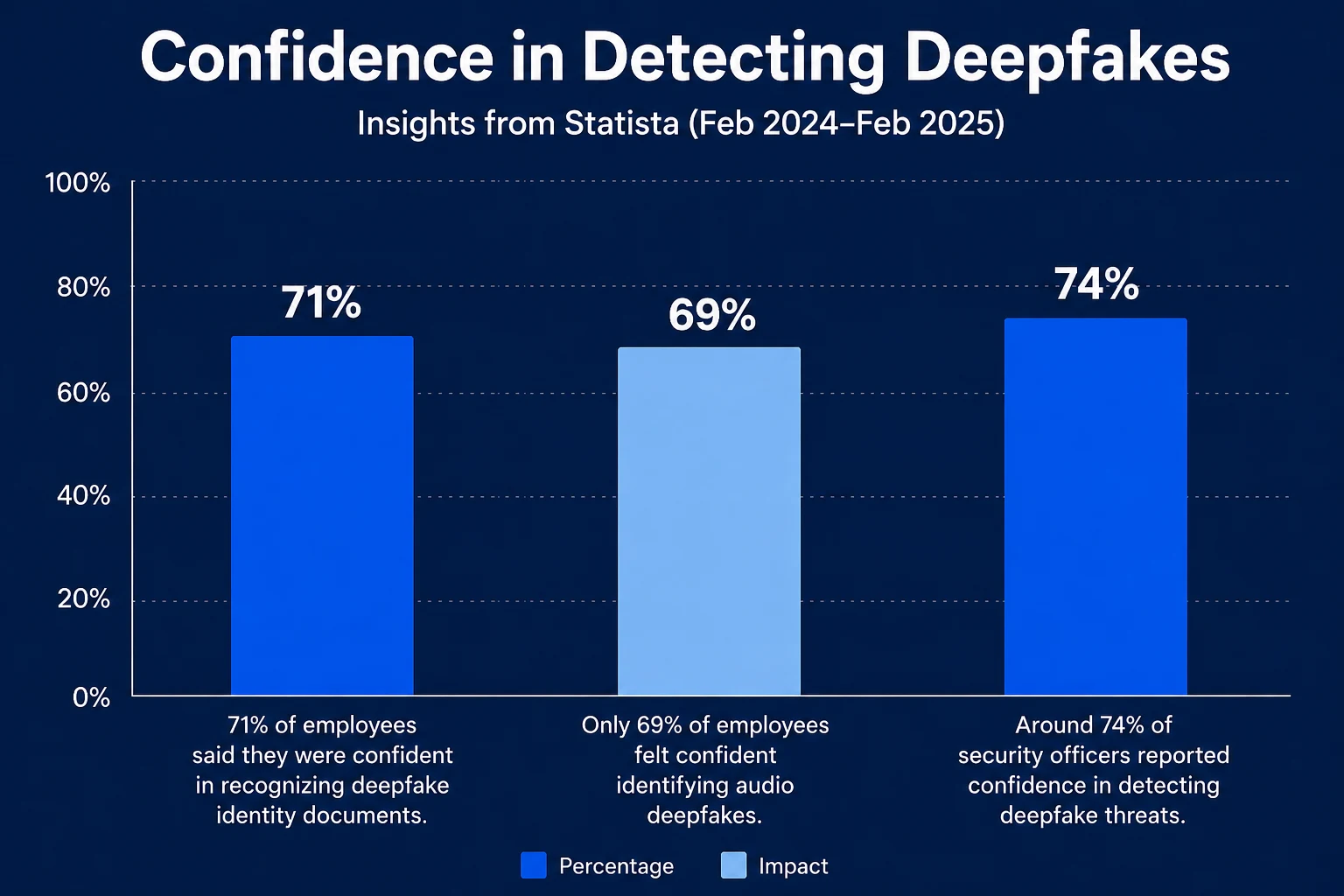
These statistics highlight a growing gap between the sophistication of AI-generated fraud and the ability of organizations to detect it effectively.
What AI Interview Cheating Actually Looks Like
AI interview cheating is no longer limited to candidates searching for answers online during interviews. Modern AI tools can now generate real-time responses, assist with technical assessments, clone voices, and even manipulate live video feeds during remote hiring processes. These technologies allow candidates to appear more qualified, experienced, or fluent than they actually are, making it increasingly difficult for recruiters to separate genuine talent from AI-assisted deception.
Unlike traditional cheating methods, AI-powered interview fraud often happens silently in the background. Candidates may use hidden AI copilots, secondary devices, voice assistants, or browser-based tools that provide instant answers during interviews. In many cases, recruiters may not immediately notice suspicious behavior because the responses sound polished and technically accurate.
As AI interview cheating becomes more sophisticated, recruiters need stronger verification systems, structured assessments, and AI-powered monitoring tools to maintain hiring integrity.
Deepfake Red Flags Recruiters Should Watch For
Recruiters should pay close attention to candidates who display multiple suspicious behaviors during remote interviews, including:
Lip-sync mismatches or visual glitches
Robotic or emotionally flat speech
Frequent off-screen eye movement
Long delays before answering
Overly polished or scripted responses
Difficulty handling follow-up questions
Suspicious screen-sharing interruptions
Inconsistent technical depth during discussions
While a single signal may not confirm fraud, multiple indicators appearing together can suggest AI-assisted interview manipulation or impersonation attempts.
How to Prevent Deepfake Interviews in Your Hiring Process
Preventing deepfake interviews requires a proactive hiring strategy that combines technology, structured verification, recruiter training, and secure interview workflows. As AI-generated deception becomes more advanced, organizations can no longer rely solely on traditional video interviews and manual observation. Companies must build hiring processes designed specifically to detect impersonation, AI-assisted cheating, and synthetic candidate behavior before fraudulent applicants enter the organization.
The most effective prevention strategies focus on verifying candidate identity early, reducing opportunities for external assistance, and continuously monitoring authenticity signals throughout the recruitment process. Organizations that strengthen interview security not only reduce fraud risk but also improve hiring quality and protect sensitive business operations.
Implement Multi-Layer Identity Verification
Identity verification should begin before the first interview stage. Recruiters should validate that the candidate attending the interview matches the submitted application and identification documents.
Effective verification methods include:
Government-issued ID validation
Live selfie authentication
Facial recognition matching
Email and phone verification
Real-time liveness checks
Adding multiple verification layers significantly reduces the chances of proxy candidates or fake identities entering the hiring pipeline.
Use AI-Powered Interview Monitoring
Manual detection alone is no longer enough to identify sophisticated deepfake activity. AI-powered interview intelligence platforms can monitor behavioral patterns, facial consistency, audio synchronization, and suspicious candidate activity during live interviews.
Modern AI interview monitoring tools can detect:
Face-swapping anomalies
Voice cloning indicators
Behavioral inconsistencies
Suspicious eye movement
Real-time answer generation patterns
External device usage
Sherlock AI help recruiters identify interview fraud risks in real time while maintaining a smooth candidate experience.
Introduce Structured Live Assessments
Fraudulent candidates often struggle during unscripted, interactive tasks that require genuine expertise. Structured live assessments make it harder for AI-assisted candidates to rely on external support systems.
Recommended assessment methods include:
Live coding challenges
Real-time case studies
Technical walkthroughs
Problem-solving exercises
Verbal project explanations
Scenario-based simulations
Interactive assessments help recruiters validate practical skills rather than memorized or AI-generated answers.
Limit Opportunities for External Assistance
Many interview fraud attempts rely on hidden devices, secondary monitors, or off-camera coaching. Organizations should reduce opportunities for external assistance during interviews.
Best practices include:
Requiring camera visibility throughout interviews
Asking candidates to share their screen
Using secure browser environments
Restricting unauthorized software access
Conducting environment verification checks
These steps make it more difficult for candidates to use hidden AI copilots or proxy support during interviews.
Train Recruiters to Identify Fraud Signals
Recruiters and hiring managers need ongoing education about modern AI-assisted interview fraud techniques. Many organizations still lack formal training around deepfake detection and interview integrity.
Training programs should cover:
Common deepfake indicators
AI cheating behaviors
Identity fraud detection
Behavioral red flags
Voice and video inconsistencies
Secure interview best practices
Educated recruiters are more likely to detect suspicious behavior early in the hiring process.
Conduct Continuous Verification Throughout Hiring
Identity verification should not stop after the first interview. Fraudsters sometimes switch candidates between interview stages or onboarding processes.
Continuous verification strategies include:
Repeat identity checks during final interviews
Live onboarding verification
Consistent facial comparison across stages
Device fingerprint tracking
Post-hire authentication procedures
Ongoing verification helps ensure that the person hired is the same individual who completed the interview process.
Strengthen Hiring Policies and Compliance Procedures
Organizations should establish clear hiring integrity policies that define acceptable interview conduct and consequences for fraudulent activity.
Strong hiring policies may include:
AI usage disclosure requirements
Candidate authenticity agreements
Secure assessment guidelines
Interview recording consent
Fraud investigation procedures
Documented policies help organizations respond quickly when suspicious activity is detected.
Use Behavioral and Risk Scoring Systems
AI-powered behavioral analysis systems can evaluate candidate authenticity using multiple signals during interviews. These tools help recruiters prioritize high-risk interviews for additional review.
Behavioral risk scoring may analyze:
Communication consistency
Response timing
Facial movement patterns
Voice synchronization
Device activity
Interview interaction behavior
Combining behavioral intelligence with human review creates a more secure and scalable hiring process.
According to industry research, organizations are increasingly investing in AI-driven interview security because remote hiring fraud is becoming a major operational and cybersecurity concern. Companies that implement proactive interview protection systems are better positioned to prevent fraudulent hires, safeguard sensitive data, and maintain trust in remote recruitment processes.
Where Fraud Hits Hardest
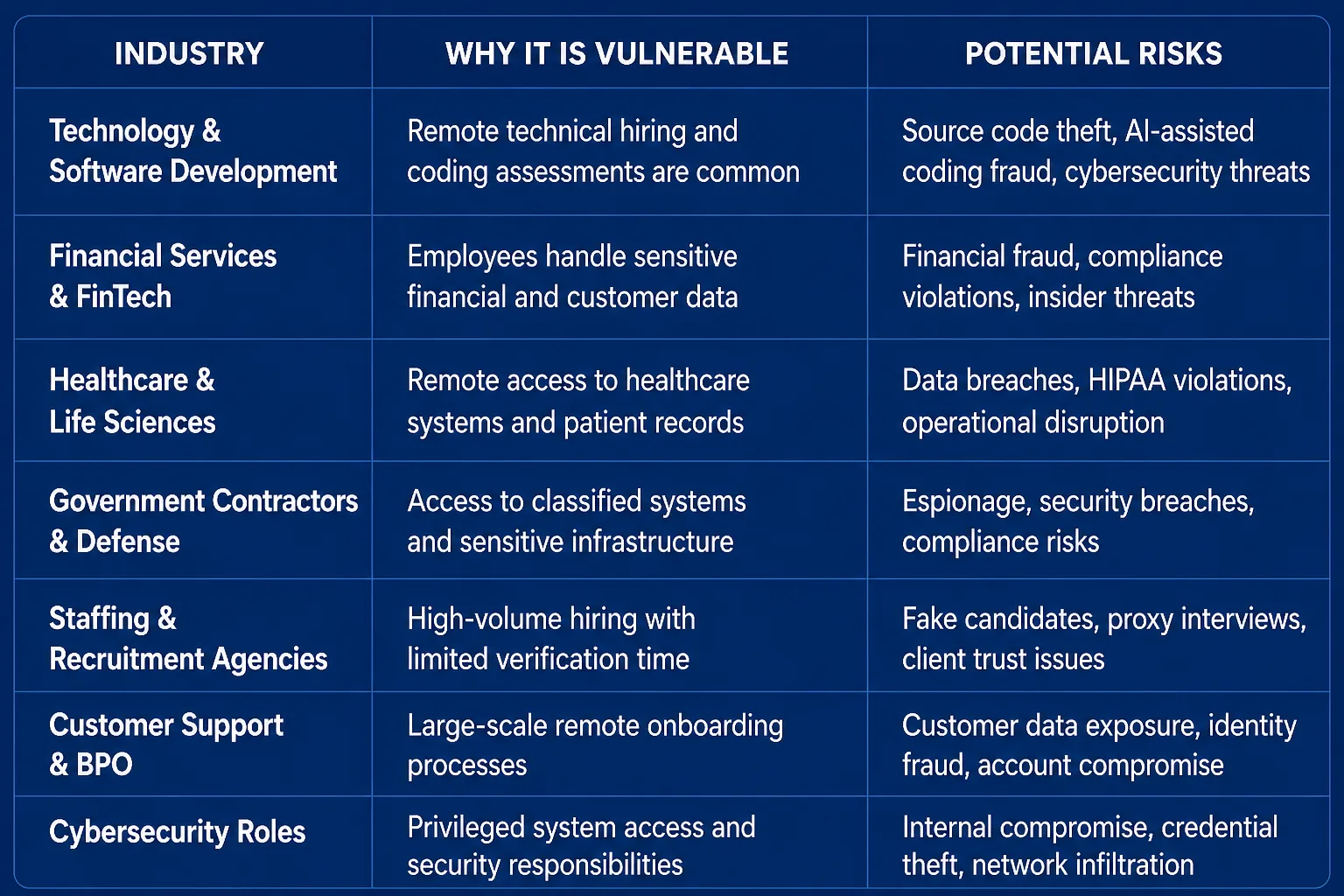
Deepfake interview fraud does not impact every industry equally. Sectors that rely heavily on remote hiring, handle sensitive data, or recruit for highly specialized roles are far more vulnerable to AI-assisted interview deception. Fraudulent candidates often target organizations where identity verification is limited and hiring teams are under pressure to recruit quickly. In these environments, deepfake interviews, proxy candidates, and AI-generated responses can easily bypass traditional screening processes.
Industries such as technology, finance, healthcare, government contracting, and staffing face the highest risk because employees in these sectors often gain access to confidential systems, customer data, intellectual property, or critical infrastructure. A single fraudulent hire can lead to cybersecurity breaches, financial losses, compliance violations, and reputational damage. As remote hiring continues to expand globally, organizations in high-risk industries are increasingly adopting AI-powered interview verification tools like to strengthen hiring security and reduce fraud exposure.
How Sherlock AI Helps Detect and Prevent Deepfake Interviews
As deepfake interview fraud becomes more sophisticated, organizations need more than manual screening and traditional video interviews to protect their hiring process. Recruiters are now facing AI-generated candidates, proxy interview setups, voice cloning attacks, and real-time AI-assisted cheating that can easily bypass standard verification methods. Sherlock AI was built to solve this growing challenge by helping companies identify suspicious interview activity before a fraudulent hire enters the organization.
Unlike basic interview platforms, Sherlock AI focuses specifically on interview integrity, candidate authenticity, and fraud prevention. The platform uses advanced AI-driven analysis to detect behavioral anomalies, monitor interview consistency, and identify signs of deepfake manipulation during remote hiring workflows.
Real-Time Deepfake Detection
Sherlock AI continuously analyzes live interview sessions to identify visual and behavioral inconsistencies commonly associated with deepfake technology.
The system can help detect:
Face-swapping artifacts
Lip-sync inconsistencies
Facial rendering glitches
Lighting mismatches
Suspicious video behavior
By monitoring these signals in real time, recruiters can identify potential impersonation attempts much earlier in the hiring process.
Voice and Audio Analysis
Voice cloning technology has become increasingly realistic, making manual detection difficult during remote interviews. Sherlock AI uses audio analysis to identify irregular speech patterns and synthetic voice behavior.
Voice analysis capabilities include:
Audio synchronization monitoring
Robotic speech pattern detection
Voice consistency analysis
Speech timing evaluation
Unnatural tonal variation detection
These insights help recruiters identify candidates using AI-generated or manipulated audio systems.
Behavioral Intelligence Monitoring
One of the strongest indicators of interview fraud is abnormal candidate behavior. Sherlock AI evaluates multiple behavioral signals throughout the interview process to identify suspicious activity.
Behavioral monitoring can identify:
Delayed responses
Scripted communication patterns
Unusual eye movement
Off-screen attention shifts
AI-assisted response behavior
Inconsistent interaction patterns
This behavioral intelligence helps organizations move beyond simple resume validation and assess interview authenticity more effectively.
AI-Assisted Cheating Detection
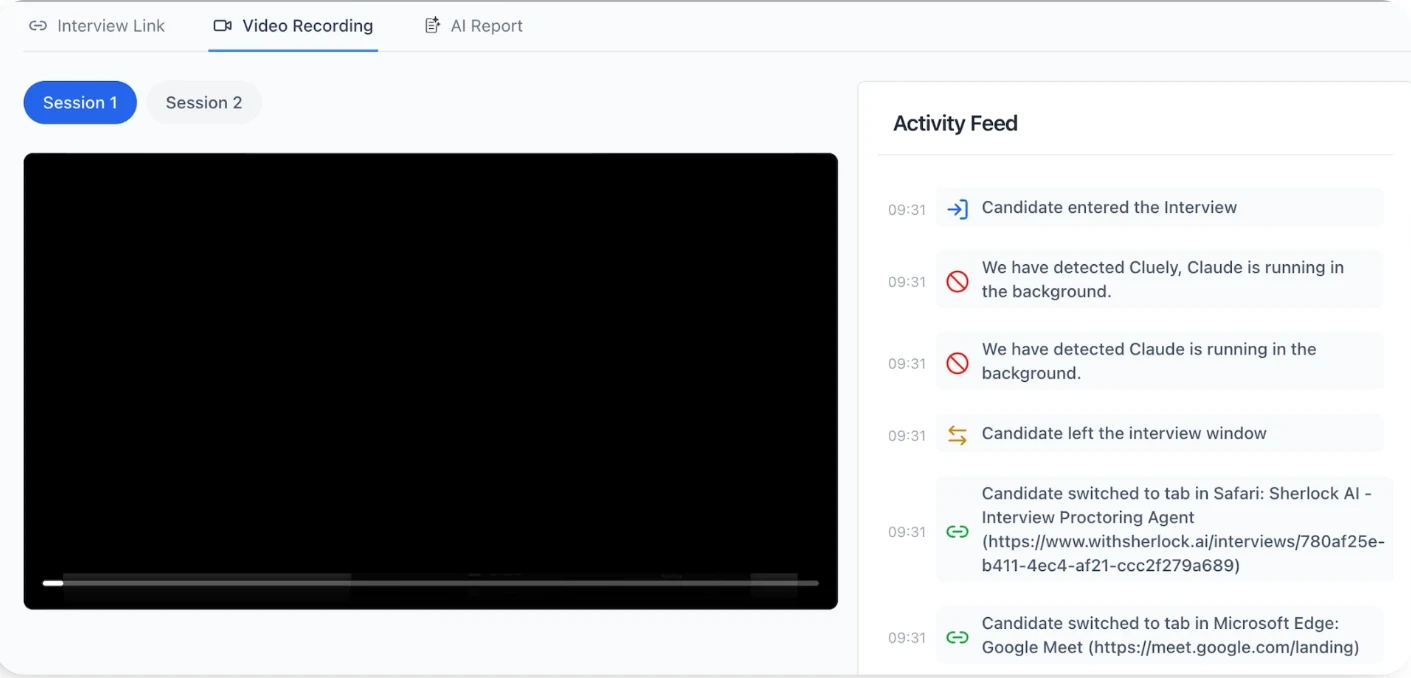
Candidates increasingly use hidden AI copilots during technical and behavioral interviews. Sherlock AI helps identify real-time AI assistance by analyzing conversational timing, response structure, and interaction consistency.
The platform can detect:
AI-generated response patterns
Unnaturally optimized answers
Real-time prompting behavior
External assistance indicators
Suspicious answer timing
This allows recruiters to better evaluate whether candidates genuinely possess the required skills and expertise.
Scalable Hiring Protection for Remote Teams
Large organizations and staffing firms often process thousands of remote interviews every month, making manual fraud detection nearly impossible at scale. Sherlock AI automates interview integrity monitoring without disrupting the candidate experience.
This helps organizations:
Reduce fraudulent hires
Improve hiring quality
Protect sensitive company data
Strengthen remote hiring security
Scale secure recruitment operations
As remote hiring continues to expand globally, companies need scalable protection against AI-driven interview fraud.
Securing the Future of Remote Hiring
Deepfake interviews and AI-assisted hiring fraud are no longer future concerns. They are active threats affecting organizations across industries today. From face-swapping technology and voice cloning to proxy interviews and real-time AI answer generation, fraudulent candidates are using increasingly advanced tools to bypass traditional hiring processes.
To stay ahead of these threats, companies need a combination of secure hiring workflows, recruiter awareness, identity verification systems, and AI-powered fraud detection technology. Organizations that continue relying solely on manual interview processes may struggle to identify sophisticated deception techniques in modern remote hiring environments.
Platforms like Sherlock AI are helping organizations strengthen interview integrity by detecting suspicious candidate behavior, identifying deepfake indicators, and protecting remote hiring pipelines from fraud at scale.
As AI technology continues to evolve, hiring security will become just as important as candidate evaluation itself. Companies that prioritize authenticity, verification, and interview integrity today will be far better prepared for the future of remote recruitment.