Back to all blogs
Learn 15 Top Interviewing Techniques for Interviewers to conduct structured interviews, improve hiring decisions, and make smarter, more confident hiring decisions.

Abhishek Kaushik
May 20, 2026
Hiring the right candidate is one of the most critical decisions any organization makes, and it often comes down to how well interviews are conducted. Strong interviewing techniques for interviewers are not just about asking questions. They are about uncovering real capabilities, reducing bias, and creating a consistent, high-quality hiring experience.
In today’s competitive talent market, unstructured interviews and gut-based decisions no longer work. According to some studies, the research suggests that less than 20% of a person’s actual job performance can be attributed to scores in a structured interview. Without a clear framework, interviews often rely on first impressions, which can be misleading and inconsistent.
The challenge most interviewers face is not a lack of questions, but a lack of the right approach. Poor interviewing techniques can lead to costly hiring mistakes, increased employee turnover, and lost productivity.
Effective interviewing techniques solve this by introducing structure, clarity, and fairness into the process. Techniques such as behavioral interviewing, situational questions, and scorecards help interviewers evaluate candidates based on real skills rather than assumptions.
Candidate experience is another crucial factor. Studies indicate that over 58% of job seekers lose interest when hiring takes longer than two weeks, yet according to research, average hiring processes stretch to 3-6 weeks. This disconnect creates a serious problem since top talent typically gets hired within just 10 days.
Technology is also reshaping how interviews are conducted. Platforms like Sherlock AI enable interviewers to standardize interviews, reduce bias, and gain deeper insights into candidate responses, making hiring decisions more accurate and data-driven.
In this guide, we will explore the top interviewing techniques for interviewers to help you conduct effective, fair, and high-impact interviews.
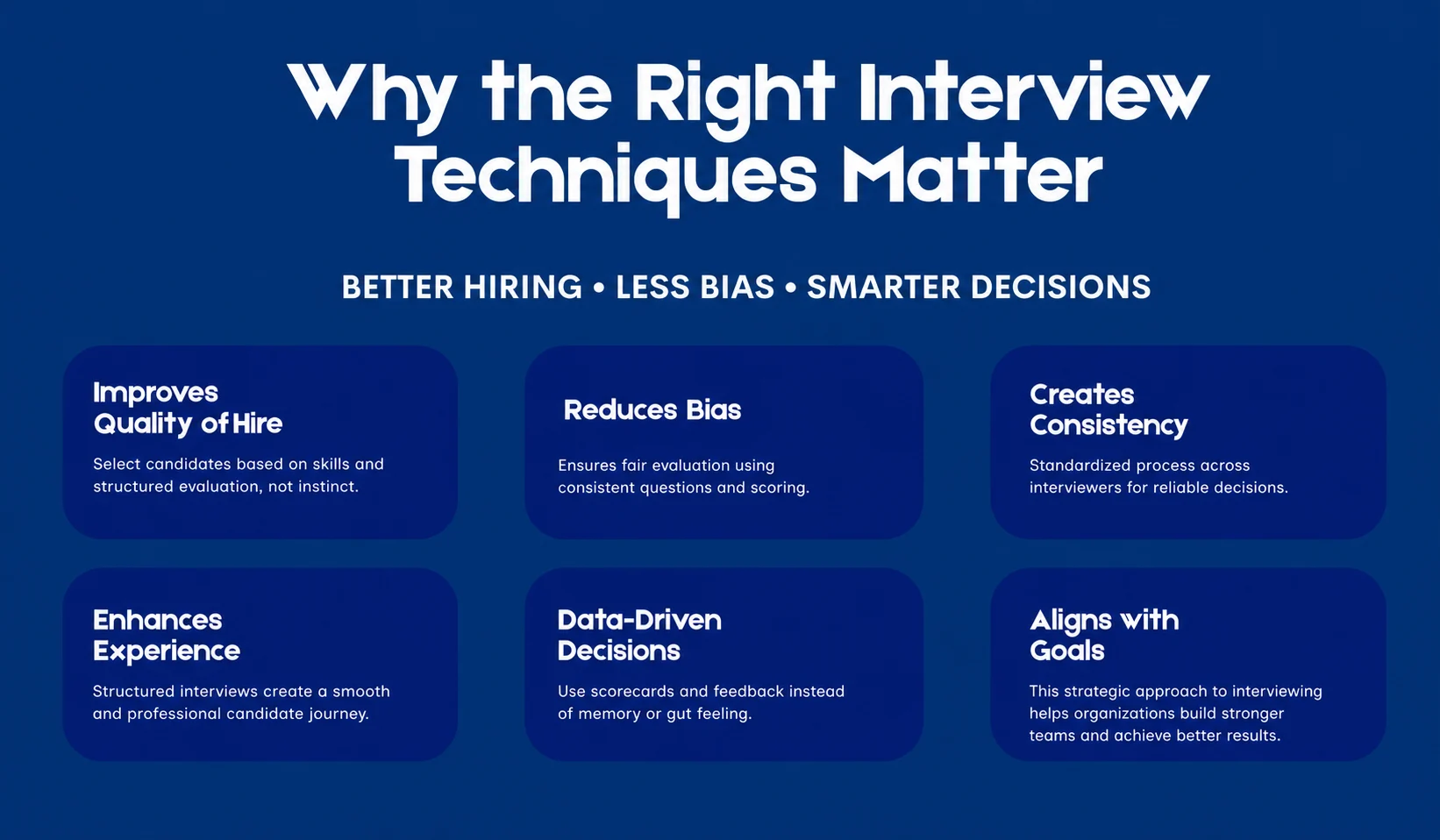
Why Using the Right Interview Techniques is Important
Using the right interviewing techniques is not just a best practice, it is a necessity in modern hiring. Interviews are often the deciding factor between a great hire and a costly mistake, yet many organizations still rely on inconsistent or unstructured approaches. This is where effective techniques make a measurable difference.
Improves Quality of Hire
The primary goal of any interview is to identify the best candidate for the role. Without structured techniques, interviewers tend to rely on instinct, which can lead to poor decisions. Research shows that traditional interviews have relatively low predictive accuracy when it comes to job performance. By using structured interviewing techniques such as standardized questions, evaluation scorecards, and competency-based assessments, interviewers can significantly improve the quality of their hiring decisions.
When every candidate is evaluated using the same criteria, it becomes easier to compare responses objectively. This leads to better alignment between the candidate’s skills and the job requirements, ultimately improving long-term performance and retention.
Reduces Unconscious Bias
Bias in interviews is often unintentional, but it can heavily influence hiring outcomes. Factors such as first impressions, communication style, or even shared interests can impact decisions if interviews are not structured properly.
Using consistent interviewing techniques helps reduce this bias. Asking the same set of questions, focusing on job-related competencies, and using scoring frameworks ensures that candidates are judged fairly. This not only improves diversity and inclusion but also strengthens the credibility of the hiring process.
Creates a Consistent Interview Process
One of the biggest challenges in hiring is inconsistency across interviewers and teams. Different interviewers may ask different questions, evaluate differently, or prioritize different skills. This lack of standardization leads to confusion and unreliable hiring decisions.
Effective interviewing techniques bring consistency into the process. From pre-defined question sets to structured feedback forms, they ensure that every candidate goes through a similar experience. This consistency makes it easier to collaborate, compare feedback, and make data-driven decisions.
Enhances Candidate Experience
Interviews are not just about evaluating candidates. They are also an opportunity to showcase your organization. A poorly conducted interview can leave candidates frustrated and disengaged.
On the other hand, well-structured interviews create a positive and professional experience. Clear communication, relevant questions, and a smooth process make candidates feel respected and valued. This improves your employer brand and increases the likelihood of candidates accepting offers.
Supports Data-Driven Hiring Decisions
Modern hiring is increasingly driven by data rather than intuition. Interviewing techniques such as scorecards, structured feedback, and performance indicators allow interviewers to make decisions based on evidence.
Instead of relying on memory or subjective opinions, interviewers can refer to documented evaluations. This reduces errors, improves accountability, and ensures better hiring outcomes over time.
Aligns Interviews with Business Goals
Effective interviewing techniques ensure that the hiring process aligns with organizational goals. By focusing on role-specific competencies, cultural contribution, and long-term potential, interviewers can select candidates who not only fit the role but also contribute to business growth.
This strategic approach to interviewing helps organizations build stronger teams and achieve better results.
How Sherlock AI Helps
Sherlock AI enhances interviewing techniques by bringing structure, consistency, and intelligence into the process. It helps interviewers standardize questions, evaluate responses objectively, and reduce bias through AI-driven insights. This ensures that every interview is aligned with best practices while improving efficiency and accuracy.
15 Top Interviewing Techniques for Interviewers
Mastering interviewing techniques is essential for conducting effective, structured, and unbiased interviews. Below are seven proven techniques that help interviewers assess candidates more accurately while improving consistency and candidate experience.
1. Prepare Interview Questions in Advance
Preparation is the backbone of a successful interview. Without a clear structure, interviews often become inconsistent, leading to poor comparisons between candidates and missed insights.
Start by identifying the core competencies required for the role such as technical skills, problem-solving ability, communication, and cultural contribution. Then create a mix of behavioral, situational, and role-specific questions aligned with these competencies. Group questions into categories so you can cover all critical areas within the given time.
Well-prepared questions also reduce the chances of asking irrelevant or biased questions. They help interviewers stay focused and ensure that every candidate is evaluated fairly.
Example:
For a project management role:
“Tell me about a time when a project went off track. How did you bring it back on schedule?”
You can also prepare follow-up prompts like:
“What was the biggest challenge?” or “What would you do differently?”
2. Review the Candidate’s Resume and Background
Reviewing a candidate’s resume before the interview allows you to move beyond generic questions and have a more meaningful conversation. It helps you personalize the interview and focus on areas that matter most.
Pay attention to career progression, achievements, gaps, and role changes. Look for measurable outcomes such as revenue growth, cost savings, or performance improvements. This helps you validate claims and explore real impact.
It also allows you to identify inconsistencies or areas that need clarification, making your evaluation more thorough.
Example:
“I see that you led a team of 10 in your previous role. What were your key responsibilities, and how did you measure team success?”
For gaps:
“I noticed a 6-month break in your career. Can you share what you focused on during that time?”
3. Use Structured Interviewing
Structured interviewing ensures consistency by asking all candidates the same set of core questions and evaluating them using a predefined scoring system. This approach improves fairness and makes it easier to compare candidates objectively.
Create a scorecard with clear rating criteria for each competency. For example, rate answers on a scale of 1 to 5 based on clarity, relevance, and impact. This reduces reliance on memory and personal bias.
Structured interviews are especially useful when multiple interviewers are involved, as they align everyone on what “good” looks like.
Example:
Question: “Describe a time you handled a difficult stakeholder.”
Scoring criteria:
1 = No clear example
3 = Basic example with moderate impact
5 = Strong example with measurable outcome and clear problem-solving approach
4. Apply Behavioral Interviewing Techniques
Behavioral interviewing is based on the principle that past behavior is the best predictor of future performance. Instead of hypothetical answers, candidates provide real examples from their experience.
Encourage candidates to structure their responses using the STAR method:
Situation
Task
Action
Result
This helps you evaluate not just what they did, but how they approached the situation and what outcomes they achieved.
Behavioral questions are particularly effective for assessing soft skills like leadership, teamwork, adaptability, and decision-making.
Example:
“Tell me about a time you had to handle conflicting priorities. How did you manage it?”
Follow-up questions:
“What was your thought process?”
“What was the final outcome?”
“What did you learn from that experience?”
5. Ask Open-Ended and Probing Questions
Open-ended questions encourage candidates to provide detailed responses, giving you deeper insights into their thinking and behavior. They help uncover not just what candidates did, but why and how they did it.
Probing questions take this a step further by digging deeper into initial responses. This helps validate claims and uncover hidden details.
Avoid leading questions, as they can influence responses. Instead, remain neutral and curious.
Example:
Primary question:
“How do you handle tight deadlines?”
Probing questions:
“Can you give a recent example?”
“What challenges did you face?”
“How did you prioritize tasks?”
“What was the result?”
This layered questioning approach helps you assess problem-solving ability, time management, and resilience.
6. Practice Active Listening
Active listening is a critical skill that separates average interviewers from great ones. Instead of focusing only on asking questions, effective interviewers pay close attention to the candidate’s responses, tone, and thought process.
This means avoiding interruptions, maintaining eye contact in video or in-person interviews, and acknowledging responses with follow-up questions. Active listening helps you capture deeper insights and prevents you from missing important details.
It also builds trust, making candidates feel heard and respected, which often leads to more honest and detailed answers.
Example:
If a candidate says, “I struggled with team communication during a project,”
You can respond with:
“What specifically caused the communication gap, and how did you address it?”
This shows engagement and encourages deeper discussion.
7. Maintain a Conversational Interview Style
While structure is essential, interviews should not feel like interrogations. A conversational style helps candidates relax and express themselves more naturally.
Start with a brief introduction, explain the flow of the interview, and create a comfortable environment. Use a friendly tone and allow the conversation to flow while still covering all key questions.
This balance helps you get authentic responses rather than rehearsed answers.
Example:
Instead of jumping straight into questions, begin with:
“Can you walk me through your journey and what led you to apply for this role?”
This opens up the conversation and sets a positive tone.
8. Encourage Candidates to Give Specific Examples
Candidates often give vague or generalized answers. A strong interviewing technique is to consistently ask for specific, real-world examples.
This helps validate their experience and ensures that their claims are backed by actual results.
Encouraging examples also reduces the chances of exaggerated or misleading responses.
Example:
If a candidate says, “I improved team productivity,”
Follow up with:
“Can you share a specific instance where you improved productivity? What actions did you take and what was the measurable result?”
This ensures clarity and credibility in their response.
9. Use the 70/30 Rule
A common mistake interviewers make is talking too much. The 70/30 rule suggests that the candidate should speak 70% of the time, while the interviewer speaks 30%.
This allows candidates to fully express their experiences, skills, and thought processes. It also gives interviewers more data to evaluate.
To apply this effectively, ask concise questions and allow silence when needed. Avoid the urge to fill gaps or lead the candidate.
Example:
Ask a question like:
“Tell me about a challenging decision you had to make at work.”
Then allow the candidate to speak without interruption, only stepping in to probe further if needed.
10. Establish Clear Evaluation Criteria (Scorecards)
Without clear evaluation criteria, interview feedback can become subjective and inconsistent. Using scorecards helps standardize how candidates are assessed.
Define key competencies for the role and assign rating scales for each. This ensures that all interviewers evaluate candidates using the same benchmarks.
Scorecards also make post-interview discussions more objective and data-driven.
Example:
For a leadership role, your scorecard might include:
Communication skills (1–5)
Decision-making ability (1–5)
Team management (1–5)
Each interviewer fills this independently, making it easier to compare candidates later.
11. Assess Both Technical Skills and Soft Skills
A common mistake interviewers make is focusing only on technical abilities while overlooking soft skills. While technical skills can often be taught or improved, soft skills like communication, adaptability, and teamwork are harder to develop and equally important for long-term success.
A well-rounded interview should evaluate both. This ensures that the candidate not only performs the job effectively but also collaborates well within the team and organization.
Example:
For a developer role:
Technical question: “How would you optimize a slow-performing query?”
Soft skill question: “Tell me about a time you had to explain a complex technical issue to a non-technical stakeholder.”
This combination gives a complete picture of the candidate.
12. Be Aware of Unconscious Bias
Unconscious bias can influence hiring decisions without the interviewer even realizing it. Factors such as background, communication style, or personal similarities can unintentionally affect judgment.
To minimize bias, focus strictly on job-related criteria and use structured techniques like standardized questions and scorecards. Avoid making decisions based on “gut feeling” or first impressions.
Awareness is the first step. Training interviewers and encouraging diverse interview panels can further reduce bias.
Example:
Instead of thinking, “I relate to this candidate, so they might be a good fit,”
Focus on:
“Did this candidate demonstrate the required competencies based on their responses?”
13. Manage Time Effectively During Interviews
Time management ensures that all critical areas are covered within the interview duration. Poor time allocation can lead to rushed evaluations or missed questions.
Divide the interview into clear sections such as introduction, core questions, candidate questions, and closing. Allocate time to each section and stick to it as much as possible.
This ensures a smooth and professional interview experience for both the interviewer and the candidate.
Example:
For a 45-minute interview:
5 minutes: Introduction
30 minutes: Core questions
5 minutes: Candidate questions
5 minutes: Closing
This structure keeps the interview organized and efficient.
14. Handle Candidate Questions Effectively
Interviews are a two-way process. Candidates evaluating your organization is just as important as you evaluating them.
Encourage candidates to ask questions and provide clear, honest, and transparent answers. This builds trust and helps candidates make informed decisions.
How you respond to their questions also reflects your company culture and professionalism.
Example:
If a candidate asks:
“What does success look like in this role?”
A strong response would be:
“In the first six months, success would mean achieving X goals, collaborating with Y teams, and contributing to Z outcomes.”
This provides clarity and sets expectations.
15. Close the Interview Professionally and Clearly
The way you end an interview leaves a lasting impression. A strong closing ensures that candidates feel respected and informed about the next steps.
Summarize key points discussed, thank the candidate for their time, and clearly communicate what happens next in the hiring process.
A professional closing reduces uncertainty and improves candidate experience.
Example:
“Thank you for sharing your experiences today. We will be reviewing all candidates this week and will get back to you by next Friday with an update.”
This sets clear expectations and reflects professionalism.
Common Interviewing Mistakes Interviewers Should Avoid
Even with the best intentions, interviewers often make mistakes that impact hiring outcomes. These mistakes can lead to poor candidate evaluation, biased decisions, and a negative candidate experience. Understanding and avoiding these common pitfalls is essential to applying interviewing techniques effectively.
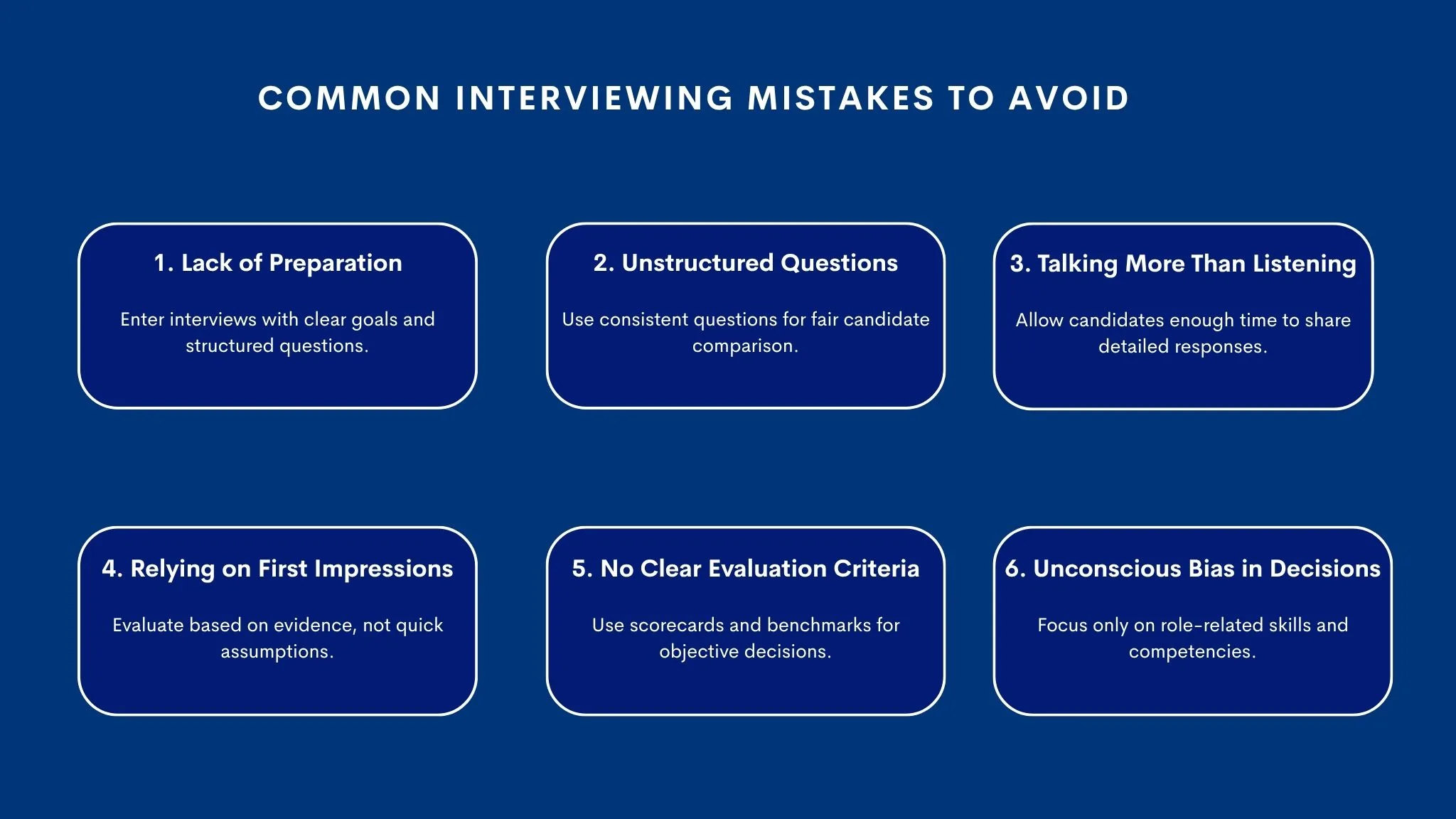
1. Lack of Preparation
Entering an interview without preparation leads to unfocused conversations and missed opportunities to assess key skills. Without reviewing the job requirements and candidate background, interviewers struggle to ask relevant and insightful questions.
Preparation ensures that interviews remain structured, consistent, and aligned with the role.
2. Asking Unstructured or Inconsistent Questions
When interviewers ask different questions to different candidates, it becomes difficult to compare responses fairly. Unstructured interviews often introduce bias and lead to unreliable hiring decisions.
Using a standardized set of questions ensures consistency and improves the accuracy of evaluations.
3. Talking More Than Listening
A common mistake is when interviewers dominate the conversation. This limits the candidate’s ability to share meaningful insights about their experience and skills.
Effective interviews focus on listening, allowing candidates to explain their thought processes and demonstrate their capabilities.
4. Relying on First Impressions
Forming quick judgments based on first impressions can negatively impact the entire interview. Interviewers may unconsciously look for information that confirms their initial opinion.
This leads to biased evaluations and prevents a fair assessment of the candidate.
5. Not Defining Clear Evaluation Criteria
Without clear evaluation criteria, interview feedback becomes subjective and inconsistent. Interviewers may rely on memory or personal opinions rather than measurable standards.
Structured scorecards and defined benchmarks help ensure objective and comparable evaluations.
6. Allowing Unconscious Bias to Influence Decisions
Unconscious bias can affect how candidates are evaluated, from communication style to background. Even unintentional bias can lead to unfair hiring decisions.
Using structured interviewing techniques and focusing on job-related criteria helps reduce bias and improves hiring outcomes.
How Sherlock AI Enhances Interviewing Techniques for Interviewers
Applying the right interviewing techniques is essential, but maintaining consistency, reducing bias, and making data-driven decisions at scale can be challenging. This is where Sherlock AI plays a critical role by strengthening and streamlining the entire interview process.
1.Standardizes Interview Structure
One of the biggest challenges in interviewing is inconsistency. Different interviewers often ask different questions and evaluate candidates differently. Sherlock AI helps standardize the process by providing structured interview frameworks, ensuring that every candidate is assessed using the same criteria.
This improves fairness and makes it easier to compare candidates objectively.
2.Enables Objective Evaluation with Scorecards
Sherlock AI allows interviewers to use predefined scorecards aligned with role-specific competencies. Instead of relying on memory or subjective opinions, interviewers can evaluate candidates based on clear, measurable parameters.
This leads to more accurate and consistent hiring decisions while reducing the chances of bias.
3.Improves Quality of Insights
Capturing and analyzing candidate responses manually can be difficult, especially across multiple interviews. Sherlock AI enhances this by providing deeper insights into responses, helping interviewers identify strengths, gaps, and patterns more effectively.
This ensures that decisions are based on evidence rather than assumptions.
4.Reduces Unconscious Bias
Bias is one of the biggest challenges in hiring. Sherlock AI helps reduce this by using structured interviews with standardized questions and consistent evaluation criteria. This ensures candidates are assessed based on skills rather than personal impressions.
5.Enhances Interviewer Efficiency
Managing interviews, taking notes, and evaluating candidates can be time-consuming. Sherlock AI simplifies this process by organizing interview data, tracking evaluations, and reducing manual effort.
This allows interviewers to focus more on meaningful conversations rather than administrative tasks.
Detects AI Copilot and External Assistance
Sherlock AI can identify the use of AI copilots in interviews or hidden real-time interview assistance tools (e.g., Cluely, Parakeet AI type tools) during interviews. This helps ensure that candidate responses are genuine and reflect their actual skills and knowledge.
By maintaining authenticity and bringing greater visibility into the interview process, it supports more reliable and trustworthy hiring decisions
7.Supports Better Hiring Decisions
By combining structured interviewing techniques with data-driven insights, Sherlock AI helps organizations make more informed hiring decisions. It ensures that candidates are evaluated based on relevant skills, competencies, and performance indicators.
This ultimately leads to better quality hires, improved retention, and stronger team performance.
Sherlock AI acts as a powerful support system for interviewers, ensuring that every interview is structured, consistent, and aligned with best practices.
Mastering Interviewing Techniques for Smarter Hiring Decisions
Effective interviewing is no longer just about asking the right questions. It is about creating a structured, consistent, and insight-driven process that helps you identify the best talent with confidence. The techniques covered in this guide are designed to move interviews away from guesswork and toward a more reliable, skills-focused approach.
From preparation and structured questioning to active listening and objective evaluation, each technique plays a role in improving the quality of hiring decisions. Avoiding common mistakes and applying these techniques consistently ensures that every candidate is assessed fairly and thoroughly.
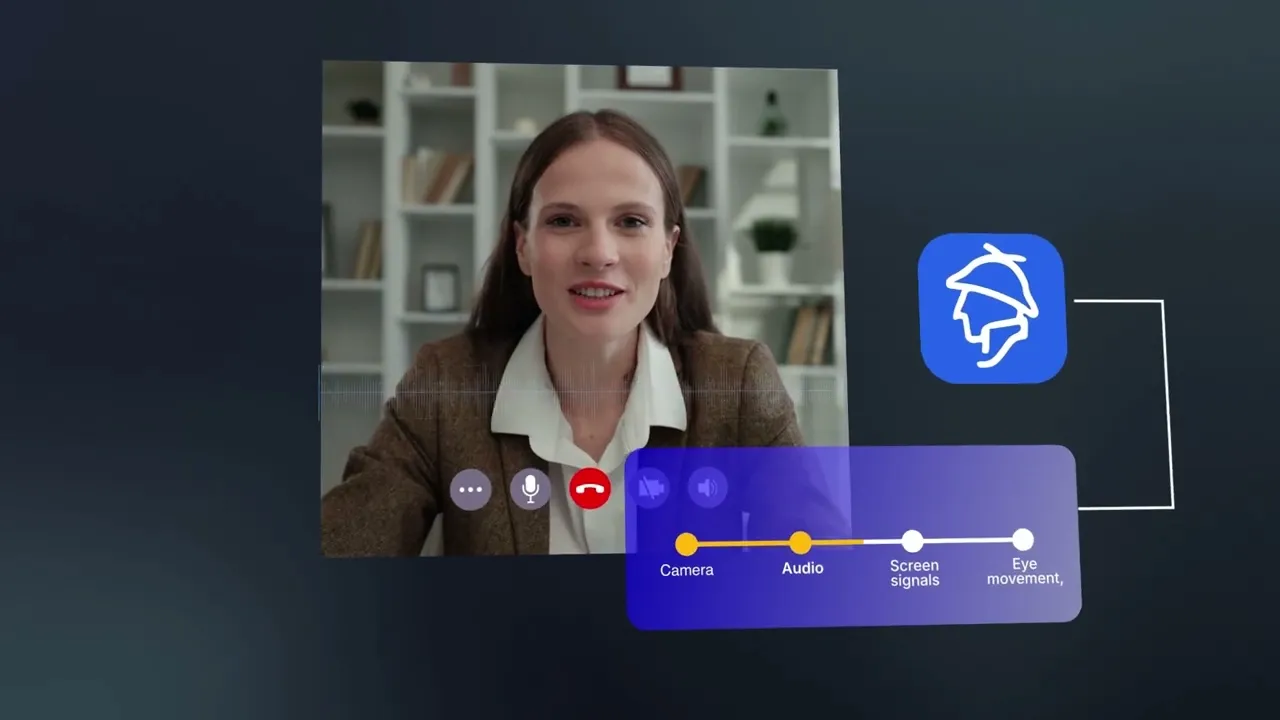
However, applying these techniques at scale can be challenging, especially across multiple interviewers and teams. This is where technology becomes essential. Sherlock AI strengthens Sherlock AI strengthens interviewing techniques by acting as an interview intelligence layer. It monitors interviews using multimodal signals such as audio, behavior, and device activity to detect AI-assisted responses and suspicious patterns in real time. It also provides live alerts during interviews, enabling interviewers to focus on evaluating candidates while maintaining confidence in the authenticity of responses.
In a competitive hiring landscape, organizations that invest in better interviewing techniques gain a clear advantage. By combining proven methods with tools like Sherlock AI, interviewers can improve accuracy, enhance candidate experience, and build stronger teams.
The result is a more efficient, fair, and effective hiring process that consistently delivers the right talent.