Back to all blogs
Transform AI interview notes into scorecards, summaries, and ATS updates to help recruiters make faster, smarter hiring decisions and improve recruitment outcomes.

Abhishek Kaushik
Dec 26, 2025

TL;DR
AI note-taking tools provide a detailed transcription of interviews, capturing AI interview transcripts for recruiters to extract insights, ensuring more consistent and faster hiring decisions.
Recruiters can translate these notes into scorecards, summaries, and ATS updates with minimal effort.
This reduces inconsistency, speeds decision-making, and creates audit-ready records.
The key is aligning AI outputs with your hiring criteria and human evaluation judgment.
Most interviews generate valuable insights, but much of that information is lost when it is captured through manual notes. Interviewers often focus on different aspects of the conversation, which leads to inconsistent documentation.
AI note-taking tools solve this problem by automatically recording, transcribing, and structuring interview conversations. Instead of relying on scattered notes, recruiters receive clear transcripts and structured insights that can support faster hiring decisions.
The real value appears when these AI interview notes are transformed into scorecards, summaries, and ATS updates that help hiring teams evaluate candidates consistently.
What Are AI Interview Notes or AI Interview Transcripts?
AI interview notes are automatically generated records of interview conversations created using AI-powered transcription tools. These tools listen to the conversation, convert speech into text, and organize the discussion into structured insights.
Instead of manually writing notes, recruiters receive:
Complete interview transcripts
Key competency highlights
Behavioral insights from candidate responses
Structured summaries of the conversation
This structured documentation allows recruiters to review interviews more objectively and make more consistent hiring decisions.
How AI Note-Takers Capture and Structure Interview Data
AI interview data analysis extracts key competencies, behavioral indicators, and sentiment cues, providing recruiters with structured interview insights. These insights are validated by organizations like Stanford HAI, which improves hiring accuracy.
Key competencies and behavioral indicators
Experience alignment with job requirements
Role-specific terminology and examples
Answer sentiment and confidence cues
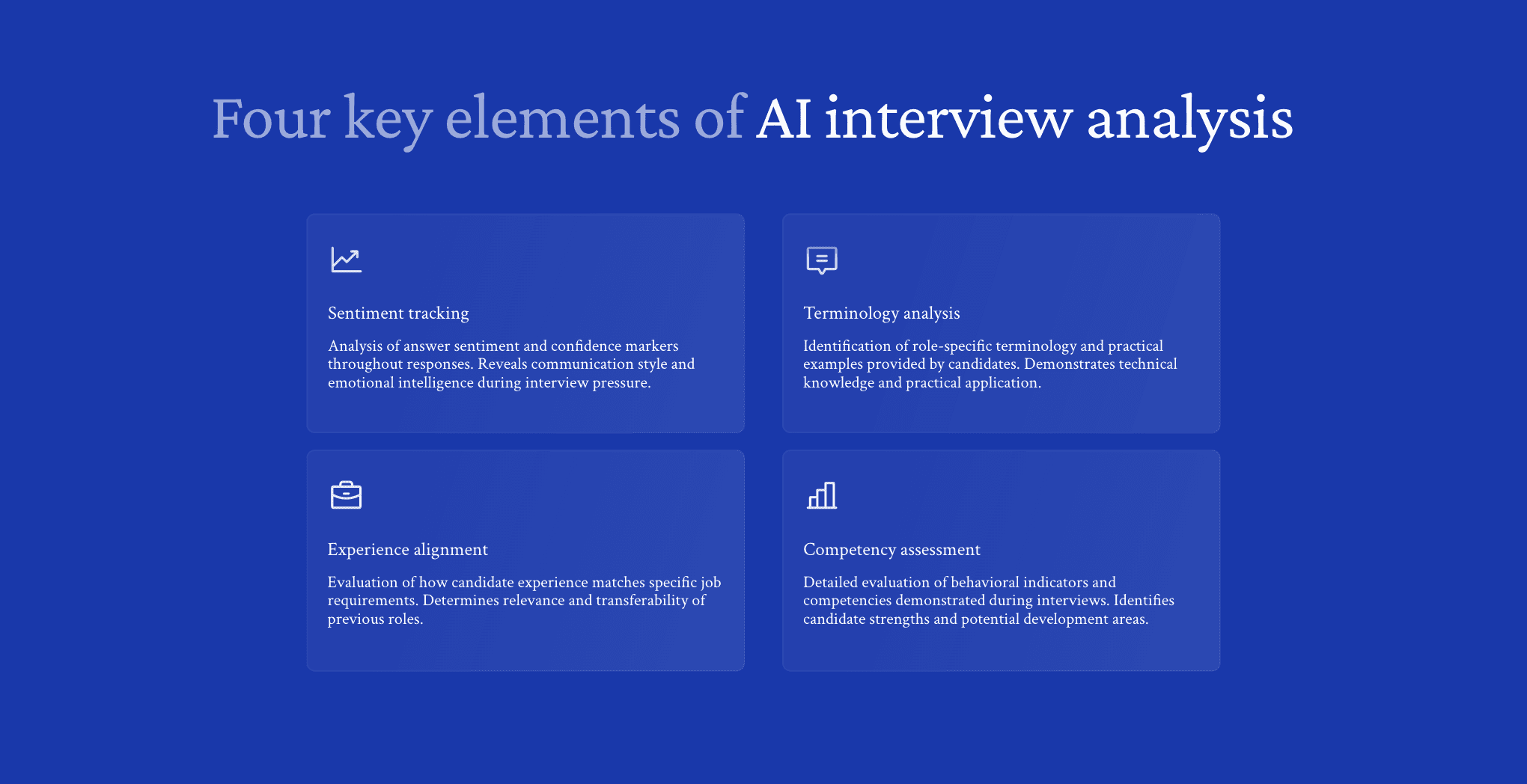
This structured data becomes the foundation for turning raw interview transcripts into meaningful hiring insights.
Step 1: Convert Transcripts into Scorecards
Scorecards help ensure that every candidate is evaluated against the same criteria. AI can assist by mapping transcript language to competencies such as:
Problem-solving
Communication clarity
Technical proficiency
Leadership or collaboration behaviors
Recruiters review the AI suggestions and confirm the scoring, keeping human judgment at the center of the process.
According to SHRM’s 2025 recruiting benchmarking data, organizations using structured scorecards that track hiring metrics such as time‑to‑fill, cost‑per‑hire, and quality‑of‑hire achieve significantly higher hiring quality, reducing recruitment costs and avoiding costly mis‑hires.
Step 2: Generate Interview Summaries for Faster Decision-Making
AI summaries condense the transcript into a readable narrative that captures:
The core themes of the conversation
Strengths and development areas
Candidate motivation and fit signals
These summaries help hiring managers quickly understand the interview without having to review full transcripts or video recordings.
Step 3: Automatically Update Your ATS With Key Decisions
Manual ATS updates are time-consuming and often skipped, which breaks the documentation trail. AI note-taking systems can:
Autofill evaluation forms
Upload summaries
Update interview outcomes
Tag interview competencies
Notify relevant stakeholders
This keeps hiring pipelines accurate and audit-ready.
How to Turn AI Interview Notes into Actionable Insights
AI-generated interview notes are most valuable when they are transformed into structured insights that support better hiring decisions. By organizing transcripts into summaries, evaluation frameworks, and recruitment systems, hiring teams can review candidates more efficiently and make more consistent hiring choices.
Step 1: Convert Interview Transcripts into Structured Scorecards
Interview transcripts contain detailed information about candidate responses, but this information needs to be structured for proper evaluation. Converting transcripts into standardized scorecards allows recruiters to assess candidates using the same criteria across interviews.
Structured scorecards help hiring teams compare candidates more objectively and reduce inconsistencies in evaluation.
Key evaluation areas can include:
Problem-solving abilities
Communication clarity
Technical proficiency
Leadership or collaboration behaviors
Step 2: Generate Interview Summaries for Faster Hiring Decisions
Reviewing full interview transcripts can be time-consuming, especially when multiple candidates are being evaluated. AI-generated summaries highlight the most important insights from the conversation, allowing hiring teams to quickly understand candidate performance.
These summaries make it easier for recruiters and hiring managers to compare candidates without reviewing the entire transcript.
Important elements in interview summaries include:
Core themes of the conversation
Candidate strengths and improvement areas
Motivation and alignment with the role
Step 3: Extract Key Skills and Competency Insights
AI tools can analyze interview conversations and identify responses that demonstrate specific skills and competencies. This helps recruiters understand how well candidates match the requirements of the role.
By highlighting relevant competencies, AI interview insights support more structured candidate evaluations.
Common competency insights include:
Technical and role-specific skills
Communication and collaboration abilities
Leadership or decision-making indicators
Problem-solving approaches
Step 4: Identify Patterns Across Multiple Interviews
AI interview tools can analyze multiple candidate interviews and detect patterns in responses, performance, and competencies. This helps recruiters compare candidates more effectively and identify top performers.
Pattern analysis also helps hiring teams recognize recurring strengths or skill gaps among applicants.
Pattern insights may include:
Frequently demonstrated strengths across candidates
Common skill gaps in applicant pools
Differences in candidate responses to key questions
Step 5: Automatically Update Your ATS with Interview Insights
AI interview tools can integrate with applicant tracking systems to streamline recruitment workflows. Instead of manually updating candidate records, recruiters can automatically store interview insights within the ATS.
This ensures that interview documentation is organized and accessible across the hiring team.
Common ATS updates include:
Autofill evaluation forms
Upload interview summaries
Update interview outcomes
Tag candidate competencies
Notify relevant stakeholders
Step 6: Share Insights with Hiring Teams for Better Decisions
AI-generated insights can be shared with hiring managers and interview panel members to support collaborative decision-making. Structured notes and summaries help stakeholders review candidate performance more easily.
This improves transparency and ensures that hiring decisions are based on documented insights rather than individual memory.
Shared insights can include:
Interview summaries and highlights
Candidate competency evaluations
Strengths and improvement areas
Interviewer feedback
These steps help recruiters transform raw interview transcripts into structured insights that improve candidate evaluation, collaboration, and hiring decisions.
Why Human Review Still Matters in AI Interview Insights
AI interview tools can analyze conversations and generate transcripts, summaries, and competency insights. However, AI-generated interview notes should support recruiters rather than replace human judgment in hiring decisions.
Key reasons why human review remains essential include:
Understanding context and communication nuances
AI tools can detect keywords and patterns, but recruiters are better equipped to interpret tone, intent, and subtle communication cues during interviews.Evaluating cultural fit and candidate motivation
Important factors such as team compatibility, long-term potential, and motivation are difficult for AI systems to fully measure.Validating AI-generated insights
Recruiters should review AI summaries and competency insights to ensure the observations accurately reflect the candidate’s responses.Avoiding misinterpretation of responses
AI may occasionally misinterpret complex answers or nuanced explanations, which is why human oversight is important.Balancing AI efficiency with human judgment
Research from Harvard Business Review shows that AI tools improve hiring efficiency, but the best results come from combining AI analysis with recruiter expertise.
Harvard Business Review, 2025 research highlights that while AI assessment tools enhance hiring efficiency, fully automated decisions can increase mis‑hire risk by missing critical human context and nuances. The study recommends hybrid human‑AI evaluations to balance efficiency with authentic candidate assessment.
The goal is not automated hiring, but AI-supported decision-making that improves transparency, consistency, and fairness in recruitment.
Best Practices for Using AI Interview Notes
To get the most value from AI interview documentation, organizations should follow a few best practices. When used properly, AI-generated interview notes can improve evaluation consistency, support better hiring decisions, and streamline recruitment workflows.
Align AI Insights with Hiring Criteria
AI-generated interview summaries should reflect the competencies and evaluation criteria defined in your hiring process. When insights are aligned with role-specific requirements, recruiters can evaluate candidates more consistently and compare applicants using the same framework.
Train Recruiters to Validate AI Insights
AI tools can highlight patterns and summarize candidate responses, but recruiters should review these insights before making final hiring decisions. Human validation helps ensure that AI-generated observations are interpreted correctly and applied in the proper context.
Maintain Structured Interview Processes
Structured interviews make it easier for AI tools to capture and analyze candidate responses. When interviewers follow consistent questions and evaluation criteria, AI systems can generate clearer and more reliable interview insights.
Integrate AI Interview Notes with Recruitment Systems
Integrating AI interview tools with recruitment platforms such as applicant tracking systems helps recruiters store and access interview documentation more efficiently. This allows hiring teams to review transcripts, summaries, and evaluations in one centralized location.
Combine AI Insights with Human Judgment
AI interview tools help organize and analyze interview data, but they cannot fully evaluate context, personality, or cultural fit. Recruiters should combine AI-generated insights with their professional judgment to make well-informed hiring decisions.
How Sherlock AI Helps Turn Interview Notes into Actionable Insights
AI-generated interview notes become far more valuable when they are automatically organized into structured insights that recruiters can use during the hiring process. This is where platforms like Sherlock AI help streamline the entire workflow.
Instead of manually reviewing transcripts or updating recruitment systems, Sherlock AI analyzes interview conversations and converts them into structured insights that support faster and more consistent hiring decisions.
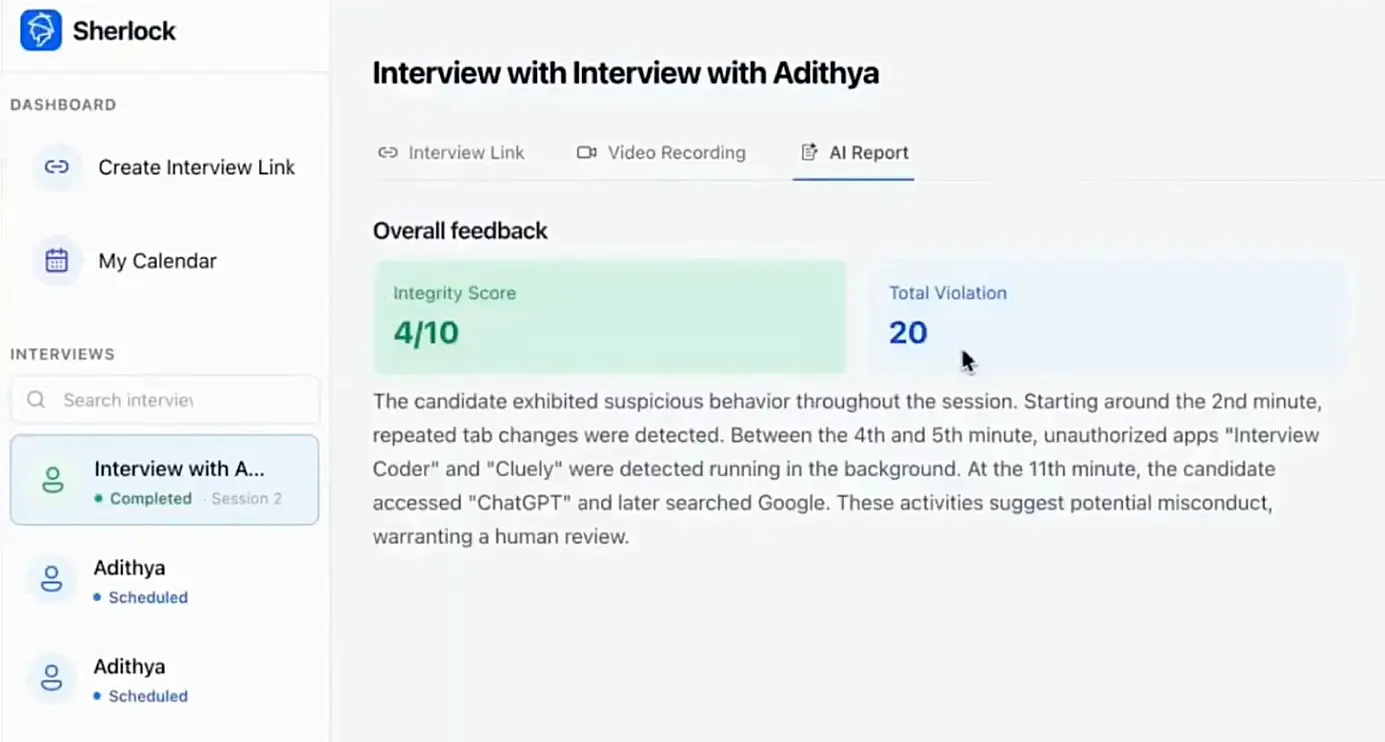
Key Capabilities of Sherlock AI
Feature | How It Helps Recruiters |
|---|---|
AI Interview Transcription | Automatically converts interview conversations into accurate transcripts for easier review. |
Structured Interview Summaries | Highlights the most important parts of the conversation, including candidate strengths and key responses. |
Competency-Based Insights | Identifies skills, behavioral indicators, and competencies demonstrated during the interview. |
Scorecard Generation | Converts interview responses into structured evaluation criteria for consistent candidate assessment. |
ATS Integration | Automatically updates candidate records, summaries, and evaluation notes within recruitment systems. |
Collaboration for Hiring Teams | Enables recruiters and hiring managers to review interview insights and make decisions faster. |
By transforming raw interview conversations into structured insights, Sherlock AI helps recruitment teams reduce manual work, improve candidate evaluation, and make more data-driven hiring decisions.
Conclusion
AI-generated interview notes are transforming how recruitment teams capture and use interview data. Instead of relying on manual note-taking and fragmented feedback, recruiters can now convert interview conversations into structured insights that support more consistent and informed hiring decisions. When interview transcripts are organized into scorecards, summaries, and competency insights, hiring teams can evaluate candidates more efficiently. This not only saves time but also improves collaboration between recruiters and hiring managers by ensuring everyone has access to the same structured information.
However, AI insights work best when they complement human expertise. Recruiters still play a critical role in interpreting responses, evaluating cultural fit, and making final hiring decisions. The most effective recruitment processes combine AI-driven analysis with professional judgment.
Platforms like Sherlock AI help organizations take this process a step further by automatically transforming interview conversations into actionable hiring insights. From generating structured summaries and competency-based evaluations to integrating interview notes with recruitment systems, Sherlock AI enables teams to move beyond simple transcripts and focus on smarter hiring decisions.
As organizations continue adopting AI-powered recruitment tools, the ability to turn interview notes into actionable insights will become an essential part of building faster, more transparent, and data-driven hiring processes.artifacts that drive transparent and fair hiring decisions.
When transcripts become structured scorecards, readable summaries, and complete ATS records, hiring becomes faster, more transparent, and more defensible.