Back to all blogs
Learn interview meaning, types, formats, and questions. Discover the best interview formats with examples and expert tips to improve performance and succeed.

Abhishek Kaushik
May 20, 2026
Hiring has evolved far beyond simple question-and-answer conversations. Today, interviews play a critical role in determining workforce quality, business performance, and long-term organizational success. Yet, many companies still struggle to make the right hiring decisions. According to a CareerBuilder survey, nearly 74% of employers admit they have hired the wrong candidate, highlighting how common and costly hiring mistakes can be.
The impact of a poor interview decision goes beyond just replacing an employee. Research shows that a bad hire can cost companies up to $15,000 or more, affecting productivity, team morale, and overall business efficiency. These costs often stem from ineffective interview processes, rushed decisions, or lack of structured evaluation methods.
At the same time, hiring practices are rapidly evolving. Organizations are no longer relying solely on traditional face-to-face interviews. With the rise of remote work and global talent pools, interviews now take multiple forms including virtual, panel, and asynchronous formats. This shift has increased both the opportunities and the complexity of evaluating candidates effectively.
Despite these advancements, one challenge remains constant. Interviews must be conducted in a way that ensures consistency, fairness, and accurate assessment of candidates. A well-structured interview helps employers evaluate not just technical skills but also communication ability, problem-solving approach, and cultural fit. On the other hand, an unstructured or biased interview process can lead to poor hiring outcomes and missed opportunities.
In this guide, we will break down everything you need to know about interviews, including their meaning, types, formats, and real-world examples. Whether you are a recruiter or a job seeker, understanding how interviews work can significantly improve your chances of success.
What Is an Interview?
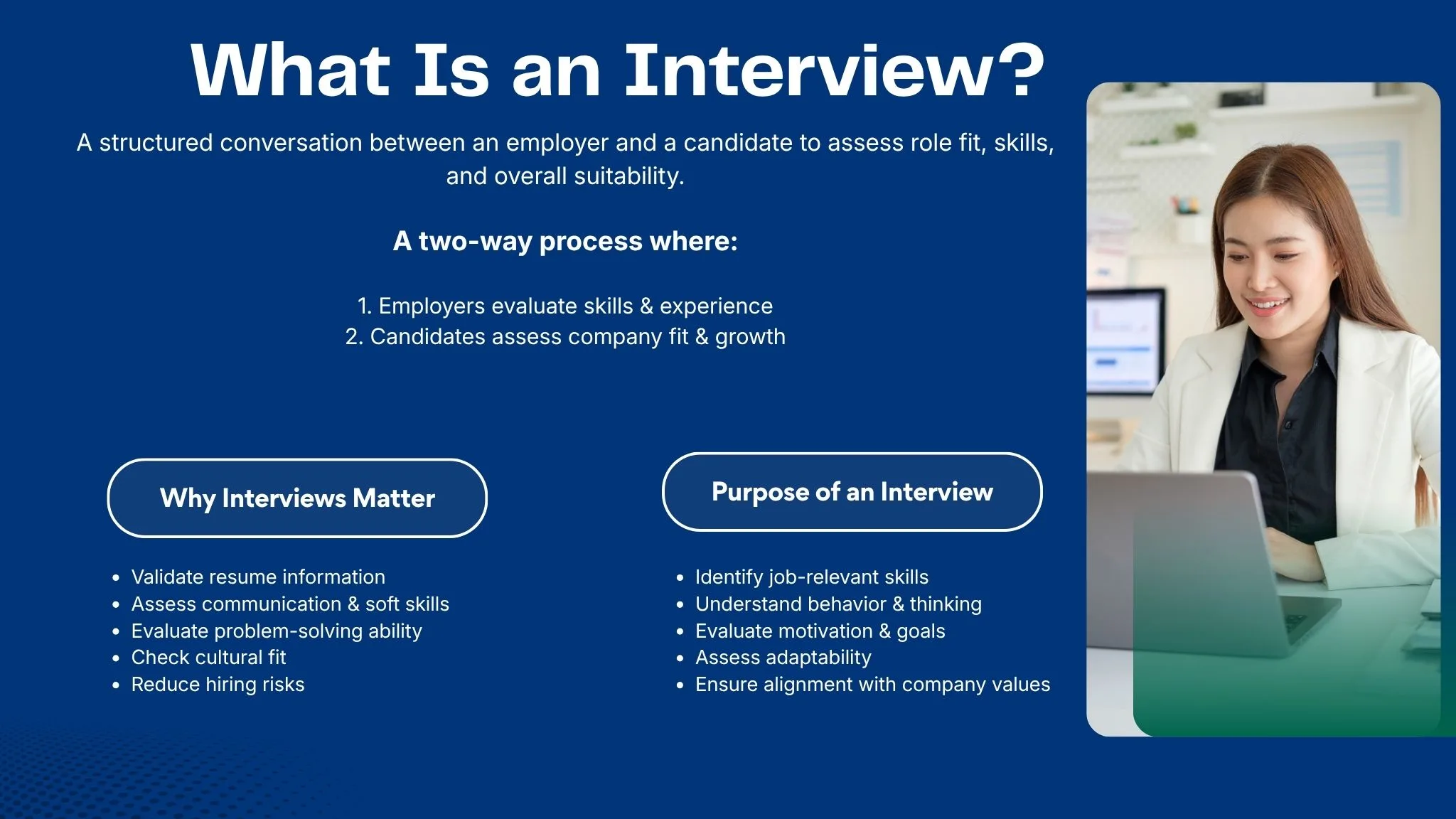
An interview is a structured conversation between an employer and a candidate, designed to evaluate whether the candidate is suitable for a specific role. It is one of the most critical stages in the hiring process where skills, experience, personality, and problem-solving ability are assessed in real time.
At its core, an interview is not just about answering questions. It is a two-way communication process where both the recruiter and the candidate exchange information to determine mutual fit. While the employer evaluates qualifications and competencies, the candidate also assesses the company’s culture, expectations, and growth opportunities.
An interview can be defined as:
A formal or informal interaction where an interviewer asks questions to assess a candidate’s knowledge, skills, behavior, and overall suitability for a job role.
Interview Definition
An interview can be defined as:
A formal or informal interaction where an interviewer asks questions to assess a candidate’s knowledge, skills, behavior, and overall suitability for a job role.
Why Do Interviews Matter?
Interviews play a crucial role in hiring because resumes alone cannot provide a complete picture of a candidate. They help employers go beyond written qualifications and evaluate real-world capabilities.
Here is why interviews are important:
They help validate the information mentioned in resumes
They assess communication and interpersonal skills
They evaluate problem-solving and critical thinking abilities
They determine cultural and team fit
They reduce the risk of wrong hiring decisions
For candidates, interviews are equally important as they provide an opportunity to showcase their strengths, clarify their experience, and make a strong impression.
Purpose of an Interview
The main purpose of an interview is to ensure that the right candidate is selected for the right role. However, the objective goes deeper than just selection.
Key purposes include:
Identifying job-relevant skills and competencies
Understanding candidate behavior in real scenarios
Evaluating motivation and career goals
Assessing adaptability and learning ability
Ensuring alignment with company values
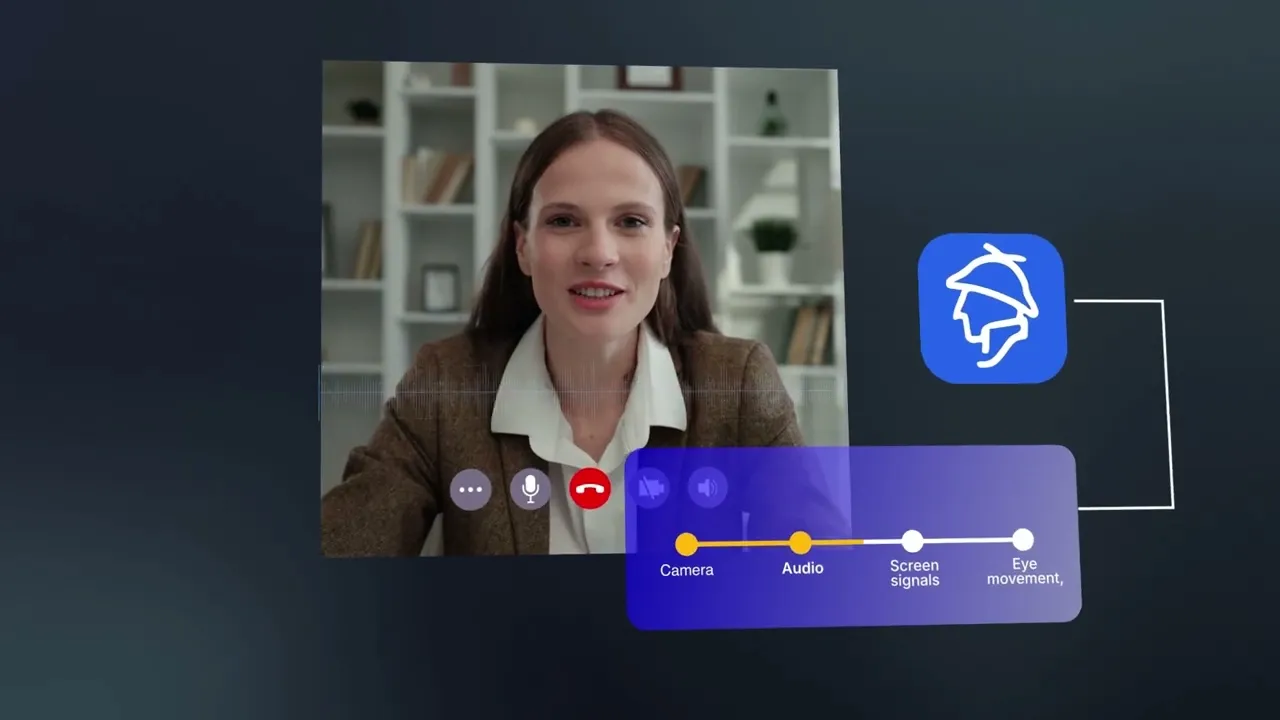
Modern hiring processes are evolving rapidly, especially with the adoption of AI-driven interview platforms. Tools like Sherlock AI help recruiters conduct structured and unbiased interviews by standardizing questions, analyzing responses, and improving decision-making accuracy while keeping the process interview-focused.
Types of Interviews
Interviews are not one-size-fits-all. Different roles, industries, and hiring goals require different interview approaches. That is why organizations use multiple types of interviews to evaluate candidates from various angles such as technical expertise, behavioral traits, communication skills, and cultural alignment.
A well-designed interview process often combines multiple interview types to create a complete picture of the candidate. For example, a company may start with a video interview, followed by a technical interview, and end with a behavioral or panel interview.
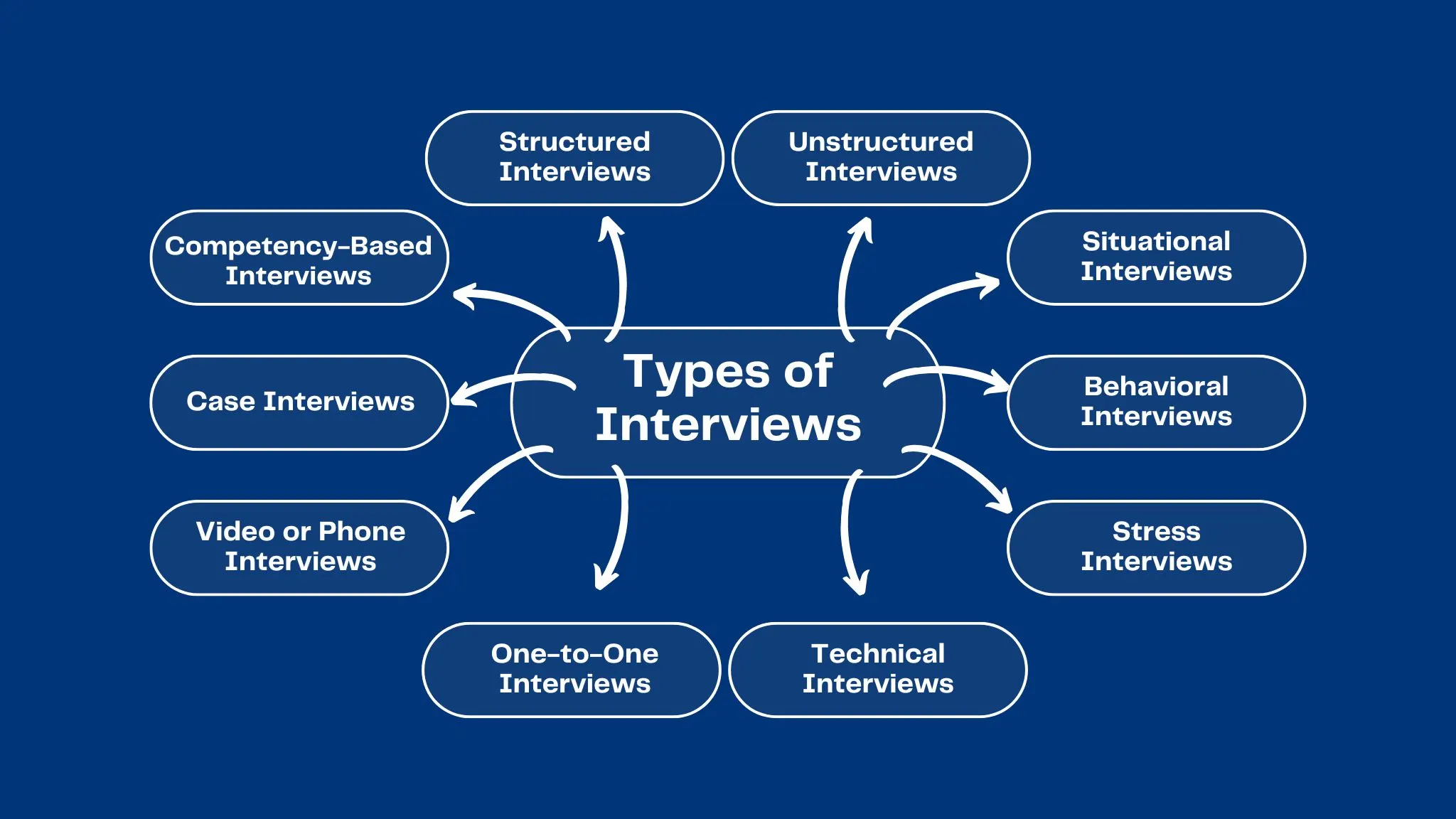
Below are the most important types of interviews, explained in detail with practical context and examples.
Structured Interviews
A structured interview is a highly organized interview method where all candidates are asked the same set of predetermined questions in the same sequence. Each response is evaluated using a standardized scoring system.
This method is widely used by organizations that prioritize fairness, consistency, and data-driven hiring decisions.
In structured interviews, interviewers avoid improvisation. Instead, they follow a script designed to assess specific skills or competencies. This ensures that every candidate is judged on the same criteria, reducing the chances of bias.
Example:
A company hiring for a sales executive role may ask every candidate:
Describe a time when you successfully closed a difficult deal
How do you handle rejection from clients
What strategies do you use to meet sales targets
Each answer is rated based on predefined parameters such as communication skills, persuasion ability, and problem-solving approach.
Real-world application:
Large organizations and enterprises often rely on structured interviews for campus hiring or bulk recruitment where hundreds of candidates are evaluated.
Unstructured Interviews
Unstructured interviews are flexible and conversational. Unlike structured interviews, there is no fixed set of questions. The interviewer guides the discussion based on the candidate’s responses, experience, and overall flow of conversation.
This type of interview is often used to explore a candidate’s personality, communication style, and cultural fit in a more natural setting.
Example:
An interviewer may begin with:
“Walk me through your career journey,” and then ask follow-up questions such as:
What motivated you to switch roles
Tell me more about that project you mentioned
What challenges did you face there
The direction of the interview changes depending on the candidate’s answers.
Real-world application:
Startups and creative industries often prefer unstructured interviews to understand how candidates think and communicate rather than just what they know.
Situational Interviews
Situational interviews are designed to evaluate how a candidate would handle hypothetical situations related to the job role. Instead of focusing on past experiences, they test a candidate’s ability to think critically and respond logically.
These interviews are particularly useful when hiring candidates with limited experience, such as fresh graduates.
Example:
“You are managing multiple deadlines and your manager assigns an urgent task. How would you handle this situation?”
A strong answer would include prioritization, communication with stakeholders, and effective time management.
Real-world application:
Customer service, operations, and managerial roles often use situational interviews to assess decision-making skills.
Behavioral Interviews
Behavioral interviews focus on past experiences to predict future performance. The idea is simple: how a candidate behaved in the past is a strong indicator of how they will behave in similar situations in the future.
Candidates are expected to provide specific examples rather than general answers.
Example:
“Tell me about a time when you failed to meet a deadline. What did you do?”
A strong response would include:
The situation and context
The actions taken
The outcome and lessons learned
For instance, a candidate might explain how they missed a deadline due to poor planning but later improved their time management and delivered successful projects.
Real-world application:
Behavioral interviews are widely used across industries, especially for mid-level and senior roles.
Stress Interviews
Stress interviews are intentionally designed to put candidates under pressure. The goal is to evaluate how they react in challenging or uncomfortable situations.
Interviewers may ask difficult questions, interrupt answers, or create a fast-paced environment.
Example:
An interviewer might say:
“Your answer does not make sense. Can you explain it better?”
or ask multiple questions rapidly without giving much time to think.
Real-world application:
Roles in sales, finance, customer support, and crisis management often require individuals to perform under pressure, making stress interviews relevant.
Technical Interviews
Technical interviews are designed to evaluate a candidate’s domain-specific knowledge and practical skills. These interviews go beyond theoretical understanding and focus on real-world problem-solving.
They are essential for roles that require specialized expertise.
Example:
For a software developer:
Write code to solve a specific problem
Debug an existing program
Design a scalable system
For a data analyst:
Interpret a dataset
Explain trends and insights
Suggest data-driven decisions
Real-world application:
Technology, engineering, finance, and analytics roles heavily rely on technical interviews.
One-to-One Interviews
A one-to-one interview is a direct interaction between a single interviewer and a candidate. It is one of the most widely used interview formats across industries.
This type of interview allows for a focused and personalized discussion.
Example:
A hiring manager conducts a detailed discussion about the candidate’s experience, achievements, and career goals.
Real-world application:
Used in almost every hiring process, especially in final rounds where decision-makers assess candidates more closely.
Video or Phone Interviews
Video and phone interviews are remote interview methods that have become standard in modern hiring. They are often used as the first step in the interview process.
These interviews help recruiters quickly screen candidates before moving to more detailed rounds.
Example:
A recruiter schedules a 30-minute video call to evaluate communication skills, basic qualifications, and interest in the role.
Real-world application:
Widely used in remote hiring, global recruitment, and early-stage screening.
Case Interviews
Case interviews are problem-solving interviews where candidates are given real or hypothetical business scenarios. They are asked to analyze the situation and propose a structured solution.
Example:
“A company is facing a decline in profits. How would you identify the problem and improve performance?”
Candidates are expected to break down the problem, ask relevant questions, and provide logical solutions.
Real-world application:
Consulting firms, product management roles, and business strategy positions frequently use case interviews.
Competency-Based Interviews
Competency-based interviews focus on evaluating specific skills required for the role. These may include leadership, teamwork, communication, adaptability, or problem-solving.
Each question is designed to assess a particular competency.
Example:
“Describe a time when you had to lead a team during a difficult situation.”
The interviewer evaluates whether the candidate demonstrates leadership qualities such as decision-making, accountability, and communication.
Real-world application:
Common in corporate environments where roles are clearly defined by required competencies.
To make these interview types more effective and consistent, modern hiring teams are increasingly using platforms like Sherlock AI. These tools help standardize interview questions, analyze candidate responses, and ensure fair evaluation across all interview types while keeping the process focused purely on interviews.
Types of Interview Formats
Interview formats define how an interview is conducted rather than what is asked. While interview types focus on evaluation methods, formats focus on the structure, setting, and interaction style of the interview process.
Choosing the right interview format is crucial because it directly impacts candidate experience, evaluation quality, and hiring efficiency. Many organizations combine multiple formats to create a seamless and effective hiring journey.
Below are the most commonly used interview formats in modern recruitment.
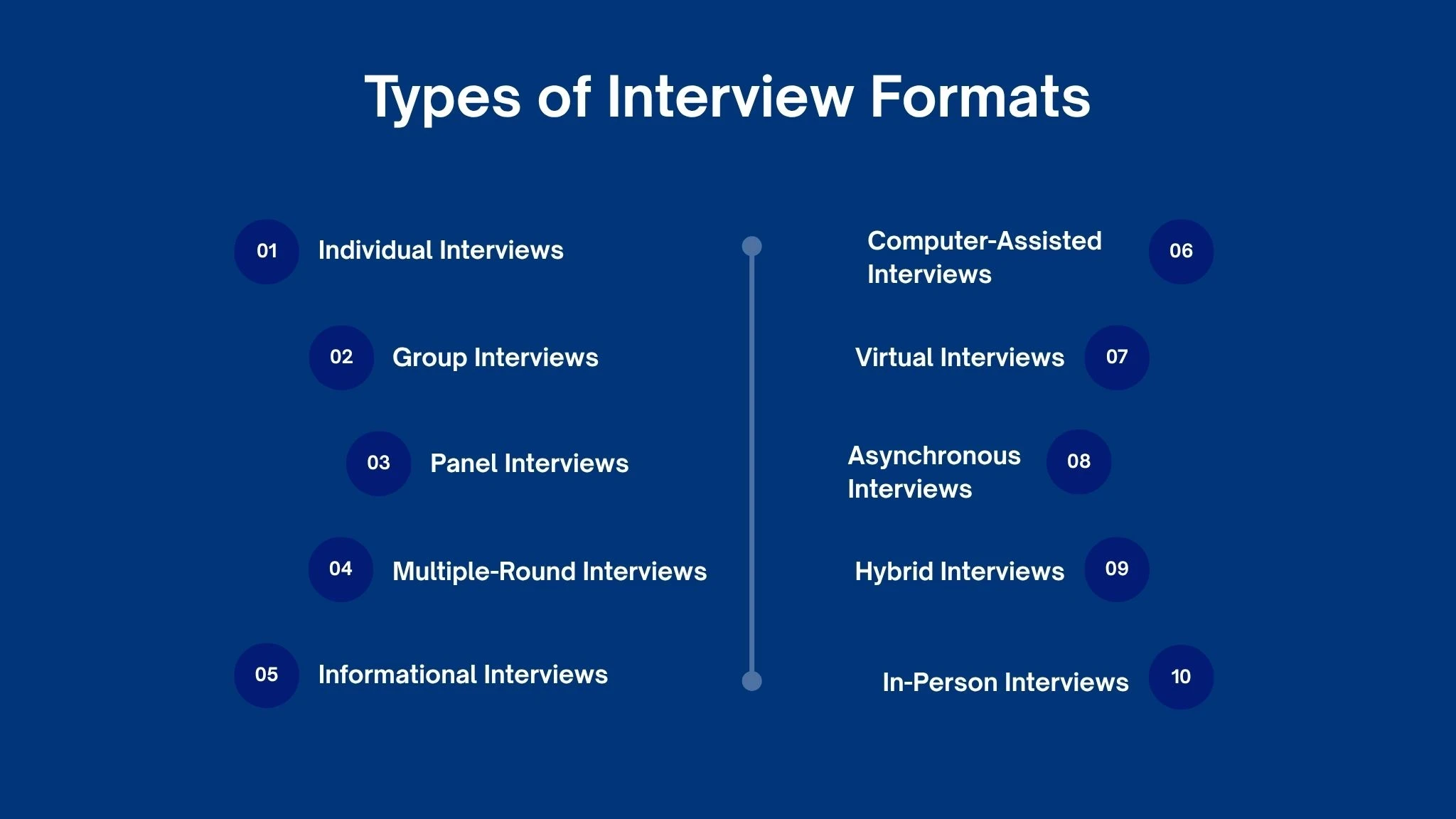
Individual Interviews
Individual interviews involve one interviewer and one candidate. This is the most traditional and widely used interview format.
It allows for a focused and detailed conversation where the interviewer can explore the candidate’s background, skills, and motivations without distractions.
Example:
A hiring manager conducts a 45-minute interview to discuss the candidate’s experience, achievements, and role expectations.
Advantages:
Personalized interaction
Easier communication and understanding
Flexible questioning
Disadvantages:
Higher risk of interviewer bias
Limited perspective compared to panel interviews
How to Prepare:
Build strong communication skills
Be clear and confident in responses
Research the interviewer and company
Group Interviews
Group interviews involve multiple candidates being interviewed at the same time. Candidates may be asked to participate in discussions, activities, or problem-solving tasks.
This format is often used to evaluate teamwork, leadership, and communication skills.
Example:
A company invites 5 to 10 candidates and assigns a group task such as solving a business problem or discussing a topic while observers evaluate their behavior.
Advantages:
Efficient for screening multiple candidates
Evaluates teamwork and leadership
Highlights communication skills
Disadvantages:
Less individual attention
May disadvantage introverted candidates
How to Prepare:
Participate actively without dominating
Listen to others and collaborate
Demonstrate leadership and initiative
Panel Interviews
Panel interviews involve multiple interviewers evaluating a single candidate at the same time. Each panel member may focus on a different area such as technical skills, culture fit, or leadership.
Example:
A candidate is interviewed by a panel consisting of a hiring manager, HR representative, and technical lead.
Advantages:
Multiple perspectives reduce bias
Comprehensive evaluation
Saves time by combining rounds
Disadvantages:
Can be intimidating for candidates
Requires strong coordination among interviewers
How to Prepare:
Maintain eye contact with all panel members
Address questions clearly and confidently
Stay calm and composed
Multiple-Round Interviews
Multiple-round interviews involve several stages of interviews, each focusing on different aspects of the candidate’s profile.
This format is commonly used for mid-level and senior roles where deeper evaluation is required.
Example:
Round 1: HR screening
Round 2: Technical interview
Round 3: Managerial discussion
Round 4: Final leadership round
Advantages:
Thorough evaluation process
Reduces hiring risk
Allows specialization in each round
Disadvantages:
Time-consuming
May lead to candidate drop-offs
How to Prepare:
Stay consistent across rounds
Be prepared for increasing difficulty
Review feedback from previous rounds if available
Informational Interviews
Informational interviews are informal conversations where the goal is not immediate hiring but knowledge sharing and networking.
Candidates use this format to learn more about a company, role, or industry.
Example:
A candidate connects with a professional to understand their role, career path, and industry insights.
Advantages:
Helps build professional connections
Provides industry insights
Low-pressure environment
Disadvantages:
No direct job offer
Requires proactive effort
How to Prepare:
Prepare thoughtful questions
Focus on learning rather than impressing
Be respectful of time
Computer-Assisted Interviews
Computer-assisted interviews involve the use of technology to conduct or support interviews. This includes AI-driven interviews, automated assessments, and recorded video responses.
Example:
A candidate records answers to predefined questions, which are later reviewed by recruiters or analyzed using AI.
Advantages:
Scalable and efficient
Standardized evaluation
Saves recruiter time
Disadvantages:
Limited human interaction
May feel impersonal
How to Prepare:
Practice speaking clearly on camera
Maintain good body language
Ensure proper lighting and sound
Virtual Interviews
Virtual interviews are conducted online using video conferencing tools. They have become a standard format in remote and global hiring.
Example:
A recruiter conducts an interview via Zoom or Google Meet with a candidate located in a different city or country.
Advantages:
Enables remote hiring
Reduces travel costs
Flexible scheduling
Disadvantages:
Dependent on internet connectivity
Limited physical interaction
How to Prepare:
Test your internet and equipment
Choose a quiet and professional background
Maintain eye contact through the camera
Asynchronous Interviews
Asynchronous interviews allow candidates to record their responses to questions at their convenience without a live interviewer present.
Recruiters review these responses later.
Example:
A candidate receives a set of questions and records video answers within a given deadline.
Advantages:
Flexible for candidates and recruiters
Eliminates scheduling conflicts
Scalable for large hiring needs
Disadvantages:
No real-time interaction
Limited opportunity for follow-up questions
How to Prepare:
Practice concise and structured answers
Be mindful of time limits
Maintain professionalism throughout
Hybrid Interviews
Hybrid interviews combine both in-person and virtual elements. Some rounds may be conducted online, while others are held face-to-face.
Example:
Initial screening is done virtually, followed by an in-office final round.
Advantages:
Flexible and efficient
Combines benefits of both formats
Improves candidate experience
Disadvantages:
Requires coordination
May create inconsistency if not structured well
How to Prepare:
Be ready for both virtual and in-person settings
Maintain consistency across all rounds
Adapt to different interview environments
In-Person Interviews
In-person interviews are conducted face-to-face at the company’s office or a designated location. They allow for deeper interaction and better assessment of body language and interpersonal skills.
Example:
A final round interview conducted at the company office with team members and leadership.
Advantages:
Strong personal connection
Better communication and observation
Immersive experience
Disadvantages:
Time and travel involved
Less flexible compared to virtual formats
How to Prepare:
Dress professionally
Arrive on time
Maintain confident body language
The choice of interview format can significantly impact both the quality of hiring decisions and the overall candidate experience. While traditional formats like individual and panel interviews remain widely used, modern formats such as virtual and asynchronous interviews are becoming increasingly important in today’s remote-first world.
Common Interview Questions with Sample Answers
Preparing for common interview questions is one of the most effective ways to improve interview performance. While every interview is different, certain questions are consistently asked across industries to evaluate a candidate’s communication skills, confidence, problem-solving ability, and overall suitability for the role.
The key to answering these questions effectively is to stay clear, structured, and relevant. Instead of memorizing answers, candidates should focus on understanding what the interviewer is trying to assess.
Below are some of the most commonly asked interview questions along with sample answers and guidance.
Tell Me About Yourself
This is usually the opening question and sets the tone for the entire interview. The goal is to provide a concise and structured summary of your professional background.
How to Answer:
Start with your current role or education
Highlight key achievements or experience
End with what you are looking for
Sample Answer:
“I have a background in finance with over three years of experience in financial analysis and reporting. In my current role, I work on budgeting and forecasting, where I helped reduce costs by 15 percent through data-driven insights. I am now looking for an opportunity where I can apply my analytical skills in a more strategic role.”
What Are Your Strengths and Weaknesses?
This question evaluates self-awareness and honesty.
How to Answer:
Mention strengths relevant to the role
Provide examples to support them
Be honest about weaknesses and show improvement
Sample Answer:
“One of my strengths is my ability to stay organized and manage multiple priorities effectively. For example, I have consistently delivered projects on time even under tight deadlines.
As for my weakness, I used to hesitate while speaking in large groups, but I have been actively working on it by participating in presentations and improving my confidence.”
Why Do You Want to Work Here?
This question tests your interest in the company and role.
How to Answer:
Show that you have researched the company
Align your goals with the company’s vision
Highlight how you can contribute
Sample Answer:
“I am interested in this role because it aligns well with my experience in project management and my interest in working on impactful projects. I also appreciate the company’s focus on innovation and continuous improvement, which matches my professional values.”
Tell Me About a Challenge You Faced and How You Handled It
This is a behavioral question used to assess problem-solving skills.
How to Answer:
Describe the situation clearly
Explain the actions you took
Highlight the result and what you learned
Sample Answer:
“In my previous role, we faced a delay in project delivery due to unexpected resource constraints. I reorganized the task distribution, communicated clearly with stakeholders, and adjusted timelines. As a result, we completed the project with minimal delay and maintained client satisfaction.”
Where Do You See Yourself in Five Years?
This question evaluates long-term goals and alignment.
How to Answer:
Show ambition and growth mindset
Keep your goals realistic and relevant
Align with the company’s opportunities
Sample Answer:
“In the next five years, I see myself growing into a role with greater responsibility where I can contribute to strategic decisions while continuing to develop my skills and expertise.”
Why Should We Hire You?
This is your opportunity to position yourself as the best candidate.
How to Answer:
Highlight your key strengths
Connect your skills to the job role
Show confidence without exaggeration
Sample Answer:
“I believe my combination of technical expertise, problem-solving ability, and adaptability makes me a strong fit for this role. I am confident that I can quickly contribute to the team and add value through my skills and experience.”
Tell Me About a Time You Worked in a Team
This question evaluates teamwork and collaboration.
How to Answer:
Share a specific example
Highlight your role in the team
Explain the outcome
Sample Answer:
“In a recent project, I worked with a cross-functional team to launch a new product feature. I coordinated with designers and developers to ensure smooth execution, and we successfully launched the feature on time with positive user feedback.”
Do You Have Any Questions for Us?
This is often the final question and an opportunity to show interest.
How to Answer:
Ask thoughtful and relevant questions
Focus on role expectations or growth opportunities
Sample Answer:
“Yes, I would like to understand what success looks like in this role during the first six months and how performance is typically evaluated.”
Real-World Interview Examples
Understanding interview concepts becomes much more effective when you see how they are applied in real-world scenarios. These examples help bridge the gap between theory and practice, giving candidates a clear idea of how different interview types work and how to respond effectively.
Below are practical, role-based interview examples that demonstrate how candidates are evaluated across different situations.
Example 1: Marketing Associate – Behavioral Interview
Scenario:
A candidate applying for a marketing role is asked:
“Tell me about a campaign you worked on and the results you achieved.”
Sample Response:
The candidate explains a social media campaign where they analyzed audience insights, optimized content strategy, and improved engagement. They highlight measurable outcomes such as a 30 percent increase in reach and higher conversion rates.
Example 2: Software Developer – Technical Interview
Scenario:
A candidate is given a coding problem:
“Write a function to find the first non-repeating character in a string.”
Sample Response:
The candidate walks through their approach step by step, uses an efficient algorithm, writes clean code, and explains the logic along with time and space complexity.
Example 3: Customer Support Executive – One-to-One Interview
Scenario:
A candidate is asked:
“How would you handle an angry customer?”
Sample Response:
The candidate explains that they would listen actively, acknowledge the issue, show empathy, and provide a clear resolution while maintaining professionalism throughout the interaction.
Example 4: Sales Trainee – Group Interview
Scenario:
A group of candidates is asked to discuss strategies to increase sales for a product.
Sample Response:
A strong candidate contributes meaningful ideas, listens to others, builds on team suggestions, and demonstrates leadership without dominating the discussion.
Example 5: Business Analyst – Case Interview
Scenario:
“A company’s profits are declining. How would you identify the problem and improve performance?”
Sample Response:
The candidate breaks the problem into components such as revenue streams, cost structure, and market factors. They ask clarifying questions, analyze possible causes, and propose structured, data-driven solutions.
Example 6: HR Executive – Situational Interview
Scenario:
“What would you do if two employees in your team have a conflict?”
Sample Response:
The candidate explains that they would listen to both sides, understand the root cause, mediate the discussion, and work toward a fair resolution while maintaining a positive work environment.
Example 7: Project Manager – Panel Interview
Scenario:
A candidate is interviewed by a panel including a senior manager, HR, and a technical lead.
Sample Response:
The candidate answers questions related to project planning, stakeholder communication, and risk management while maintaining clarity and confidence across different types of questions.
How Sherlock AI Improves the Interview Process
As hiring becomes more competitive and fast-paced, organizations need interview processes that are structured, fair, and efficient. Traditional interviews often suffer from inconsistencies, bias, and lack of standardized evaluation, which can lead to poor hiring decisions.
Sherlock AI addresses these challenges by bringing structure and intelligence into the interview process while keeping the focus entirely on interview performance.
Structured and Standardized Interviews
Sherlock AI enables recruiters to create consistent interview frameworks by standardizing questions across all candidates. This ensures that every candidate is evaluated on the same criteria, improving fairness and making comparisons more reliable.
Objective Evaluation of Candidates
Instead of relying solely on subjective judgment, Sherlock AI helps analyze candidate responses in a more structured way. This allows hiring teams to make decisions based on clear, job-relevant insights rather than personal bias.
Improved Candidate Experience
A well-structured interview process not only benefits recruiters but also enhances the candidate experience. Sherlock AI ensures that interviews are organized, transparent, and focused, helping candidates present their skills more effectively.
Scalable Hiring for Growing Teams
For organizations handling high-volume hiring, maintaining consistency can be challenging. Sherlock AI makes it easier to scale interviews without compromising on quality by streamlining the entire process.
Data-Driven Hiring Decisions
With better insights and structured evaluation, recruiters can make more informed hiring decisions. Sherlock AI supports this by ensuring that every interview is aligned with role-specific requirements and measurable outcomes.
Sherlock AI plays a crucial role in modernizing interviews by making them more structured, fair, and efficient. By focusing purely on interview performance and standardizing the evaluation process, it helps organizations identify the right talent while improving overall hiring quality.
Conclusion
Interviews are a fundamental part of the hiring process that go far beyond simple conversations. They are structured evaluations designed to assess a candidate’s skills, experience, behavior, and overall fit for a role. From understanding different types of interviews to exploring various interview formats, it is clear that a well-planned approach is essential for effective hiring.
Each interview type serves a specific purpose, whether it is evaluating technical expertise, problem-solving ability, or interpersonal skills. Similarly, choosing the right interview format helps create a smooth and efficient experience for both recruiters and candidates. When combined, these elements lead to better hiring decisions and improved outcomes.
For candidates, success in interviews comes from preparation, clarity, and the ability to communicate real-world experiences effectively. For organizations, the focus is shifting toward more structured, consistent, and unbiased interview processes that prioritize job-relevant evaluation.
This is where solutions like Sherlock AI add value by helping teams standardize interviews, evaluate candidates objectively, and make data-driven hiring decisions while keeping the process entirely interview-focused.
Ultimately, mastering interviews is about understanding the process, preparing strategically, and presenting your value with confidence. Whether you are a candidate aiming to succeed or a recruiter looking to hire the right talent, a well-structured interview approach is the key to long-term success.