Back to all blogs
How to Detect Cheating in Video Interviews using practical methods and AI-driven insights from Sherlock AI to ensure authentic hiring and safeguard the hiring integrity.
Abhishek Kaushik
Feb 3, 2026
Remote and video interviews have become a permanent part of modern hiring. While they offer speed, flexibility, and global reach, they also introduce a growing challenge for recruiters and hiring managers: cheating in video interviews. A recent survey found that 15% cheated on a phone interview, 13%during an in-person interview, and 11% in a video interview.
With the rise of AI tools, second screens, real-time prompts, and impersonation tactics, traditional interview methods are no longer enough to ensure candidate authenticity. This is why organizations are actively searching for reliable ways to detect cheating in video interviews without harming candidate experience.
In this guide, we break down how cheating happens, how prevalent it is, what interviewers can do manually, and how AI-powered platforms like Sherlock AI help detect cheating accurately and at scale.
Cheating During Video Interviews: How Prevalent Is It?
Cheating in remote hiring is no longer an edge case. Multiple hiring surveys show that a significant percentage of candidates admit to receiving external help during online interviews or assessments.
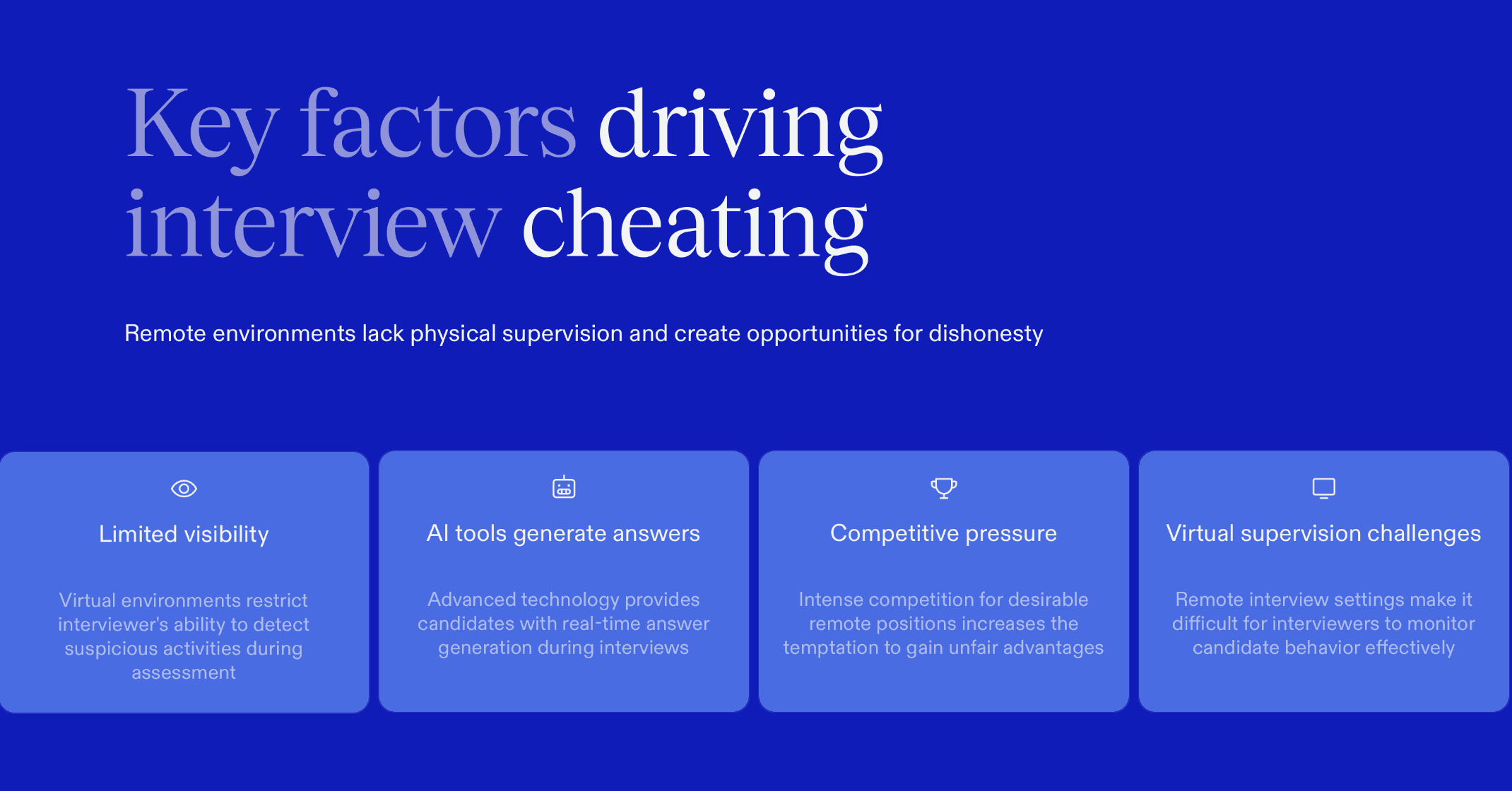
Common factors driving this increase include:
Easy access to AI tools that generate real-time answers
Lack of physical supervision
High competition for remote roles
Limited interviewer visibility during virtual interviews
As video interviews become the first filter in hiring, failing to detect cheating can result in poor hires, productivity loss, and long-term trust issues.
Types of Cheating Possible in a Video Interview
Before discussing detection methods, it is important to understand the different ways candidates may attempt to cheat during video interviews. Remote hiring environments reduce physical supervision, making it easier for candidates to rely on external support that misrepresents their actual skills.
1. External AI Assistance
One of the fastest growing forms of cheating in video interviews is the use of AI tools such as ChatGPT or real-time AI copilots. Candidates input interview questions into these tools and receive instant answers that they read or paraphrase during the interview.
This often results in responses that sound polished but lack depth, personal experience, or logical consistency when follow-up questions are asked. AI-assisted answers may also show sudden shifts in vocabulary, tone, or structure that do not align with the candidate’s earlier responses.
2. Second Screen Usage
Second screen cheating involves using smartphones, tablets, or additional monitors during the interview. Candidates may search for answers, refer to prepared notes, or receive real-time guidance without the interviewer noticing.
This behavior is particularly common in technical interviews, case discussions, and competency-based questions. Frequent eye movement away from the camera, delayed responses, or reading-like speech patterns often indicate second screen usage.
3. Proxy Interviews and Impersonation
In proxy interviews, a more skilled individual appears on behalf of the actual candidate, especially during early screening or technical rounds. This type of fraud is common in remote hiring for high-demand roles such as software engineering or data science.
Impersonation becomes evident later when the hired candidate cannot replicate the same level of performance or communication. Inconsistent facial features, voice patterns, or behavioral cues across interview stages are common indicators of proxy participation.
4. Audio Assistance
Some candidates use hidden earbuds, Bluetooth devices, or wired headsets to receive live answers from another person during the interview. This assistance may come from a coach, friend, or paid service.
Audio-assisted cheating often results in unnatural pauses, delayed responses, or whispered repetition of answers. Candidates may also struggle when asked to explain answers in their own words or adapt them to new scenarios.
5. Pre-recorded or Scripted Responses
Candidates sometimes rely on memorized scripts or pre-recorded answers for common interview questions. While preparation is acceptable, over-rehearsed responses reduce authenticity and flexibility.
When faced with situational or reasoning-based follow-up questions, these candidates often hesitate, repeat the same phrasing, or fail to adapt their answers. This pattern indicates a lack of real understanding rather than genuine experience.
How to Detect Cheating in a Video Interview?
Detecting cheating in a video interview requires a combination of observation, interview design, and technology. Below are the key methods interviewers and hiring teams can use to identify dishonest behavior during remote interviews.
1. Watch Eye Movement and Attention Shifts
Eye behavior often provides early clues about whether a candidate is relying on external assistance during a video interview.
Frequent glances away from the camera may indicate second screen usage.
Downward eye movement often suggests reading from notes or AI tools.
Delayed eye contact before answering complex questions can signal external help.
Consistent attention shifts during critical questions are stronger indicators than occasional movement.
When these behaviors appear repeatedly, they may point to divided attention rather than natural thinking.
2. Analyze Response Time and Pauses
Response timing can reveal whether answers are being generated independently or with outside support.
Long pauses before answering may indicate candidates waiting for AI-generated responses.
Inconsistent response speed across questions can be a warning sign.
Authentic candidates typically respond with a natural conversational flow.
Unnatural delays often become more visible when follow-up questions are introduced.
3. Listen for Unnatural Speech Patterns
Speech quality and structure often change when candidates rely on external tools or scripted content.
Overly polished or generic answers may be AI-assisted.
Sudden changes in vocabulary or tone suggest external input.
Difficulty explaining answers in simple terms can indicate lack of true understanding.
These inconsistencies usually emerge when candidates are asked to explain their reasoning.
4. Ask Adaptive Follow-Up Questions
Follow-up questions test whether candidates truly understand what they are saying.
Request explanations of how answers were derived.
Ask candidates to apply concepts to new or unexpected scenarios.
Probe deeper into real-world experiences related to their responses.
Candidates who depend on scripted or AI-generated answers often struggle to adapt.
5. Request Screen Sharing When Needed
Screen sharing increases transparency and limits opportunities for external assistance.
Screen sharing limits the use of secondary devices.
Observing real-time problem solving reveals genuine skill level.
Hesitation or resistance to screen sharing may indicate reliance on external resources.
Live task execution helps interviewers assess both competence and confidence.
6. Observe Audio and Environmental Cues
Audio behavior and surroundings can reveal hidden forms of assistance.
Hidden earbuds or headsets can enable live assistance.
Long listening pauses or repeated phrasing may suggest audio prompts.
Asking for a brief view of the surroundings promotes transparency.
Small audio and environmental cues often reveal more than visual signals alone.
7. Monitor Behavioral Consistency Across the Interview
Consistency in behavior and reasoning is a strong indicator of authenticity.
Authentic candidates maintain consistent reasoning and communication.
Cheating candidates may contradict earlier answers.
Inconsistent confidence levels across questions can be a red flag.
Behavioral shifts across different stages often indicate external influence.
8. Use AI-Powered Interview Analysis
AI technology enhances detection by analyzing patterns beyond human observation.
AI detects gaze deviation, multitasking behavior, and response latency.
Behavioral analysis identifies patterns humans may miss.
Sherlock AI flags potential AI assistance and impersonation risks.
This allows hiring teams to make data-backed decisions at scale.
9. Look for Patterns, Not Single Indicators
Cheating detection is most accurate when multiple signals are evaluated together.
One signal alone does not confirm cheating.
Multiple indicators appearing together strengthen detection accuracy.
Combining human judgment with AI insights ensures fair evaluation.
A pattern-based approach reduces false positives while protecting interview integrity.
How Sherlock AI Helps Detect Cheating in Video Interviews
Cheating in video interviews is rarely obvious. It shows up as small behavioral inconsistencies, timing gaps, and authenticity issues that are easy to miss in real time. Sherlock AI is designed to surface these subtle signals and convert them into clear, actionable insights for hiring teams.
Instead of monitoring candidates in a disruptive way, Sherlock AI evaluates how candidates behave, respond, and engage throughout the interview, helping recruiters focus on decision quality rather than suspicion. Sherlock AI:
Analyzes real-time interview behavior to identify attention shifts and engagement inconsistencies.
Distinguishes genuine knowledge from AI-assisted answers by evaluating reasoning depth and response continuity.
Flags proxy interview risks by tracking behavioral consistency across multiple interview rounds.
Builds a unified candidate integrity profile instead of evaluating interviews in isolation.
Surfaces subtle cheating signals without interrupting the interview experience.
Works silently in the background without intrusive monitoring or rigid proctoring rules.
Integrates smoothly into existing hiring workflows with minimal process changes.
Helps recruiters focus on decision quality rather than manual suspicion checks.
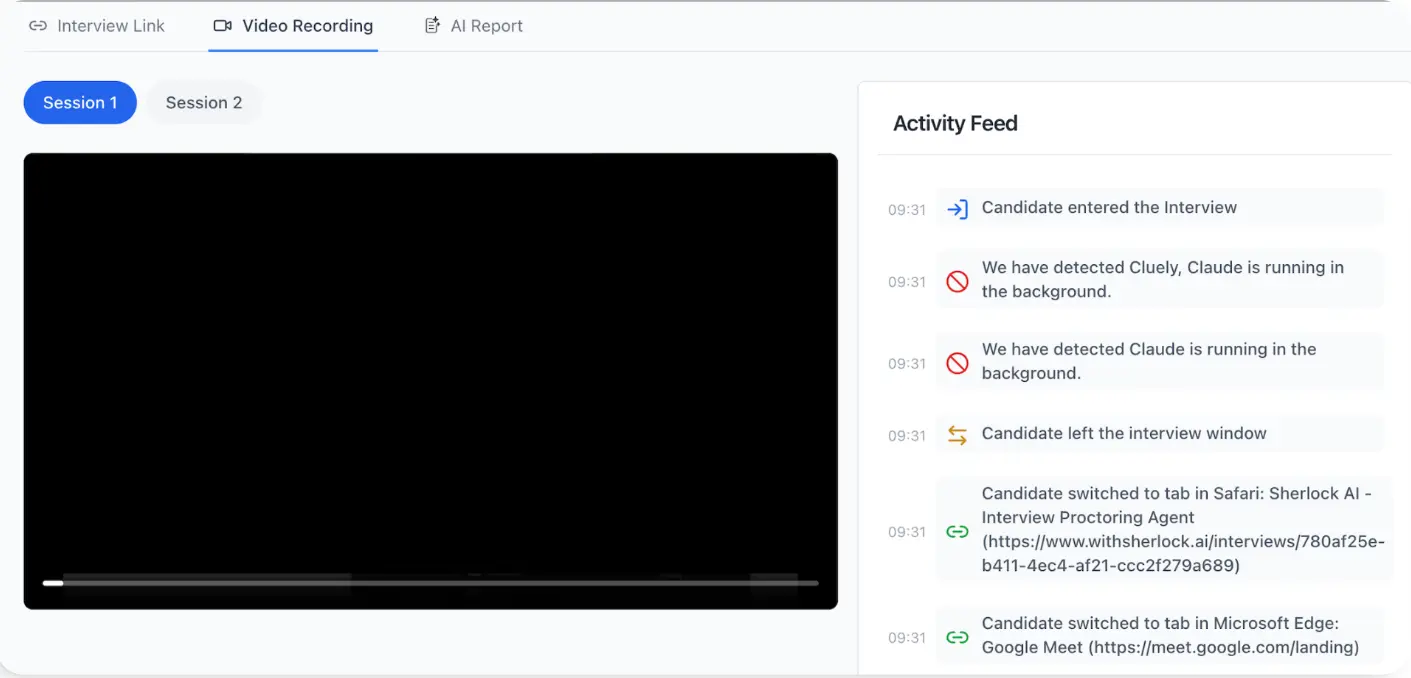
Sherlock AI integrates directly with scheduled interviews through secure calendar and video platform connections, working seamlessly without disrupting the interview flow.
👉 Explore How to Detect and Prevent Cluely AI in Interviews
Conclusion
Cheating in video interviews has become a practical challenge in remote hiring, not an exception. As candidates gain access to AI tools and external assistance, relying only on traditional interview methods increases the risk of poor hiring decisions.
Addressing this challenge requires a shift toward behavioral awareness, structured questioning, and intelligent analysis that can surface subtle inconsistencies without disrupting the interview experience. When hiring teams prioritize authenticity over surface-level answers, they gain a clearer and more reliable view of real candidate capability.
By combining human judgment with behavioral intelligence from platforms like Sherlock AI, organizations can detect cheating signals in real time, ask better follow-up questions, and make more confident hiring decisions. This approach helps protect hiring integrity while building teams based on genuine skill and trust in a remote-first hiring environment.