Back to all blogs
Proxy interviews are rising in remote hiring. See how Sherlock AI detects stand-ins, real-time assistance, and interview fraud.
Abhishek Kaushik
Mar 5, 2026
Remote hiring has transformed how companies evaluate talent but it has also introduced a growing integrity challenge - proxy interviews. In a proxy interview, the person being evaluated is not the person who will ultimately join the organization.
Industry research highlights the scale of the issue. 59% of hiring managers suspect candidates have used AI or deceptive tactics to misrepresent themselves, and more than 30% report encountering cases where someone other than the listed applicant participated in an interview. Looking ahead, Gartner projects that by 2028, one in four job candidates globally could be partially or wholly fake, driven by AI-generated identities, deepfakes, and organized interview fraud.
Traditional interview safeguards were never designed for this reality. This is where Sherlock AI comes in, shifting interview integrity from intuition and surface-level checks to continuous, signal-based evaluation built specifically to prevent proxy interviews at scale.
What Is a Proxy Interview?
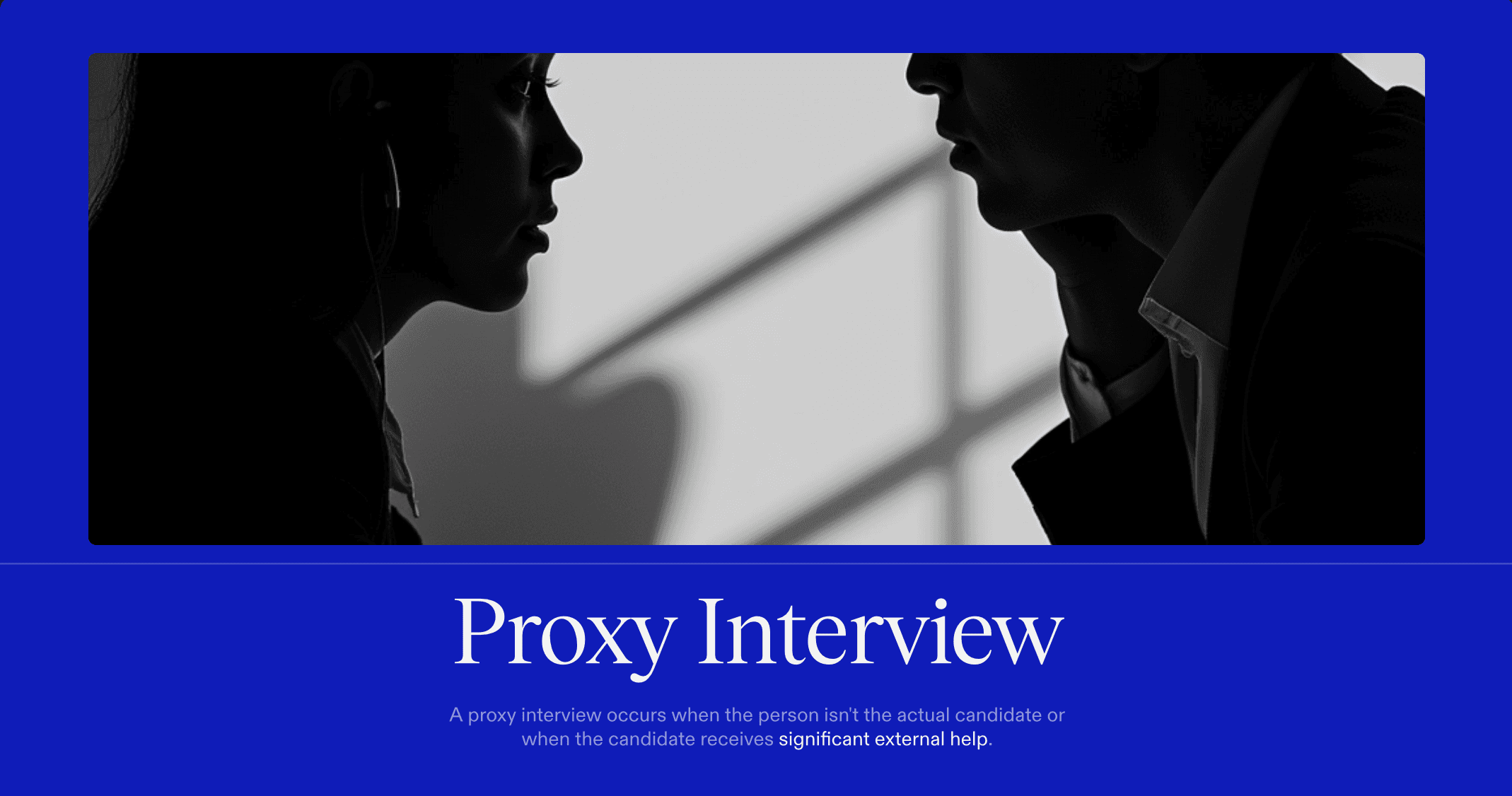
A proxy interview occurs when the individual appearing in an interview is not the actual candidate being assessed or when the candidate’s responses are heavily influenced by external assistance. Unlike resume fraud or exaggeration, proxy interviews compromise the interview process itself.
Common proxy interview patterns include:
Stand-ins
A more experienced individual attends the interview on behalf of the candidate, particularly in technical or high-stakes rounds.Real-time assistance
The candidate receives live coaching through:Hidden audio prompts
Messaging or chat tools
Off-screen collaborators providing answers or guidance
Interview swapping
One individual clears interviews, while a different person joins after hiring.
These approaches are often coordinated, rehearsed, and optimized to pass standard interview formats, especially when those formats rely heavily on video presence and scripted questioning.
👉 How to Detect AI Voice Bots in Interviews
Why Traditional Video Interviews Fail to Catch Proxy Interviews
Most interview processes were designed for a simpler era of cheating. As a result, they struggle to detect modern proxy tactics.
Same face, different behavior
Communication style shifts noticeably across rounds
Confidence fluctuates inconsistently
Technical depth changes under probing or unstructured follow-ups
Camera-on does not equal authenticity
Seeing a face does not guarantee independent thinking
Off-camera inputs remain invisible
Visual presence is often mistaken for legitimacy
Intuition replaces evidence
Recruiters rely on gut feel rather than measurable signals
Red flags are dismissed as stress or interview anxiety
Inconsistencies go undocumented and unverified
Preventing proxy interviews requires a shift from point-in-time verification to continuous evaluation of authenticity throughout the interview process.
This is exactly the gap Sherlock AI was built to address.
Sherlock AI: Purpose-Built to Prevent Proxy Interviews
Sherlock AI is an interview intelligence platform designed specifically for modern, remote hiring environments. Instead of passively observing candidates, Sherlock AI actively evaluates who is thinking, who is responding, and how those responses are generated.
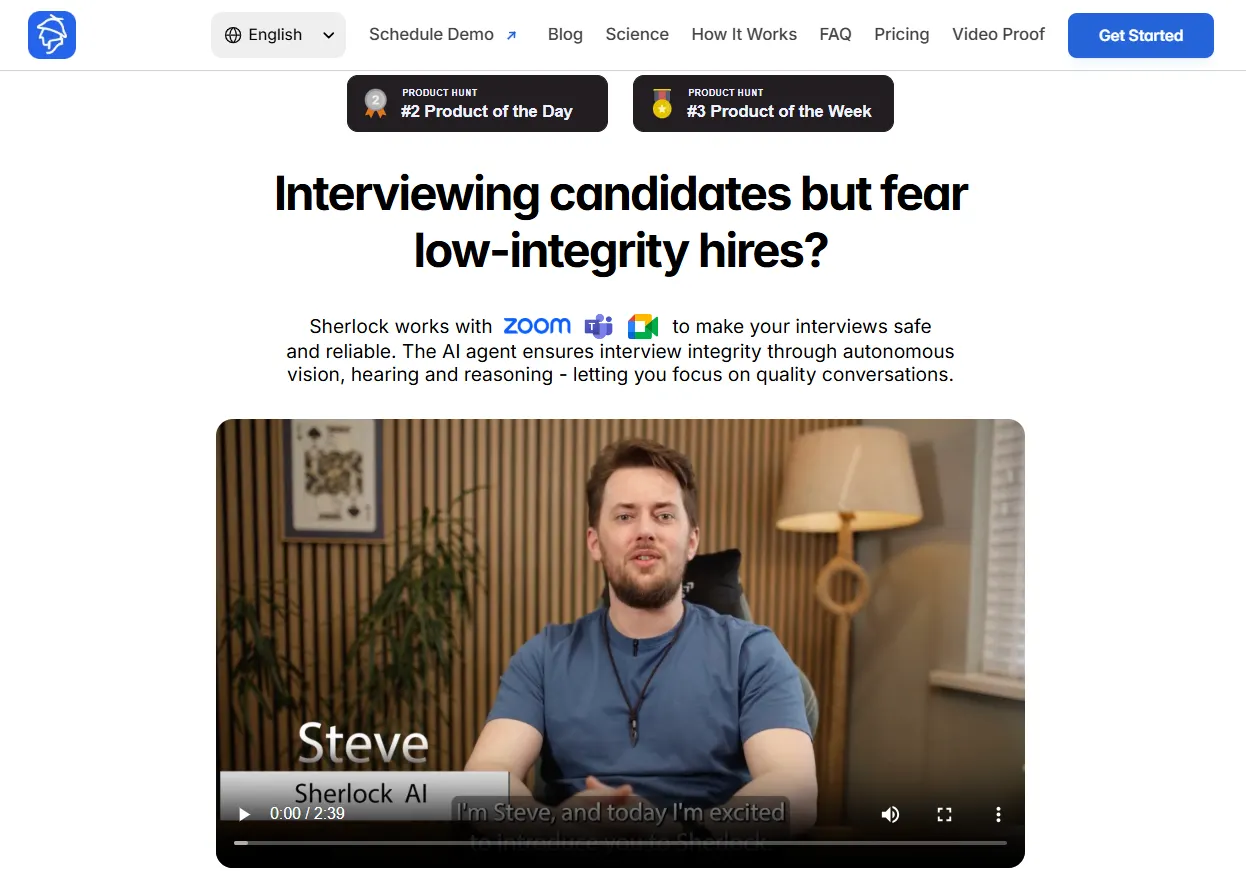
Rather than relying on a single signal such as a webcam feed or ID check, Sherlock AI combines multiple signals over time to build confidence in interview authenticity.
How Sherlock AI Prevents Proxy Interviews: An End-to-End View
Sherlock AI prevents proxy interviews by operating before, during, and across interview stages, ensuring that inconsistencies cannot hide behind isolated moments.
1. Continuous Identity & Authorship Verification
Sherlock AI goes beyond one-time identity verification.
Confirms that the same individual who applied is consistently participating throughout the interview
Monitors stability in speech patterns, interaction style, and response formation
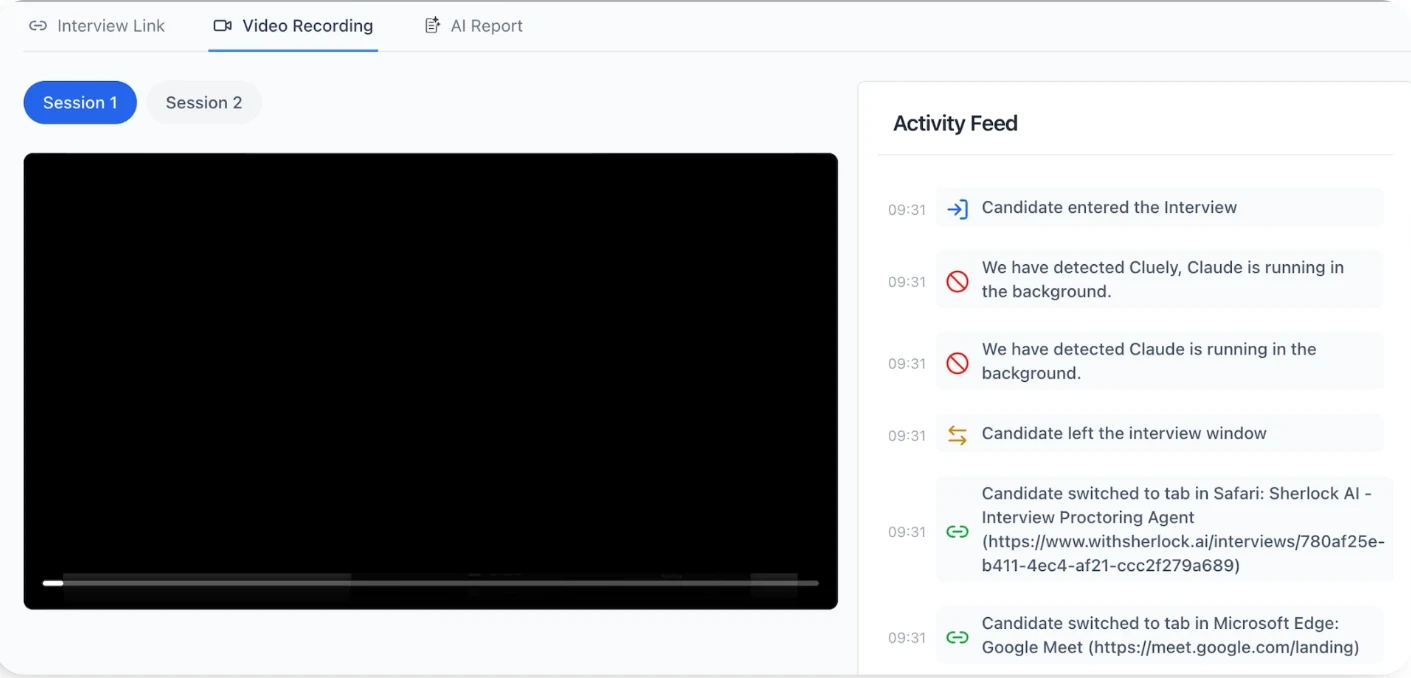
Detects anomalies that suggest impersonation, off-screen coaching, or response relaying
Crucially, Sherlock AI verifies authorship of reasoning, not just visual presence. If answers are being fed or generated externally, inconsistencies emerge in how ideas are articulated, refined, and defended over time.
2. Multimodal Behavioral Analysis
Sherlock AI evaluates interviews using multiple interconnected signals rather than isolated observations:
Device and interaction patterns
Identifies behaviors consistent with external tool usage or third-party assistanceAudio environment analysis
Flags unnatural pauses, response timing irregularities, or signs of off-screen promptingReasoning and fluency patterns
Differentiates authentic problem-solving from rehearsed or AI-generated responses
This multimodal approach allows Sherlock AI to detect engineered responses, even when delivery appears confident and polished.
3. Real-Time Alerts and Interviewer Support
Sherlock AI provides real-time integrity alerts during interviews.
Instead of discovering issues after the fact, interviewers are supported in the moment, enabling them to:
Probe deeper when reasoning appears inconsistent
Ask follow-up questions that require genuine understanding
Adjust interview flow based on integrity signals
This transforms Sherlock AI into a supportive assistant, not a surveillance tool, helping interviewers stay focused while increasing confidence in decision-making.
4. Consistency Tracking Across Interview Rounds
Proxy interviews often rely on fragmentation, different people or tools performing well in isolated rounds.
Sherlock AI closes this gap by:
Tracking behavioral and reasoning consistency across stages
Identifying shifts that would be difficult for genuine candidates but common in proxy scenarios
Providing structured integrity insights to hiring teams post-interview
Additional Value Beyond Proxy Interview Prevention
While preventing proxy interviews is core, Sherlock AI also strengthens overall hiring quality.
AI fluency observation
When AI tools are permitted, Sherlock AI evaluates how candidates use them, distinguishing thoughtful augmentation from blind reliance.Automated notes and structured insights
Interview takeaways are captured consistently, reducing bias and improving debrief quality.
This ensures that integrity checks enhance the interview experience for both candidates and recruiters.
Sherlock AI vs Traditional Interview Integrity Methods
Traditional safeguards were built for in-person interviews and simple rule violations. Proxy interviews exploit their blind spots.
Sherlock AI replaces subjective judgment with signal-based intelligence, enabling scalable, defensible interview integrity across remote hiring pipelines.
Capability | Traditional Methods (Human Proctoring & Basic ID Checks) | Sherlock AI |
|---|---|---|
Identity Verification | One-time ID or camera check at the start of the interview | Continuous identity and behavior consistency monitoring throughout the interview |
Proxy Interview Detection | Largely manual; depends on interviewer intuition | Automated detection using behavioral, contextual, and interaction signals |
Behavioral Consistency Analysis | Not tracked across interview stages | Tracks shifts in communication style, confidence, and reasoning depth |
Detection of Real-Time Assistance | Difficult to spot unless obvious | Flags patterns consistent with off-screen coaching or AI-generated responses |
Remote Desktop & Tool Misuse | Screen sharing gives false assurance | Monitors interaction and response patterns to detect external control or assistance |
Scalability | Does not scale well; requires more interviewers or proctors | Scales seamlessly across high-volume remote hiring |
Bias & Subjectivity | High, as decisions rely on gut feel | Reduced bias through signal-based, consistent evaluation |
Real-Time Alerts | None; issues noticed post-hire or during debriefs | Live alerts during interviews to prompt follow-up probing |
Candidate Experience | Often intrusive or awkward | Low-friction and natural interview flow |
Post-Interview Insights | Manual notes and memory-based recall | Structured insights and integrity signals captured automatically |
Adaptability to New Cheating Tactics | Slow; requires retraining interviewers | Continuously improves as new proxy patterns emerge |
Hiring Confidence | Reactive, issues surface after onboarding | Proactive, confidence built into every interview |
Conclusion
Proxy interviews are no longer rare or obvious. They are a natural outcome of remote hiring, real-time AI assistance, and fragmented interview workflows. Relying on cameras, identity checks, and intuition alone is no longer sufficient.
Sherlock AI prevents proxy interviews by making authenticity measurable, continuously analyzing identity consistency, behavioral signals, and reasoning patterns throughout the interview process. For hiring teams scaling remote interviews, it provides a proactive, low-friction way to protect hiring decisions before problems surface post-hire.
In today’s hiring landscape, interview integrity is not optional. It is foundational and Sherlock AI is built to uphold it.