Back to all blogs
An overview of how AI affects interview fairness and why strong hiring depends on assessing reasoning, not surface-level polish.

Abhishek Kaushik
Dec 22, 2025
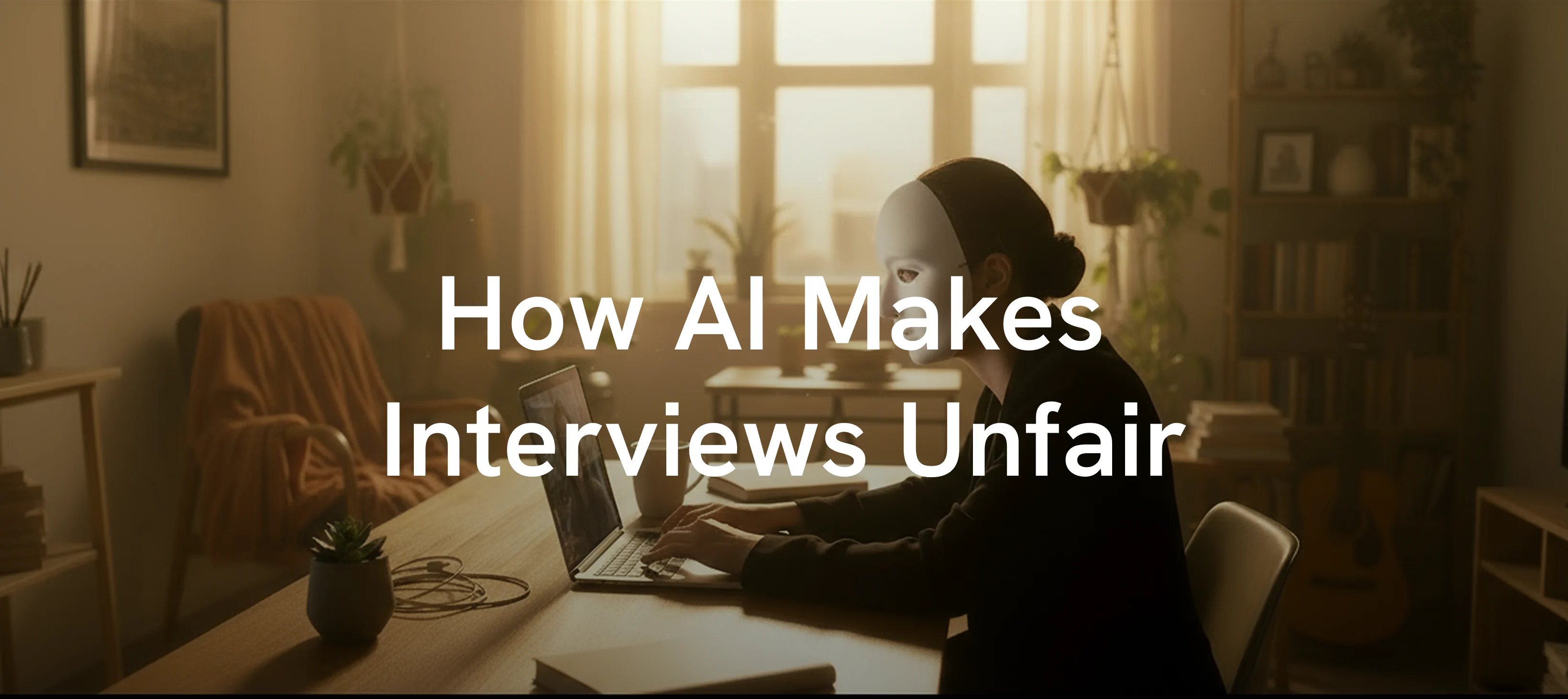
AI does not just help candidates.
It changes who has an advantage during interviews.
AI can:
Help candidates organize answers
Reduce anxiety
Support non-native speakers
But AI can also:
Hide the lack of fundamental skills
Reward memorization over reasoning
Enable proxy or coached participation
Make confident candidates look stronger than competent ones
The result:
Interviews can become less about skill and more about access to tools.
To keep interviews fair, we must evaluate thinking, not polish.
The Four Ways AI Can Create Unfairness in Interviews
1. It Amplifies Confidence Gaps
AI helps candidates speak smoothly, even when:
They lack direct experience
Their understanding is surface-level
They are repeating rehearsed narrative patterns
This gives:
Polished storytellers are an advantage
Over practitioners with deeper but less rehearsed experience
AI‑based hiring systems can shape the candidate experience by favouring those who present their background in polished, structured formats over those with deeper but less rehearsed experience.
Real Example
A strong engineer who communicates plainly may score lower than:
A weak engineer reading a polished, AI-generated behavioral script.
This is a fairness distortion.
2. It Rewards Memorization Instead of Understanding
AI coaching centers now sell:
System design scripts
Leadership behavior stories
“Perfect interview answers”
These are not:
Fake
Dishonest
by themselves
But when a candidate cannot:
Paraphrase in their own words
Explain tradeoffs
Adapt when assumptions shift
Then the answer is not their own thinking.
Interview signal becomes performance, not competence.
3. It Enables Background or Proxy Participation
Remote interviews make it easy to:
Have another person feed answers through a second device
Receive whisper coaching
Use face or voice masking software
This disadvantages:
Honest candidates
Internal candidates competing for promotions
Early career talent without access to coaching networks
Sherlock AI fixes this automatically through:
Identity consistency verification
Voice match detection
Behavioral reasoning patterns
This restores fairness.
4. It Overweighs Language Skill and Underweighs Reasoning
Without guardrails, AI makes answers:
Longer
Cleaner
More structured
But longer answers are not better answers. Structured language is not real understanding.
Research on bias in AI-enabled hiring shows that AI often rewards longer, cleaner answers, confusing polish for understanding. Interviews need to focus on how candidates think, decide, and adapt, not how smoothly they speak.
A fair interview evaluates:
How the candidate reasons under constraints
How do they make decisions
How do they update their approach when something changes
These signals are hard to fake with AI.
Read more: The Security Impact of AI-Assisted Interviews
So the Problem Is Not the AI
The problem is with the interview design:
Measures fluency, not reasoning
Measures storytelling, not decisions
Measures confidence, not ownership
Measures output, not adaptability
AI is simply a multiplier:
It multiplies good reasoning when used well
It multiplies fraud or performance theater when misused
How to Restore Fairness
Recruiters and interviewers can level the playing field by:
Shift | Old Way | Fair and AI-Aware Approach |
|---|---|---|
Understanding | “Tell me your story.” | “Paraphrase the problem in your own words.” |
Skill signal | Correct answers | Tradeoff reasoning and constraints adaptation |
Code evaluation | Final output | Debugging and the iteration process |
Identity | Assumed | Verified across steps |
These do not make interviews harder. They make interviews more real.
What Sherlock AI Adds
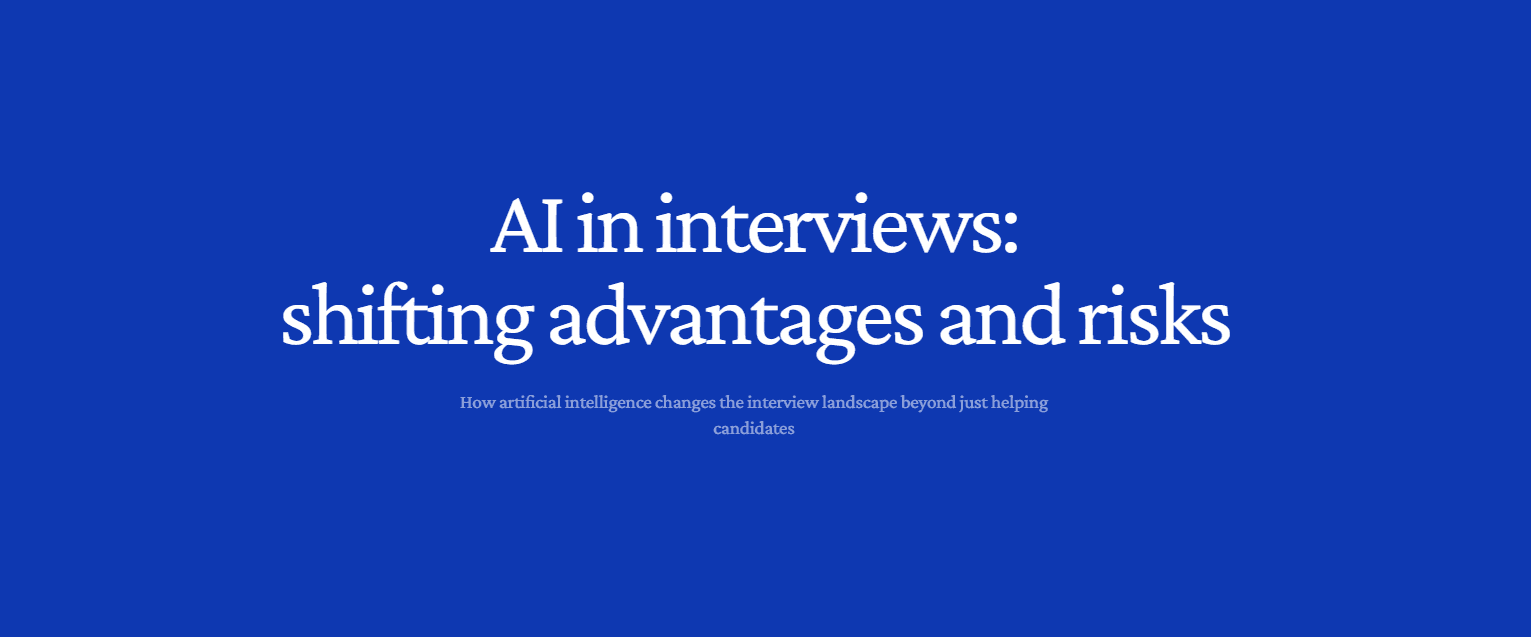
Sherlock AI restores fairness by:
Confirming that the person interviewing is the applicant
Detecting AI-coached or proxy answers through reasoning inconsistency
Highlighting behavior mismatches in real time
Helping interviewers evaluate thinking patterns, not word polish
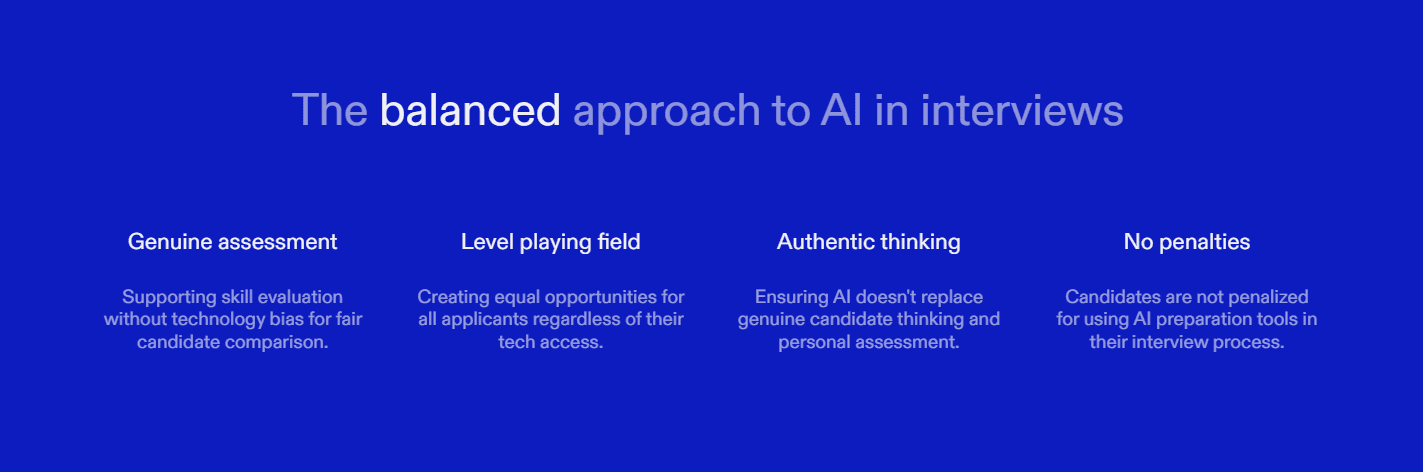
Sherlock AI does not punish AI usage. It ensures AI does not replace the candidate's thinking.
Conclusion
AI does not automatically make interviews unfair. It makes traditional interview scoring methods unreliable.
To keep hiring fair:
Evaluate reasoning, not fluency
Evaluate adaptability, not confidence
Verify identity, not assume it
Ask questions that require thinking, not repeating
Fairness is not about banning AI. Fairness is about ensuring the candidate’s mind is what is being evaluated. This is how hiring remains accurate and ethical in the AI era.