Back to all blogs
Learn how to identify ChatGPT usage in interviews and assess candidates' true understanding with these practical techniques and tips.

Abhishek Kaushik
Dec 18, 2025
Is It Possible to Know If an Answer Came From ChatGPT? Yes and no. You cannot detect ChatGPT in interview outputs by scanning text alone.
But you can detect ChatGPT usage patterns in how an answer is delivered in a live conversation.
Interviewers should focus on cognitive markers, reasoning structure, and conversational adaptability, not written linguistic traits.
Why You Cannot Reliably Detect ChatGPT in interviews from Text Alone
There is no perfect test that says:
This answer was written by ChatGPT.
This is because:
AI can paraphrase
Humans can rephrase
Models share patterns with standard business writing
Many correct answers naturally look “structured”
What detection tools look for instead:
Stylometric patterns
Syntactic regularity
Lack of personal narrative
Repetition of template reasoning frameworks
These signals are suggestive, not deterministic.
The AI‑text detection landscape remains highly uncertain. For instance, OpenAI announced the withdrawal of its AI Text Classifier in July 2023, stating that, “As of July 20, 2023, the AI classifier is no longer available due to its low rate of accuracy.
Moreover, a 2025 literature review found that although many AI‑text detection tools can reach moderate accuracy (above 50%), they remain unreliable, and therefore should not be relied upon for high‑stakes decisions.
So the question is not:
Did the candidate use ChatGPT?
The real question is:
Does the candidate understand what they are saying?
How to Detect ChatGPT Usage in Live Interviews
ChatGPT answers have distinct behavioral fingerprints.
1. Overly Structured Responses
ChatGPT tends to respond in:
Lists of 3 or 5 points
Well-balanced explanations
Perfect transitions
Example pattern:
First, I would start by understanding the requirements. Next, I would collaborate with stakeholders...
Ask:
How did you learn to do that in practice? What was hard about it?
ChatGPT cannot produce personal constraints or discomfort.
2. No Personal Pronoun Variation
AI answers avoid:
“I messed up.”
“I changed my mind because”
“I misunderstood something initially.”
An authentic experience includes imperfection.
3. No Story Scaffolding
Real practitioners anchor answers in:
People
Timelines
Tradeoffs
Friction
AI responses stay context-neutral.
Ask:
Tell me the part where you disagreed with someone.
AI cannot simulate conflict well.
4. Cognitive Depth Collapse
When pushed to explain how they made decisions, AI-assisted candidates break.
Example:
Why did you choose that approach instead of another?
A real practitioner will:
Describe internal logic
Describe uncertainty
Describe alternative approaches considered
A ChatGPT answer repeats surface reasoning.
How to Break AI-Generated Answers in Real Time
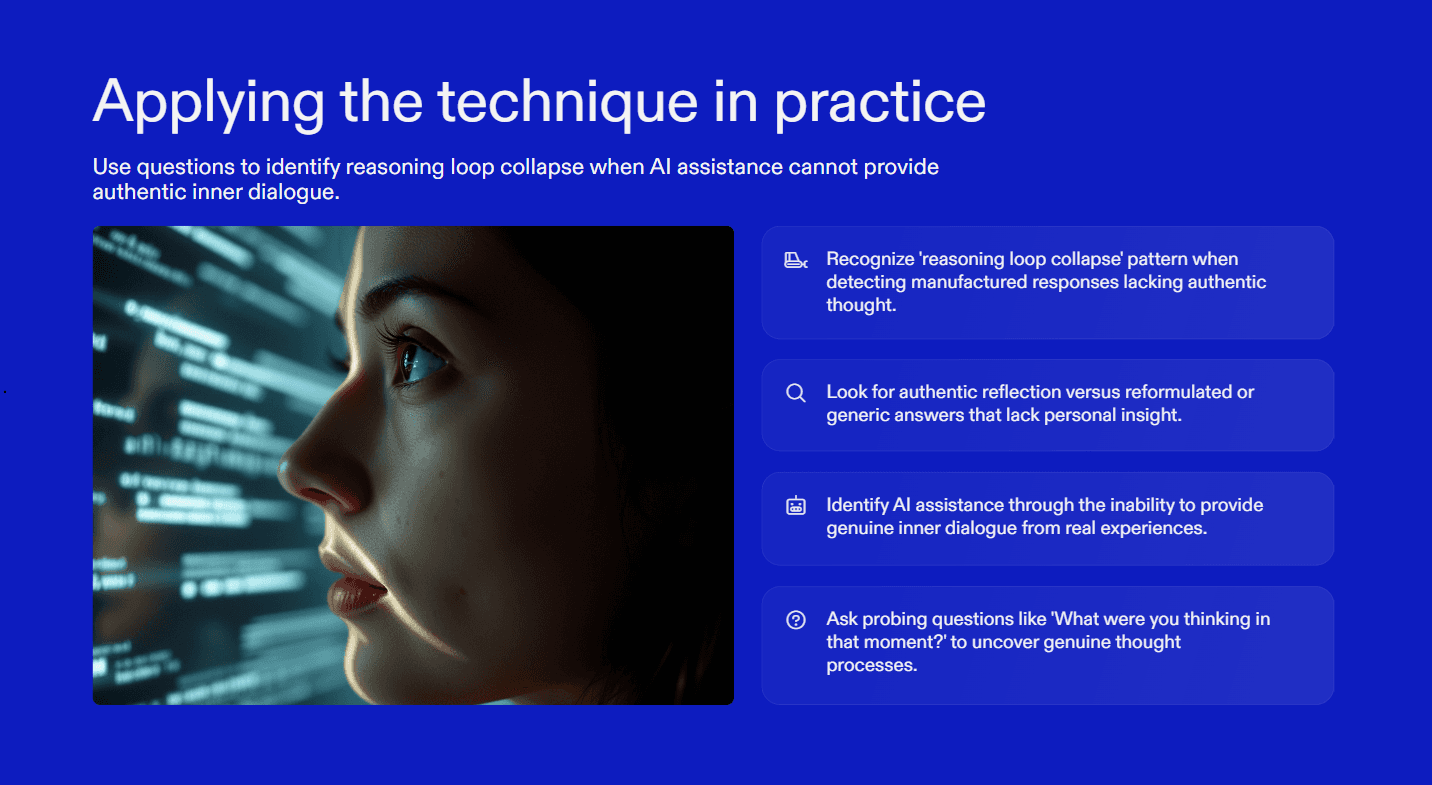
This is the key technique.
Use reflective micro-pauses and branching follow-ups.
Example:
You: Walk me through the moment when requirements changed.
Candidate: Gives a structured answer
You: What were you thinking in that moment?
Candidate: If real, they narrate inner reasoning
If AI-assisted: They restate the same answer in different wording
This is called reasoning loop collapse.
What Recruiters Should Do
Focus on authentic experience ownership, not “fluency”.
Ask:
“What did you personally own?”
“What tradeoff did you argue for?”
“What changed your mind mid-way?”
Avoid:
Yes or no technical trivia
Memorized definitions
“Tell me about a time” without probing depth
Policy Recommendation for 2026 Hiring
Companies should not:
Ban ChatGPT
Punish its use
They should:
Require disclosure
Validate understanding
Evaluate thinking, not formatting
Ensure identity verification during interviews if the risk is high
This is how hiring evolves instead of collapsing under new tools.
Read more: Should You Allow Candidates to Use ChatGPT in Interviews?
Conclusion
You cannot reliably detect ChatGPT by scanning text.
But you can reliably detect whether a candidate:
Understands their own claims
Owns their experience
Can reason under uncertainty
The goal is not to catch people. The goal is to hire for real thinking.