Back to all blogs
Explore the pros and cons of letting candidates use ChatGPT in interviews and how to set fair, practical guidelines for modern hiring.

Abhishek Kaushik
Dec 2, 2025
TL;DR
ChatGPT and similar AI tools can:
Accelerate problem solving
Support brainstorming
Help clarify concepts
but they can also:Mask lack of genuine skill
Enable coached answer recitation
Facilitate proxy or off-camera support
So the question is not yes or no.
The real question is:
Under what conditions can AI use be allowed without weakening the signal of the interview?
The answer is to allow AI use only in transparent, constrained, declared ways, while evaluating reasoning, not just final answers.
Why This Decision Matters
If the policy is unclear:
Recruiters appear inconsistent
Candidates feel treated unfairly
Managers rely on intuition instead of evidence
Teams risk hiring people who cannot perform without AI assistance
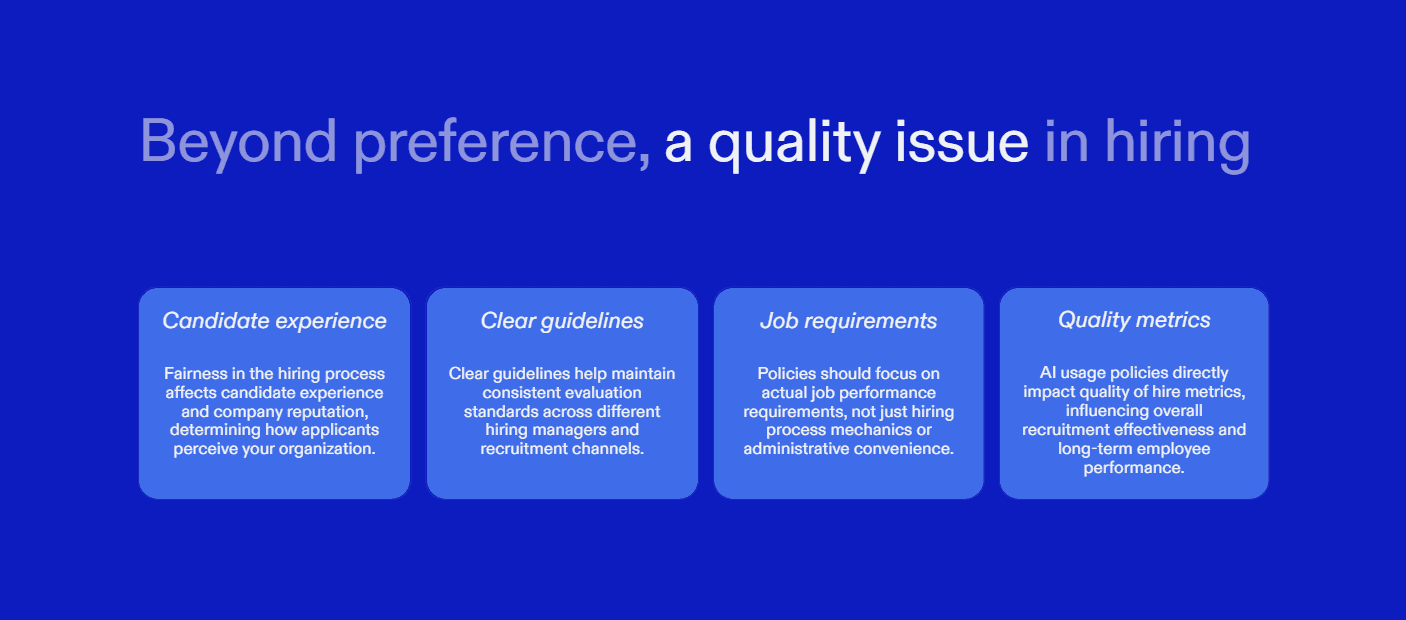
This is a quality of hire and fairness issue, not just a hiring preference.
In a recent survey of verified professionals, 20% admitted to secretly using AI tools during interviews, while 55% said it has become the new norm.
The policy must reduce ambiguity.
Situations Where AI Use Is Acceptable
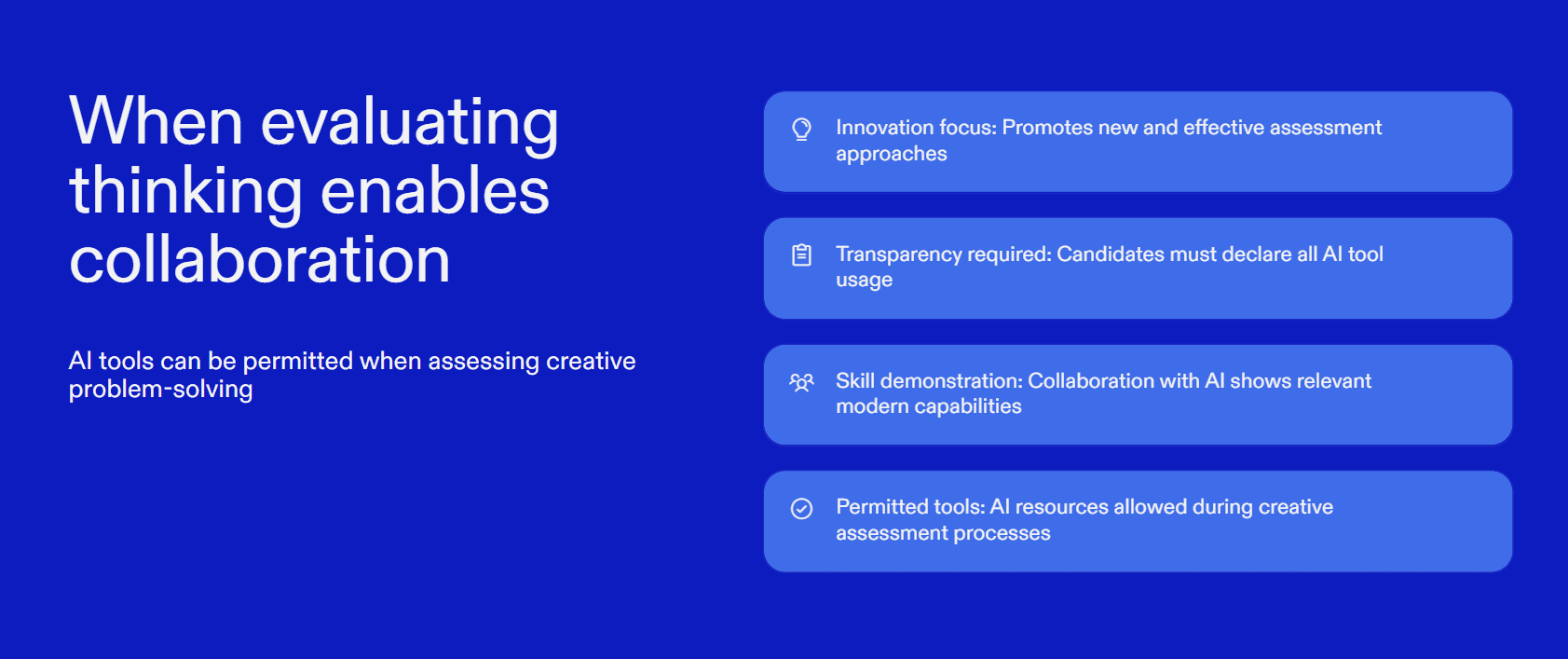
AI is useful when evaluating:
Brainstorming ability
Market scanning
High-level architecture outlines
Role-play scenarios for creativity-oriented roles
Allowing AI in these contexts can:
Speed up ideation
Reveal how candidates critique suggestions
Show collaboration patterns
The key signal becomes:
How the candidate interacts with the AI
not
What the AI produces
Read more: Should Candidates Use AI During Interviews?
Situations Where AI Use Should Not Be Allowed
AI breaks the evaluation when the interview measures:
Problem solving under real constraints
Independent reasoning ability
Coding implementation and debugging flow
Architecture tradeoff thinking
Personal ownership of past work
If AI is allowed here:
You are measuring tool usage, not capability
This leads to bad hires who cannot perform independently.
The Principle for Setting Policy
Your policy should answer one question clearly:
Is this interview evaluating what the candidate knows
or how the candidate thinks?
If evaluating knowledge or experience ownership:
AI should be restricted
Reasoning checks must be applied
Identity verification should run across sessions
If evaluating collaboration or creativity:
AI can be allowed
But usage must be declared
The Fair Use Policy Structure (Copy This Template)
Allowed
Asking AI to summarize research
Using AI to outline a system at a high level
Brainstorming alternative approaches
Generating clarifying questions
Not Allowed
Generating full answers to interview questions
Producing code during a coding technical round
Using AI to narrate pre-scripted behavioral responses
Receiving live coaching during an interview
Candidate Declaration
Candidates should say:
I am using AI for X.
I am not using it to generate final outputs.
This sets a fairness baseline.
What About Detection?
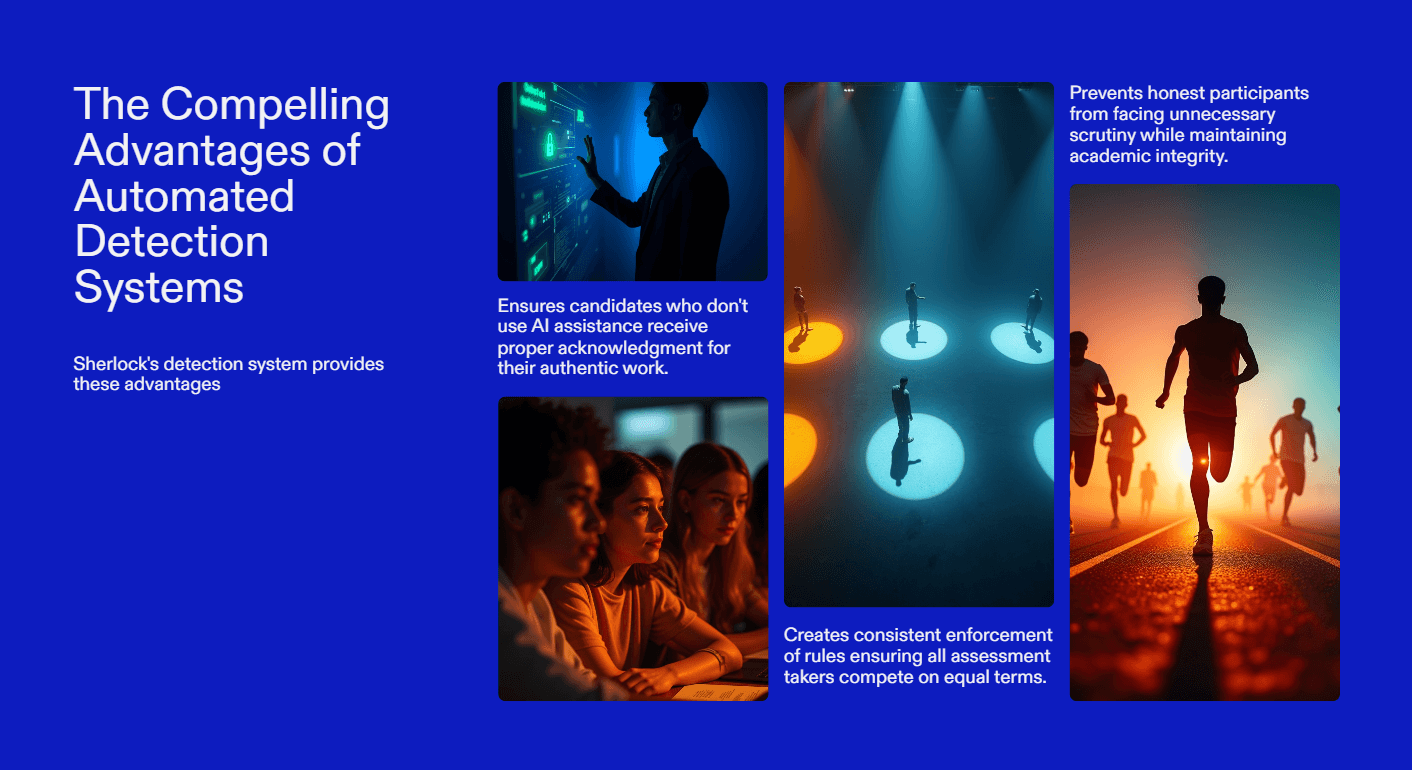
Sherlock AI enforces this policy automatically:
Detects AI-generated narrative structure
Monitors typing and editing patterns
Flags background coaching behavior
Confirms identity consistency across sessions
This ensures:
Candidates who play fair are rewarded
Teams avoid over-policing honest participants
How to Explain the Policy to Candidates (Script)
Use neutral tone:
No defensiveness.
No intimidation.
Clear expectations.
Conclusion
The question is not whether AI belongs in interviews.
It is how to let AI in without losing the signal of real skill.
The correct approach is:
Allow AI for ideation
Restrict AI for final answer production
Evaluate reasoning and adaptability
Verify identity and consistency
This preserves:
Fairness
Talent quality
Audit safety