Back to all blogs
Discover how to identify and prevent LockedIn AI usage in interviews while protecting candidate trust and interview fairness.

Abhishek Kaushik
Jan 7, 2026
Remote interviews were meant to widen access to talent, but they’ve also opened the door to a new kind of cheating that traditional interview processes weren’t designed to handle.
In fact, 68% of technical hiring managers now report suspecting candidates of cheating during remote interviews, and companies lose an average of $33,000 per bad hire resulting from interview fraud, a hidden cost of interview “help” that goes beyond cloudy gut feelings. According to a 2025 survey of 3,000 hiring managers, nearly 60% said they’ve suspected AI tools or other deceptive methods being used by candidates to misrepresent themselves during the hiring process, highlighting how pervasive and hard-to-detect this issue has become.
Tools like LockedIn AI now offer candidates real-time, invisible assistance during interviews listening to questions, generating polished answers, and delivering them instantly through hidden interfaces, hotkeys, or secondary devices. The result? Hiring decisions based on AI-generated responses rather than real human capability.
For recruiters and hiring managers, this creates a serious problem:
Technical interviews no longer reflect real skill
Communication assessments become unreliable
Trust in remote hiring erodes
The challenge isn’t just catching cheaters, it’s preserving fairness without harming genuine candidates or over-policing interviews.
What Is LockedIn AI & Why It’s a Challenge in Interviews
LockedIn AI is a real-time interview assistance tool designed to support candidates during live interviews. Unlike traditional prep tools, it listens to questions as they are asked, analyzes them instantly, and generates suggested responses in real time. These answers can be delivered discreetly using hotkeys, hidden windows, or background modes.
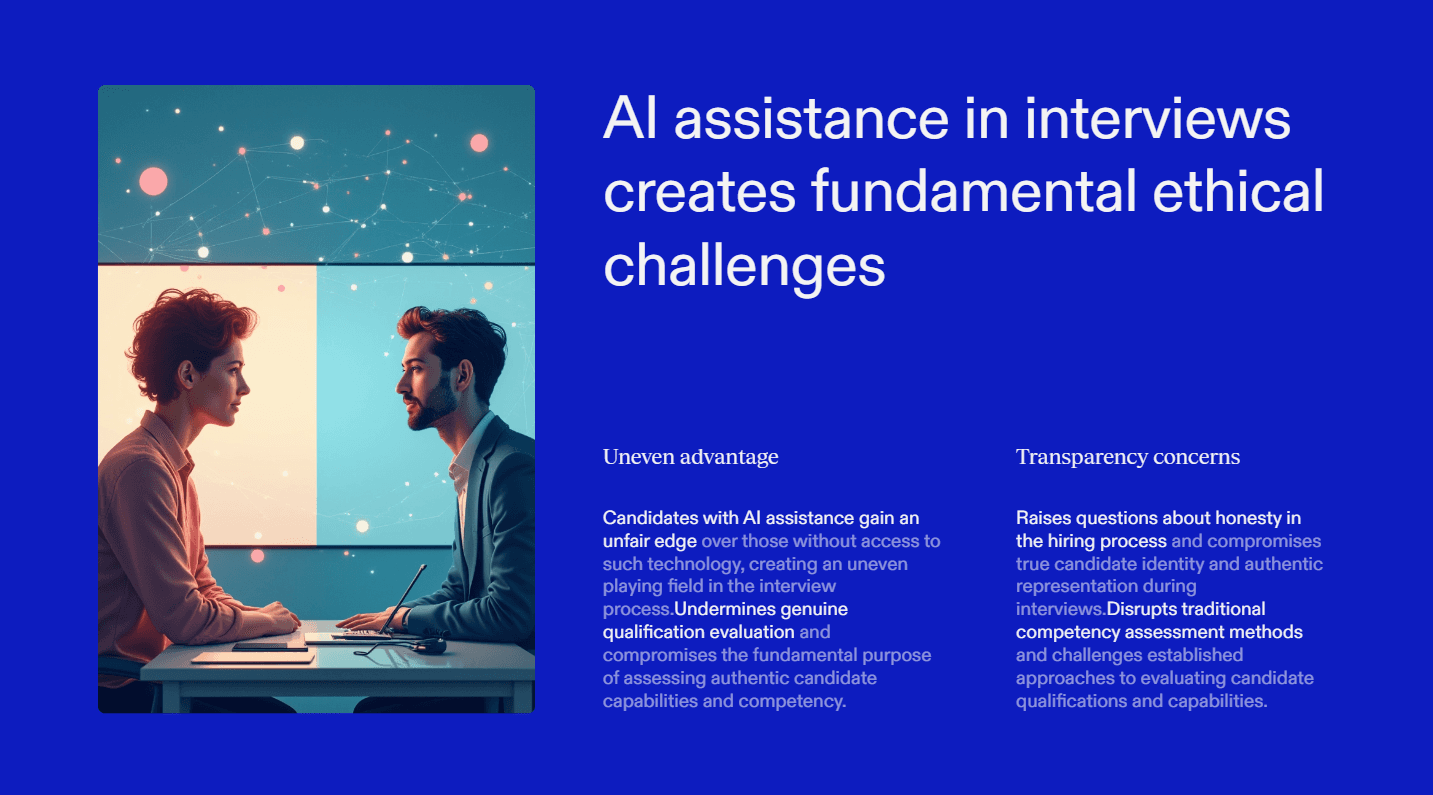
Why this is a problem: The reasoning and framing of answers may come from the AI, not the candidate. This means the interview evaluates the AI’s performance rather than the candidate’s real skills, judgment, or experience.
It’s also the kind of behavior most AI interview policies are now trying to call out explicitly, rather than leaving as a gray area.
Common Ways LockedIn AI Is Used During Interviews
Before employers can detect AI-assisted cheating, it’s important to understand the tactics candidates may use. LockedIn AI is designed to operate discreetly, so users often combine multiple methods to remain undetected.
Many of these tactics mirror the broader patterns seen across remote interviews, from hidden AI tools used in interviews to real-time AI coaching.
1. Hotkey-Based Stealth Controls
LockedIn AI includes keyboard shortcuts that allow candidates to control the tool without interacting directly with the screen or mouse. Using these hotkeys, candidates can:
Capture the screen instantly: The AI records the interview question in real time to process it.
Pause/resume AI responses: Candidates can temporarily stop the AI if they feel the timing is suspicious, then resume when safe.
Toggle microphones: The AI may require audio input for context. Hotkeys allow candidates to turn audio on or off discreetly.
Hide or move windows off-screen: The AI interface can be completely hidden from the interviewer’s view, including screen-sharing situations.
Why it matters: These hotkeys make it extremely difficult for interviewers to notice the AI operating in the background. Even monitored or recorded interviews may not reveal this activity because it leaves almost no visible trace.
2. Secondary Devices
Another common tactic is using additional hardware. Candidates may run LockedIn AI on:
A second laptop placed just outside the camera’s frame.
A tablet or phone positioned discreetly nearby.
A hidden browser window outside the shared screen, so the interviewer cannot see it.
Why it matters: By using secondary devices, the AI can operate completely off the primary interview device, bypassing screen-sharing or software monitoring. This method makes detection much harder and allows candidates to rely fully on AI assistance without leaving obvious clues.
3. Earphones & Audio Routing
AI-generated responses are often delivered through subtle audio devices, such as:
Small earbuds that are almost invisible on camera.
Bone-conduction headphones, which transmit sound through the cheekbones, leaving the ears open and appearing “normal.”
Why it matters: Audio delivery allows candidates to hear AI responses without showing anything visually suspicious. Unlike visible screens or software activity, audio cues are difficult for interviewers to detect unless specifically monitored.
Candidates use a combination of stealth controls, secondary devices, and discreet audio to receive AI-generated assistance during live interviews. Understanding these methods is the first step in designing detection strategies and AI-resistant interview formats.
How to Detect LockedIn AI During Interviews
Detecting real-time AI assistance isn’t about catching someone in the act of cheating, it’s about recognizing patterns and behaviors that AI cannot easily replicate. By combining behavioral observation, environmental checks, and active questioning, interviewers can uncover AI use while still maintaining fairness.
1. Behavioral Red Flags
AI-generated answers often appear too perfect or overly structured, which can make them stand out from normal human responses. Watch for:
Unnaturally perfect answers with no pauses: Humans typically think while speaking, leading to small hesitations or filler words. AI responses can seem instant and flawless.
Inconsistent communication style: The candidate may switch between casual and formal language or sudden over-clarity that doesn’t match their usual style.
Delayed responses followed by highly structured replies: Some AI tools take a moment to process questions. If a candidate pauses unusually long and then delivers a polished, detailed response, it may be AI-assisted.
Difficulty answering follow-up or clarifying questions: AI may struggle with unexpected clarifications or personal-context probing. Humans can draw on experience, while AI can falter when context shifts.
Why it matters: These behavioral cues give insight into whether the candidate is reasoning themselves or relying on AI-generated output.
Once you’ve seen a few of these patterns, they become much easier to recognize in live conversations.
👉 8 Clear Signs a Candidate Is Using AI to Answer Questions During a Live Interview
2. Screen & Environment Checks
Many AI tools, including LockedIn AI, rely on off-screen activity, so visibility is key:
Share the entire screen, not a single window: Limiting candidates to one window increases the chance of missing hidden AI interfaces.
Rotate the webcam to show surroundings: This ensures no secondary devices (laptops, tablets, phones) are being used off-camera.
Remove headphones unless explicitly allowed: Earbuds or bone-conduction devices can deliver AI responses silently.
Why it matters: Environmental checks disrupt the ability of AI tools to operate secretly and make it easier to detect unusual setups. The key is to design them so they feel like standard security hygiene, not like intrusive surveillance.
3. Real-Time Follow-Up Questions
AI often struggles when required to adapt reasoning in real time. Ask questions that require thinking beyond a scripted answer:
“Why did you choose that approach?”
“Can you explain this in simpler terms?”
“How would this change if X condition applied?”
Why it matters: AI can produce polished answers to standard questions, but reasoning about “why” and “what-if” scenarios exposes whether the candidate understands the content or is simply repeating AI output.
4. In-Interview Task Switching
AI workflows depend on capture → process → response cycles, so introducing unpredictability can disrupt assistance:
Short live exercises: Small tasks force immediate thinking.
Whiteboarding sessions: Real-time visual problem-solving requires human judgment.
Verbal problem-solving under time pressure: AI cannot respond instantly without noticeable delays.
Why it matters: Task switching exposes whether answers come from the candidate’s own knowledge and reasoning, rather than a hidden AI system.
Detecting LockedIn AI is about observing behavioral inconsistencies, off-screen activity, adaptability, and reaction under pressure. By combining these strategies, interviewers can identify potential AI use while still creating a fair environment for genuine candidates.
Can LockedIn AI Be Detected?
LockedIn AI is difficult to detect in standard interviews, but it can be identified with the right tools.
Most live interviews today are conducted on platforms that do not track background activity or analyze how responses are generated. This creates a gap where candidates can use tools like LockedIn AI without being noticed.
The challenge with traditional interviews
Recruiters often rely on observation during the conversation. While signs like delayed responses or unusually polished answers may raise concerns, they are not reliable indicators of AI assistance. This makes it hard to confidently identify misuse.
Where Sherlock AI makes a difference
Sherlock AI is designed to address this exact gap. By analyzing behavioral signals, response patterns, and interaction consistency, it helps identify potential AI assisted responses that would otherwise go undetected.
A more reliable way to ensure interview integrity
With added visibility into candidate behavior, recruiters can move beyond guesswork and make more confident hiring decisions based on genuine performance rather than AI generated support.
How to Prevent AI Misuse in Interviews
Detection is only half the solution. To maintain fairness and integrity, organizations need to prevent AI-assisted cheating through clear policies, interview design, and monitoring practices. Prevention reduces the temptation and opportunity for candidates to misuse AI.
1. Set Clear AI Usage Policies
Explicit policies clarify expectations and consequences for both candidates and hiring teams:
State whether AI tools are allowed: Be transparent about acceptable practices so candidates know the rules.
Define prohibited behaviors: Specify that real-time assistance or hidden devices are not permitted.
Communicate consequences of misuse: Clearly explain what happens if a candidate is found using AI inappropriately.
Why it matters: Clear communication reduces ambiguity, encourages ethical behavior, and protects genuine candidates from unfair suspicion. Transparency sets the tone that the organization values honesty and integrity.
2. Use Proctored & Invigilated Interviews
Live monitoring makes it much harder to use AI tools discreetly:
Proctored interviews can include full-screen observation, webcam monitoring, or live invigilation.
Even minimal supervision significantly reduces the feasibility of running AI tools off-screen or on secondary devices.
Why it matters: Proctoring ensures accountability without being overly invasive. It’s not about spying on candidates, it’s about leveling the playing field and making sure the interview reflects real human skill.
3. Design AI-Resistant Interview Formats
Some interview formats are inherently harder for AI to handle because they require real-time thinking, personal experience, and adaptability:
Conversational interviews: Open-ended discussions about experience and problem-solving reveal reasoning patterns AI cannot replicate.
Deep experience-based questions: Asking about specific past projects, decisions, and lessons learned emphasizes human judgment.
Scenario-driven problem solving: Presenting unpredictable or novel situations forces candidates to think critically, which AI struggles to emulate.
Why it matters: AI is good at producing polished, scripted responses, but it struggles with originality, adaptability, and human context. AI-resistant formats allow interviewers to accurately assess true skills.
Preventing AI misuse in hiring requires clear rules, monitored interviews, and AI-resistant formats. By setting expectations, supervising candidates, and asking experience- and scenario-based questions, hiring teams can reduce AI-assisted cheating while fairly evaluating real human skills.
Where Sherlock AI Fits In
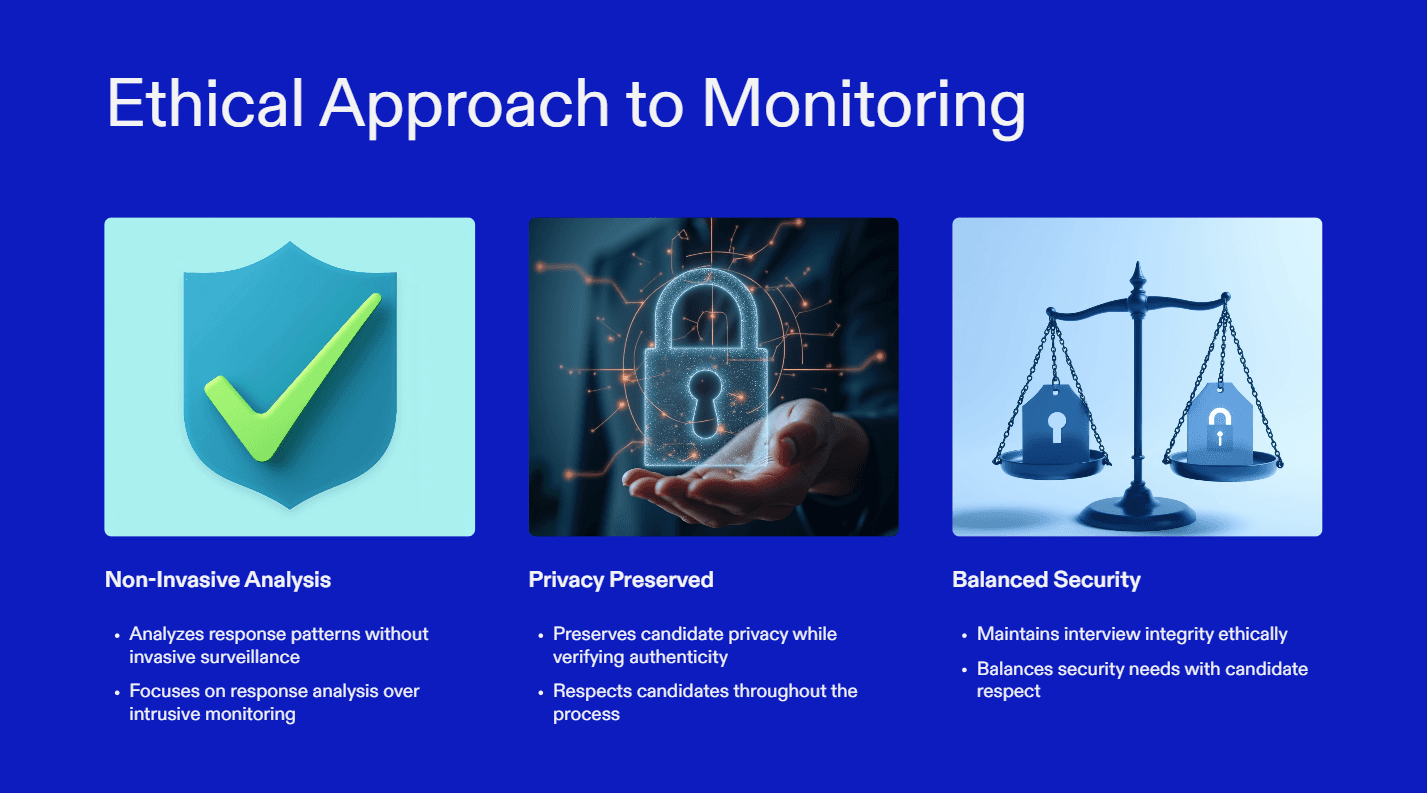
Sherlock AI is designed to protect interview integrity rather than help candidates bypass the process. It combines AI detection with behavioral analysis to identify patterns consistent with real-time AI assistance, such as over-structured answers, unnatural response timing, or linguistic uniformity.
Unlike invasive monitoring, Sherlock AI works ethically, supporting fair hiring by:
Verifying candidate authenticity through response analysis
Maintaining trust in remote interviews by reducing reliance on guesswork
Reducing false positives with a human-in-the-loop review
Why it matters: Sherlock AI helps organizations detect potential AI-assisted responses while keeping the interview experience fair and transparent for genuine candidates.
Conclusion
As AI tools become more sophisticated, traditional interview methods alone are no longer enough. Real-time AI assistance can distort assessments of a candidate’s reasoning, communication, and problem-solving skills.
To maintain fairness and effectiveness, hiring teams need to combine better interview design, sharper observation, and clear expectations. This includes behavioral monitoring, environmental checks, scenario-based tasks, and policies that explicitly address AI usage.
By focusing on how candidates think, adapt, and respond in real time, organizations can preserve trust, evaluate genuine human skills, and ensure that interviews reflect true capability, even in an AI-enabled world.