Back to all blogs
Compare the best Xobin alternatives in 2026. See how Sherlock AI ensures secure, AI-era interview integrity and authentic candidate evaluation.

Abhishek Kaushik
Feb 25, 2026

Remote hiring has evolved rapidly over the last few years. What began as simple webcam monitoring and browser restrictions has now become a complex challenge involving AI-generated answers, proxy candidates, deepfakes, and real-time external assistance.
Many teams that once relied on Xobin are now exploring stronger, AI-native proctoring and interview integrity platforms. The reason is simple: traditional rule-based monitoring struggles to detect sophisticated, AI-assisted fraud. Recent research reports that a significant portion of companies now experience hiring identity fraud and widespread AI use in interviews.
In 2026, hiring teams need more than surface-level surveillance. They need intelligent systems that can validate authorship, detect behavioral inconsistencies, and identify hidden AI assistance in real time without disrupting the candidate experience. The focus has shifted from restricting candidates to verifying authenticity, making advanced interview integrity platforms a strategic necessity rather than a nice-to-have feature.
Top 10 Xobin Proctoring Alternatives in 2026
If you are evaluating Xobin alternatives in 2026, this guide breaks down the most advanced platforms in the market, starting with a purpose-built interview integrity system designed for the AI era.
1. Sherlock AI
Sherlock AI is an AI-first interview integrity and proctoring platform built specifically for remote hiring and high-stakes technical assessments. Instead of relying on browser lockdowns or heavy surveillance, it focuses on validating authenticity through behavioral intelligence.
Rather than monitoring isolated actions, Sherlock AI evaluates patterns across the entire session to determine whether the candidate’s reasoning, communication, and on-screen behavior align consistently.

How Sherlock AI Is Different from Traditional Proctoring
Most legacy tools depend on screen recording, webcam snapshots, or restricted environments. Sherlock takes a different approach by analyzing multimodal signals in real time, including:
Visual behavior patterns
Voice and speech consistency
Interaction timing and response structure
Device-level activity indicators
This correlation of signals enables deeper fraud detection without intrusive candidate controls.
Key Features:
AI-driven integrity detection in real time: Identifies structured answer patterns, abnormal response timing, and behavioral inconsistencies that may indicate external AI assistance.
Impersonation and proxy detection: Continuously verifies participant continuity using facial consistency checks, voice alignment, and presence validation across the session.
Synthetic identity and deepfake safeguards: Detects liveness irregularities, visual manipulation artifacts, and anomalies in video feeds.
Behavioral pattern intelligence engine: Evaluates reasoning flow, speech cadence, gaze shifts, and interaction behavior throughout the interview instead of flagging isolated movements.
Non-intrusive device signal monitoring: Flags suspicious activity such as background applications, virtual environments, or remote access tools without enforcing rigid lockdowns.
Audio and environmental signal analysis: Identifies overlapping voices, subtle coaching patterns, and background disruptions linked to external collaboration.
Technical authorship verification: Aligns verbal explanations with coding activity to confirm that the same individual is solving the problem in real time.
Live integrity alerts for interviewers: Provides contextual risk signals during the session so interviewers can ask follow-up questions when needed.
Comprehensive post-session integrity reports: Generates structured summaries with behavioral evidence and risk scoring to support faster, more confident hiring decisions.
Optional AI fluency insights: Evaluates how candidates responsibly leverage approved AI tools, helping organizations measure practical AI collaboration skills.
Human-reviewed decision model: All system signals remain advisory, ensuring recruiters maintain full control over final hiring outcomes.
Candidate-respectful design: Focuses on high-signal behavioral analytics instead of invasive surveillance or complex installations.
Seamless workflow integration: Integrates with ATS platforms and calendars, automatically joining interviews without requiring extra candidate setup.
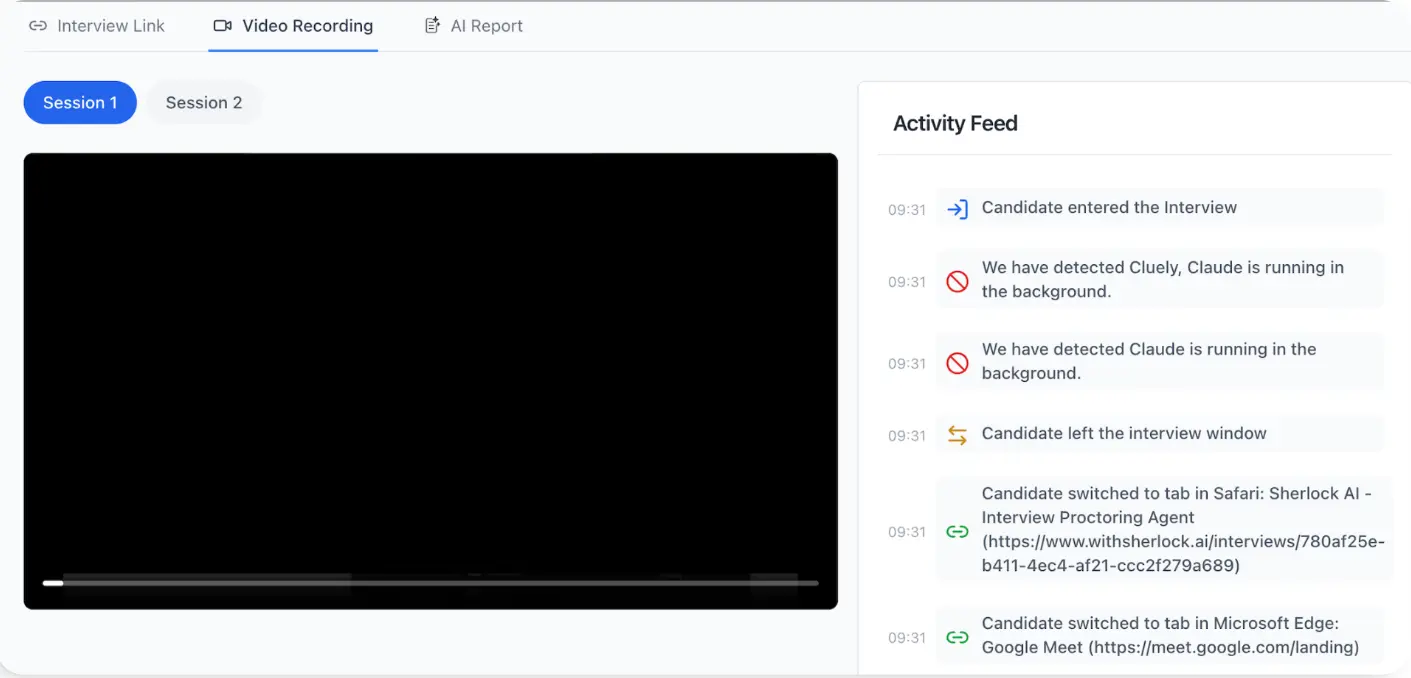
Detection of real-time AI assistance tools(e.g., Cluely, Parakeet AI): Identifies behavioral and system-level patterns associated with covert AI copilots and live answer suggestion tools used during interviews. Sherlock detects inconsistencies between spoken reasoning, interaction timing, and on-screen activity to uncover hidden external assistance. This ensures candidates are evaluated on their genuine thinking ability, not AI-supported responses.
Best For:
Remote live coding and technical interviews
High-volume hiring with limited manual invigilation resources
Roles where authorship validation is critical
Organizations seeking AI-era interview authenticity without heavy browser restrictions
Sherlock AI marks a transition from traditional surveillance-based proctoring to intelligent authenticity verification. By combining real-time behavioral analysis, authorship validation, and candidate-friendly implementation, it enables hiring teams to detect modern fraud while preserving fairness and interview experience quality.
👉 Explore How Sherlock AI Detects AI Interview Cheating in Remote Hiring
2. Mercer | Mettl
Mercer | Mettl is an end-to-end talent assessment and secure online proctoring solution used by enterprises, campuses, and certification bodies. It combines automated and human proctoring to create a scalable remote test-taking environment. With a broad library of skill tests and compliance certifications, Mettl supports both high-stakes academic exams and enterprise hiring. Its fraud-prevention suite includes real-time monitoring, biometric checks, and AI-driven suspicious behavior alerts. Mettl’s analytics deliver actionable insights into candidate performance and risk.
Key Features:
Automated AI Proctoring: Uses machine learning to monitor visual, audio, and device signals to flag suspicious test behavior in real time.
Live Human Proctors: Certified invigilators can supervise exams alongside AI checks to ensure maximum security and compliance.
Biometric Identity Verification: Verifies candidate identity using face matching and ID validation before and during the exam.
Customizable Question Libraries: Offers a wide range of pre-built skill assessments and the ability to tailor questions to specific roles.
Actionable Analytics Dashboard: Provides reports on candidate performance, integrity flags, and test completeness for informed decision-making.
3. TestGorilla
TestGorilla is a skills-based hiring platform that combines pre-employment tests, video interviews, and AI-powered anti-cheating tools. It offers a large library of skill assessments covering technical, cognitive, and role-specific capabilities. TestGorilla’s integrity engine monitors candidate behavior during tests to detect anomalies and suspicious patterns. The platform is designed to reduce bias and help teams shortlist objectively. Its simple setup and integrations make it popular with high-growth startups and enterprise teams alike.
Key Features:
Anti-Cheating Monitoring: AI checks for tab switching, unexpected behavior, and pattern inconsistencies that indicate fraud.
Large Test Library: Hundreds of role-based assessments covering language, cognitive skills, technical tasks, and job simulations.
Video Response Questions: Candidates can submit recorded answers for human review in addition to traditional tests.
Collaborative Team Scoring: Hiring teams can review scores and provide feedback within the platform.
ATS Integrations: Connects with major applicant tracking systems to streamline candidate workflows.
4. iMocha
iMocha is an AI-powered assessment platform focused on skill validation across technical and non-technical domains. It offers coding simulators, domain quizzes, and advanced proctoring options to secure test integrity. AI talent insights help teams identify skill gaps and fit for specific roles. iMocha’s advanced proctoring checks behaviour and system activity to reduce fraud. With customizable tests and analytics, it supports both hiring assessments and internal upskilling programs.
Key Features:
AI Coding Simulation: Allows candidates to code in real-time with auto-grading and plagiarism checks.
Secure Proctoring Suite: Monitors video, audio, and activity signals to detect irregular behaviour during tests.
Skill Benchmarking: Compares candidate scores with industry benchmarks for objective evaluation.
Pre-Built and Custom Tests: Large question library with the ability to customize assessments for job roles.
Detailed Analytics: Provides performance, integrity, and attempt-level insights for each candidate.
5. HackerRank
HackerRank is a technical skills assessment and interview platform widely used for evaluating developers and engineering talent. It includes coding challenges, real-time collaborative interviews, and automated scoring tools. With proctoring options, teams can secure live tests and pair-programming sessions. HackerRank’s platform supports role-specific templates and customizable test creation. Its candidate ranking and report features help teams make faster, data-driven decisions.
Key Features:
Coding Challenge Library: Extensive library of algorithmic, data structure, and language-specific challenges.
Live Interview Module: Enables real-time coding interviews with built-in code editor and video.
Automated Scoring Engine: Scores candidate submissions instantly based on correctness and efficiency.
Proctoring Controls: Tracks suspicious activity and enforces integrity during live tests.
Team Collaboration Tools: Allows hiring managers to annotate candidate performance and share feedback.
6. Talview
Talview is an AI-driven hiring platform that includes remote proctoring, video interviewing, and candidate analytics. It integrates AI behaviour monitoring with remote exams and interviews to detect likely cheating patterns. Talview supports mobile and web assessments and adapts to global hiring needs. The platform’s analytics assist recruiters with insights and candidate scoring. Its flexible workflow integrations make it suitable for both high-volume hiring and specialized roles.
Key Features:
AI Proctoring Monitoring: Tracks facial cues, movement, and environment inconsistencies during assessments.
Video Interviewing: Supports scheduled and asynchronous interviews with candidate submissions.
Mobile-Friendly Assessments: Candidates can take tests on mobile without compromising security.
Multi-Format Tests: Supports MCQs, coding tasks, simulations, and interview questions.
Recruiter Analytics Dashboard: Delivers AI-driven candidate scores and insights for faster decision-making.
7. Glider AI
Glider AI is a high-volume hiring platform focused on large-scale skill assessment and screening. It combines automated tests with proctoring intelligence to ensure test legitimacy. Glider’s assessments cover cognitive, technical, and workplace skills. Recruiters can use role-based templates and configure automatic shortlisting workflows. With proctoring and analytics, Glider helps reduce bias and improve hiring efficiency.
Key Features:
Automated Screening Workflows: Configures multi-stage assessments and rule-based shortlisting.
Secure Proctoring Engine: AI identifies suspicious patterns, unusual activity, and integrity risks.
Role-Based Assessments: Pre-built test tracks for specific job families and skills.
Cognitive and Behavioral Tests: Includes logic, reasoning, and soft-skill assessments beyond coding.
Hiring Analytics: Reports on pass rates, score distribution, and integrity signals.
8. ProctorU (Meazure Learning)
ProctorU is a widely used remote proctoring service geared toward academic institutions and certification programs. It offers live human monitoring and automated AI proctoring options. ProctorU’s human proctors intervene in real time when suspicious behaviour is detected. It supports high-stakes assessments and ensures compliance with academic integrity standards. The platform offers detailed audit logs and session recordings for verification.

Key Features:
Live Proctor Monitoring: Human proctors watch sessions and intervene immediately when needed.
Automated AI Oversight: AI tracks visual and behavioural signals to flag potential integrity issues.
Secure Candidate Verification: ID checks and biometric validations confirm test-taker identities.
Exam Audit Logs: Detailed session records support compliance and dispute resolution.
Custom Configuration: Institutions can tailor duration, rules, and proctoring levels per exam.
9. CodeSignal
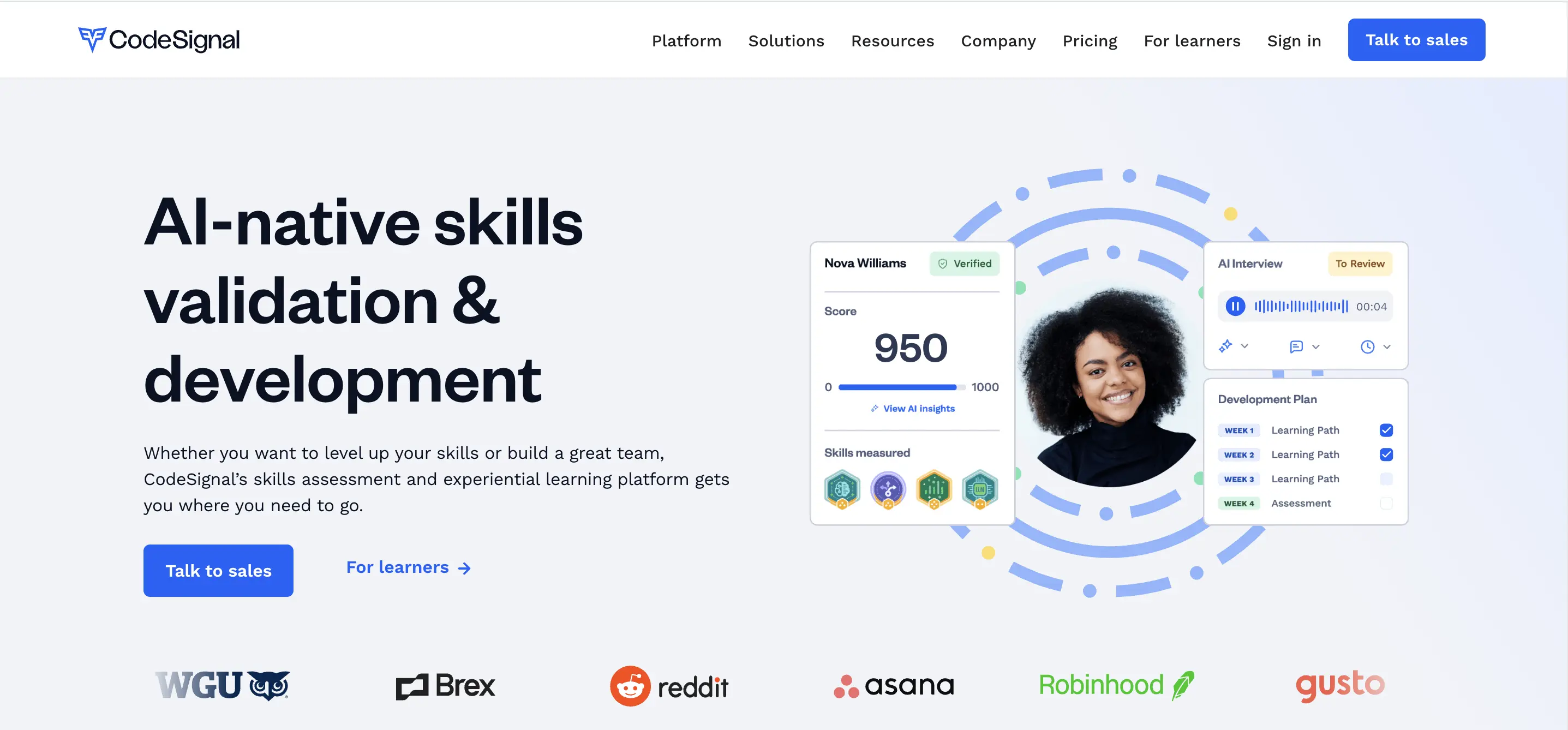
CodeSignal is a technical evaluation platform built for assessing coding ability, problem solving, and real-world task performance. It includes test creation tools, secure proctoring, and candidate scoring analytics. CodeSignal’s integrated proctoring monitors activity to ensure fairness. Recruiters can choose from standardized assessments or build custom challenges. The platform’s scorecards help teams compare talent objectively.
Key Features:
Standardized Skill Certifications: Offers validated benchmark tests for coding ability.
Secure Proctoring Signals: Monitors behaviour and system events to detect integrity risks.
Custom Test Builder: Create tailored challenges for specific job requirements.
Performance Scorecards: Breakdown candidate metrics by skill area and attempt quality.
Interview Integration Tools: Pair with live interviews or take-home tasks seamlessly.
10. Honorlock
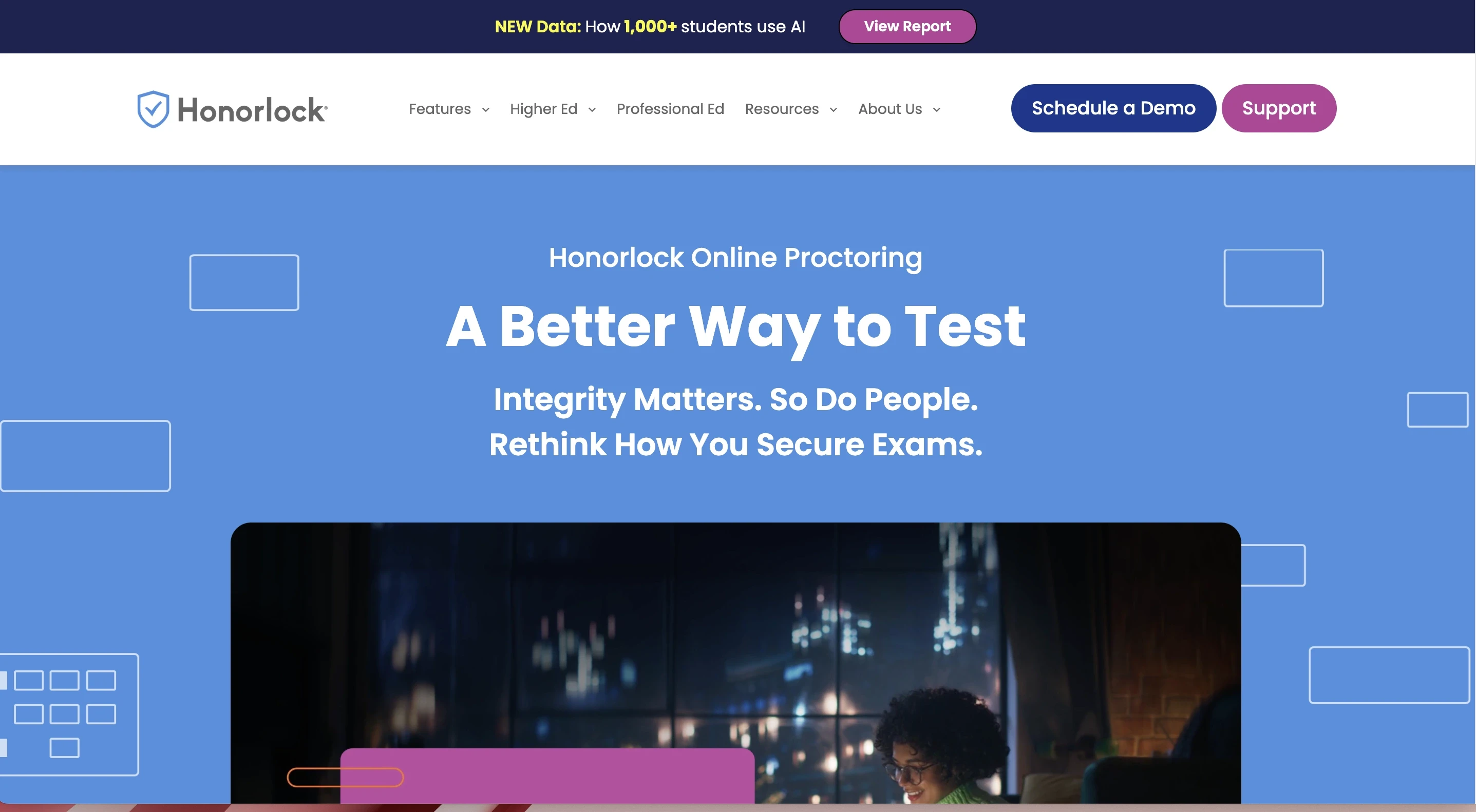
Honorlock is a remote proctoring solution built for education and certification programs. It uses AI and human review to track irregular behaviour and prevent academic dishonesty. Honorlock’s system flags suspicious activity and offers optional live proctors. The tool supports browser-based exams and secure test environments without software installs. It also includes search and device monitoring to check for unauthorized behavior.
Key Features:
AI Behavioral Monitoring: Detects red flags such as unusual eye movement, secondary voices, and tab changes.
Live Proctor Assistance: Human reviewers can join sessions when alerts are triggered.
Search Monitoring: Checks for unauthorized search engine usage during tests.
Browser-Based Security: Enables secure exams without downloads or heavy installs.
Detailed Session Reports: Provides exam records and flagged behaviour summaries.
The Future of Interview Integrity Belongs to AI-Native Platforms
As remote hiring becomes standard practice, interview fraud has evolved beyond simple rule-breaking. AI-generated answers, proxy candidates, hidden assistance tools, and synthetic identities are reshaping the risk landscape. Traditional proctoring methods are no longer enough to guarantee authentic evaluation.
This is where Sherlock AI stands apart. Instead of relying on browser lockdowns or surface-level monitoring, Sherlock AI focuses on validating behavioral authenticity, authorship, and real-time reasoning consistency. It enables hiring teams to detect sophisticated fraud patterns while maintaining a respectful and seamless candidate experience.
When evaluating Xobin alternatives in 2026, organizations must look beyond feature lists and prioritize true interview integrity. Platforms that combine behavioral intelligence, real-time risk insights, and workflow integration will define the next era of secure hiring.
Choosing an AI-native solution like Sherlock AI ensures your hiring process remains fair, scalable, and future-ready in an increasingly AI-driven world.