Back to all blogs
Learn how to identify dishonest answers in video interviews with effective questioning and cognitive probes. Improve your hiring accuracy and spot fake experiences.
Abhishek Kaushik
Dec 22, 2025

Dishonest answers in interviews do not look like lying in the cinematic sense. They show up in reasoning gaps, inconsistencies, ownership avoidance, and narrative drift.
You do not need to “detect lies”. You need to detect a lack of real experience.
The goal is not to accuse or confront.
The goal is to test depth, probe reality, and observe stability under pressure.
First Principle
You cannot reliably catch dishonesty by:
Facial expressions
Eye movement
Tone shifts
Micro-expressions
Those cues are scientifically unreliable.
A large review of deception research concludes that facial cues, micro‑expressions, and vocal changes are not reliable indicators of dishonesty, and that traditional lie‑detection methods based on these cues are scientifically unsupported.
So we use cognitive signals, not intuition.
The Reliable Way to Detect Dishonest Answers
Test whether the candidate’s reasoning matches their story.
Real experience has:
Specific constraints
Tradeoffs
People dynamics
Emotional context
Imperfection
Dishonest or AI-fabricated experience is:
Clean
General
Polished
Over-structured
Impersonal
The Four Categories of Dishonest Answer Patterns
1. Ownership Ambiguity
The candidate cannot explain:
What they personally did
Why did they make specific decisions
Their influence on outcomes
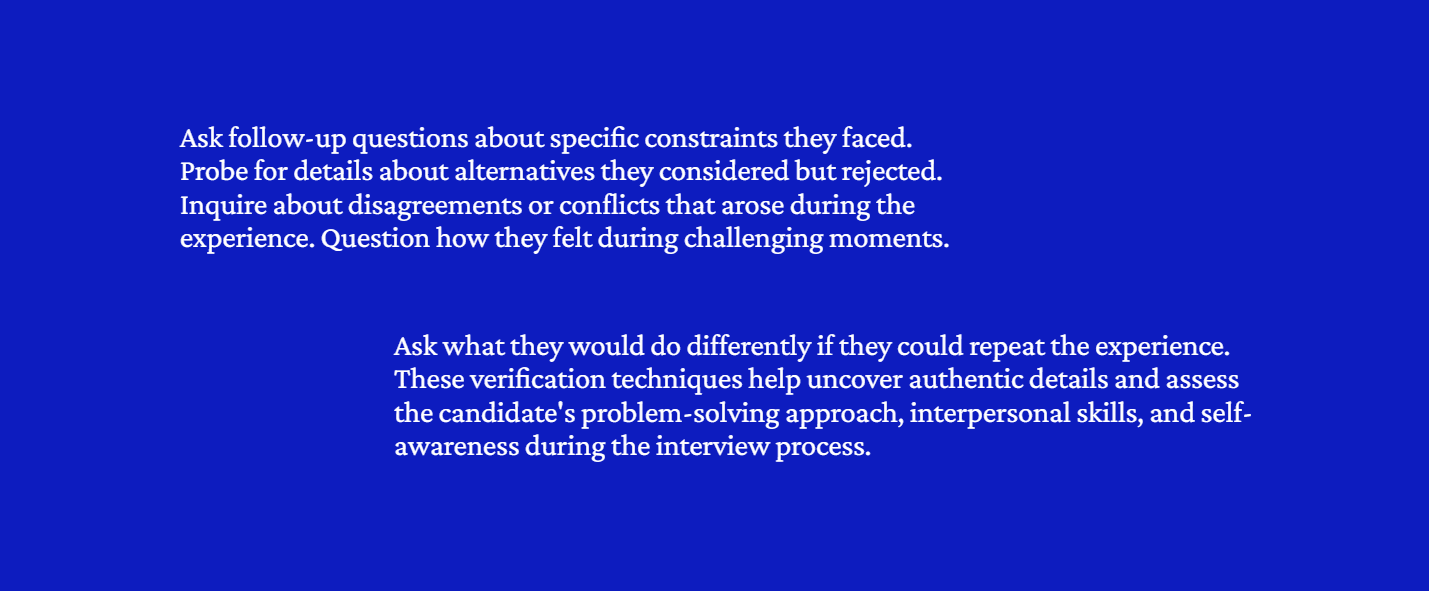
Ask:
Which part did you personally own, and how did you decide your approach?
Dishonest answers return to group pronouns:
We did
The team decided
The process was
Real contributors say:
I pushed for
I disagreed with
I changed direction
2. Absence of Constraints
Real work has:
Time pressure
Budget limits
People disagreements
Technical debt
Dishonest answers describe work as:
Smooth
Straightforward
Conflict free
Ask:
What was the hardest part, and why was it hard?
Dishonest answers will stay generic.
3. Narrative Drift Under Follow-Up Pressure
If the answer is memorized or generated:
It will not survive a detail-level follow-up.
Ask:
What changed between week one and week six?
Who pushed back against your approach?
Real experiences reveal:
Emotions
Tension
Personal reaction patterns
AI-derived or dishonest answers break into:
Repetition
Reframing
Topic shifting
4. Lack of Temporal Anchoring
Real stories occur in time:
Before X
During Y
After Z
Dishonest experiences:
Do not move in time
Describe events as isolated islands
Ask:
Walk me through the sequence. What happened first?
If they cannot build a timeline, they did not live it.
Read more: How To Spot a Dishonest Candidate and What To Do About It
The Interview Structure That Reveals Truth
Step 1: Start Open
Let them speak freely.
Do not interrupt.
Please pay attention to how they structure their story.
Step 2: Probe Ownership
What did you personally decide?
Step 3: Probe Difficulty
What went wrong or got messy?
Step 4: Probe Adaptation
What did you change once things were not working?
Step 5: Probe Reflection
If you were to redo this, what would you do differently?
Real reflection = authentic experience.
Dishonest answers collapse or become abstract.
How to Document Dishonesty Safely and Legally
Write what you observed
Not your interpretation.
Do write:
Candidate could not explain their personal role in project.
Could not provide timeline or sequence.
Answer repeated after probing.
Do not write:
Candidate lied.
Candidate was dishonest.
Candidate is suspicious.
Document signals, not conclusions.
For Video Interviews Specifically
Watch for:
Signal | Interpretation |
|---|---|
Off-screen gaze when answering | Reading or receiving prompts |
Perfectly structured responses | Scripted or AI-generated |
Sudden pauses before clarifying questions | Real-time prompting |
No variation in emotional tone | Non-lived experience |
These are not proof; they are triggers to probe the depth of reasoning.
A report by Workable notes that video interviews are vulnerable to bias related to appearance, accent, and communication style, and recommends using structured, objective evaluation frameworks to mitigate these risks.
At scale, teams rely on tools designed to surface reasoning gaps, rather than labeling intent or making accusations.
Conclusion
Catching dishonesty in interviews is not about spotting deception. It is about testing depth, ownership, and real-world cognitive texture.
Dishonest answers break under:
Timeline probing
Tradeoff questioning
Reflection requests
Your job is not to catch people. Your job is to validate truth.