Back to all blogs
Deepfake candidates are entering live interviews using AI. Learn how it happens, the red flags recruiters miss, and how to protect interview integrity.
Abhishek Kaushik
Jun 22, 2026
In remote hiring, it’s not always easy to know who you’re really talking to. Fraudsters are now using AI deepfake technology to create fake candidates who can sit in for real people during video interviews.
In a survey of 1,000 hiring managers, about 17 % said they have already seen people use deepfakes in job interviews, that’s nearly 1 in 6 recruiters facing this issue right now.
Experts warn this problem could grow quickly. Research by Gartner predicts that by 2028, as many as 1 in 4 job applicants worldwide could be fake, largely because AI tools make it easy to generate realistic videos and voices.
AI tools may help recruiters with speed and volume, but they also open the door for identity fraud and deceptive practices. What used to be a normal video call can now be a deepfake interview, where the person on camera is not who they claim to be.
This blog explores how deepfake candidates are slipping into interviews, what warning signs hiring teams should watch for, and how recruiters can protect their hiring process in this new age of AI.
How Deepfake Candidates Are Entering Live Interviews
Deepfake interviews don’t look dramatic or obvious. Most of the time, they look normal, which is exactly why they work.
These are the most common forms hiring teams are encountering:
Face swaps: A real person appears on video, but their face is digitally replaced to match the candidate’s profile photos or ID.
Voice cloning: The person speaking uses an AI-generated voice trained on short audio samples of the real candidate.
Proxy speakers: A more skilled individual answers questions live while pretending to be the candidate on the résumé.
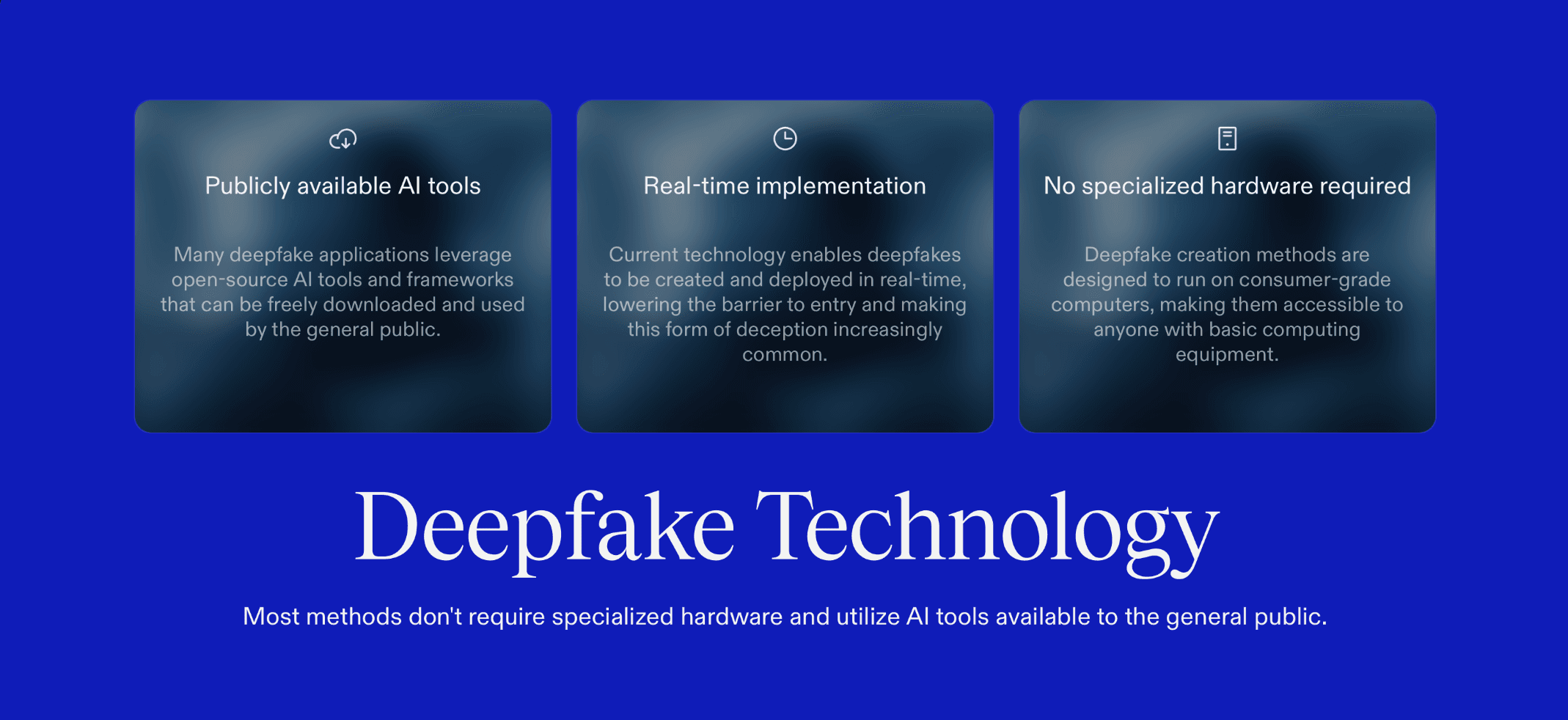
None of these require advanced hardware. Many use readily available AI tools that work in real time.
Why Live Video Is No Longer a Trust Signal
For years, video interviews were treated as proof of identity. That assumption no longer holds.
AI can now sync lips, facial movement, and voice convincingly.
Stable internet and HD cameras reduce visible glitches.
Interviewers are focused on answers, not behavioral consistency.
As a result, “seeing the candidate live” no longer guarantees you’re evaluating the right person.
Common Entry Points for Deepfake Candidates
Deepfake interviews usually enter where speed and scale matter more than verification.
Remote technical interviews: High pressure, complex questions, and limited time make it easier to hide impersonation.
Early-stage screening rounds: Short interviews with limited cross-checking create low-risk entry points for fraud.
High-volume or campus hiring: Large candidate pools overwhelm manual checks, allowing fake profiles to blend in.
Deepfake interviews aren’t a future problem. They are already exploiting gaps in remote interview workflows, especially where trust is assumed instead of verified.
Read more: Deepfake Candidate Interviews (Real Examples, Red Flags, and a Playbook to Respond)
Red Flags Recruiters Miss in Deepfake Interviews
Most deepfake interviews fail because small signals don’t line up over time and those gaps are easy to miss in a single conversation.
1. Visual Inconsistencies
These signals are subtle and often ignored, especially in fast-moving interviews.
Micro-delays between speech and facial movement: Lips, jaw, or expressions lag slightly behind the audio.
Unnatural eye focus: Eyes appear fixed, unfocused, or don’t track naturally during conversation.
Odd head movement: Head stays too still or moves in repetitive, mechanical patterns.
Individually, these don’t raise alarms. Together, they start to form a pattern.
2. Behavioral Mismatches
This is where most deepfake interviews quietly break down.
Perfect answers, weak follow-ups: Initial responses sound polished, but the candidate struggles when asked to go deeper.
Inconsistent confidence: The candidate appears highly confident on some topics and strangely unsure on closely related ones.
Scripted delivery: Responses feel rehearsed and lack natural pauses, corrections, or thinking moments.
These gaps suggest performance, not real understanding.
3. Identity Continuity Issues
Deepfake interviews rarely hold up across multiple stages.
Resume vs interview mismatch: Skills listed confidently on paper don’t appear naturally in conversation.
Interview vs later rounds mismatch: The person in technical rounds doesn’t feel like the same candidate seen earlier.
Style and communication shifts: Tone, clarity, and problem-solving approach change noticeably over time.
Each stage looks “fine” on its own. The inconsistency only appears when viewed together.
Why Human Interviewers Miss This at Scale
Even experienced interviewers struggle to detect these patterns because:
Interviews are judged in isolation, not across stages.
Recruiters are trained to assess skills, not fraud signals.
High-volume hiring leaves little time for detailed comparison.
Human memory is unreliable across dozens or hundreds of interviews.
No single red flag is obvious enough to stop the process.
Deepfake interviews fail pattern checks and most hiring teams aren’t set up to look for patterns across interviews.
Measuring Interview Integrity in a Deepfake Era
Deepfake interviews have changed the rules of hiring. When AI can convincingly imitate faces, voices, and behavior, relying on interviewer judgment alone is no longer enough.
Why “Trust the Interviewer” No Longer Works
Traditional interviews depend heavily on human instinct. That breaks down at scale.
Interviewers see only one stage, not the full hiring journey.
Each interview happens in isolation, without historical comparison.
Deepfake and proxy interviews are designed to appear confident and polished.
High interview volume leaves little time to question authenticity.
Even strong interviewers can miss fraud when they don’t have context.
From Candidate Monitoring to Interview Integrity Auditing
Modern hiring needs a mindset shift.
Candidate monitoring focuses on watching people, often raising privacy concerns.
Interview integrity auditing focuses on evaluating the interview itself.
Instead of asking “Is this candidate cheating?”, the question becomes:
“Does this interview hold up as authentic and consistent?”
This approach scales better and avoids intrusive surveillance.
In a world of deepfakes, interview integrity has to be measured, not assumed. Teams that rely only on trust will fall behind those that rely on signals, patterns, and consistency.
Sherlock AI: Built for Interview Integrity
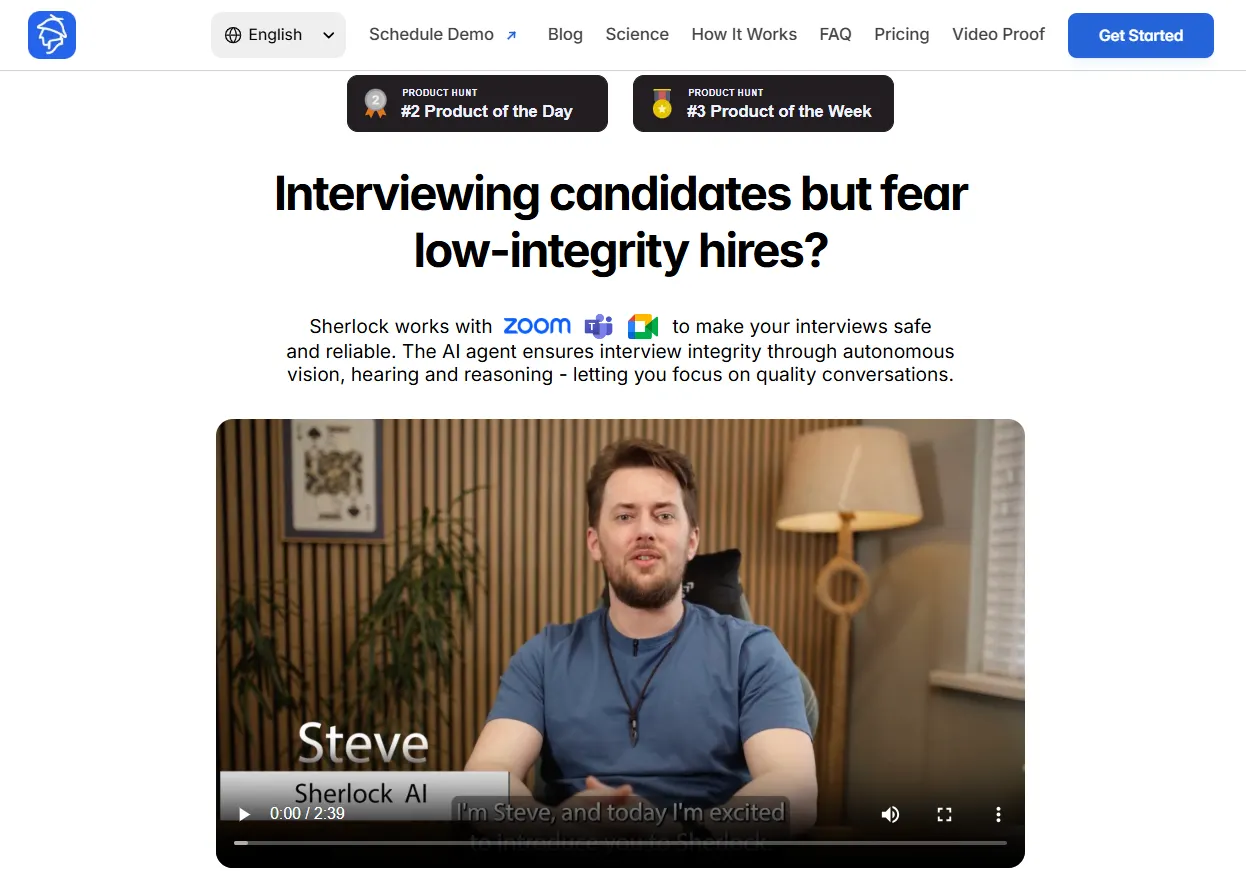
Most hiring tools were not designed for a world where deepfake interviews exist.
Sherlock AI is different. It is purpose-built to detect interview fraud and integrity risks without monitoring candidates or invading privacy.
Sherlock AI doesn’t try to “catch” candidates in real time. Instead, it audits interview integrity across the hiring process.
Analyzes interviews across multiple stages, not in isolation
Detects inconsistencies in responses, skills, and behavior over time
Flags risk patterns that human interviewers can’t reliably spot at scale
This makes it especially effective against deepfake and proxy interviews that only break down when viewed end-to-end.
How Sherlock AI Detects Deepfake and Proxy Interviews
Sherlock AI focuses on signals that are hard to fake consistently:
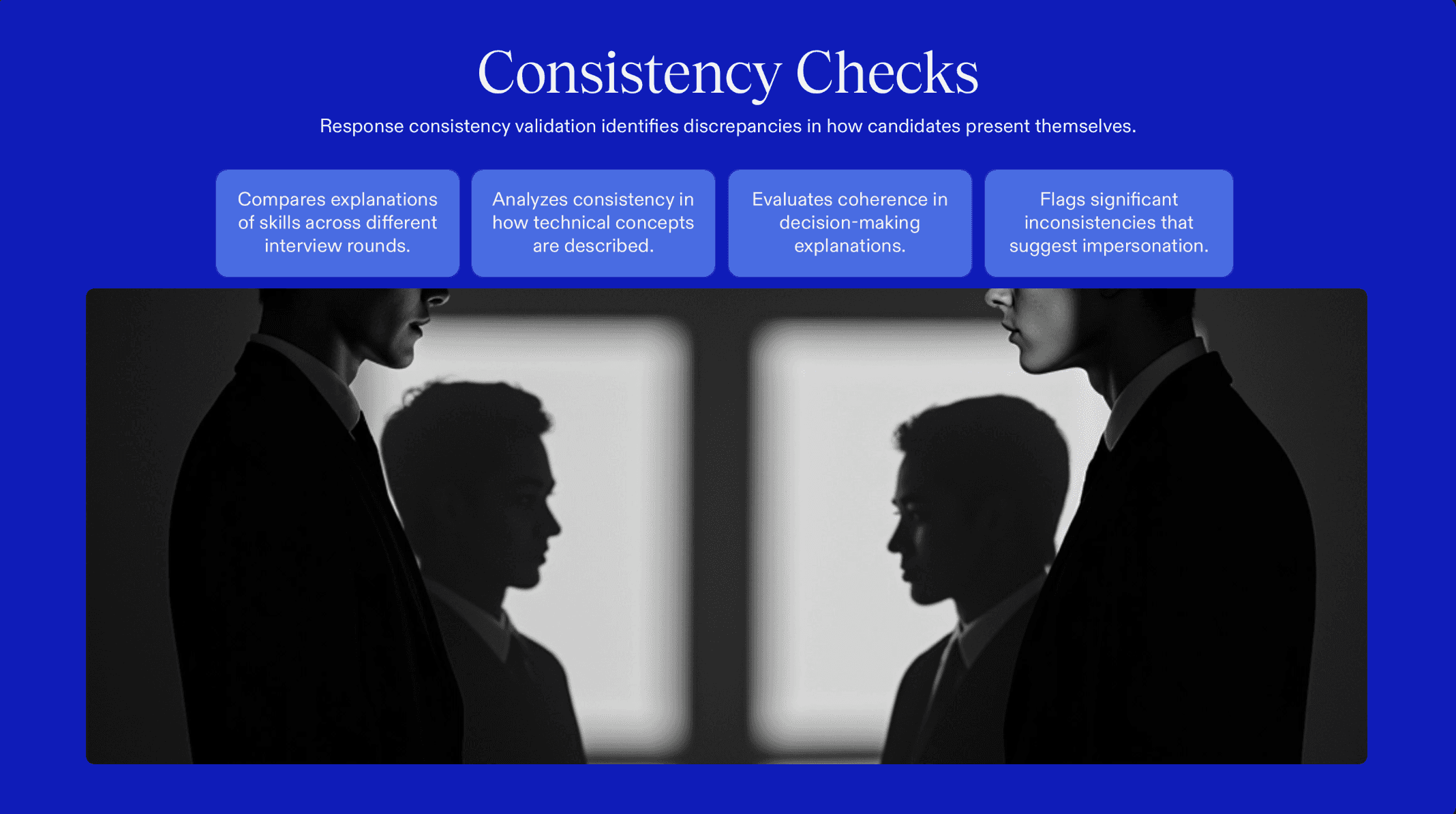
Response consistency checks
Compares how candidates explain skills, concepts, and decisions across rounds.Linguistic and behavioral patterns
Identifies sudden shifts in language style, clarity, or confidence that suggest impersonation.Skill authenticity validation
Separates real understanding from scripted or rehearsed answers.Identity continuity signals
Highlights cases where the “candidate” appears different across interviews.
These signals work together to surface risk without relying on face recognition or intrusive tracking.
Designed for Scale
Deepfake interviews thrive in volume. Sherlock AI is built for exactly those environments.
Works across thousands of interviews
Requires no change to existing interview formats
Helps recruiters prioritize reviews instead of manually rechecking everyone
Reduces false positives by focusing on patterns, not single moments
This makes Sherlock AI especially effective for campus hiring, mass hiring, and remote technical interviews.
Privacy-First by Design
Unlike surveillance-based tools, Sherlock AI:
Does not monitor candidates’ screens or environments
Does not rely on biometric identification
Focuses on interview data, not personal behavior
Keeps candidate trust intact while protecting hiring integrity
This makes it safer for compliance and better for candidate experience.
Deepfake interviews don’t fail because of one obvious mistake. They fail because the story doesn’t stay consistent over time.
Sherlock AI is built to find exactly that.
Conclusion
Deepfake candidate interviews are no longer a rare edge case. They are a growing risk in remote, campus, and high-volume hiring, where speed and scale often come at the cost of verification. As AI makes impersonation easier, relying on video calls and interviewer instinct is no longer enough.
The reality is simple: most deepfake interviews don’t look suspicious in isolation. They only break down when responses, behavior, and skills are compared across stages. That’s why hiring teams need to move beyond trust-based interviews and toward measurable interview integrity.
By focusing on consistency, patterns, and skill authenticity, rather than intrusive monitoring, organizations can protect their hiring process without harming candidate experience. In the deepfake era, the teams that succeed will be the ones that measure interview integrity instead of assuming it.