Back to all blogs
Remote hiring has made identity verification a critical part of modern recruitment. In this guide, learn how organizations can verify candidate identity remotely, prevent hiring fraud, detect deepfakes, and build secure hiring workflows.

Abhishek Kaushik
Jun 18, 2026
Remote hiring has transformed recruitment, but it has also created new security risks for HR teams and recruiters. Today, companies are no longer just evaluating skills and experience. They also need to confirm whether the candidate attending the interview is actually the same person behind the resume, credentials, and employment history.
The rise of AI-generated resumes, deepfake video interviews, proxy interviews, and identity fraud has made remote candidate verification a critical part of modern hiring. The problem is growing even faster with remote and hybrid work adoption. A recent workforce fraud report revealed that 74% of employers consider fake degrees and forged documents their biggest hiring concern, while 77% are worried about deepfake-driven identity fraud and AI-generated resumes. Remote hiring opens doors to global talent, but it also removes the traditional face-to-face verification process recruiters once relied on. Without proper safeguards, companies risk hiring impersonators, fake candidates, or individuals using stolen credentials. In some cases, organizations have even discovered that the person who joined after onboarding was completely different from the person interviewed.
The shift toward remote recruitment has also changed the way organizations approach trust and compliance in hiring. Earlier, recruiters could verify a candidate’s identity through in-person interviews, physical document checks, and office onboarding processes. In remote hiring environments, these traditional safeguards are replaced with digital workflows, creating opportunities for identity manipulation and impersonation. This is why businesses are now investing heavily in remote identity verification technologies, AI-powered fraud detection systems, and continuous candidate authentication methods.
For modern recruiters, verifying candidate identity remotely is no longer optional. It is a necessary step for protecting company security, maintaining hiring integrity, and building trust in distributed teams.
In this guide, we will explain how to verify candidate identity remotely, the biggest risks in virtual hiring, and the best practices companies can use to detect impersonation, deepfakes, and hiring fraud effectively.
What Is Remote Candidate Identity Verification?
Remote candidate identity verification is the process of confirming that a job applicant is genuinely who they claim to be during virtual hiring. As remote hiring becomes the standard across global organizations, recruiters can no longer rely on physical document checks or in-person interviews to validate identities. This has created a growing need for secure digital verification methods that prevent impersonation, fake profiles, and AI-driven hiring fraud.
Today, recruiters face a new generation of hiring risks. Some candidates use stolen credentials, manipulated resumes, deepfake technology, or proxy interviewers to bypass recruitment systems. In many cases, the person attending the interview is not the same individual who eventually joins the organization. This can lead to compliance issues, financial losses, security threats, and poor hiring decisions.
Remote identity verification helps organizations solve these challenges by combining document authentication, biometric checks, live video verification, behavioral analysis, and AI-powered fraud detection. Instead of depending solely on manual review, companies can now verify candidate authenticity throughout the hiring lifecycle.
For modern hiring teams, identity verification is no longer just a compliance step. It has become a critical layer of workforce security.
Why Remote Identity Verification is Important
The rise of distributed workforces has dramatically changed recruitment processes. Companies are hiring across cities, countries, and time zones without ever meeting candidates in person. While this expands access to talent, it also increases exposure to identity fraud.
Several emerging threats are making remote verification essential:
AI-generated candidate profiles
Deepfake video interviews
Proxy interview participation
Fake government IDs
Stolen professional credentials
Synthetic identities created using AI tools
According to industry reports, identity fraud in remote hiring has increased significantly as organizations accelerate digital recruitment workflows. Recruiters are now expected to validate candidates without creating friction in the candidate experience.
This is where intelligent verification platforms like Sherlock AI help organizations build trust into remote hiring processes while maintaining speed and efficiency.
Why Traditional Verification Methods No Longer Work
Traditional identity verification methods were designed for in-person recruitment environments. In remote hiring, many of these approaches are no longer reliable enough to stop modern fraud tactics.
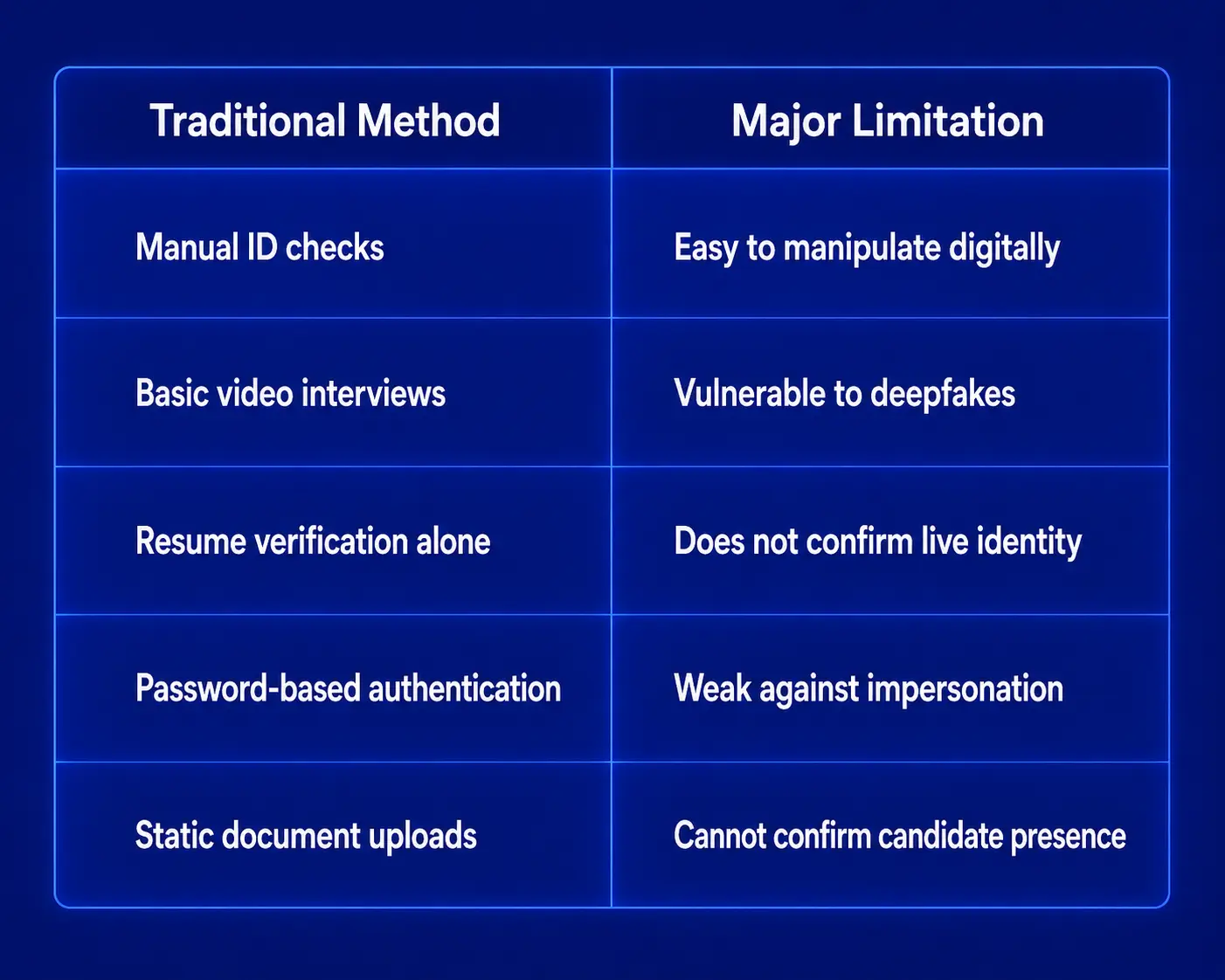
Modern hiring requires real-time identity intelligence rather than static verification methods.
Key Challenges in Verifying Candidate Identity Remotely
While remote hiring offers flexibility and faster recruitment, it also introduces several identity verification challenges that traditional hiring methods rarely faced. Recruiters must now validate candidates without physical interaction, making it easier for fraudsters to exploit weaknesses in digital hiring systems.
Understanding these challenges is essential for building a secure and scalable hiring process.
1. Deepfake Video Interview Fraud
One of the fastest-growing threats in remote hiring is the use of deepfake technology during virtual interviews. AI-powered tools can now manipulate facial movements, voice patterns, and lip synchronization in real time, allowing fraudsters to impersonate another person during interviews.
In some cases, candidates use prerecorded AI-generated videos or voice-cloning software to answer interview questions. These attacks are becoming increasingly sophisticated and difficult to detect through manual observation alone.
Common warning signs include:
Delayed lip synchronization
Unnatural facial expressions
Robotic speech patterns
Inconsistent lighting or blinking
Audio lag during responses
Distorted jawline movements
Organizations that rely only on standard video conferencing tools often struggle to detect these manipulations accurately.
2. Proxy Interviewing
Proxy interviewing occurs when another individual attends the interview on behalf of the actual applicant. This is becoming more common in technical hiring, where skilled professionals are hired to complete coding interviews or assessments for unqualified candidates.
The problem often becomes visible only after onboarding, when the employee fails to perform at the expected level.
Proxy fraud can involve:
Real-time coaching during interviews
Hidden second devices
Screen sharing manipulation
External assistance during assessments
Identity swapping between interview rounds
Without continuous identity verification throughout the recruitment process, recruiters may unknowingly hire the wrong individual.
3. Fake or Manipulated Documents
Candidates may submit edited government IDs, fake educational certificates, or altered employment records to secure opportunities. Manual document reviews are often insufficient because modern editing tools can create highly convincing forged documents.
Recruiters handling high-volume hiring frequently struggle to identify subtle inconsistencies such as:
Font mismatches
Altered expiration dates
Edited photographs
Fake holograms
Inconsistent document formatting
AI-assisted document verification systems help reduce human error by automatically detecting tampering patterns.
4. Global Remote Hiring Complexity
Companies hiring internationally must verify candidates across different countries, document standards, and regulatory environments. Identity documents vary significantly between regions, making manual verification difficult and time-consuming.
Recruiters also face challenges related to:
Language differences
Regional compliance laws
Varying identity standards
Cross-border background verification
Time-zone limitations
This complexity increases the need for automated and scalable identity verification systems.
5. Candidate Experience vs Security Balance
Organizations must strengthen hiring security without creating a frustrating candidate experience. Excessive verification steps can increase application drop-offs and negatively impact employer branding.
Recruiters often struggle to balance:
Fast hiring timelines
Frictionless onboarding
Strong fraud prevention
Privacy compliance
Verification accuracy
The ideal verification process should feel seamless while still maintaining strong security controls.
Best Practices for Identity Verification in Remote Hiring
As remote hiring continues to grow, organizations need stronger verification processes to prevent impersonation, hiring fraud, and security risks. Relying only on resumes and video interviews is no longer enough in today’s AI-driven recruitment landscape.
Implementing the right identity verification strategies helps organizations build secure, compliant, and trustworthy hiring workflows while maintaining a smooth candidate experience.
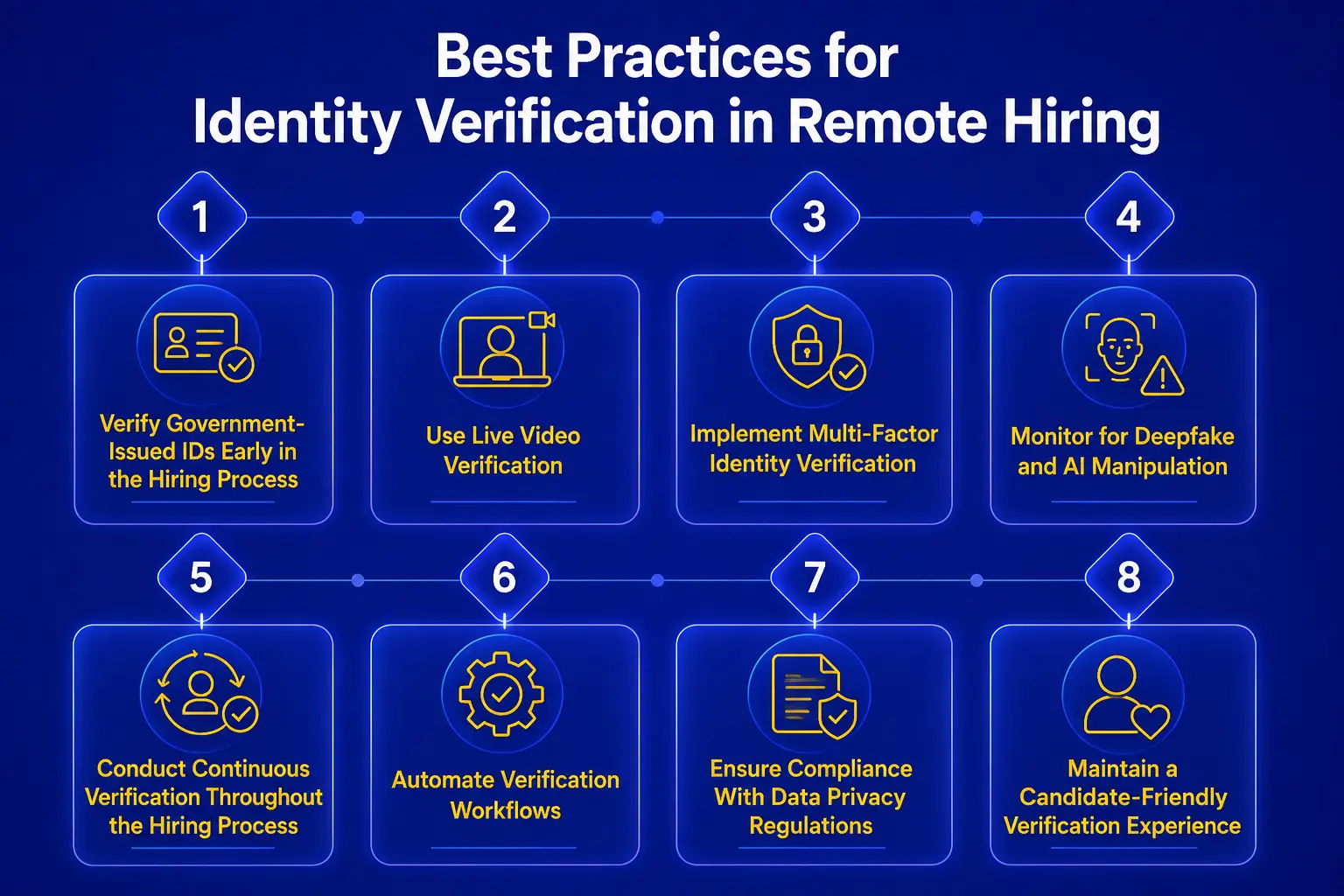
Below are the most effective best practices for identity verification in remote hiring.
1. Verify Government-Issued IDs Early in the Hiring Process
Identity verification should begin at the initial stages of recruitment rather than after the final hiring decision. Requesting government-issued identification early helps recruiters confirm candidate authenticity before investing additional time in interviews and assessments.
Commonly verified documents include:
Passports
Driver’s licenses
National identity cards
Work permits
Employee authorization documents
AI-powered document verification systems can also detect forged or manipulated IDs more accurately than manual reviews.
2. Use Live Video Verification
Live video verification adds an additional layer of security by confirming that the candidate matches the submitted identity documents in real time.
During live verification, recruiters can:
Match facial features with ID photos
Observe behavioral consistency
Detect suspicious interview behavior
Verify live presence through liveness checks
This reduces the risk of impersonation and proxy interviewing during remote recruitment.
3. Implement Multi-Factor Identity Verification
Relying on a single verification method increases vulnerability to fraud. Organizations should combine multiple verification layers to strengthen hiring security.
An effective multi-factor verification process may include:
Document authentication
Facial recognition
OTP verification
Device validation
Behavioral analysis
Email and phone verification
Using multiple checkpoints improves fraud detection accuracy significantly.
4. Monitor for Deepfake and AI Manipulation
Deepfake interview fraud is becoming increasingly sophisticated. Organizations should adopt AI-powered tools that can detect synthetic media manipulation during remote interviews.
Key indicators to monitor include:
Irregular facial movements
Audio synchronization issues
Unnatural blinking patterns
Voice inconsistencies
Facial distortion during movement
Background manipulation
Advanced fraud detection systems help recruiters identify suspicious activity in real time.
5. Conduct Continuous Verification Throughout the Hiring Process
Identity verification should not be limited to a single stage of recruitment. Fraudulent candidates may attempt identity switching between interviews, assessments, and onboarding.
Organizations should verify candidates consistently across:
Application submission
Online assessments
Technical interviews
Final interviews
Offer acceptance
Employee onboarding
Continuous verification ensures the same individual participates throughout the hiring journey.
6. Automate Verification Workflows
Manual verification processes can be slow, inconsistent, and prone to human error. Automated identity verification systems improve efficiency while maintaining stronger security controls.
Automation helps organizations:
Reduce verification time
Improve hiring scalability
Minimize manual review errors
Maintain verification consistency
Accelerate onboarding workflows
This is especially important for companies handling high-volume remote recruitment.
7. Ensure Compliance With Data Privacy Regulations
Identity verification processes involve sensitive personal information. Organizations must ensure that candidate data is handled securely and in compliance with applicable privacy regulations.
Best practices include:
Encrypting candidate data
Limiting unauthorized access
Maintaining secure storage systems
Following regional compliance standards
Using privacy-first verification platforms
A transparent verification process also improves candidate trust and confidence.
8. Maintain a Candidate-Friendly Verification Experience
While security is important, overly complicated verification steps can negatively affect candidate experience. The ideal process should be fast, seamless, and easy to complete.
Organizations should focus on:
Mobile-friendly verification
Clear verification instructions
Minimal onboarding friction
Fast verification turnaround
Transparent communication
Balancing security and usability helps reduce candidate drop-offs during hiring.
Making the Remote Identity Verification Process Candidate-Friendly
While strong identity verification is essential for secure remote hiring, organizations must also ensure the process remains simple, transparent, and user-friendly for candidates. A complicated or time-consuming verification experience can frustrate applicants, increase drop-off rates, and negatively impact employer branding.
The goal is to create a verification workflow that balances security with convenience.
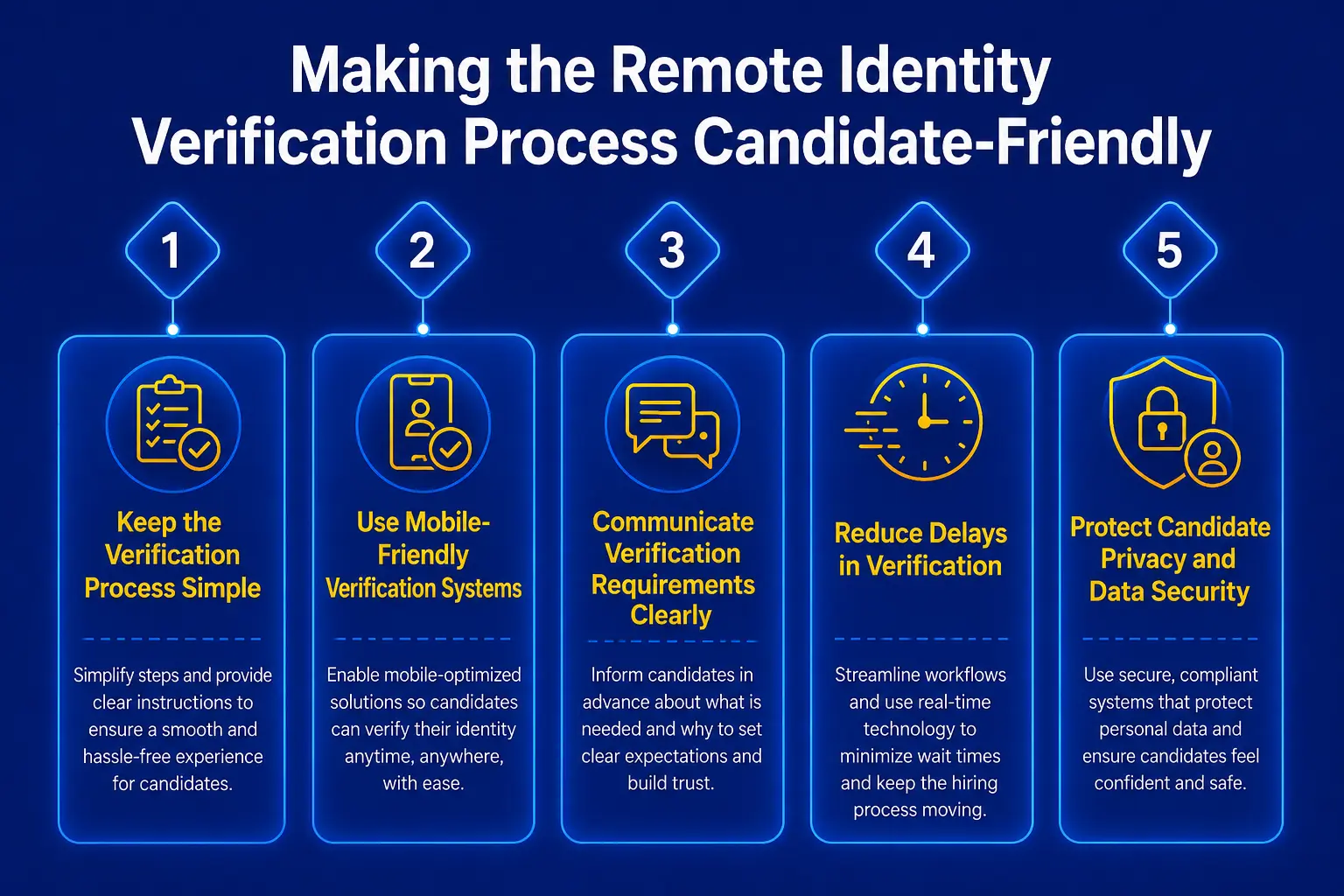
Below are the best ways organizations can make remote identity verification more candidate-friendly.
1. Keep the Verification Process Simple
Candidates should be able to complete verification steps without confusion or technical difficulties. Complex workflows often lead to delays and poor candidate experience.
Organizations should focus on:
Clear instructions
Minimal verification steps
Easy document uploads
Simple navigation
Fast completion times
A streamlined process improves both candidate satisfaction and verification efficiency.
2. Use Mobile-Friendly Verification Systems
Most candidates prefer completing verification steps through smartphones or tablets. Mobile-friendly verification platforms allow applicants to upload documents, complete facial scans, and verify identities conveniently from anywhere.
Mobile optimization helps improve:
Accessibility
Completion rates
Candidate convenience
Verification speed
Global hiring flexibility
This is especially important for remote and international recruitment.
3. Communicate Verification Requirements Clearly
Candidates are more likely to cooperate when they understand why identity verification is necessary. Recruiters should explain the purpose of each verification step and how candidate data will be protected.
Transparent communication should include:
Required documents
Verification timelines
Privacy policies
Security measures
Support information
Clear guidance reduces uncertainty and builds trust during the hiring process.
4. Reduce Delays in Verification
Long verification wait times can negatively affect hiring momentum and candidate engagement. Automated verification systems help organizations complete identity checks quickly while maintaining accuracy.
Faster verification benefits include:
Reduced hiring delays
Better candidate experience
Faster onboarding
Improved recruiter productivity
Lower application drop-offs
Efficient workflows create a smoother recruitment journey for applicants.
5. Protect Candidate Privacy and Data Security
Candidates want assurance that their personal information is being handled securely. Organizations should adopt privacy-first verification practices that comply with data protection regulations.
Best practices include:
Secure document storage
Encrypted data transfer
Limited data access
Transparent consent processes
Regulatory compliance
Strong privacy standards help increase candidate confidence in the hiring process.
Establishing a Remote Verification Workflow
A structured remote verification workflow helps organizations create a secure and consistent hiring process while reducing the risk of identity fraud, impersonation, and onboarding errors. As remote hiring becomes more common, recruiters need a standardized system that verifies candidate identities at multiple stages of recruitment rather than relying on a single manual check.
An effective workflow combines identity verification, document authentication, live candidate validation, and fraud detection into one streamlined process. This not only improves hiring security but also helps organizations maintain compliance and deliver a smoother candidate experience.
Define identity verification requirements before hiring begins
Collect and validate government-issued identification documents
Conduct live facial verification during virtual interviews
Monitor for deepfake activity and suspicious behavior
Verify candidate information across multiple recruitment stages
Automate verification and fraud detection processes
Maintain secure storage of candidate verification data
Ensure compliance with privacy and employment regulations
A strong remote verification workflow helps organizations build trust, improve hiring accuracy, and protect internal systems from fraudulent candidates. By combining automation with intelligent fraud detection, companies can create a scalable hiring process that supports both security and candidate experience.
How Sherlock AI Helps Organizations Verify Candidate Identity Remotely
As remote hiring fraud becomes more sophisticated, organizations need more than basic document checks and video interviews to verify candidate authenticity. AI-generated profiles, proxy interviews, deepfake videos, and real-time AI-assisted cheating are creating major challenges for recruiters and security teams.
Sherlock AI is designed specifically to help organizations detect and prevent modern interview fraud during remote hiring workflows. The platform combines AI-powered behavioral analysis, deepfake detection, identity verification, and real-time fraud monitoring to help companies confidently evaluate genuine candidates.
Key Features of Sherlock AI
1. Deepfake Detection During Live Interviews
Sherlock AI analyzes video and audio signals in real time to identify deepfake manipulation, synthetic identities, face swaps, and AI-generated interview fraud.
The platform detects:
Lip-sync inconsistencies
Unnatural facial movements
Synthetic voice patterns
Video manipulation signals
Facial distortion anomalies
This helps organizations identify fraudulent candidates before hiring decisions are made.
2. AI Copilot and Hidden Assistance Detection
Candidates increasingly use hidden AI tools and real-time copilots during interviews to generate answers. Sherlock AI monitors for suspicious behavioral and response patterns associated with AI-assisted cheating.
The system can identify:
Scripted response behavior
Unnatural answer timing
Sudden shifts in communication style
External answer assistance
Hidden AI tool usage
This allows recruiters to evaluate genuine candidate knowledge instead of AI-generated responses.
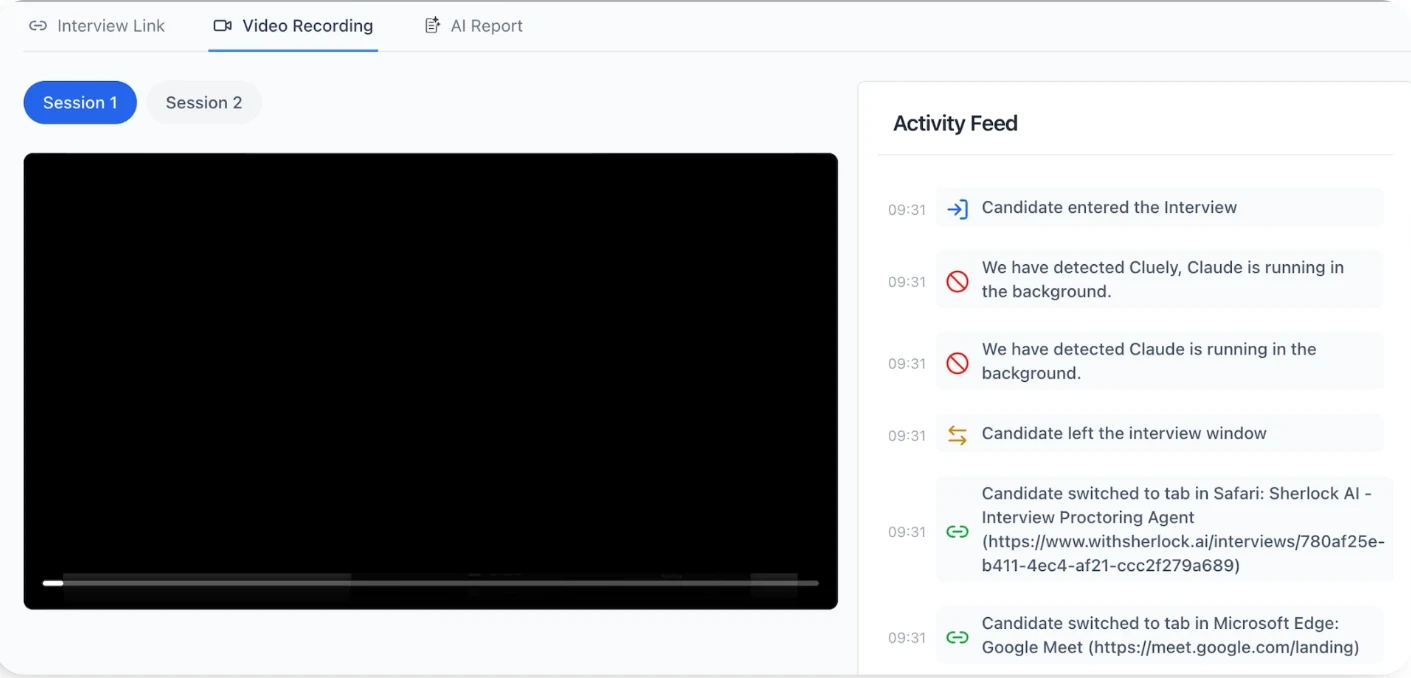
3. Proxy Candidate Detection
Sherlock AI helps detect cases where another individual participates in interviews on behalf of the actual applicant.
The platform analyzes:
Voice consistency
Facial behavior patterns
Cross-interview identity matching
Behavioral inconsistencies across hiring stages
This reduces the risk of impersonation during remote hiring.
4. Behavioral Intelligence and Risk Analysis
Instead of relying only on static identity checks, Sherlock AI continuously evaluates behavioral signals during interviews.
Behavioral monitoring includes:
Response timing analysis
Conversation flow consistency
Behavioral anomaly detection
Candidate interaction patterns
Interview-stage consistency tracking
This creates a more complete view of candidate authenticity.
5. Continuous Monitoring Across Interview Stages
Sherlock AI verifies consistency throughout the recruitment process instead of performing one-time identity checks.
The platform can compare candidate behavior across:
Screening interviews
Technical assessments
Behavioral interviews
Final hiring rounds
This helps identify identity switching or suspicious inconsistencies between interview stages.
6. Real-Time Fraud Detection Alerts
Sherlock AI surfaces suspicious behavior as interviews happen, allowing recruiters to investigate concerns immediately rather than after the hiring process is complete.
Real-time monitoring helps organizations:
Detect fraud early
Improve hiring confidence
Reduce insider security risks
Strengthen remote recruitment integrity
The platform works silently in the background while interviewers focus on candidate evaluation.
Final Thoughts
Verifying candidate identity remotely has become an essential part of modern hiring. As organizations increasingly rely on virtual recruitment, traditional verification methods are no longer enough to prevent impersonation, deepfake fraud, proxy interviews, and fake credentials.
A strong remote identity verification strategy helps organizations improve hiring accuracy, strengthen workforce security, maintain compliance, and protect sensitive business operations from fraud-related risks.
By implementing structured verification workflows, using AI-powered fraud detection tools, and continuously monitoring candidate authenticity throughout the hiring process, companies can build secure and trustworthy remote recruitment systems.
Solutions like Sherlock AI enable organizations to confidently verify candidate identities through advanced behavioral intelligence, deepfake detection, automated verification workflows, and real-time interview fraud prevention.
As remote hiring continues to grow, organizations that invest in intelligent verification technologies will be better positioned to protect their workforce, improve hiring integrity, and build long-term trust in digital recruitment processes.