Back to all blogs
Learn how to spot dishonest candidates in interviews, recognize modern red flags, and apply practical strategies to protect hiring quality without losing strong talent.

Abhishek Kaushik
Jan 27, 2026
Hiring the right person is one of the biggest challenges for companies today. At the same time, many job seekers bend the truth to improve their chances. In a survey of nearly 2,000 U.S. workers, 80% said they have lied during a job interview, and 44% of those admitted to lying frequently.
Other research shows this issue is widespread across the hiring process, 44% of Americans surveyed admit they’ve lied in the hiring process and end up with job offers they might not otherwise have received.
Interview dishonesty makes it harder to judge true capability, identifying these gaps early helps protect the quality and credibility of hiring decisions.
Common Signs of Candidate Dishonesty
1. Resume Inconsistencies, Vague Timelines, Over-Polished Descriptions
Job titles or dates that don’t make sense
If dates overlap or employment periods are padded without clear explanation, it’s a red flag worth verifying with references or background checks.
Inflated roles and generic phrasing
Phrases like “managed key tasks” or “worked on major projects” without specifics can be a sign of embellishment. Honest resumes usually list measurable results, concrete tools used, or specific responsibilities.
Inconsistency across platforms
When a resume says one thing but LinkedIn or a portfolio profile says something different, that’s a solid indicator to dig deeper. Honest candidates tend to keep their professional narrative consistent.
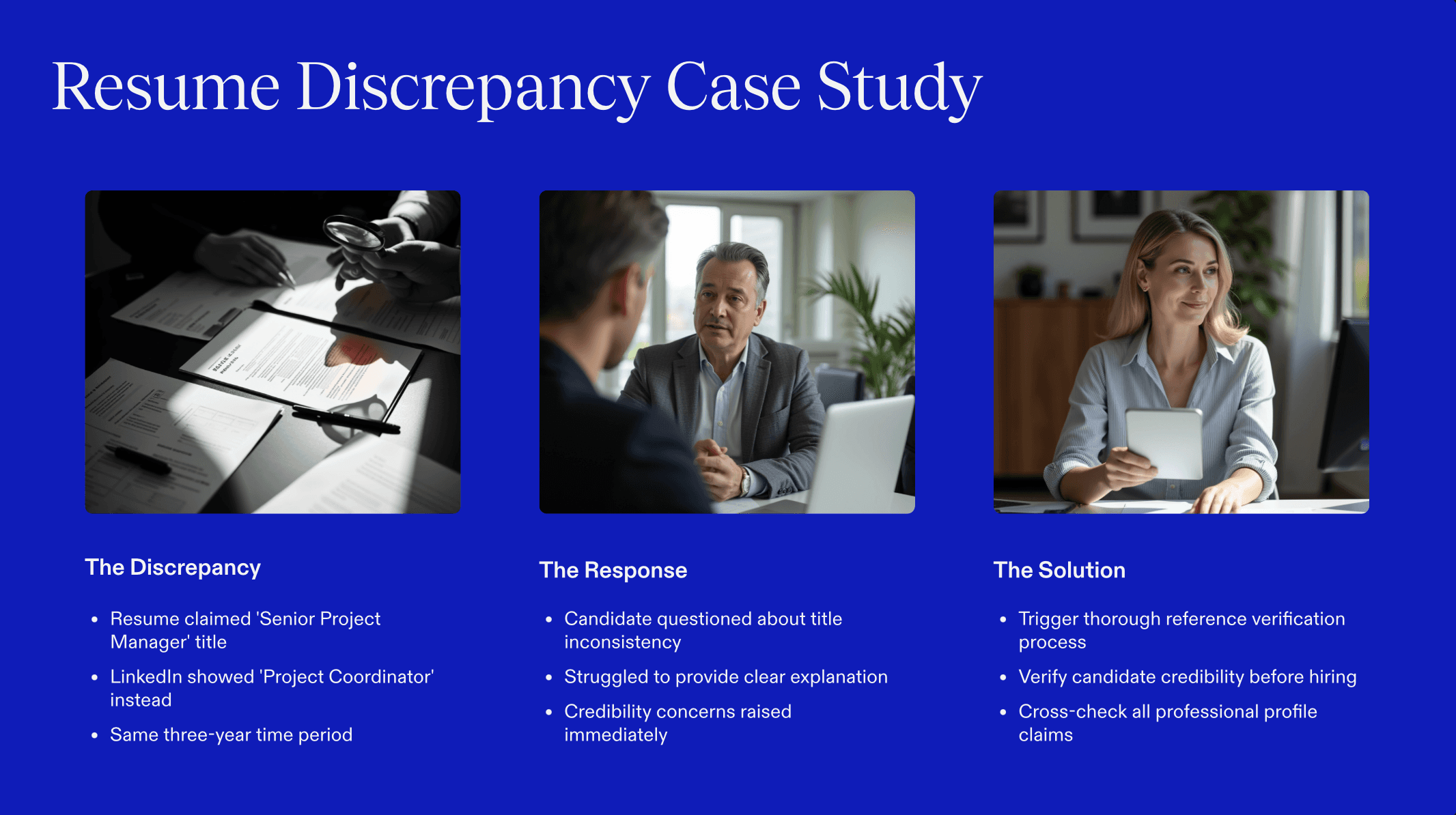
Example: A candidate lists “Senior Project Manager” for three years on their resume, but LinkedIn shows a role of “Project Coordinator” for the same period. When asked about the discrepancy, they struggle to explain it. This kind of mismatch should trigger reference checks.
2. Behavioral Cues During Interviews
Behavioral red flags are subtle, but they often show up when the candidate can’t back up their claims:
Vague or evasive answers
When asked about specific work they’ve done, dishonest candidates may speak broadly without details, or repeat rehearsed phrases that don’t actually relate to the question.
Inconsistent narratives
If a candidate gives different details about the same experience when questions are reworded, it suggests the story isn’t real.
Non-verbal behavior
Avoiding eye contact, excessive fidgeting, or delayed responses when discussing key experiences can be a sign of discomfort and potential dishonesty when combined with other red flags.
Example: During a technical interview, a candidate claims deep expertise with a software tool but hesitates, uses fillers (“um,” “uh”), and avoids eye contact when asked to describe a recent related project. These behavioral cues often align with fabricated experience.
3. Mismatch Between Claimed Experience and Depth of Explanation
This is one of the most reliable interview signals of dishonesty:
Surface-level talk with no depth
A candidate might claim mastery of a skill like advanced Excel, database management, or a programming language, but when asked follow-ups like “walk me through how you used it on a real project,” they can’t provide specifics.
Defensiveness or deflection
Rather than offering concrete examples, candidates who are exaggerating may try to shift topics, get defensive, or overemphasize their honesty.
Failure on technical or scenario questions
Honest candidates draw on real experience to answer scenario-based questions. Those who are dishonest often fall short because their claimed experience isn’t grounded in actual practice.
Example: A candidate with “Python experience” on their resume can’t explain basic concepts like list comprehensions or functions when probed. This depth mismatch is a practical sign that the resume may have been embellished.
Modern Ways Candidates Misrepresent Themselves
Today’s hiring landscape is shaped by remote interviews, digital tools, and global competition. Those factors create opportunities for newer forms of misrepresentation that many recruiters still underestimate.
1. AI-Assisted Answers and Real-Time Coaching
Live assistance during interviews
Some candidates use hidden AI tools or real-time prompts to generate polished answers on the fly. Recruiters have reported interviewees giving suspiciously perfect responses that sound too scripted, which can be a sign of tools being used behind the scenes.
Tools disguised as note-taking or reference apps
HR professionals have noted candidates bringing seemingly innocuous software into remote interviews that actually feeds them answers as questions are asked.
Employers are so concerned about this trend that some are bringing portions of their interview process back in-person precisely to reduce the risk of off-screen technology aiding responses.
2. Proxy Interviews and Identity Masking
Gartner projects that by 2028 up to one in four job candidates could be fake, in part because proxy and identity fraud become more common without strong verification steps.
Someone else answering for the candidate
“Proxy interviewers” are a growing problem in remote hiring. In some cases, a third party more qualified than the applicant takes over the interview, either sitting in view or hidden off-camera.
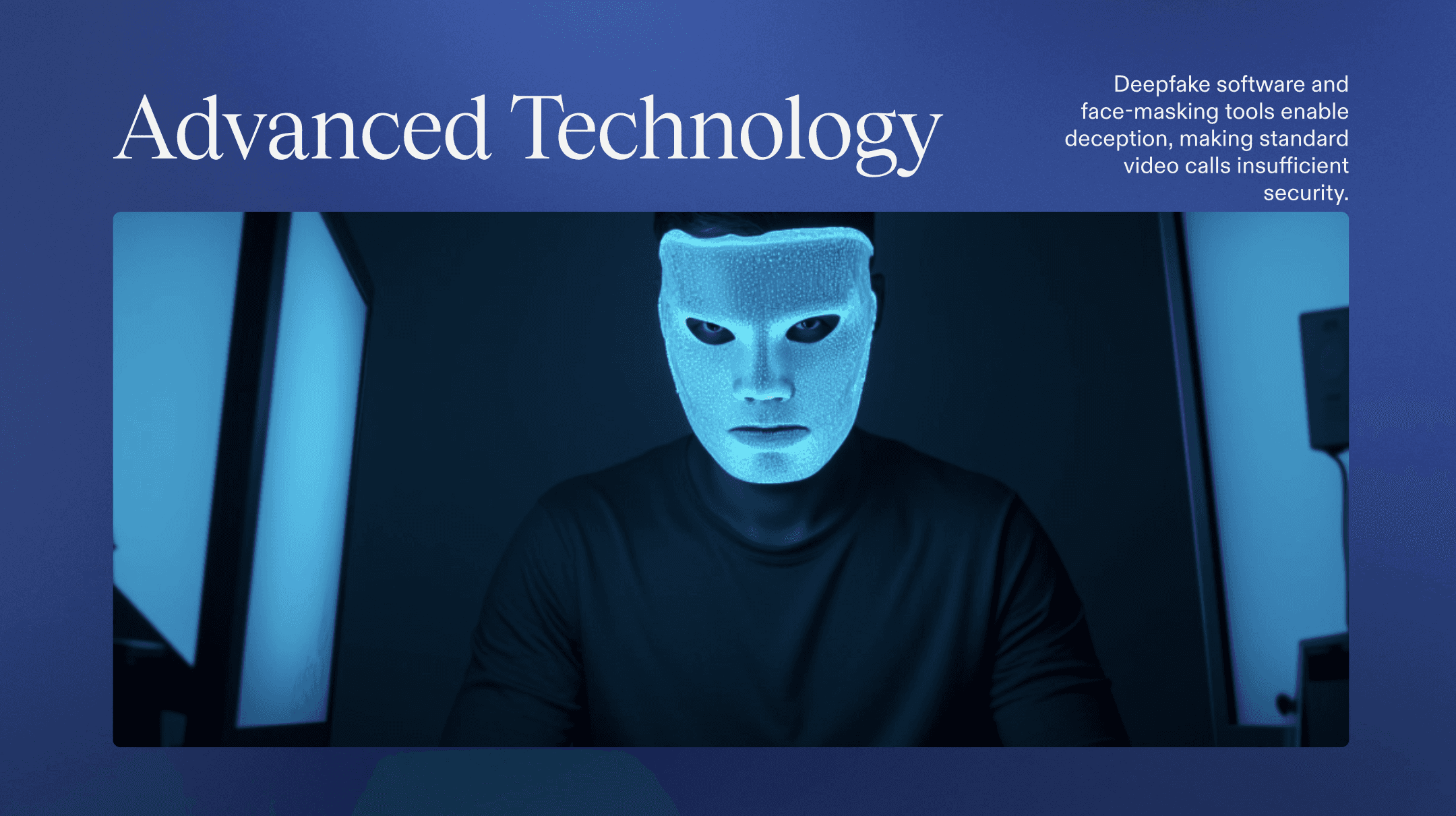
Deepfake or face-masking tools
Candidates can use deepfake software or manipulated video streams to impersonate someone else during a live interview. These tools can replace faces or voices in real time, making verification much harder over standard video calls.
A well-known example is the “Ivan X” case, where a company discovered a job applicant was using deepfake video and audio to impersonate a real person during remote interviews
3. Inflated Skills Backed by Surface-Level Knowledge
Scripted rather than genuine understanding
Some applicants rely on shallow knowledge that sounds good in an interview but falls apart with deeper questioning. AI tools have made it easier to produce impressive talking points without real expertise behind them.
Automated coding and task completion tools
In technical roles, candidates may use tools that automatically generate code or complete assignments during a live assessment rather than demonstrating their own problem-solving process.
Inflated skills create misleading impressions in interviews. Recruiters may fill roles with people who cannot perform independently once hired.
How Recruiters Should Respond Without Losing Good Talent
The goal is to design hiring processes where real ability naturally stands out and shortcuts become harder to hide.
1. Use Structured Interviews and Skill Validation
Ask the same core questions to every candidate. Structured interviews reduce bias and make inconsistencies easier to spot because answers can be compared objectively.
Validate skills with practical tasks such as short work samples, case studies, or role-specific exercises reveal whether a candidate can actually perform the job. Work-sample testing is one of the strongest predictors of future performance.
Honest candidates usually welcome structured, skills-based evaluation because it gives them a fair chance to demonstrate real capability.
2. Ask Follow-Up Questions That Reveal Inconsistencies
Probe for specifics, not opinions. Instead of “Are you good at X?”, ask “Tell me about the last time you used X. What problem were you solving?”
Revisit the same experience later in the interview. Dishonest answers often change slightly when candidates are asked to describe the same situation from a different angle.
Use scenario-based questions, asking how someone would handle a real job situation exposes whether their experience is practical or rehearsed.
3. Use Monitoring, Proctoring, and Behavioral Detection Tools as Support
Tools that flag unusual behavior like frequent eye shifts, long response delays, or repeated off-screen glances help interviewers decide where to probe further, not who to reject automatically.
Platforms like Sherlock AI are built specifically to protect interview integrity in modern hiring environments. Instead of replacing interviewer judgment, Sherlock AI provides structured signals and evidence that support better decision-making.
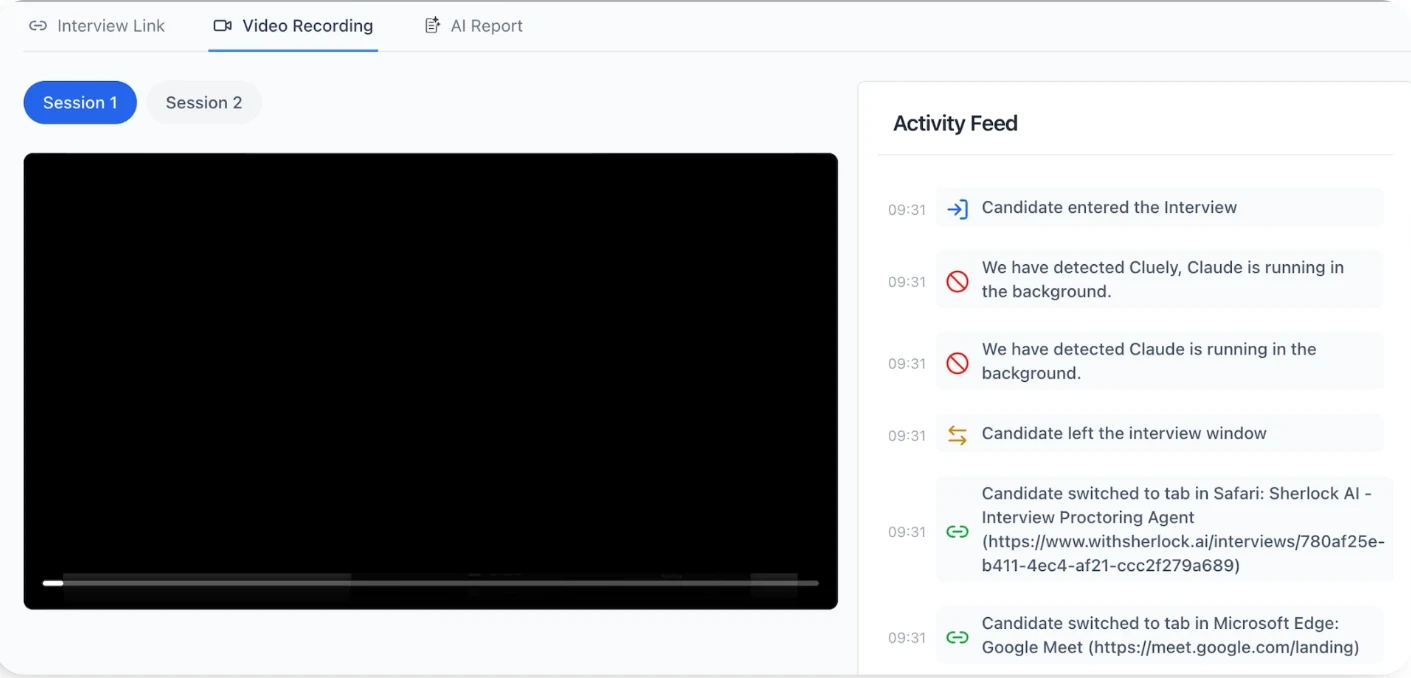
Key ways Sherlock AI supports recruiters during interviews:
Detects proxy interviews by identifying patterns that suggest another person may be assisting or replacing the candidate during a live interview
Flags real-time external assistance, such as scripted answers, AI copilots, or second-screen coaching, based on behavioral and response analysis
Monitors eye movement and attention shifts to identify frequent off-screen glances that may indicate prompts or external help
Analyzes response timing to surface unnatural delays that often occur when candidates wait for generated or assisted answers
Tracks answer consistency across questions, highlighting when responses sound overly polished yet lack depth or coherence
Supports identity verification by helping detect mismatches between the candidate and expected identity signals during the interview
Works in live interview environments, allowing issues to be identified while the interview is still in progress
Provides interviewer-facing insights, not candidate-facing interruptions, keeping the interview experience natural and professional
Creates an audit trail of integrity signals that recruiters can reference during hiring decisions or internal reviews
Scales across teams, enabling consistent interview integrity standards without relying on individual interviewer intuition alone
Sherlock AI equips interviewers with objective context so they can ask better follow-up questions, validate skills more confidently, and protect the hiring process without turning interviews into interrogations.
Conclusion
Interview dishonesty is no longer limited to obvious resume exaggeration or inconsistent answers. As hiring moves online and tools become more sophisticated, the risks have become harder to spot and easier to underestimate. Recruiters cannot rely on instinct alone to separate genuine ability from assisted performance.
The most effective response is a balanced one. Structured interviews, skill-based validation, and thoughtful follow-up questions create a fair environment where real experience stands out. When combined with interview integrity tools like Sherlock AI, recruiters gain additional context that helps them probe deeper without disrupting the candidate experience.
The result is a hiring process that rewards genuine skill, protects interview integrity, and still delivers a positive candidate experience.