Back to all blogs
Learn how to calibrate interview panels using AI-powered notes and scorecards for more consistent, fair, and data-driven hiring decisions.

Abhishek Kaushik
Dec 22, 2025
Panel calibration fails when people discuss impressions. It succeeds when people discuss evidence.
The only reliable way to make interview decisions:
Use AI-structured notes to capture reasoning signals accurately
Use scorecards aligned to the competencies you actually hire for
Hold short, structured calibration sessions where disagreements are resolved using evidence, not preferences
This ensures:
Consistency
Fairness
Faster hiring decisions
Fewer mis-hires
Why Calibration Breaks Without Structure
Most debriefs default to:
“I liked them.”
“They seemed senior”
“Not sure they’ll be a culture fit.”
“Strong energy”
“Didn’t feel convincing”
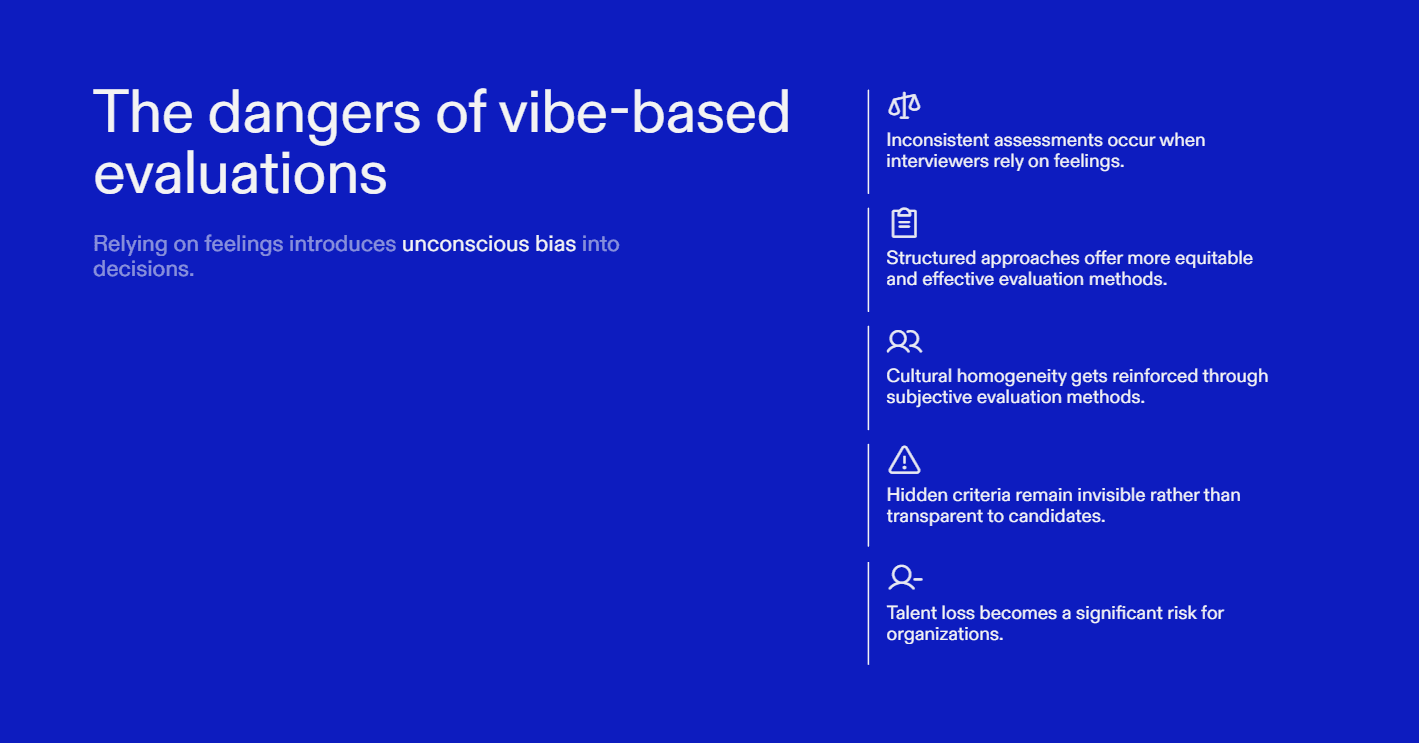
These are vibe-based evaluations.
Vibes introduce:
Bias
Hidden criteria
Interviewer inconsistency
Cultural homogeneity
Talent loss or mis-hire risk
The Key Principles of Panel Calibration
Principle | Meaning |
|---|---|
Evidence over impression | Only discuss what the candidate actually said or demonstrated |
Competencies over personality | Evaluate skills, not style |
Shared scoring language | Everyone uses the same definitions of “meets” or “exceeds” |
Neutral facilitation | Avoid dominant voices steering the room |
Step 1: Use AI Notes for Evidence Gathering
During the interview:
AI captures reasoning
AI timestamps follow-up adaptation signals
AI highlights ownership markers
AI records tradeoff discussion sequences
After the interview:
Interviewers review structured notes, not memory
This ensures:
Everyone is reacting to the same information, not their subjective recall.
Research shows that AI systems designed to transcribe and analyze interview dynamics can significantly minimize bias (e.g., sentiment and interviewer bias) and surface skill-based evidence rather than impressions.
Step 2: Use a Shared Scorecard
Each interviewer scores only the competencies assigned to them.
Example competencies:
Problem-solving depth
Architectural reasoning
Ownership and accountability
Collaboration style
Adaptability under constraint
Example score levels:
Insufficient Evidence
Emerging
Meets Expectation
Exceeds Expectation
This creates a shared, consistent language across interviewers.
Using clearly defined competency levels mirrors how scoring rubrics in AI-assisted coding interviews standardize evaluation, shifting decisions toward comparable, evidence-based judgment.
Step 3: Run a 12-Minute Calibration Meeting
Yes, 12 minutes. More than that means the system failed upstream.
Meeting Agenda
Minute | Action |
|---|---|
1 | State the goal: select using evidence |
2–6 | Each interviewer reads their scorecard highlights aloud (no discussion) |
7–9 | Facilitator surfaces only score discrepancies |
10–11 | Team reviews notes + evidence together to resolve |
12 | Decision recorded in ATS with a justification sentence |
No debate about personality.
No persuasion battles.
No memory storytelling.
Best practices for productive performance calibration meetings include establishing clear criteria, training reviewers (especially for first‑time participants), preparing participants, and documenting all decision‑making practices to ensure consistency, fairness, and trust in the evaluation process.
The Debrief Discussion Rules
Use these phrases to enforce evidence discipline:
If someone gives a vibe comment:
Can you point to the specific moment in the notes where that was demonstrated?
If someone speaks in general terms:
Which competency does that relate to?
If someone tries to explain away the lack of evidence:
If we do not have demonstrated evidence, we must score it as “insufficient evidence” regardless of how we feel.
This is how you remove bias without emotional conflict.
Step 4: Document the Decision Clearly
Use this ATS-safe template:
Or if declining:
No mention of:
Personality
Confidence
Accent
Background assumptions
Outcome Benefits
Outcome | Impact |
|---|---|
Faster decisions | No long debrief arguments |
Reduced bias | Evidence replaces impression |
Higher hiring confidence | Teams trust the process |
Clear auditability | Every choice is explainable |
Better culture fit | Fit = work values, not personality clone |
This builds a talent system that scales globally.
Conclusion
Calibration is not about getting everyone to agree. Calibration is about getting everyone to evaluate the same way.
When:
AI captures the signal
Scorecards structure evaluation
Panels discuss evidence instead of impressions
Teams hire:
More accurately
More fairly
More confidently
Consistency is not a constraint. Consistency is a quality.