Back to all blogs
Learn how to score AI-assisted coding interviews with a clear, structured rubric - plus a sample template and spreadsheet you can use right away.

Abhishek Kaushik
Dec 5, 2025
In 2026, many candidates use:
Copilot
ChatGPT
Pre-trained coding templates
Scripted interview walkthroughs
So evaluating code output correctness alone no longer measures real skill.
To score accurately, interviewers must evaluate how candidates think, not just what they type.
This rubric gives a step-by-step scoring system that focuses on:
Reasoning clarity
Tradeoff understanding
Debugging ability
Adaptability when requirements shift
Sherlock AI automatically verifies authorship and detects AI misused for full solution generation.
The rubric ensures fairness and consistency across interviews.
The Four Signal Areas to Score (Total 10 points)
Skill Area | Score Range | Weight | What It Measures |
|---|---|---|---|
Reasoning & Decomposition | 0 to 3 | High | Can they break down the problem clearly? |
Code Construction Process | 0 to 3 | High | Did they build the solution in understandable, editable steps? |
Adaptability Under Constraint Change | 0 to 2 | Medium | Does the solution evolve logically when assumptions shift? |
Debugging & Maintenance Awareness | 0 to 2 | Medium | Can they explain failure cases and edge conditions? |
This scoring method works whether AI is allowed as a thinking tool or not.
Detailed Rubric Criteria
1. Reasoning & Decomposition (0 to 3)
Score | Signal | Description |
|---|---|---|
3 | Strong reasoning | Clear step breakdown. Explains why parts belong. No guessing. |
2 | Adequate reasoning | Understands basic flow but misses some tradeoffs. |
1 | Weak reasoning | Starts coding without planning. Struggles to articulate approach. |
0 | No reasoning | Cannot explain the problem or attempt decomposition. |
Key question to ask:
Before writing code, walk me through how your solution works.
2. Code Construction Process (0 to 3)
Score | Signal | Description |
|---|---|---|
3 | Builds iteratively and narrates thinking | Code grows logically. Variable naming and control flow are understandable. |
2 | Code works but lacks clarity | Understands concept but explanation or readability is weak. |
1 | Relies on AI or copying | Cannot justify structure or edits. |
0 | No authorship | Code dropped in from external source. Sherlock will flag this. |
Important:
We evaluate how the code was produced, not just the final result.
3. Adaptability Under Constraint Change (0 to 2)
Ask a constraint shift question after code is complete:
Examples:
What if input size is 10 times larger?
What if memory is limited?
What if we need real-time performance?
Score | Signal | Description |
|---|---|---|
2 | Adapts smoothly | Explains what must change and why. |
1 | Surface-level adaptation | Gives guesswork or general statements. |
0 | Cannot adapt | Freezes or answers collapse. |
This is the strongest authentic skill indicator.
4. Debugging & Maintenance Awareness (0 to 2)
Ask:
What are the edge cases and how would you test this?
Score | Signal | Description |
|---|---|---|
2 | Identifies edge cases & test strategy | Demonstrates ownership mindset. |
1 | Mentions only obvious test cases | Shows limited experience. |
0 | Cannot identify failure scenarios | Risk of production fragility. |
Example Final Score Interpretation
Total Score | Meaning | Recommended Decision |
|---|---|---|
9–10 | Excellent independent problem solver | Hire |
7–8 | Solid capability with minor gaps | Hire or team-fit dependent |
5–6 | Needs guidance to perform | Consider junior or decline |
0–4 | Insufficient capability | Do not move forward |
Spreadsheet Version (Copy into Google Sheets)
Candidate | Reasoning (0-3) | Code Process (0-3) | Adaptability (0-2) | Debugging (0-2) | Total Score | Notes |
|---|---|---|---|---|---|---|
Name | ||||||
Name | ||||||
Name |
Column Notes:
Add data validation drop-downs: 0, 1, 2, 3
Use conditional formatting to highlight totals:
Green ≥ 8
Yellow 6–7
Red ≤ 5
This makes scoring consistent across interviewers and regions.
Why Sherlock AI Fits This Model
Sherlock AI provides:
Code authorship verification
Typing cadence continuity
Background coaching detection
Identity match across steps
This ensures:
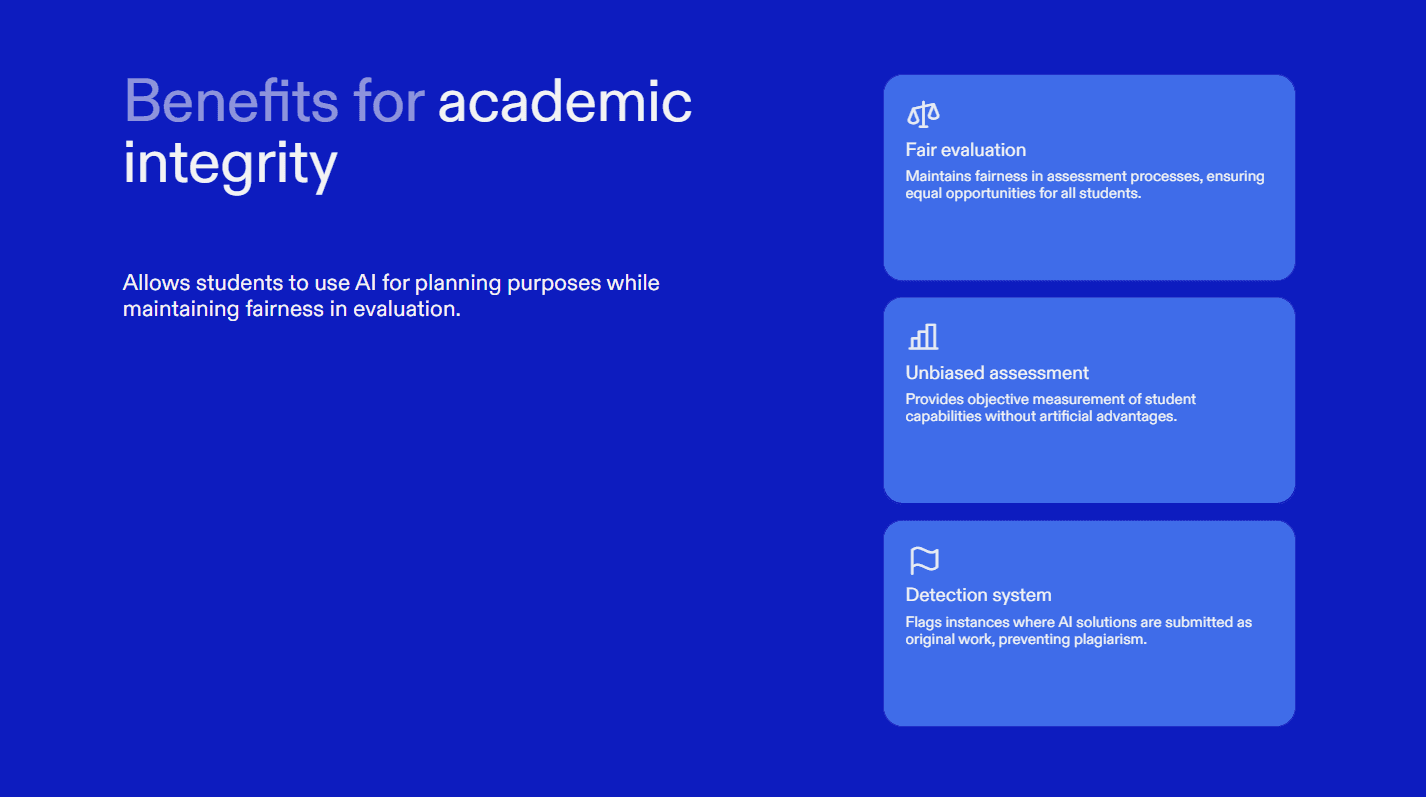
AI used for planning is acceptable
AI used for solution substitution is flagged
So the scoring rubric remains fair and unbiased.
Conclusion
Evaluating coding interviews today requires distinguishing: AI as a tool from AI as a replacement
This scoring rubric ensures that:
Real engineers score well
Coached and copy-paste candidates are exposed naturally
Interviews remain fair, scalable, and globally consistent