Back to all blogs
Find out why a full AI ban in hiring can backfire and how balanced policies lead to better, more accurate interviews.

Abhishek Kaushik
Dec 3, 2025
TL;DR
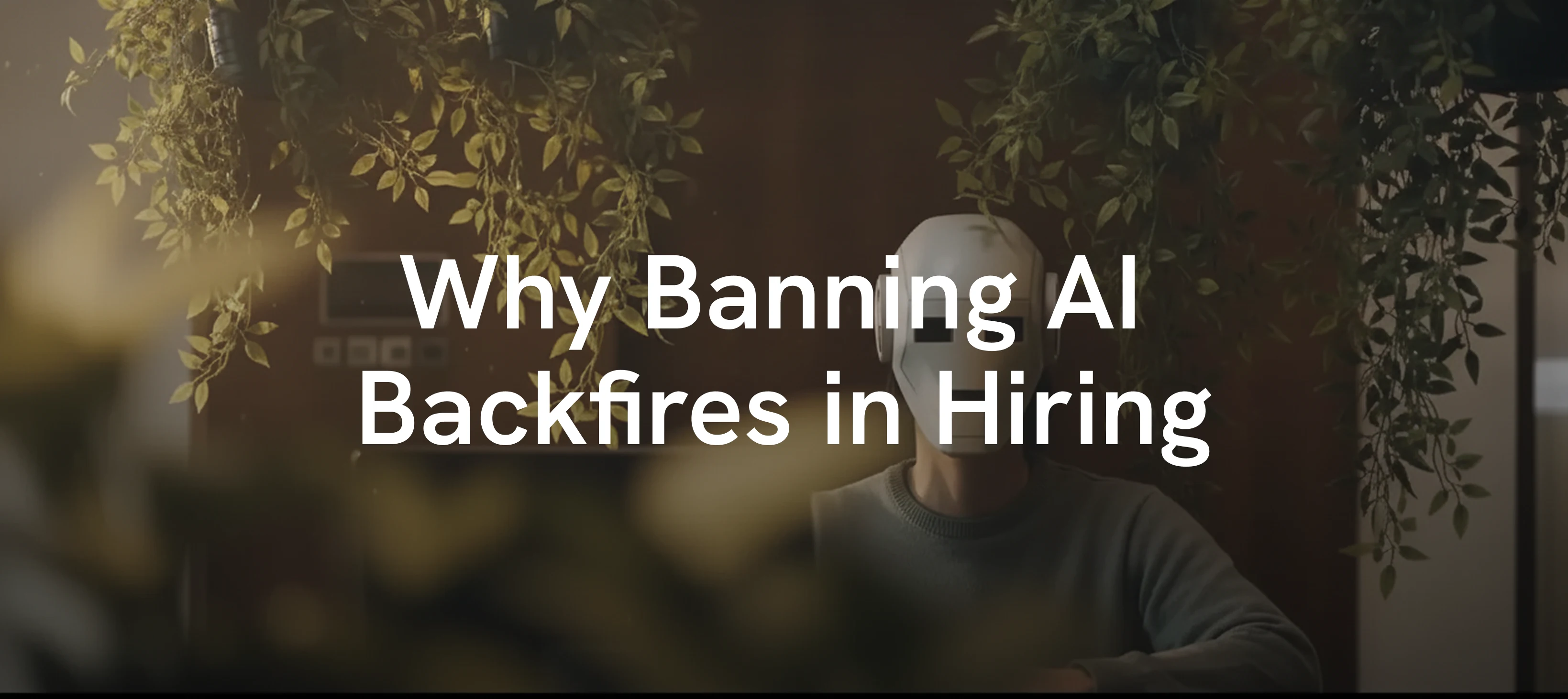
Some companies are responding to interview fraud by banning AI entirely.
This feels simple and safe, but usually creates new fairness problems while still failing to prevent fraud.
A complete ban:
Punishes honest candidates who use AI for accessibility or clarity
Does nothing to stop hidden coaching or proxy interviews
Drives AI use underground where it becomes harder to detect
Removes helpful tools that reduce interviewer bias and improve documentation
The future is not No AI.
It is Transparent and accountable AI use.

Why Companies Consider Banning AI
The reasons are real:
Increasing scripted and rehearsed AI-generated answers
Proxy interviewers posing as candidates
Whisper coaching and hidden second devices
Candidates submitting AI-written take-home work
The fear:
If we allow AI, we cannot tell if the answer is real.
But here is the catch:
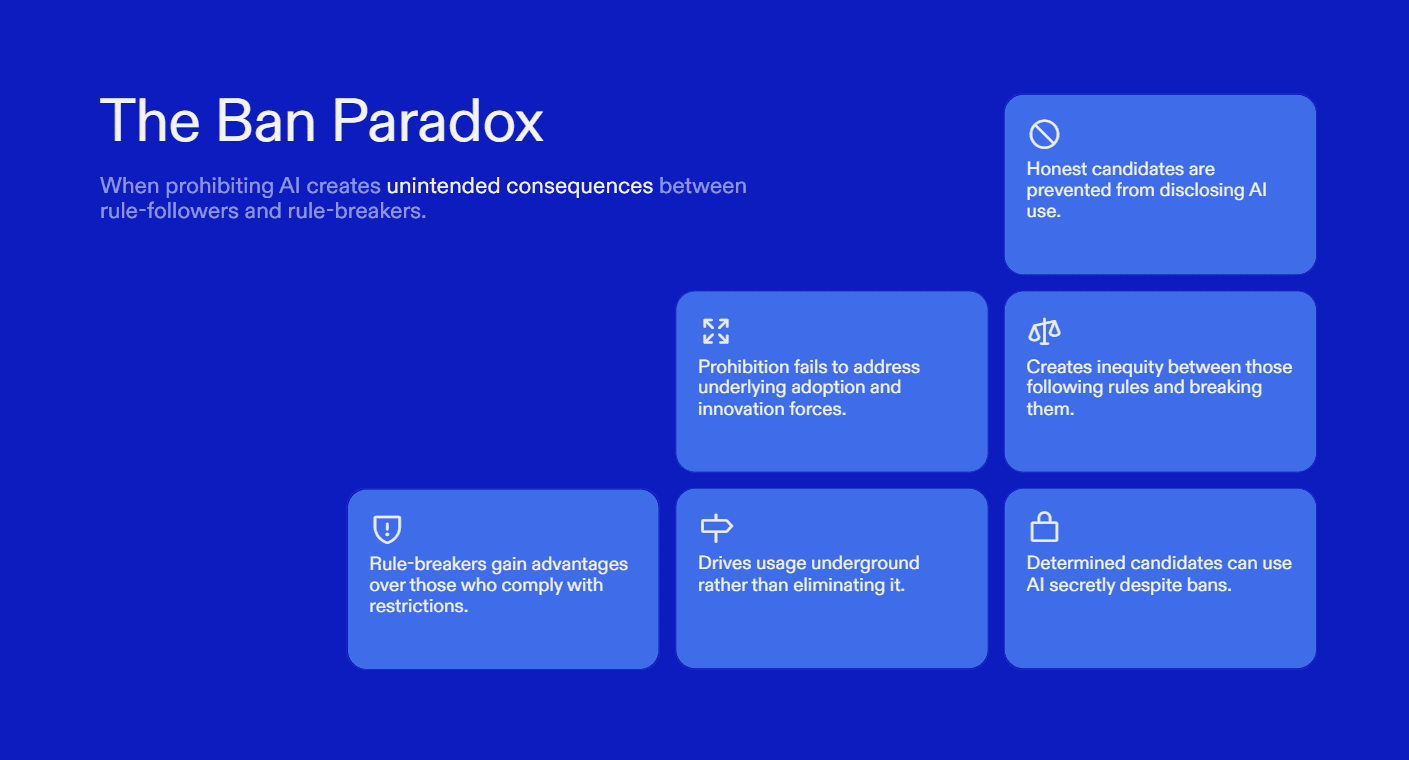
Banning AI does not stop misuse.
It only stops honest disclosure.
The Hidden Cost of a Full Ban
1. You Penalize Non-Native Speakers and Neurodivergent Thinkers
Many candidates use AI to:
Clarify thought structure
Translate ideas
Reduce language processing load
Manage interview anxiety
These candidates do have the skills.
They simply need scaffolding to communicate clearly.
A ban punishes them unfairly.
This increases structural bias.
Communication clarity is not equivalent to competence.
2. AI Use Just Moves Underground
If the rule is:
“No AI allowed during or before the interview”
Candidates who want to misuse AI will still:
Run answers through hidden prompts
Receive live coaching via chat
Use concealed secondary screens
A ban does not stop cheating.
It simply removes transparency.
A recent survey (2025) found that about 20% of respondents admitted to secretly using AI tools during job interviews. Even when there are bans, a fraction of candidates proceed to use AI anyway.
3. It Encourages Memorized Scripts Instead of Real Reasoning
If AI cannot be used to understand concepts,
candidates turn to:
Script banks
Coaching factories
Framework repetition training
The interview becomes:
A memory performance
not an evaluation of capability.
This reduces signal quality.
4. It Overloads Interviewers
Without AI support:
Interviewers must take notes manually
Bias creeps into memory recall
Scorecards become inconsistent
Evidence is harder to defend in debriefs and audits
This increases:
Hiring variance
Manager frustration
Legal exposure
Sherlock AI prevents this by automating:
Notes
Summaries
Reasoning-pattern insights
Identity integrity checks
The Solution Is Not a Ban
The solution is structured allowance.
Companies leading in fairness now:
Step | Example Rule |
|---|---|
Allow AI for prep | Research and practice allowed |
Allow AI for clarity | Notes, outlining, brainstorming allowed |
Restrict AI for real-time answer generation | No tools feeding answers during questions |
Verify identity and authorship | Sherlock provides integrity monitoring |
Score reasoning, not fluency | Updated scorecards measure thought patterns |
This keeps interviews:
Fair
Transparent
Real
Where Sherlock AI Fits
Sherlock AI ensures:
The person answering is the person applying
The reasoning belongs to the candidate, not a backstage assistant
Interviewers focus on listening, not detecting misconduct
Sherlock AI does not ban.
Sherlock AI balances.
It protects:
Honest candidates
Interviewer attention
Hiring signal accuracy
Organizational fairness goals
Conclusion
A total AI ban feels safe.
But it:
Hurts the wrong candidates
Fails to stop actual fraud
Reduces signal quality
Increases bias and workload
The future of hiring is not:
No AI
It is:
Guided, transparent, and integrity-supported AI
This leads to:
More equitable interviews
Higher signal quality
Stronger long-term performance outcomes
Sherlock AI makes this future workable at scale.