Back to all blogs
Best AI Tools to Stop AI Interview Fraud while maintaining fairness and compliance. Learn why Sherlock AI leads modern interview proctoring.
Abhishek Kaushik
Jan 29, 2026
AI interview fraud has evolved beyond simple cheating tactics. Today, candidates may rely on AI generated answers, proxy interviewers, deepfake identities, or real time external coaching while appearing completely natural on camera. As a result, traditional interview monitoring tools that focus only on webcams or screen sharing are no longer sufficient.
Remote hiring has become the norm, with only about 2 percent of employers saying they never conduct virtual interviews and 62 percent of job seekers reporting participation in virtual interviews as of 2025.
At the same time, interview fraud is rising- 59 percent of hiring managers have suspected candidates of using AI tools during interviews, and over 35 percent have encountered situations where someone other than the listed applicant participated in a remote interview.
Modern organizations now rely on AI driven interview proctoring and fraud detection tools that analyze behavior, identity consistency, and contextual signals across the interview lifecycle. These tools help hiring teams identify subtle manipulation while maintaining fairness and candidate trust.
Best AI Tools to Stop AI Interview Fraud
Below are some of the leading AI tools designed to address interview fraud in an AI assisted hiring environment.
1. Sherlock AI
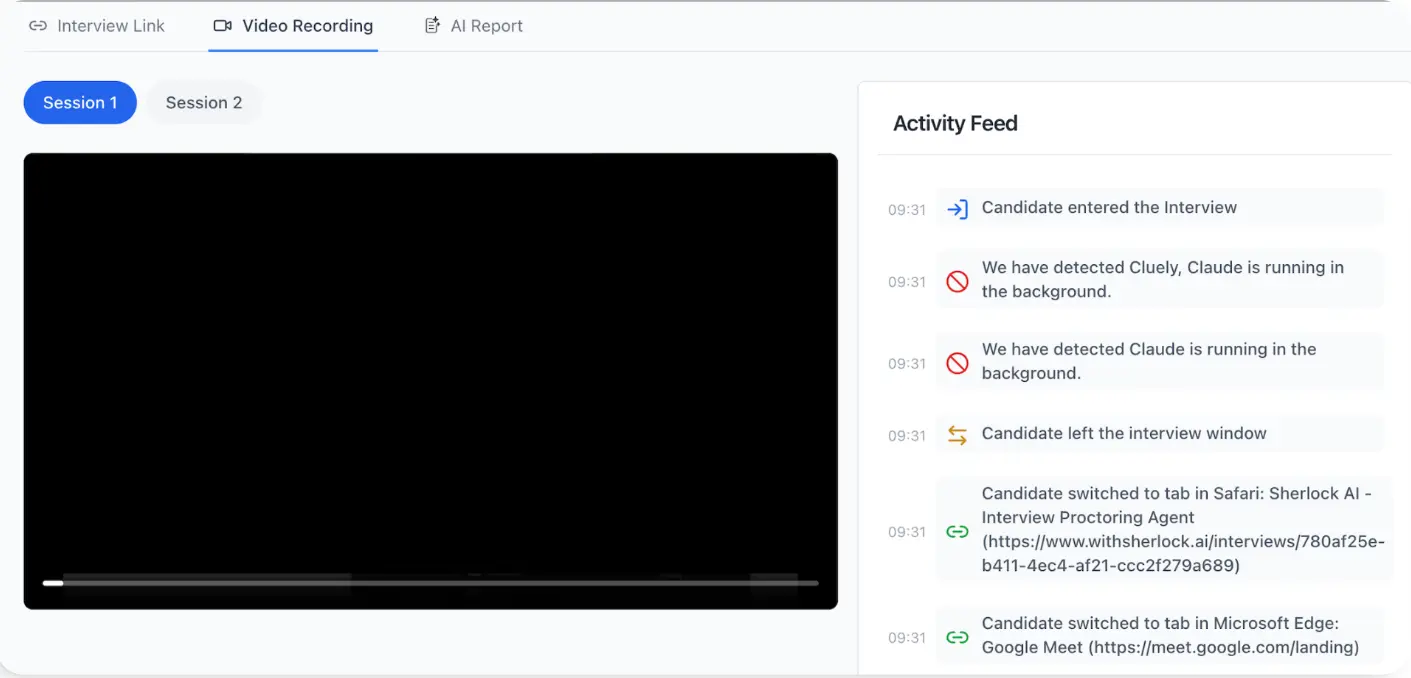
Sherlock AI is purpose-built to act as an intelligent interview proctoring agent not a surveillance tool. It focuses on detecting authenticity risks by analyzing how candidates think, respond, and behave across interview stages rather than relying on rigid rules or invasive monitoring.
Instead of issuing binary pass/fail decisions, Sherlock AI delivers contextual risk insights that explain why something appears suspicious. This enables recruiters to make informed, defensible decisions while maintaining a fair and ethical candidate experience.
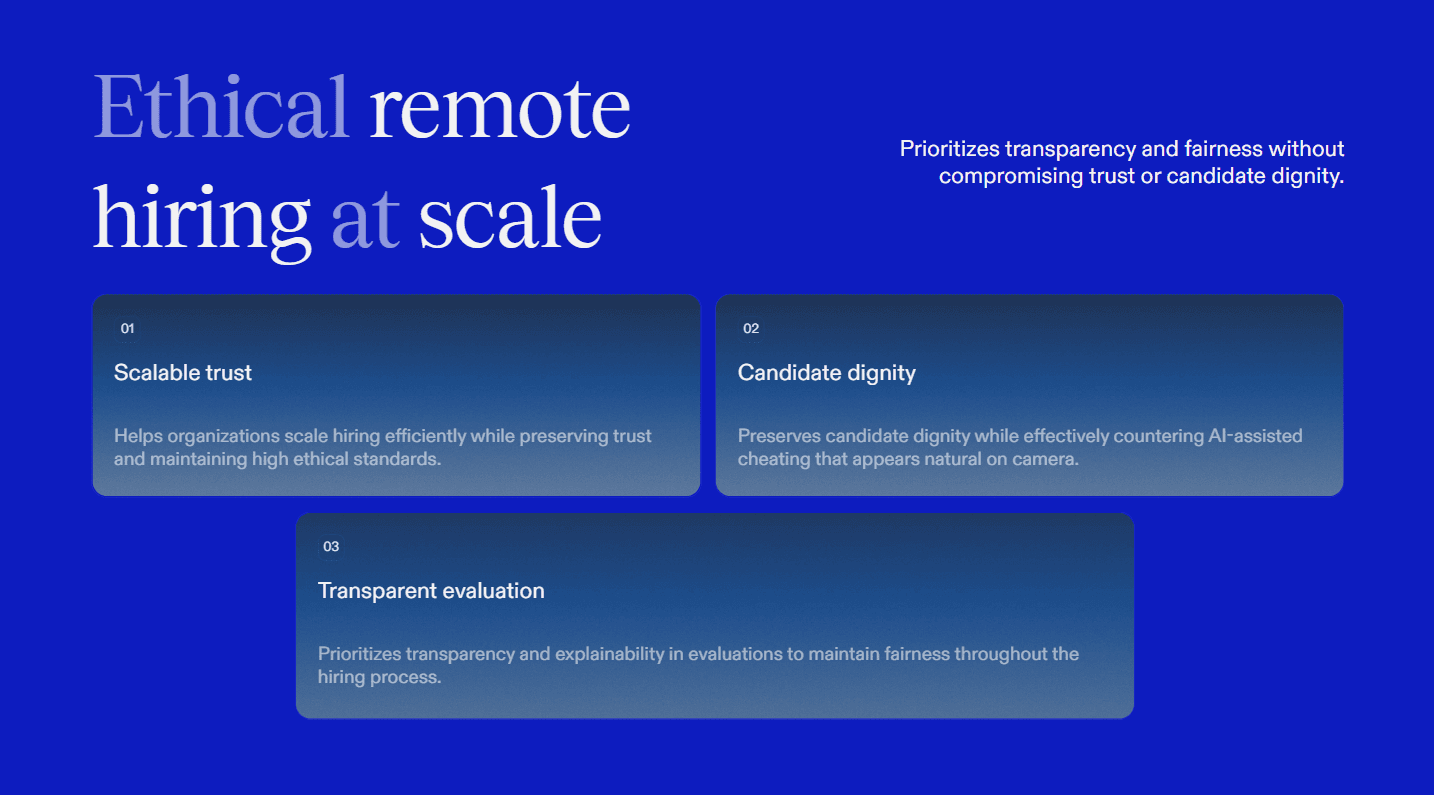
By prioritizing transparency, explainability, and bias-aware evaluation, Sherlock AI helps organizations scale remote hiring without compromising trust or candidate dignity. It is especially effective against modern AI-assisted cheating techniques that appear natural on camera.
Key Features
Detects AI-assisted and scripted interview responses
Analyzes reasoning flow and answer structure for authenticity
Identifies proxy interviews and impersonation across rounds
Compares behavioral and communication patterns over time
Flags sudden shifts in confidence, expertise, or response style
Detects usage of tools like Parakeet AI, Interview Coder, FinalRound AI, Cluely, and LockedIn AI
Provides explainable risk signals instead of opaque scores
Bias-aware evaluation designed for ethical hiring
Works across asynchronous and live interview formats
It detects the use of tools such as Parakeet AI, Interview Coder, FinalRound AI Interview Copilot, Cluely, and LockedIn AI during interviews.
2. InterviewGuard
InterviewGuard focuses on real time detection of interview manipulation during live sessions. It monitors for hidden AI tools, remote desktop usage, proxy participation, and deepfake indicators. The platform integrates with popular video interview tools and provides immediate alerts when suspicious behavior is detected.
This approach is particularly useful for live technical or high stakes interviews where real time intervention may be necessary.
Key Features
Real-time detection of hidden AI tools
Flags remote desktop and screen-sharing misuse
Identifies proxy participation and deepfake indicators
Integrates with popular video interview platforms
Instant alerts for suspicious behavior
Designed for live technical interviews
Minimal post-interview review dependency
Supports immediate interviewer action
3. ScreenInterview Proctoring
ScreenInterview Proctoring offers AI driven monitoring across video, audio, and environmental signals. It flags anomalies such as off screen attention, unexpected background changes, or inconsistent candidate behavior that may indicate external assistance.
The platform is often used for structured interviews where standardized monitoring and post interview review are required.
Key Features
Video and audio behavior analysis
Detects off-screen attention and eye-movement anomalies
Flags unexpected background or environment changes
Identifies inconsistent candidate behavior
Supports structured interview formats
Post-interview review and reporting
Scalable for standardized hiring programs
Automated anomaly flagging
4. Hyproctor
Hyproctor operates at the device level to detect hidden applications, unauthorized tools, and suspicious system behavior. Rather than focusing heavily on visual monitoring, it emphasizes system integrity and secure interview environments.
This makes it suitable for organizations concerned about covert AI tools or background applications assisting candidates during interviews.
Key Features
Detects hidden and unauthorized applications
Monitors system-level behavior during interviews
Identifies suspicious background processes
Prevents use of covert AI tools
Emphasizes system integrity over webcam monitoring
Secure interview environment enforcement
Lightweight visual intrusion
Ideal for technical assessments
5. Screentro.ai
Screentro.ai combines identity verification with interview monitoring to detect profile inconsistencies, location mismatches, and suspicious behavior patterns. It supports integration with applicant tracking systems, allowing organizations to centralize fraud detection across screening and interviews.
Its strength lies in linking interview behavior with broader candidate verification signals.
Key Features
Identity verification during interviews
Detects profile and document inconsistencies
Flags location and access mismatches
Behavioral pattern analysis
Integrates with applicant tracking systems (ATS)
Centralized fraud detection view
Cross-stage candidate risk insights
Scalable screening workflows
6. Talview
Talview provides enterprise grade interview proctoring with face recognition, voice authentication, and agentic AI based fraud detection. It is designed for large scale hiring programs and offers configurable compliance options for different regions.
Talview is often used by organizations with complex global hiring needs and strict compliance requirements.
Key Features
Face recognition and voice authentication
Agentic AI-based fraud detection
Configurable compliance controls by region
Scalable for high-volume hiring
Global deployment support
Detailed audit and compliance logs
Enterprise security standards
Multi-format interview support
7. Glider AI Proctoring
Glider AI Proctoring monitors candidate behavior across webcam, audio, and interaction signals to identify impersonation and suspicious activity. It generates detailed audit reports that help recruiters review interview integrity after the session.
This is useful for teams that prefer post interview analysis over real time alerts.
Key Features
Webcam and audio behavior monitoring
Detects impersonation attempts
Interaction and response pattern analysis
Detailed post-interview audit reports
No real-time intervention required
Recruiter-friendly review dashboards
Suitable for asynchronous interviews
Supports compliance documentation
Choosing the Right AI Tool for Interview Fraud Prevention
Not all interview fraud tools serve the same purpose. Some prioritize real time detection, while others focus on post interview analysis or system level monitoring. The most effective solutions combine multiple signals, provide explainable insights, and respect candidate privacy.
Tools like Sherlock AI stand out by shifting the focus from aggressive monitoring to behavioral authenticity. By understanding how candidates reason and interact rather than simply tracking what appears on screen, such platforms align better with modern, ethical hiring practices.
As AI assisted fraud becomes more sophisticated, organizations that rely on intelligent, transparent, and fairness focused proctoring tools will be best positioned to protect hiring integrity while continuing to scale remote recruitment confidently.
Conclusion
AI interview fraud is no longer limited to obvious cheating or rule breaking. With the rise of AI assisted answering tools, proxy participation, and identity manipulation, fraud can now occur in ways that are difficult to detect through traditional monitoring alone. As a result, organizations must rethink how they protect interview integrity in remote and global hiring environments.
AI driven interview proctoring tools play a critical role in addressing this challenge by analyzing behavior, identity consistency, and contextual signals across the interview lifecycle. However, not all tools approach the problem in the same way. The most effective solutions move beyond surface level monitoring and provide explainable insights that support fair, informed hiring decisions.
Tools like Sherlock AI demonstrate how interview fraud prevention can be both intelligent and ethical. By focusing on behavioral authenticity rather than intrusive surveillance, Sherlock AI helps hiring teams detect subtle manipulation, maintain candidate trust, and scale recruitment with confidence. As AI assisted fraud continues to evolve, adopting transparent and fairness focused proctoring solutions will be essential for building reliable and credible hiring processes.