Back to all blogs
Learn the key signs and signals of cheating in interviews, from behavioral red flags to technical warning signs, and how modern detection tools help protect hiring integrity.
Abhishek Kaushik
Jun 22, 2026

Cheating and misrepresentation in the hiring process have become major challenges for employers and candidates alike. A survey on 1,900 U.S.-based workers shows that about 80% admit to have lied during a job interview, often by embellishing skills, job responsibilities and previous job titles.
From the employer’s perspective, hiring teams also face serious concerns about candidate integrity. A large industry survey found that 59 percent of managers suspected candidates of misrepresenting themselves during hiring, and more than 60 percent of organizations have updated their hiring protocols in response to these risks.
These trends matter because deception during interviews and throughout the hiring process can lead to poor hiring decisions, lowered team performance, and increased costs for businesses. Understanding the common signs and signals of cheating helps hiring professionals protect the quality of their talent pipelines and make better decisions with confidence.
Common Forms of Interview Cheating Today
Modern interview cheating is often subtle and technology driven. Below are the most common ways it shows up in remote and hybrid interviews.
Real-time AI copilots: Candidates use browser based AI tools during the interview to generate answers, explanations, or code. In behavioral rounds, this leads to polished but generic responses. In technical interviews, AI can produce correct or near-correct solutions without real understanding.
Second-screen or secondary device assistance: Phones, tablets, or additional laptops are placed outside the camera frame. These devices are used to search for answers, consult notes, or message helpers while the interview is ongoing.
Scripted and prewritten answers: Candidates rely on AI generated or coached scripts prepared in advance. Responses sound fluent and confident but often fall apart when interviewers ask follow-up or experience-based questions.
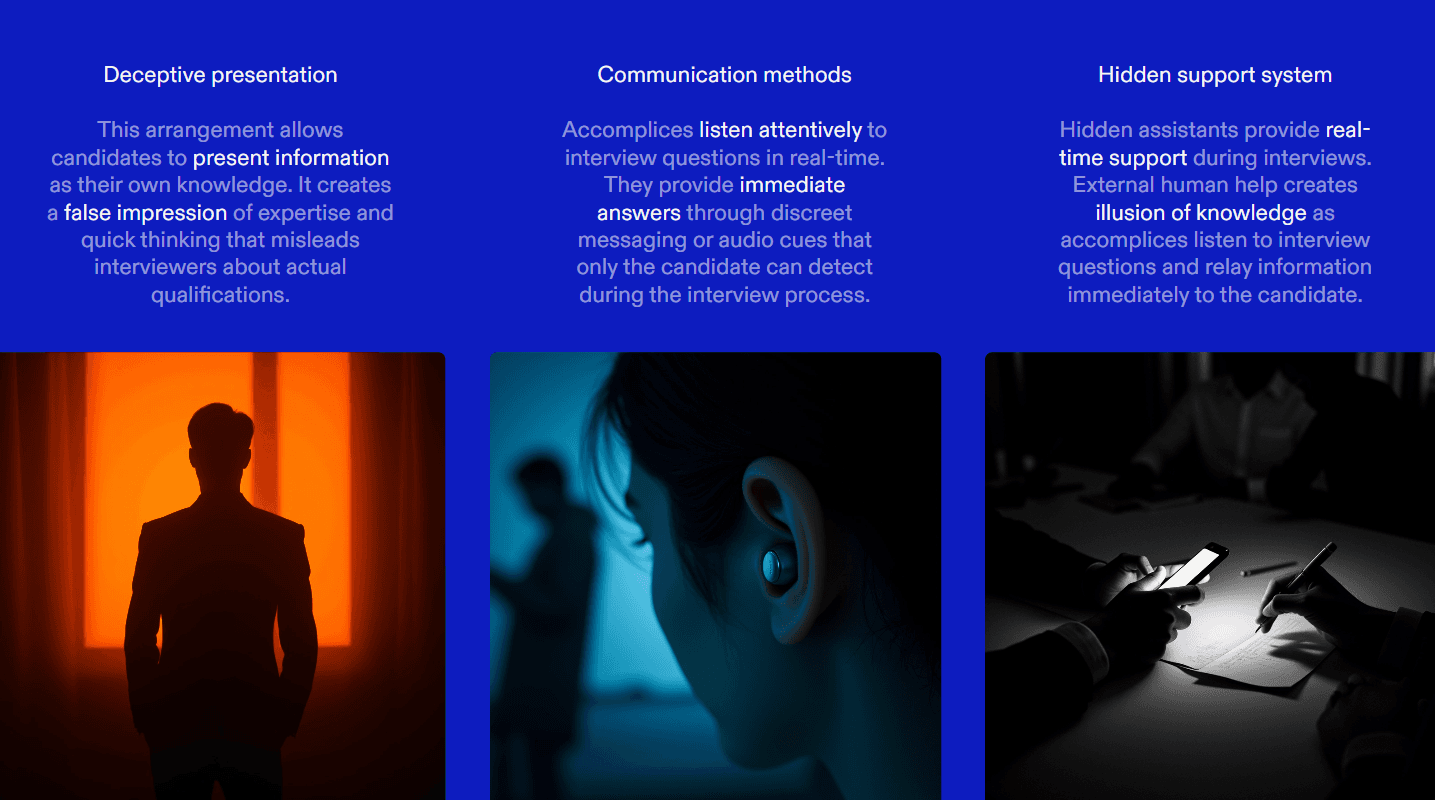
Impersonation or proxy interviewing: A more skilled individual appears for the interview instead of the actual candidate. This is more common in remote technical roles and may involve limited camera use or screen sharing to hide the switch.
Real-time external human assistance: Another person listens to the interview and provides live answers or hints through messaging apps or audio cues, allowing the candidate to respond as if the knowledge were their own.
Behavioral Red Flags During Live Interviews
Behavioral signals often provide the earliest indication that something is off. While no single sign proves cheating, consistent patterns during live interviews should prompt closer attention.
1. Delayed Responses to Simple Questions
Candidates take long pauses before answering straightforward or experience-based questions
Delays appear only after the question is asked, not during follow-ups or clarifications
Responses arrive suddenly and sound fully formed, suggesting external input rather than natural recall
Common in behavioral rounds where answers should come from personal experience
2. Unnatural Pauses and Broken Conversation Flow
Speech patterns feel interrupted or oddly timed
Pauses occur mid-sentence rather than between thoughts
Candidate appears to stop listening briefly, then resumes with a polished response
Often seen when candidates are reading, typing, or waiting for assistance
3. Eye Movement and Attention Shifts
Eyes repeatedly move away from the camera or screen in a consistent direction
Attention shifts align with moments when complex questions are asked
Candidate appears to read while speaking, with eyes scanning rather than engaging
These patterns differ from natural thinking or note referencing done before the interview
4. Overly Polished but Shallow Answers
Responses sound confident, structured, and fluent but lack concrete examples
Answers rely heavily on generic frameworks, buzzwords, or textbook explanations
When asked to explain decisions, trade-offs, or mistakes, the candidate struggles
This is common when answers are generated or heavily scripted
5. Inconsistent Explanations Under Follow-up
Initial answers sound strong, but details change when probed
Timelines, tools, or responsibilities shift between responses
Candidate repeats the same phrasing instead of adapting explanations
Inconsistencies often emerge when interviewers ask “how” or “why” questions
6. Sudden Drop in Performance During Deeper Questions
Candidate performs well on high-level questions but falters on practical or scenario-based ones
Coding, system design, or problem-solving quality drops sharply during live reasoning
Candidate struggles when asked to modify or extend their own answer
This contrast often reveals reliance on external help for the initial response
Behavioral red flags are most effective when viewed collectively rather than in isolation. When multiple signals appear across different stages of the interview, they provide valuable context for deeper evaluation and structured follow-up.
Technical and Environmental Warning Signs
Remote interviews introduce technical signals that are difficult to fake consistently. When observed carefully, these clues often reveal external assistance or rule violations that behavioral cues alone may miss.
1. Frequent Tab Switching and Window Changes
Audible or visible delays when questions are asked, followed by rapid, well-structured answers
Screen share interruptions or brief freezes that coincide with complex questions
Candidates asking for questions to be repeated more often when screen sharing is enabled
Performance improves noticeably when screen sharing is turned off
These patterns are common when candidates switch tabs to AI tools, search engines, or messaging apps.
2. Audio Inconsistencies During the Interview
Sudden microphone muting and unmuting without a clear reason
Changes in background noise at key moments, such as typing or whispering sounds
Audio delays that appear only during technical or reasoning-heavy questions
Voice volume or tone shifts after short pauses, suggesting reading or relaying information
Audio irregularities often indicate multitasking or communication with an external source.
3. Screen Reflections and Glasses Clues
Reflections in glasses showing changing screens or text movement
Light fluctuations on the face that align with screen changes
Eye focus shifting between multiple light sources during answers
While subtle, these signs become more noticeable when repeated throughout the interview.
4. Typing and Interaction Sounds During Verbal Rounds
Keyboard or phone tapping sounds while the candidate is expected to speak
Pauses that align with typing activity rather than thinking
Answers that appear immediately after sustained typing
This is especially suspicious in behavioral or conceptual rounds where typing should not be necessary.
5. Device Positioning and Camera Framing
Camera positioned unusually high, low, or off-center
Candidate rarely looks at the primary screen or camera
Head and body posture suggests engagement with something outside the visible frame
Frequent adjustments to keep certain areas out of view
These setups are often intentional to hide secondary devices or notes.
6. Suspicious Connectivity and Environment Behavior
Internet issues that occur only during difficult questions
Repeated claims of lag or disconnection when asked to explain reasoning live
Interview environment changes mid-session, such as sudden silence or background movement
While connectivity problems happen, selective timing can be a red flag when patterns repeat.
Technical and environmental warning signs are most effective when combined with behavioral observations. Together, they help interviewers distinguish between genuine technical issues and deliberate attempts to mask external assistance.
How Detection Tools Help Catch Cheating
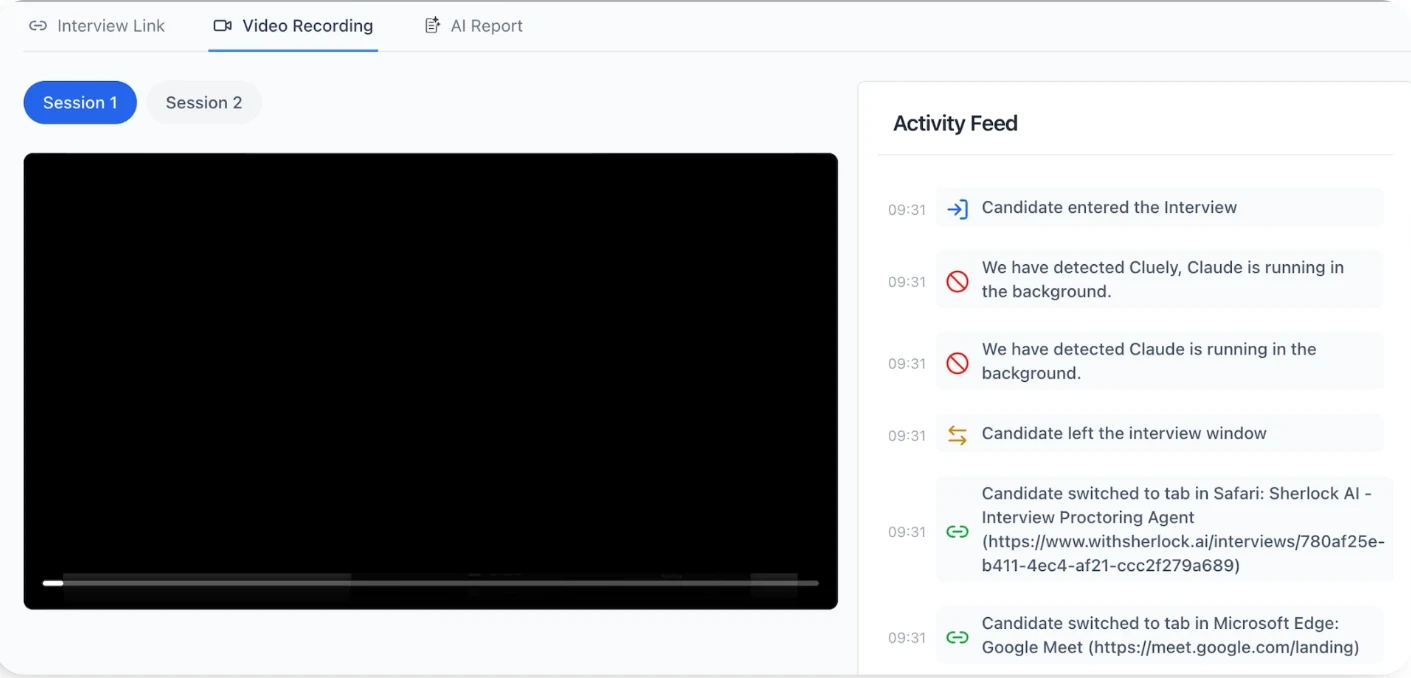
When hiring teams rely only on intuition to spot cheating in interviews, many sophisticated signals go unseen. Detection tools and automated monitoring help surface patterns and anomalies that human observers often miss, such as inconsistent timing, subtle off-screen activity, or behavioral irregularities. These systems do not replace interviewer judgment but augment it by flagging risk signals early and providing objective data to support fairer decisions.
Sherlock AI is one such solution that helps protect interview integrity in remote hiring contexts. It works alongside your existing process to watch for suspicious activity, provide insights, and reduce guesswork in judgment calls.
Benefits of using Sherlock AI
Real-time fraud detection: Flags potential AI-assisted responses or hidden assistance during live interviews so interviewers can focus on evaluation.
Seamless scheduling integration: Connects with Google, Apple, or Outlook calendars and generates secure meeting links automatically.
Behavior-aware monitoring: Combines device activity, audio cues, and behavioral signals to distinguish natural from adversarial patterns.
AI fluency observation: When AI use is allowed, Sherlock AI scores how candidates leverage tools instead of simply penalizing usage.
Automated notetaking and insights: Captures detailed interview notes and performance context without extra tools, saving interviewer time.
By integrating structured detection with human evaluation, platforms like Sherlock AI help organizations maintain trust and fairness while adapting to evolving interview challenges.
Conclusion
Cheating in interviews is no longer rare, obvious, or limited to a few bad actors. It has evolved alongside remote work and easily accessible technology, making traditional interview signals less reliable on their own. Behavioral cues, technical anomalies, and environmental patterns now play a critical role in understanding whether interview performance reflects real ability or external assistance.
Addressing this challenge does not require suspicion or heavy-handed policing. It requires clearer structure, better visibility, and tools that support interviewer judgment with objective signals. When hiring teams combine thoughtful interview design with modern detection methods, they protect both fairness and quality. The goal is to ensure that hiring decisions are based on genuine skills, honest experience, and true job readiness.