Back to all blogs
Explore how Sherlock AI protects your hiring process from interview fraud. Discover our advanced security protocols, voice & video-deepfake detection, and candidate integrity assurance.

Abhishek Kaushik
Nov 27, 2025
Sherlock AI is designed for organizations that need both interview integrity and data protection. The platform does not attempt to maximize data collection.
Instead, it limits scope to what is required to verify identity, evaluate reasoning continuity, and produce audit-ready interview notes. Every feature is built on a security model that prioritizes privacy, consent, and controlled access.
Core Security Principles
Principle | Description |
|---|---|
Data Minimization | Only collects information necessary for evaluation evidence, not behavior profiling |
Role-Based Access Control | Users see only what is relevant to their role in the hiring process |
Transparent Identity & Authorship Verification | Mechanisms designed to confirm real candidate thinking, not to trap or penalize |
Auditable Decision Trail | Hiring decisions must be reconstructable and defensible |
Candidate Fairness | No scoring based on accent, camera quality, or confidence theatrics |
Companies using Sherlock AI reported reduced internal disputes regarding interview decisions due to improved transparency in notes and scorecards.
Security Implementation Layers
1. Data Encryption
Encryption in transit (TLS 1.2+)
Encryption at rest (AES-256)
Segmented storage based on region and compliance requirements
2. Identity & Access
SSO support (Okta, Azure AD, OneLogin, Google Workspace)
SCIM provisioning for joiner-mover-leaver lifecycle
Admin controls for retention, record review, and privilege assignment
3. Audit Logging
Every access, export, note edit, score submit, and permission change is logged for compliance and investigation purposes.
4. Data Residency Options
Region-specific hosting to meet regulatory jurisdiction requirements
Candidate Transparency
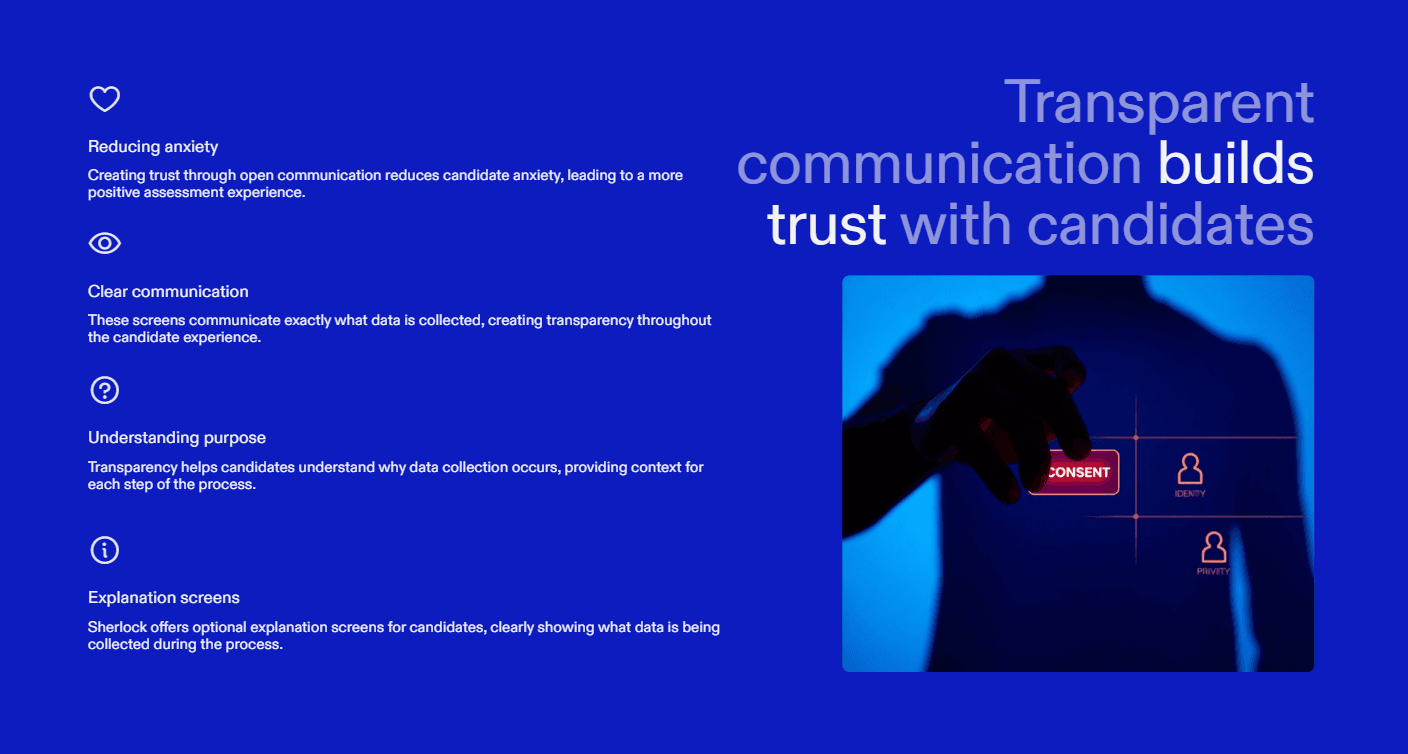
Sherlock AI provides optional candidate-facing explanation screens to ensure candidates understand what is collected and why.
This improves trust and reduces perception risk.
Vendor Comparison: Human vs AI Proctoring
Why Evaluation Has Shifted From Watching Behavior to Verifying Real Thinking
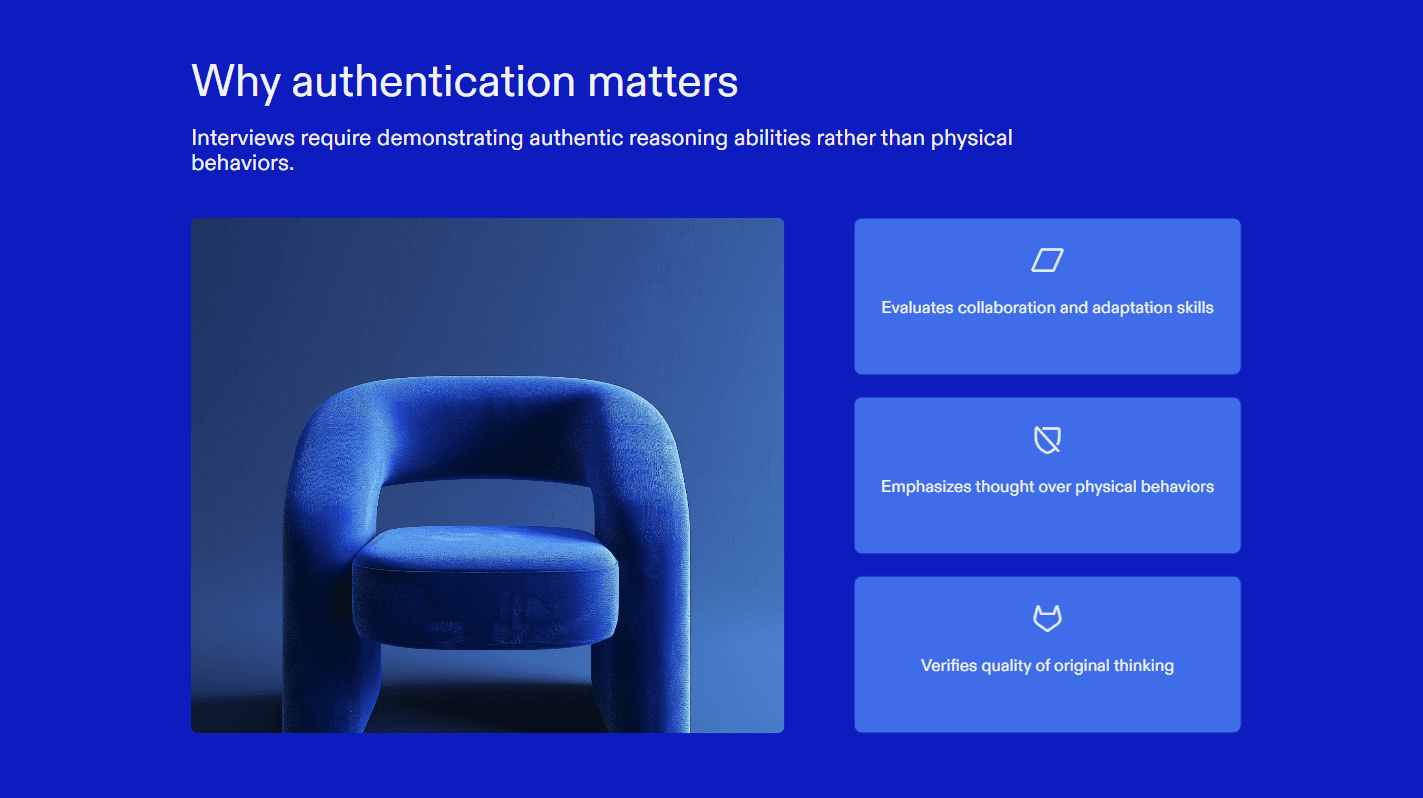
Human proctors were originally adopted to prevent visible cheating. But interviews are not exams. They require collaboration, reasoning, and adaptation. Watching someone’s camera feed cannot determine whether the thinking presented is authentic.
AI interview intelligence platforms replace surveillance with authorship validation and reasoning continuity analysis.
The Limits of Human Proctoring
Limitation | Impact |
|---|---|
Can only observe surface behavior | Misses hidden coaching or silent relays |
High fatigue and inconsistency | Risk of uneven enforcement and subjective judgments |
Cannot verify authorship of spoken reasoning | Allows proxies to present borrowed expertise |
Creates adversarial candidate experience | Reduces trust and signal quality |
Multiple enterprise teams reported that human proctors failed to detect a significant percentage of proxy interviews during remote hiring waves in 2023 to 2024.
What AI-Driven Interview Integrity Measures Instead
Evaluated Signal | What It Reveals |
|---|---|
Reasoning continuity | Whether the explanation belongs to the candidate |
Ability to re-explain | Detects rehearsed scripts vs actual understanding |
Fluency variation under follow-ups | Distinguishes live cognition from prewritten answers |
Concept translation ability | Strong marker of real expertise |
This moves the evaluation from watching to understanding.
Side-by-Side Comparison
Capability | Human Proctoring | AI Interview Intelligence (Example: Sherlock) |
|---|---|---|
Prevents visible cheating | Partial | Yes |
Detects proxy interviewers | Rare | Consistent through reasoning continuity checks |
Identifies AI-generated answers | No | Yes through fluency and conceptual re-anchoring patterns |
Produces structured notes | No | Yes (scorecards, summaries, evidence trails) |
Scales globally | Expensive and inconsistent | Platform based, uniform, repeatable |
Candidate experience | Often stressful and adversarial | Conversation-first, transparency-driven |
Key Mindset Shift
Human proctoring assumes deception must be watched for. Interview intelligence assumes real skill should be expressed, verified, and documented.
This makes the process both more fair and more rigorous.