Back to all blogs
Discover how AI-powered interview clips can replace traditional workshops, providing scalable, consistent, and effective interviewer training across teams.

Abhishek Kaushik
Dec 18, 2025
Most companies try to scale interviewer training through:
Workshops
Shadow interviews
Playbooks
“Calibrate as you go” guidance
These methods fail because:
They require synchronous time
They rely on experts being available
They degrade as people forget techniques
They cannot keep up with hiring volume
The scalable solution is:
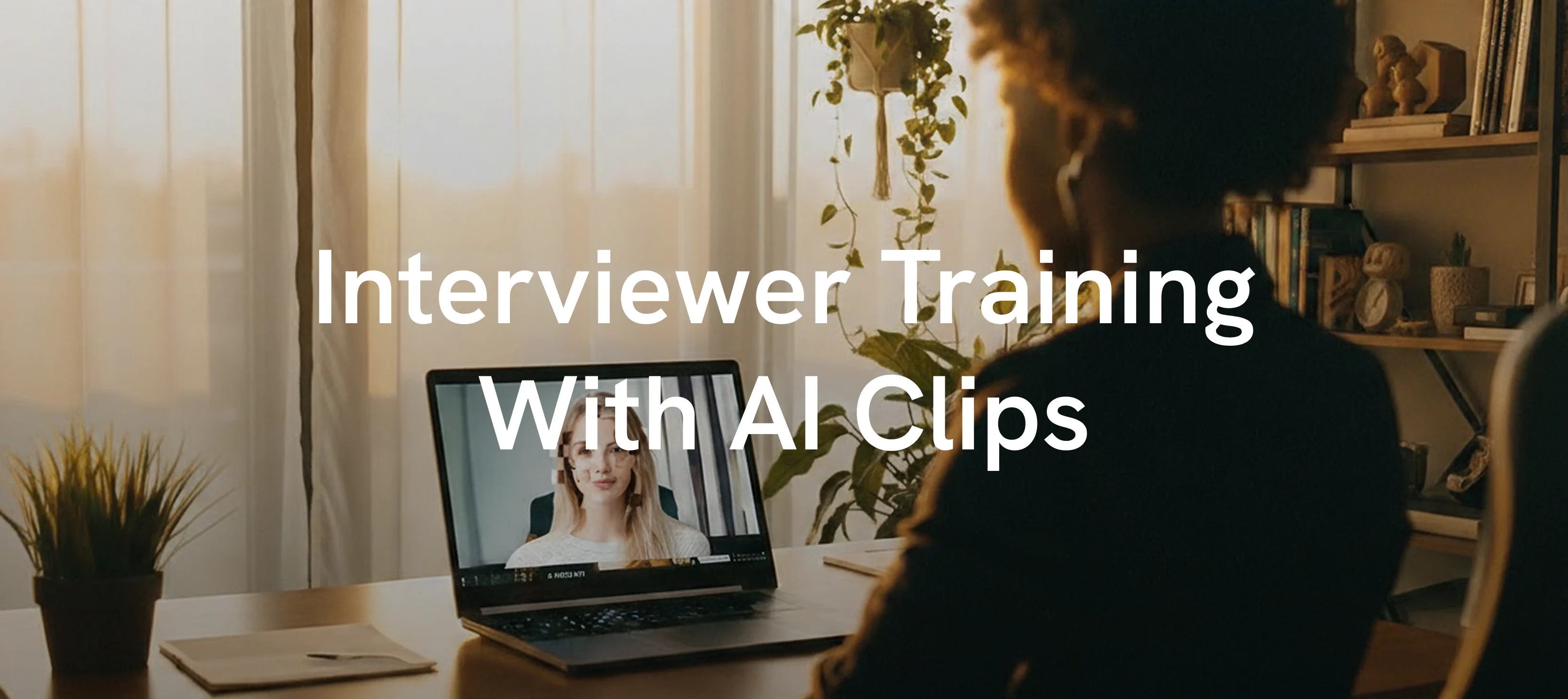
AI-powered interview clips that show real examples of good and bad probing, reasoning, and scoring patterns.
This shifts interviewer training from Lecture to Pattern recognition
The Problem: Traditional Interviewer Training Does Not Scale
A typical interviewer training workshop:
Is held once
Is forgotten by week three
Does not get reinforced during real interviews
Depends on who teaches it
And when teams change or grow:
New interviewers repeat old mistakes
Style variance increases
Hiring signal becomes inconsistent
TrainingFolks notes that more than 70% of training content is forgotten within days without ongoing reinforcement, a clear example of the forgetting curve in corporate learning.
This is a memory problem, not a capability problem.
The Shift: Train With Real Interview Clips, Not Instruction
AI-generated and privacy-safe interview snippets let interviewers learn:
How to ask follow-ups that reveal reasoning
How to avoid leading questions
How to detect coached or scripted answers
How to evaluate ownership vs participation
How to challenge assumptions gently
People learn faster from examples than from rules.
What AI Clips Actually Look Like
These are 8 to 40-second annotated segments from real interviews (internal or training libraries).
Example Clip Types
Clip Type | What It Teaches |
|---|---|
Follow-up probing moment | How to get past rehearsed answers |
Ownership validation moment | How to separate “we” from “I” |
Adaptation test moment | How to test real experience vs memorized steps |
Red flag explanation | How to spot AI-coached or proxy behavior |
Scorecard alignment moment | How to label evidence correctly |
No theory. Just recognizable patterns.
How To Implement AI Clip-Based Training
Step 1: Capture Interviews (With Consent + Policy)
Your interview platform or note-taking tool should:
Record the call
Segment conversation by topic
Tag reasoning moments
Step 2: The AI System Auto-Identifies “Signal Moments”
Examples:
Decision-making explanations
Constraint adaptation
Tradeoff reasoning
Step 3: Curate Clips into “Pattern Libraries”
Organize by role:
Backend reasoning clips
Data modeling reasoning clips
Leadership conflict negotiation clips
Step 4: Share Clips Inside Slack or Notion
Example:
“This is how to redirect when the answer sounds memorized.”
Step 5: Require New Interviewers to Tag and Label Clips
This builds pattern recognition habits.
A 2025 study published in Frontiers in Education found that structured pattern‑recognition training in AI education leads to deeper, transferable learning and improved problem‑solving skills. The study emphasizes that hands‑on, real‑world pattern recognition is crucial for building adaptive AI systems and professional competencies.
Why This Works Better Than Workshops
Workshops | AI Clip Training |
|---|---|
One-time event | Continuous reinforcement |
Instructor dependent | Systematic and consistent |
Passive learning | Active pattern recognition |
Hard to scale across regions | Instantly global |
Memory fades after 2 weeks | Durable learning through repetition |
Humans learn how to judge by comparing patterns, not by memorizing rules.
Example Micro-Learning Workflow (10 Minutes Per Week)
Total time: 10 minutes
Total training: Continuous
Total consistency: High
Interviewer confidence increases because they:
Know precisely what to listen for
Know how to document consistently
Know how to handle ambiguous cases
Cultural Impact
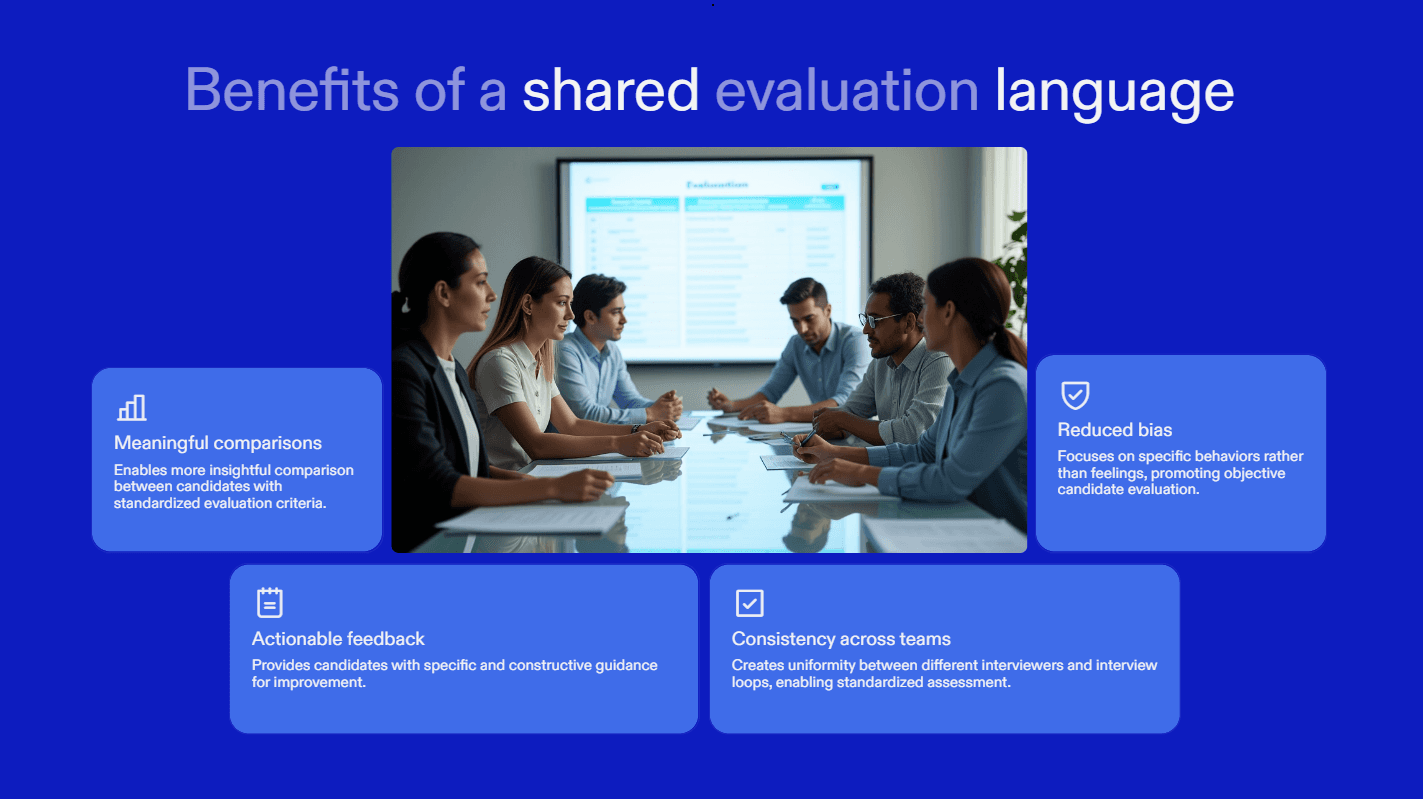
Teams start to speak a shared language:
Instead of:
“I liked them”
They say:
“They demonstrated tradeoff reasoning when constraints shifted”
Instead of:
“Strong communicator”
They say:
“Clear problem decomposition and stepwise reasoning”
This is how interview cultures mature from opinion-based to signal-based.
Conclusion
Scaling interviewer quality does not require:
More hours
More slides
More workshops
It requires:
Real examples
Pattern recognition
Repeated exposure to correct interviewing moves
AI clips turn interviewing from:
A craft held by a few senior interviewers into a skill that is repeatable across the entire hiring team.
This is how companies build high-consistency, low-bias, high-signal interview systems globally.