Back to all blogs
Ask this simple question in interviews to spot AI-coached answers and verify real experience. Learn how to detect fraud and improve hiring accuracy.

Abhishek Kaushik
Dec 26, 2025
AI-coached answers sound fluent, polished, and structured.
But they collapse the moment you ask this one question:
“What changed?”

This question instantly reveals whether the candidate:
Has real, lived experience
Or is reciting an answer generated by ChatGPT or a coaching service
Because real experience contains adaptation, not just information.
Why AI-Coached Answers Sound Convincing
Modern AI can generate:
Perfectly structured frameworks
Confident tone
Clean bullet points
Process sequences that sound senior
But it cannot generate lived adaptation because:
Real-world work contains inconsistencies
Decisions evolve with constraints
Priorities shift mid-project
Tradeoffs are imperfect and contextual
As highlighted in Artificial Intelligence and the limits of reason (2025), AI reasoning is ultimately statistical pattern-matching. It cannot step outside its training data to handle real-world unpredictability or novel edge cases.
AI answers are straight lines.
Real experience is messy.
The Question That Breaks the Script
After the candidate gives a polished answer, say:
Thank you. What changed?
Then pause.
Let silence do the work.
Why This Works
Real contributors can describe:
Shifts in requirements
Mistakes they corrected
Blockers they handled
Surprises that forced adaptation
Tradeoffs that were not obvious upfront
AI-sourced answers cannot.
Because the AI is describing:
A textbook solution
Not an actual event
How to Use the Question in Different Interview Types
For Behavioral Interviews
Candidate says:
I led the migration to microservices.
Ask:
Thank you. What changed during the migration that required you to adjust your approach?
If they cannot describe:
New constraints
Resource shifts
Performance surprises
They likely did not lead it.
For System Design
The candidate explains a scaling architecture.
Ask:
Great. At what point did your initial design assumptions stop being true?
These tests:
Real-world constraint handling
Production incident awareness
Contextual reasoning
No AI tutorial includes this.
For Coding Interviews
The candidate produced the correct code, but it seems rehearsed.
Ask:
If the input size increased by 100 times, what is the first thing you would need to rethink?
A real developer will:
Think aloud
Describe complexity tradeoffs
Adjust algorithmic choices
AI-coached responses stall or loop.
The Signal to Look For
The candidate should be able to:
Indicator | Meaning |
|---|---|
Specificity | Shows memory, not script |
Conflicts or mistakes acknowledged | Shows lived experience |
Time-based sequencing | Reflects real involvement |
Can adapt the answer when probed | Shows cognitive ownership |
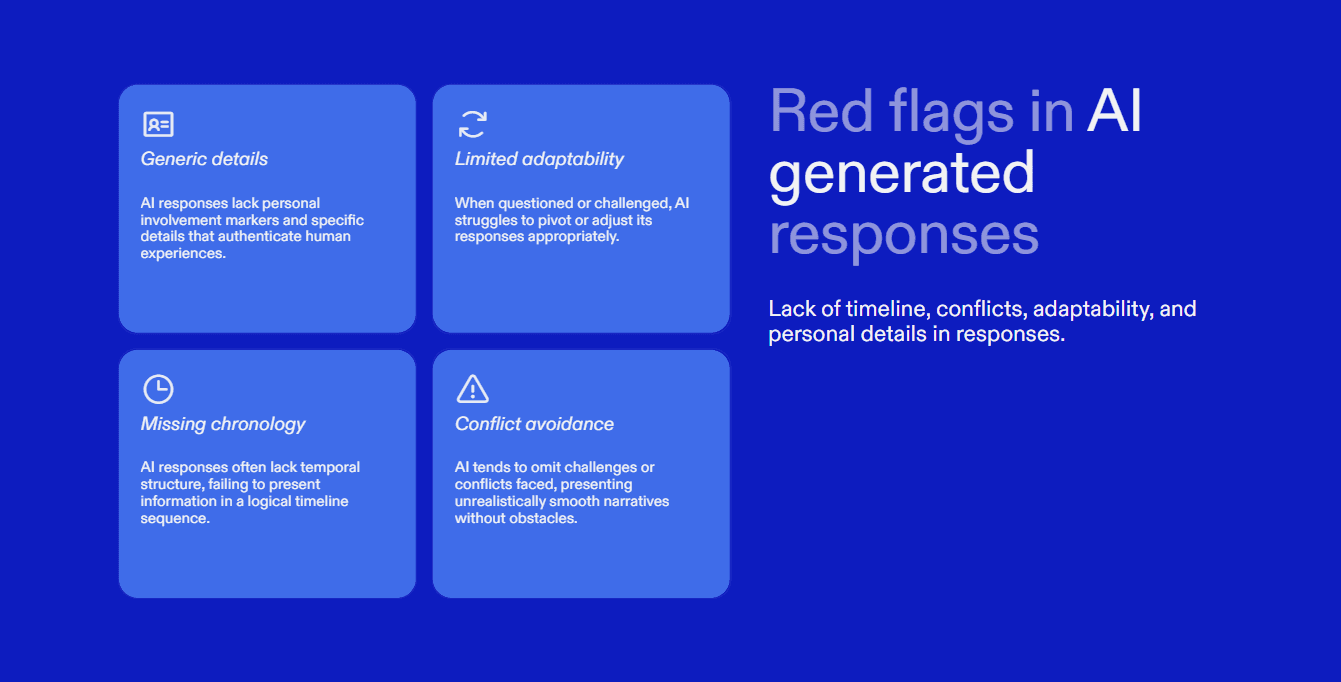
AI answers show:
No timeline
No conflict
No pivot
No personal involvement markers
The Follow-Up Ladder (If Needed)
If they stall, go here:
What was the hardest tradeoff?
If still scripted:
Who pushed back on your approach?
If still generic:
What did you change after seeing the outcome?
Three questions.
AI fails on all three.
The Documentation Template (Audit Safe)
No accusation.
Just signal.
Conclusion
You do not need:
Gotcha questions
Trick puzzles
Aggressive interrogation
You only need:
What changed?
Because real experience changes.
Scripts do not.
AI does not.
Proxies do not.
This technique:
Detects fraud fairly
Reduces bias risk
Improves hiring accuracy
Works in any industry or role level
It is a simple question with strategic impact.