Back to all blogs
Discover the pros and cons of using AI in interviews and how to strike the right balance between efficiency and fair evaluation.

Abhishek Kaushik
Dec 2, 2025
TL;DR
AI-assisted interviewing can:
Make interview notes objective
Improve fairness
Reduce interviewer fatigue
Create better decision documentation
But it can also:
Mask shallow reasoning
Reward memorized or AI-generated answers
Enable fraud and proxy behavior in remote interviews
The goal is not to replace interviewers.
The goal is to support interviewers while protecting signal integrity.
The Pros
1. More Consistent Evaluation
AI can ensure interviewers ask:
The same core questions
In the same structured order
With the same follow-up criteria
This reduces:
Personality bias
Accent bias
Confidence bias
Real World Example
A global engineering team found that after switching to structured AI-scaffolded interviews:
Variance in interviewer scoring dropped
Calibration meetings became shorter
Hiring decisions became faster and more defensible
2. Better Notes and Documentation
AI note-takers capture:
Candidate answers verbatim
Key decision points
How the candidate reasons through problems
This helps:
Panel debriefs
Audit reviews
Candidate reconsideration requests
Without AI
Notes often look like:
With AI
Notes look like:
This is actual evaluation.
3. Reduced Interviewer Fatigue
Interviewers can focus on:
Listening for reasoning
Asking the right follow-ups
instead of:
Typing
Remembering prompts
Managing a call while evaluating
This improves interviewer performance quality.
Real World Example
A SaaS company reduced one interviewer rotation per day and lowered burnout in technical hiring pods.
The Cons
1. AI Can Mask Shallow Understanding
If a candidate uses AI to:
Generate answers
Follow scripts
Rehearse system design patterns
They may appear strong while lacking real skill.
Real World Example
A fintech hired five engineers who aced interviews using AI for rehearsed system design answers.
Within 60 days:
One could not debug staging crashes
Two could not modify their own code
Two required coaching on basic architecture reasoning
This cost money, time, and team trust.
Sherlock detects this using reasoning adaptability checks.
2. Risk of Proxy or Fraudulent Participation
Remote interviews make it easier for:
Another person to answer for the candidate
AI to whisper live solutions
Deepfake voice or face to spoof identity
Real World Example
A BPO team discovered 12 percent of offshore candidates were receiving live coaching via a second device during interviews.
Sherlock flags:
Voice identity mismatch
Facial continuity breaks
Background conversation patterns
3. Over-Reliance on Confidence and Fluency
AI can help candidates:
Speak smoothly
Structure narratives
Use professional language
But fluency is not competence.
Signal Correction
Ask a constraint shift question:
If input size doubles, what changes in your solution?
Authentic engineers adapt.
AI-fed narratives collapse.
How to Use AI Correctly in Interviews
Use AI For | Do Not Use AI For |
|---|---|
Note-taking | Generating candidate answers |
Timing & pacing guidance | Replacing human evaluation |
Ensuring consistent structure | Allowing scripted responses |
Post-interview summaries | Passing candidates who cannot reason |
AI should support evaluation, not substitute for it.
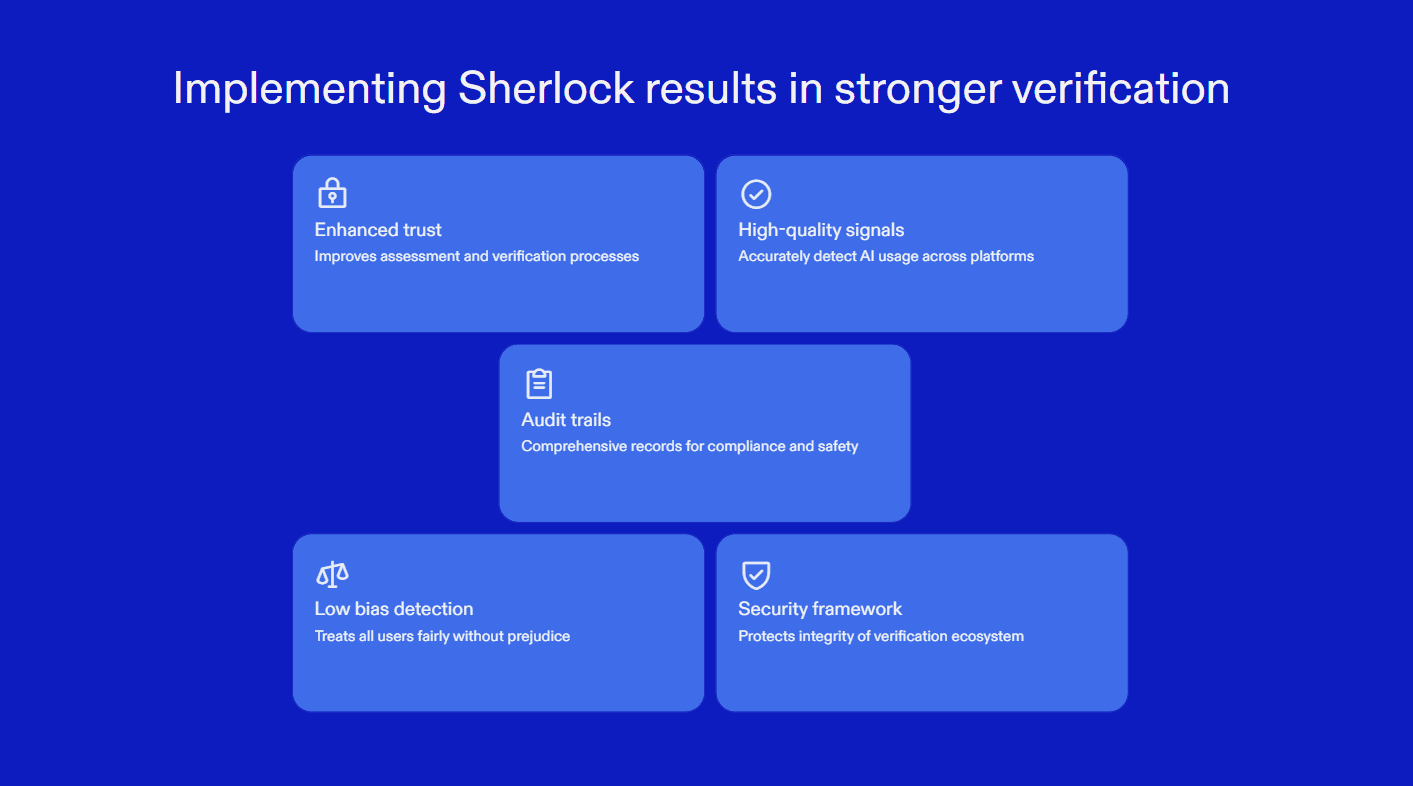
How Sherlock AI Fits
Sherlock AI provides:
Real-time identity confidence
Reasoning authenticity signals
Code authorship verification
Coaching and whisper detection
This allows companies to:
Allow fair AI use (for planning and clarity)
Prevent unfair or fraudulent AI use (for answer substitution)
The result:
High signal
Low bias
High trust
Audit safety
Conclusion
AI-assisted interviewing is not inherently good or bad.
It is powerful.
If used without guardrails, it can break hiring.
If used carefully, it improves:
Fairness
Accuracy
Candidate experience
Hiring manager confidence
The key is:
Evaluate reasoning, not output.
Verify identity, not confidence.
AI helps with both, when configured correctly.