Back to all blogs
Learn how to prevent interview fraud in 2026. Explore common fraud types, real risks, detection strategies, and how Sherlock AI helps protect hiring integrity.
Abhishek Kaushik
Jun 22, 2026
Interview fraud has escalated from a niche concern to a major threat for employers worldwide. What used to be isolated cases of resume embellishment has evolved into sophisticated tactics powered by artificial intelligence, deepfake technology, and identity manipulation.
In 2025, surveys showed that 72% of recruiters reported encountering AI-generated fake resumes, portfolios, or credentials during the hiring process. Nearly 15% of hiring professionals have seen face-swapping or voice-cloning deepfakes used in video interviews meaning virtual screening no longer guarantees authenticity.
In this landscape of rising deception, Sherlock AI equips employers with next-generation interview fraud detection tools, enabling real-time analysis, behavioral pattern detection, identity verification, and AI-driven anomaly alerts that help hiring teams stay ahead of sophisticated fraud tactics.
What Is Interview Fraud?
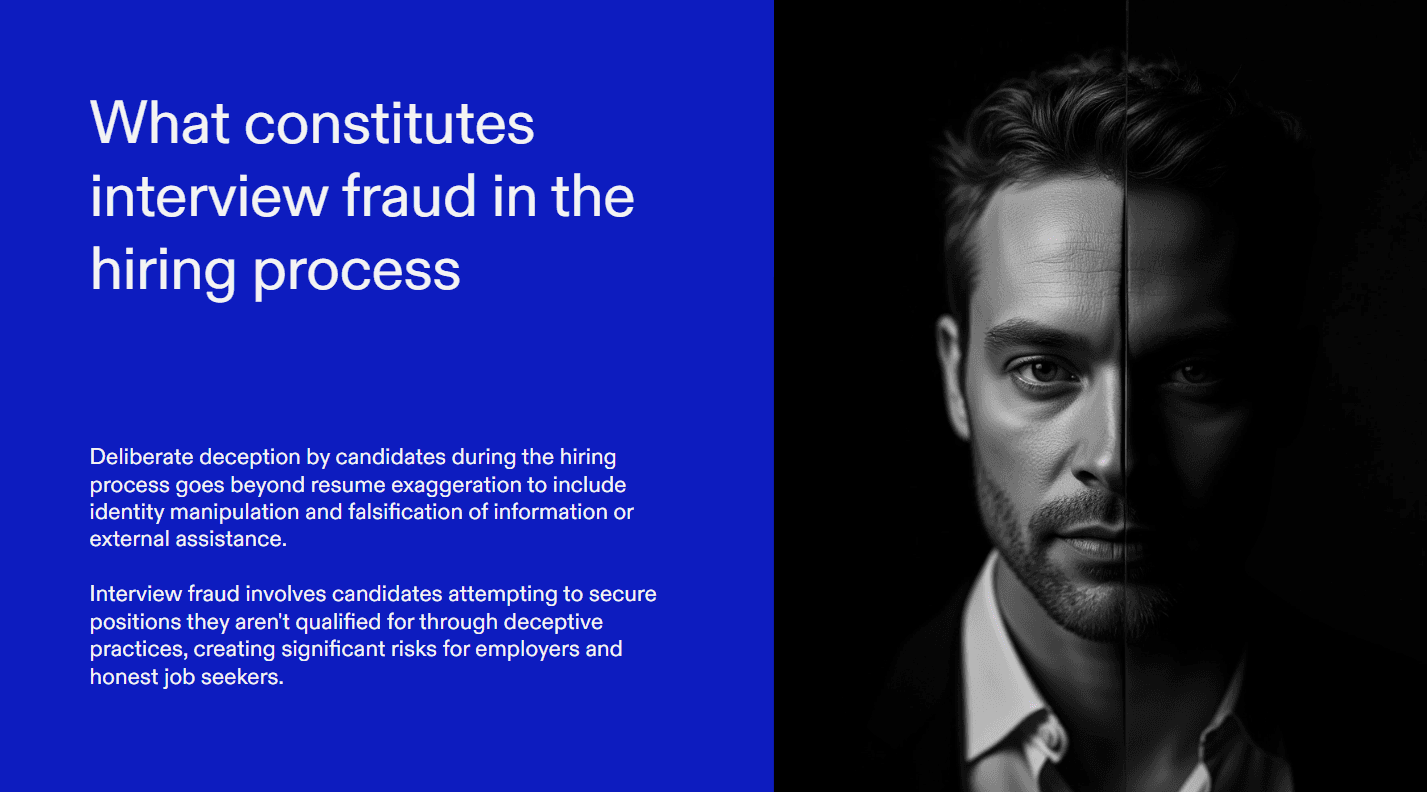
Interview fraud refers to any deliberate attempt by a candidate to deceive an employer during the hiring process in order to secure a job they may not be qualified for or entitled to. Unlike simple resume exaggeration, interview fraud involves intentional identity manipulation, falsified information, or external assistance that compromises the integrity of hiring decisions.
With the rise of remote hiring and AI-powered tools, interview fraud has become more sophisticated, harder to detect, and far more damaging to organizations. It can occur at any stage of the hiring process, from application screening to live interviews and even post-offer verification.
Common Forms of Interview Fraud
A different individual attends the interview instead of the real applicant, usually for technical or senior roles where skills are hard to assess quickly.
Impersonation is especially common in remote video interviews, where physical identity checks are limited or absent.
Candidates submit fake resumes that include fabricated job titles, exaggerated responsibilities, or employment gaps that are carefully disguised.
Fake academic degrees, certifications, or professional licenses are presented to appear qualified for regulated or high-paying roles.
Deepfake video or audio technology is used to manipulate faces and voices in real time, making synthetic identities appear authentic.
AI tools generate instant interview answers during live calls, producing polished responses without real experience behind them.
Third-party experts or coaching services discreetly assist candidates during interviews by feeding answers or guidance.
Proxy candidates are hired to clear interviews on behalf of others, leading to sharp performance drops and trust issues after hiring.
The Rise of Interview Fraud
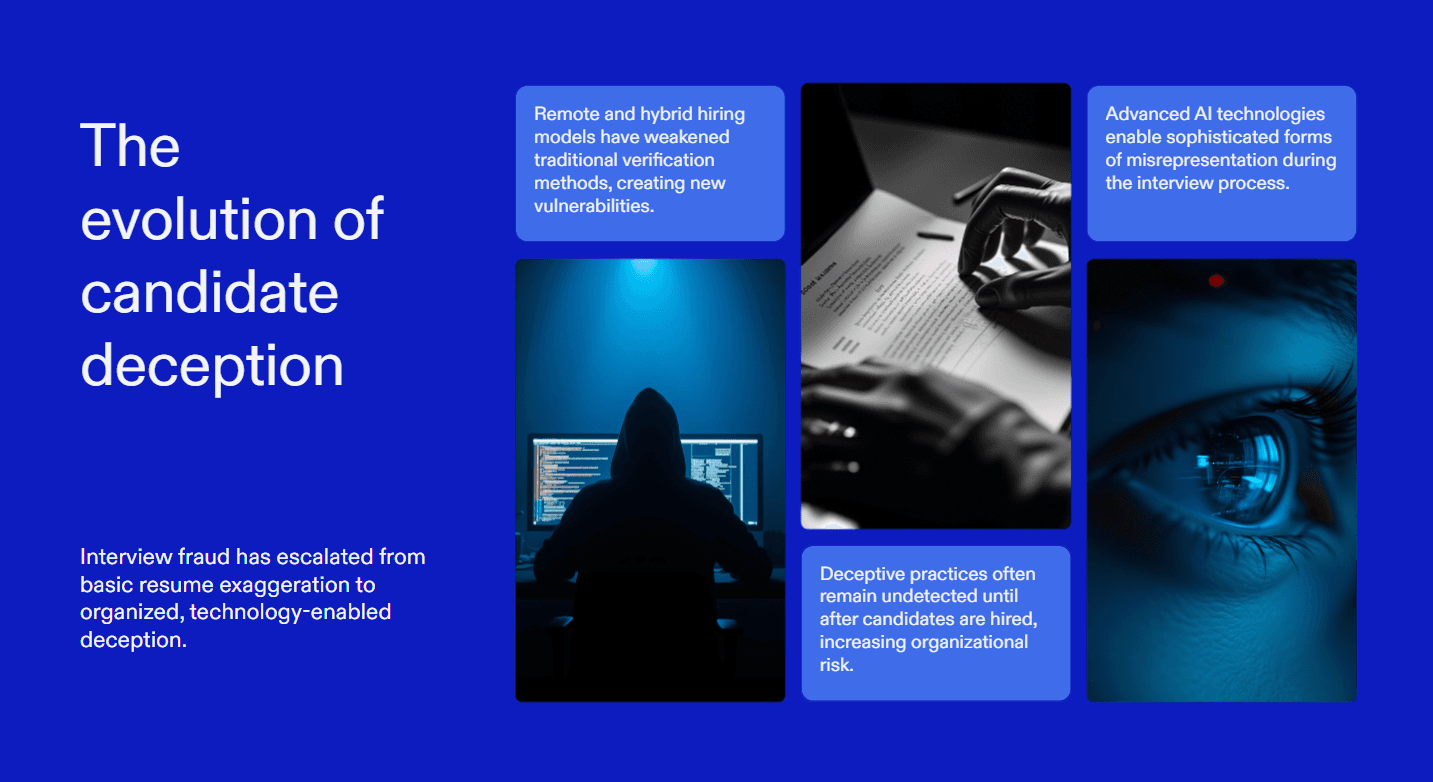
Interview fraud is rapidly becoming one of the most serious challenges in modern hiring. As organizations increasingly adopt remote and hybrid hiring models, traditional safeguards such as in-person identity verification, controlled interview environments, and manual reference checks are weakening. At the same time, advanced AI tools and global job marketplaces have made it easier than ever for candidates to misrepresent themselves.
What was once limited to resume exaggeration has evolved into organized, technology-driven interview fraud. In many cases, employers only discover the deception after onboarding, when performance gaps, security risks, or compliance issues begin to surface.
Key Drivers Behind the Rise of Interview Fraud
1. Shift to Remote and Virtual Hiring
Remote interviews reduce the ability to verify who is actually attending the interview.
Why this matters:
No physical ID verification
Limited visibility into the candidate’s environment
Easier to substitute or assist candidates without detection
Example:
A candidate attends a virtual interview with the camera on but avoids sudden movements and screen sharing. After joining, their technical ability does not match interview performance, revealing that a proxy candidate was used.
2. Easy Access to AI Tools
AI has dramatically lowered the effort required to cheat during interviews.
How AI enables fraud:
Real-time AI-generated answers to interview questions
Tools that structure responses using proven frameworks
Voice and video manipulation to match identity details
Example:
A candidate delivers perfectly structured answers but struggles to explain how they applied those skills in real projects. Follow-up questions expose a lack of hands-on experience.
3. High Competition in the Job Market
Economic uncertainty and intense competition push some candidates toward unethical shortcuts.
Common behaviors include:
Outsourcing interviews to experts
Inflating or fabricating experience
Using third-party assistance during live interviews
Example:
A junior candidate claims senior-level experience but cannot complete basic tasks during the probation period.
4. Global Talent and Verification Gaps
Hiring across borders increases complexity in verifying credentials and references.
Challenges include:
Inconsistent education and employment records
Limited access to reliable verification sources
Time-zone and location inconsistencies
Example:
A candidate lists experience at overseas companies that are difficult to verify, delaying fraud detection until after hiring.
How Interview Fraud Actually Works
Interview fraud is not random or accidental. It follows repeatable patterns that exploit gaps in modern hiring processes. Fraudsters understand how interviews are conducted, what recruiters prioritize, and where verification is weak. Below are the most common methods used today, explained clearly and practically.
1. Deepfake Technology
Fraudsters use AI tools to create synthetic video or audio that imitates a real person. During an interview, the recruiter sees and hears what appears to be a legitimate candidate, while the real individual is either assisted off-screen or not present at all.
Why it works
Video interviews are generally trusted as proof of identity
Most interviewers are not trained to recognize deepfake indicators
Interview platforms are not built to detect manipulated video or audio
Example
A candidate keeps their camera perfectly still and avoids turning their head. When asked to briefly adjust lighting or show identification on camera, they refuse or delay. This behavior often indicates deepfake usage.
2. Proxy Candidates
A skilled individual attends interviews on behalf of the actual applicant. This proxy may be hired specifically to pass technical or behavioral interviews.
Why it works
Technical interviews often follow predictable patterns
Interviewers focus on answers rather than identity verification
Remote interviews make substitution easy
Example
A candidate performs exceptionally well in coding interviews but struggles with basic tasks during their first week on the job. Investigation reveals a proxy cleared the interview rounds.
3. AI-Generated Responses
Candidates use AI tools that listen to interview questions and generate real-time responses, which the candidate reads or paraphrases.
Why it works
Responses sound fluent and structured
Answers use industry terminology and frameworks
Interviewers may confuse polish with expertise
Example
A candidate gives a perfect explanation of a leadership framework but cannot explain how they handled conflict in a real team situation. This gap suggests AI-generated assistance.
4. Document Falsification
Candidates submit fake or altered documents, including degrees, certifications, experience letters, or reference details.
Why it works
Manual verification takes time
Employers may skip checks to speed up hiring
Global verification processes vary by region
Example
A candidate claims experience at a company that no longer exists, making verification difficult until inconsistencies appear after hiring.
5. Identity Theft
Fraudsters steal real professional identities and use them during the hiring process. This often includes copying resumes, certifications, and online profiles.
Why it works
Professional profiles and resumes are publicly available
Many hiring processes lack strong identity verification
Stolen identities often appear credible
Example
An employer hires a candidate with a strong online presence, only to later discover that the real professional had no knowledge of the application.
Industries at Greatest Risk
Certain industries face a higher risk of interview fraud due to skill shortages, remote hiring, and access to sensitive systems.
1. Technology Sector
High demand for skilled engineers and developers
Heavy reliance on remote and technical interviews
Predictable interview formats make proxy use easier
Example:
A candidate performs well in coding interviews but fails basic tasks after joining, indicating interview substitution.
2. Critical Infrastructure
Includes finance, healthcare systems, and regulated industries
Access to sensitive data and critical systems
High compliance and security exposure
Example:
A fraudulent hire gains system access, triggering audits and compliance reviews.
3. Remote-First Companies
Minimal physical identity verification
Fully virtual interviews and onboarding
Distributed hiring teams
Example:
A candidate clears interviews remotely but avoids live video interactions after hiring.
The Real Cost of Interview Fraud
Interview fraud is often underestimated because its impact is not always immediate or visible. What may appear as a simple hiring mistake can quickly turn into a significant financial, operational, and reputational burden for an organization. Beyond the direct cost of recruiting and onboarding, interview fraud affects productivity, team morale, data security, and long-term trust in hiring decisions.
As hiring becomes more remote and fraud tactics grow more sophisticated, the true cost of interview fraud continues to rise. Organizations that fail to prioritize interview fraud prevention risk paying far more than the price of a single bad hire.
Impact Area | Type of Cost | Explanation | Example |
|---|---|---|---|
Direct Financial Losses | Recruiting and onboarding costs | Time and money spent on sourcing, interviewing, and onboarding candidates who turn out to be fraudulent | A company must restart hiring after terminating a fraudulent hire |
Salary and benefits loss | Wages, benefits, and bonuses paid to unqualified employees | Months of salary paid before fraud is detected | |
Project delays | Fraudulent hires slow down or derail projects | Product launch delayed due to underperformance | |
Hidden Organizational Damage | Team morale issues | Teams lose motivation when working with unqualified hires | High performers frustrated by poor collaboration |
Loss of trust in hiring | Hiring credibility and confidence decline internally | Managers question recruitment decisions | |
Brand and compliance risk | Exposure to legal, regulatory, and reputational damage | Compliance reviews triggered after fraudulent access |
Advanced Detection Technologies for Preventing Interview Fraud
As interview fraud becomes more sophisticated, organizations need detection technologies that go beyond surface-level checks. Sherlock AI is built specifically to address modern interview fraud by combining intelligence, behavioral analysis, and real-time verification into a single solution.
1. Behavioral Intelligence and Response Authenticity
Sherlock AI analyzes how candidates respond during interviews, not just what they say.
Key capabilities:
Detects scripted or AI-generated response patterns
Identifies inconsistencies across interview stages
Flags abnormal pacing, repetition, and unnatural phrasing
Why it matters:
Fraudulent candidates often deliver polished answers without real-world depth. Sherlock AI highlights these patterns early, before they turn into bad hires.
2. Identity Consistency Verification
Sherlock AI helps ensure the same individual appears throughout the hiring process.
Key capabilities:
Tracks identity consistency across multiple interviews
Identifies potential impersonation or proxy substitution
Flags identity anomalies without disrupting interviews
Why it matters:
Proxy interviews and identity substitution are common in remote hiring. Sherlock AI helps recruiters detect these risks before onboarding.
3. Real-Time Interview Risk Signals
Sherlock AI monitors interviews as they happen and surfaces risk indicators instantly.
Key capabilities:
Flags unusual pauses, delayed responses, and suspicious behavior
Detects patterns associated with external assistance
Provides actionable alerts during or immediately after interviews
Why it matters:
Real-time visibility allows hiring teams to take action while the candidate is still in the process, saving time and cost.
4. Low False Positives, High Candidate Trust
Sherlock AI is designed to balance security with candidate experience.
Key capabilities:
Focuses on behavioral signals rather than intrusive checks
Reduces unnecessary rejections
Maintains a fair and respectful hiring process
Why it matters:
Effective interview fraud prevention should protect hiring integrity without alienating genuine candidates.
By combining behavioral intelligence, identity consistency, and real-time risk detection, Sherlock AI delivers a modern and reliable approach to interview fraud prevention, helping organizations hire with confidence in 2026 and beyond.
Best Practices for Interview Fraud Prevention
Preventing interview fraud requires a structured, proactive approach that combines process discipline with intelligent technology. Organizations that rely on a single check or manual review often miss sophisticated fraud attempts. The following best practices help build a stronger and more resilient hiring framework.
Multi-Stage Verification
Conduct identity checks at multiple hiring stages to prevent impersonation or proxy interviews.
Example: A candidate clears screening but fails identity consistency checks before the final round.Advanced Reference Checking
Validate role responsibilities and performance, not just employment dates.
Example: Reference feedback does not match the candidate’s claimed seniority.Interview Process Enhancement
Use scenario-based and follow-up questions to assess real experience.
Example: A candidate struggles to explain real-world challenges despite polished answers.Technology Integration
Use tools like Sherlock AI to detect suspicious behavior in real time.
Example: AI flags unusual response patterns during a live interview.Recruiter and Interviewer Training
Train teams to recognize modern fraud tactics and red flags.
Example: Interviewers identify proxy behavior early and initiate verification.
How Sherlock AI Supports Interview Fraud Prevention
Sherlock AI strengthens interview fraud prevention by adding intelligence and visibility to every stage of the hiring process.
Detects proxy and AI-assisted interviews
Identifies behavioral patterns and response structures commonly associated with proxy candidates and AI-generated answers.Identifies identity inconsistencies
Flags changes in identity signals across interview stages, helping prevent impersonation and candidate substitution.Analyzes behavioral and response authenticity
Evaluates how candidates answer questions to distinguish genuine experience from scripted or artificial responses.Enables real-time risk detection
Surfaces suspicious activity during interviews so recruiters can take immediate action.Reduces false positives
Focuses on behavioral intelligence rather than intrusive checks, ensuring fair evaluation of genuine candidates.
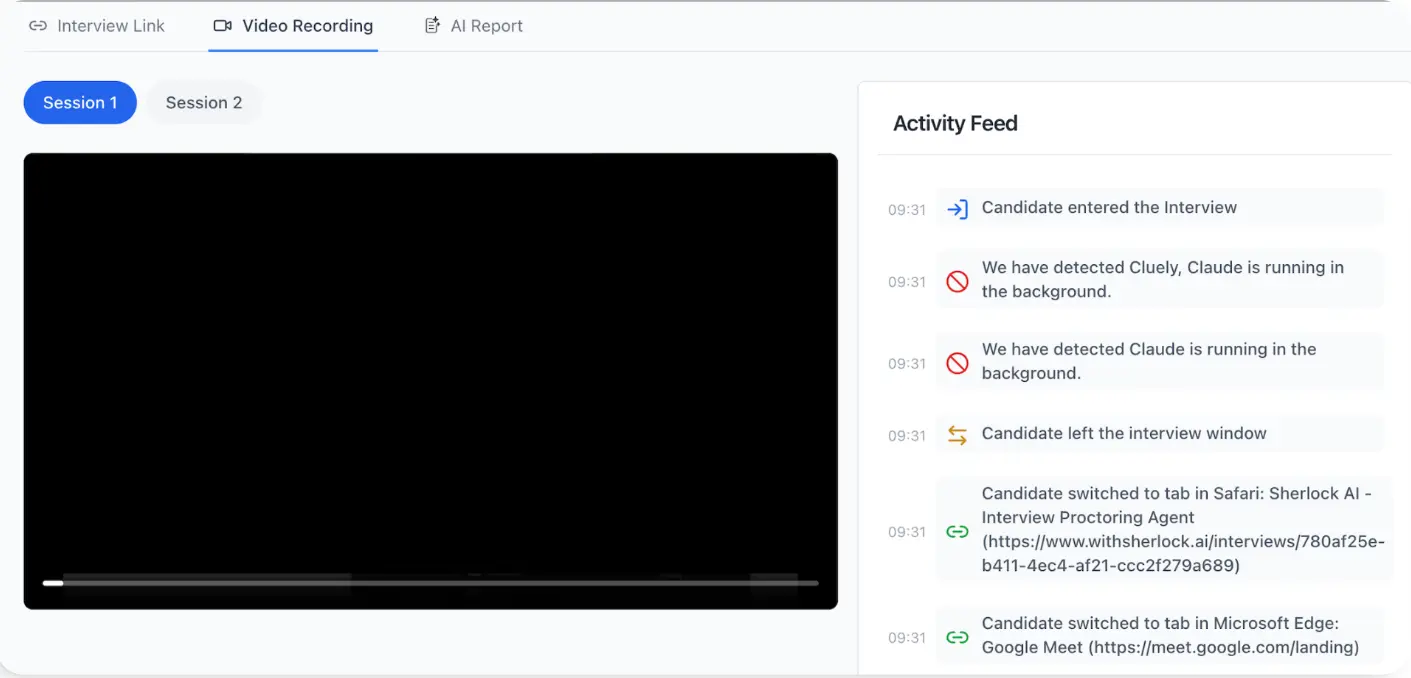
By integrating seamlessly into existing hiring workflows, Sherlock AI helps organizations prevent interview fraud without slowing down recruitment or harming the candidate experience.
Creating a Culture of Fraud Awareness
Interview fraud prevention is most effective when it becomes part of everyday hiring behavior, not just a checklist or a tool-driven process. A people-first approach helps organizations identify risks early and respond with confidence.
1. Embed Fraud Awareness into Hiring Training
Recruiters and interviewers should be trained to recognize modern fraud techniques, including AI-assisted responses and proxy interviews.
Example: An interviewer notices delayed responses and overly polished answers and follows up with situational questions.
2. Define Clear Hiring Standards
Establish and communicate clear expectations around interview integrity, identity verification, and ethical conduct.
Example: Candidates are informed in advance that identity and authenticity checks are standard parts of the hiring process.
3. Promote Ownership and Reporting
Create a culture where hiring teams feel responsible for raising concerns without fear of slowing down hiring.
Example: A recruiter flags a suspected proxy interview before the final interview stage.
4. Improve Continuously Through Feedback
Analyze hiring outcomes, detected fraud cases, and near-misses to strengthen prevention strategies.
Example: Insights from previous fraud incidents lead to updated interview formats and stronger verification steps.
By making fraud awareness a shared responsibility, organizations move from reacting to fraud after it happens to preventing it before it impacts hiring quality and trust.
Final Thoughts
As hiring becomes increasingly digital and globally distributed, interview fraud prevention is no longer optional in 2026. It is essential for protecting hiring quality, organizational security, and long-term trust. Fraud tactics continue to evolve with the rise of AI, remote work, and intense competition for high-value roles, making traditional interviews and manual checks insufficient on their own. Organizations that succeed will be those that combine structured hiring processes, well-trained recruiters and interviewers, continuous fraud awareness, and intelligent detection tools like Sherlock AI. By investing in both people and technology, companies can stay ahead of interview fraud, make confident hiring decisions, and build resilient, trustworthy teams.