Back to all blogs
Explore the rise of open-book tech interviews in the AI Era and what teams should consider to keep assessments fair and effective.

Abhishek Kaushik
Dec 2, 2025
TL;DR
Modern engineering teams work in open-book environments.
Developers use:
StackOverflow
GitHub repos
Documentation
AI assistants like ChatGPT and Copilot
So banning tools entirely in interviews is unrealistic and can feel unfair.
But allowing unrestricted AI breaks the signal of real skill.
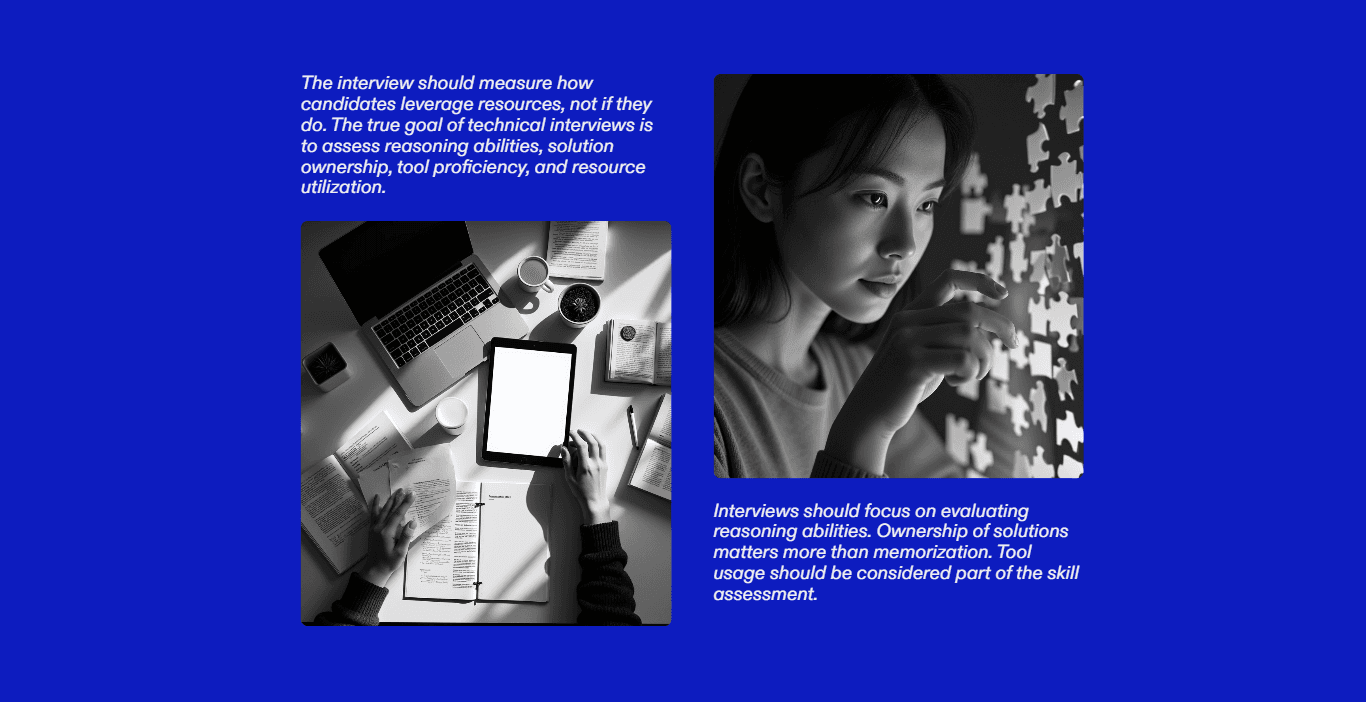
The goal is not to prevent tool usage.
The goal is to evaluate reasoning and ownership while the candidate uses tools.
The Problem
If interviews only test:
Memory
Syntax recall
Algorithm trivia
Then candidates who are highly capable in real-world engineering environments appear weaker than they are.
But if interviews allow:
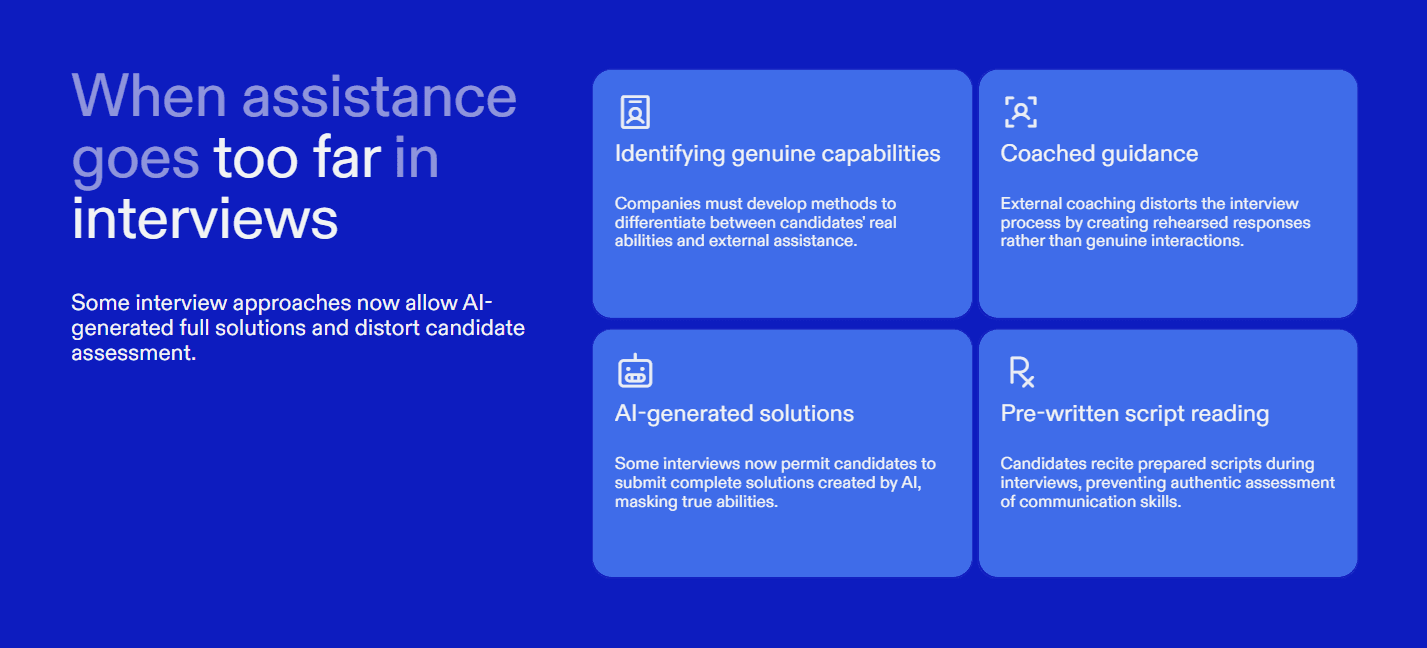
AI-generated full solutions
Pre-written script reading
Proxy or coached guidance
Then the company risks hiring people who cannot perform independently.
To balance fairness + integrity, we must define what open-book actually means in 2026.
What to Allow
These forms of assistance match real professional workflows and do not meaningfully distort skill signals:
Allowed | Why |
|---|---|
Reading official docs | Models real-world engineering |
Checking syntax or library usage | Avoids trivia bias |
Using a scratchpad or notes | Encourages organized thinking |
Asking AI to generate clarifying questions | Shows thinking scaffolding |
Using AI to brainstorm alternative approaches | Reveals reasoning critique ability |
The important rule:
Candidates may reference resources, but explanations must come from their own understanding.
What to Flag
These behaviors interfere with evaluating real reasoning:
Behavior | Why It Matters |
|---|---|
Copy-paste of complete code blocks | Hides construction ability |
Scripted story responses to behavioral prompts | Masks ownership |
AI-generated architecture diagrams or answers | Avoids tradeoff thinking |
Rehearsed or coaching-fed reasoning | Prevents authenticity signals |
Red flags are not accusations.
They are prompts for deeper probing.
What to Disallow Entirely
These practices directly compromise interview integrity:
Not Allowed | Risk |
|---|---|
Live whisper coaching | Identity substitution |
Proxy interviewers | Fraudulent representation |
Deepfake face or voice masking | Identity misrepresentation |
Continuous AI answer generation | No evaluation of reasoning ability |
This is where Sherlock AI is critical.
It detects:
Background coaching patterns
Identity mismatches
Code authorship irregularities
Scripted narrative cadence
Sherlock AI enforces fair open-book, not no-book.
The Open-Book Interview Format (Copy This Workflow)
Step 1: Introduce Expectations Clearly
Step 2: Use a Micro Problem to Observe Thinking
Small enough to finish live.
Complex enough to require decomposition.
Step 3: Ask the Constraint Shift Question
If one assumption changed, what would you do differently?
This reveals real understanding.
Step 4: Score on Reasoning, Not Output
Scorecard categories:
Clarity of explanation
Awareness of tradeoffs
Ability to adapt
Not:
Syntax correctness
Memorized patterns
Speed
What to Measure (This is the Key)
Do not measure:
Lines of code written
How fast they answer
Whether they remembered details
Measure:
How they decide
How they adapt
Whether they understand why
Signal | Meaning |
|---|---|
Explains alternatives | Real engineering maturity |
Narrates tradeoffs | Seniority indicator |
Adjusts solution under change | Authentic understanding |
Can explain output in plain language | True ownership |
Example Scorecard Language (Copy-Paste)
If concerns arise:
This keeps scoring neutral, specific, and audit-safe.
Conclusion
Open-book interviewing is not only possible.
It is the future of fair technical hiring.
The goal is not to test what candidates remember.
The goal is to test how they think, decide, and adjust.
When combined with:
Consistent reasoning-based prompts
Clear AI-use boundaries
Sherlock AI’s identity and authenticity verification
You get:
Stronger hiring accuracy
Faster interview cycles
Lower false negatives
Lower fraud exposure
This is hiring for the real world.