Back to all blogs
Discover how automated note-taking removes memory bias and improves fairness in hiring by capturing objective evidence of candidate performance.

Abhishek Kaushik
Dec 26, 2025
TL;DR
Interviewers do not mean to be biased.
Bias enters because:
Memory is selective
Humans overestimate confidence and fluency
Under pressure, interviewers summarize impressions, not evidence
Automated note-taking removes memory distortion, ensuring evaluation is based on what was said, not how it felt.
This upgrades fairness for:
Non-native English speakers
Neurodivergent candidates
Low-context communicators
Early-career applicants
Highly technical contributors who are not polished speakers.
The Bias Problem Starts in Memory
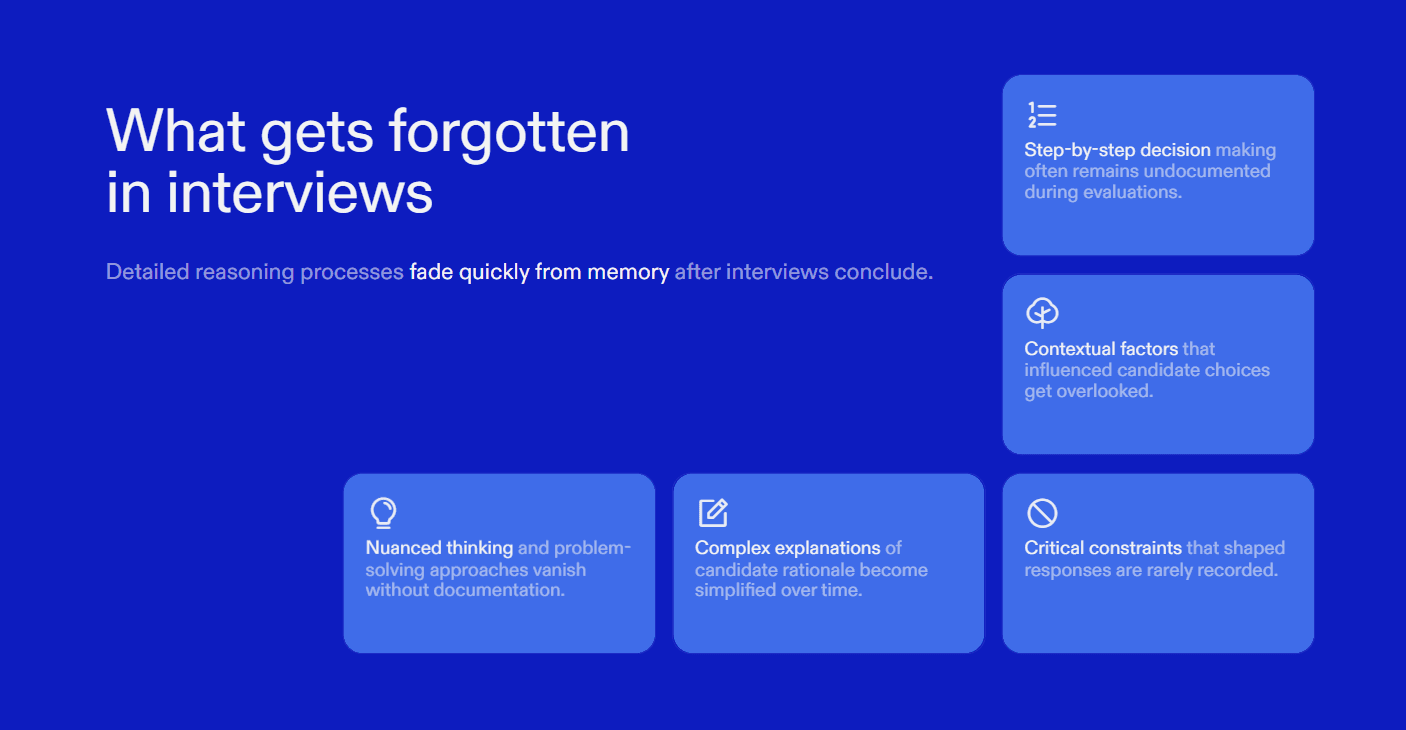
Research shows interviewers remember:
The first strong moment
The last strong moment
The parts that matched their own preference pattern
Not:
The candidate’s reasoning steps
Intermediate decision logic
Context of tradeoffs or constraints
This means:
Bias is not in the conversation.
Bias is in the memory of the conversation.
So fairness requires documentation accuracy, not just awareness training.
How Automated Notes Change the Dynamic
Without Automated Notes
Interviewers write:
Short bullet summaries
Interpretation, not evidence
Value judgments, not structure
Example bad notes:
“Strong communicator”
“Not confident”
“Senior vibes”
“Does not think strategically”
“Seems inexperienced”
These are biased framing statements because they describe style rather than thinking.
With Automated Notes
The system:
Captures the whole reasoning sequence
Highlights decisions and tradeoffs
Extracts examples and ownership markers
Timestamp-tags competency evidence
Example structured note output:
No vibe scoring.
No personality interpretation.
Just signal.
Why This Reduces Bias Across Candidate Populations
Bias Type | How Note Automation Reduces It |
|---|---|
Accent/Language Bias | Focus shifts to reasoning, not fluency |
Confidence Bias | Evidence replaces charisma evaluation |
Similarity Bias | Structured scoring replaces intuition |
Gender/Race Implicit Bias | Notes describe actions, not impressions |
Neurodivergent Communication Bias | Removes penalty for non-standard conversational pacing |
Fairness is achieved by changing what is recorded, not by telling interviewers to “be aware”.
The Key Shift: From Impressions to Evidence
Before Automation
Evaluation is:
“I feel like they could do the job.”
“The answer sounded confident.”
“They seemed unsure”
After Automation
Evaluation is:
“They explained the decision-making logic themselves.”
“They demonstrated tradeoff reasoning clearly.”
“Their approach changed meaningfully in response to new constraints.”
This is cognitive signal, not vibe signal.
The Standard Script to Set Fairness in the Interview
Say this at the beginning: This instantly:
Reduces anxiety
Levels the field
Signals safety
How to Document in a Bias-Safe Way (Template)
Use statements that describe:
Ownership
Decisions
Adjustments
Outcomes
Avoid:
“Confident”
“Nervous”
“Sharp”
“Weak speaker”
“Strong presence”
These are style markers, not skill markers.
Conclusion
Bias is not eliminated by training interviewers to “try harder”.
Bias is eliminated by changing what is recorded and evaluated.
Automated notes:
Remove memory distortion
Increase decision traceability
Protect fairness
Improve post-interview calibration
Make hiring more evidence-driven
Fair hiring is not about psychology.
Fair hiring is about signal quality.