Back to all blogs
Remote interviews face risks like AI assistance, impersonation, and leaked questions. Learn how to secure hiring without harming fairness or trust.
Abhishek Kaushik
Jan 21, 2026
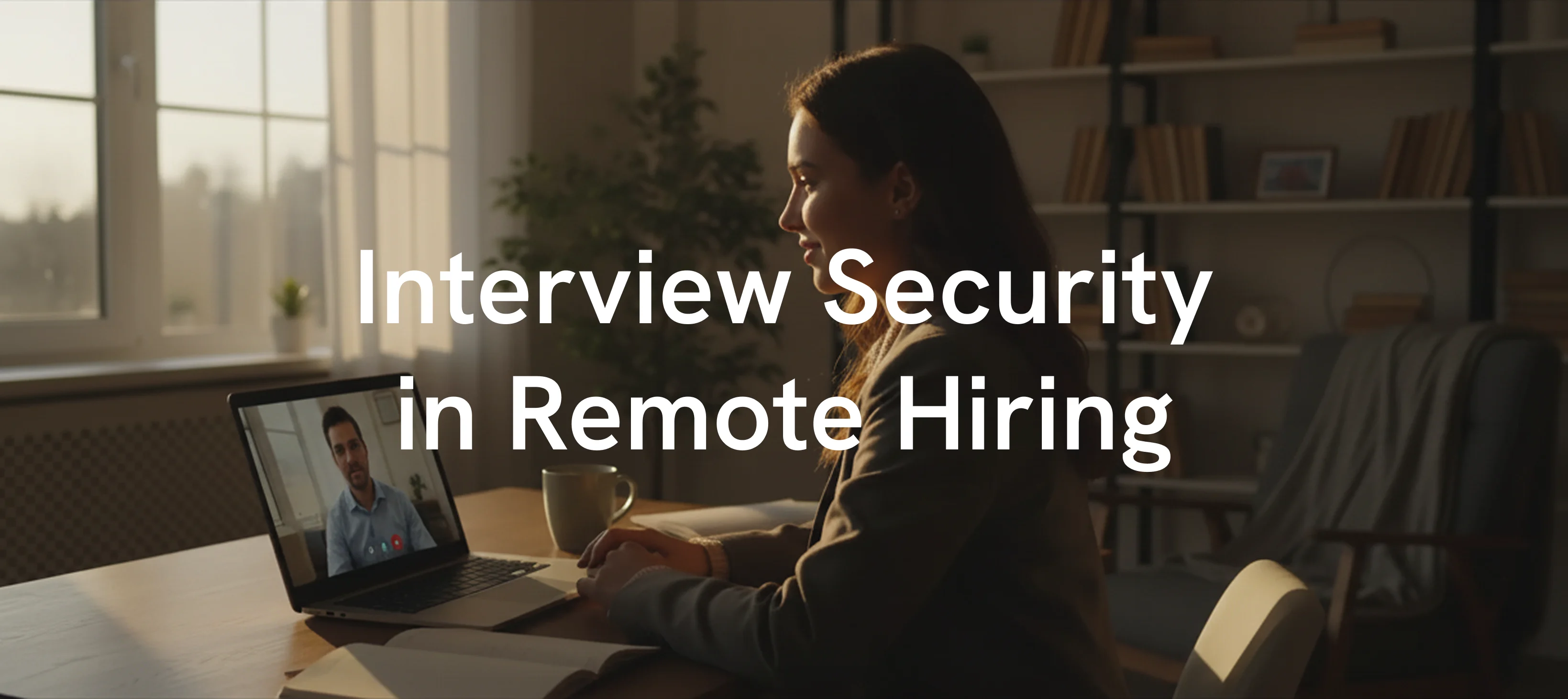
Remote hiring has become a standard way for companies to hire talent across locations. Video interviews, online coding rounds, and take home assessments make hiring faster and more flexible. But this shift has also created new security challenges that did not exist in traditional in person interviews.
Candidates can use hidden AI tools for live assistance, get help from someone off camera, or even have another person take the interview on their behalf. These issues are not rare edge cases. According to a report, 31% of managers personally interviewed a candidate later found to be a fake identity and 35% confirmed someone other than the listed applicant participated in a virtual interview, underscoring the identity-authentication problem in remote environments.
Poor interview security does not just affect fairness. It leads to bad hiring decisions, higher attrition, wasted engineering and recruiter time, and loss of trust in the hiring process. This blog explains what interview security really means in a remote setup, the real risks companies face, and how hiring teams can protect interview integrity without turning interviews into surveillance exercises.
Common Security Risks in Remote Interviews
Remote interviews remove physical oversight, which changes how candidates can bypass evaluation. These risks are not theoretical. They are patterns repeatedly observed by hiring teams running remote interviews at scale.
1. AI copilots and real time answer assistance
Live AI assistance is now one of the most frequent integrity failures in remote interviews.
Browser based copilots can generate explanations, code, or structured answers within seconds
Secondary devices like phones or tablets are often used outside the camera frame
In coding interviews, AI can interpret interviewer hints and produce near correct solutions
In behavioral rounds, AI creates polished but generic responses that mask weak experience
This breaks the signal interviewers rely on. The candidate appears competent, but the reasoning is outsourced.
2. Impersonation and proxy interviewing
Remote formats make identity verification weaker.
A more experienced person may speak while the actual candidate listens silently
Some proxy setups involve the real candidate joining briefly, then handing over the interview
Poor lighting, muted cameras, or technical issues can hide voice or face mismatches
This is difficult to detect without deliberate checks, especially in early screening rounds.
3. Hidden collaborators off camera
Another common issue is real time human assistance.
Someone else in the room prompting answers verbally or through gestures
Collaboration through messaging apps during pauses or screen sharing
Candidates delaying responses to receive guidance
Because interviewers see only a narrow video frame, this often goes unnoticed.
4. Leaked and recycled question banks
Reused interview questions lose effectiveness over time.
Standard coding or system design questions are widely shared online
Paid interview prep services train candidates on exact question patterns
Candidates memorize solutions without understanding tradeoffs or constraints
This leads to interviews testing recall instead of problem solving.
5. Take home assignment misuse
Take home tasks are often assumed to be safer, but they are easy to game.
Full solutions generated using AI tools with minimal editing
Code copied from public repositories or previous submissions
Work completed by friends, freelancers, or online services
When candidates cannot explain their own submission, the mismatch appears only after hiring.
Why these risks compound over time
Each of these issues weakens hiring signals. Together, they create false confidence in candidates who perform well only under assisted conditions. The result is higher mis hire rates, longer ramp up times, and reduced trust in remote interviews.
Understanding these specific failure points helps companies design interviews that test real thinking and apply security measures where they matter most.
Distinguishing Fair AI Use vs. Cheating
AI is now part of how candidates prepare for jobs. Treating all AI use as cheating is unrealistic and unfair. At the same time, allowing unrestricted AI use during interviews breaks the purpose of evaluation. Interview security depends on drawing a clear and enforceable line between acceptable preparation and misconduct.
Fair AI use happens before the interview.
Candidates often use AI tools to improve resume wording, understand job requirements, or practice answering common interview questions. This is similar to using online tutorials, books, or mock interviews. The candidate is still learning and forming their own understanding. The thinking happens independently, and AI is not involved at the moment of evaluation.
Examples of acceptable AI use include:
Rewriting resume bullets for clarity or grammar
Practicing behavioral questions with an AI mock interviewer
Studying algorithms, system design concepts, or role specific knowledge
Getting feedback on practice solutions after completing them independently
In all these cases, AI supports learning, not performance during the interview.
Cheating starts when AI assists in real time during evaluation.
Misconduct occurs when AI tools are used while the interview or assessment is in progress. At this point, the interview is no longer measuring the candidate’s skills. It is measuring how well they can use external assistance without being noticed.
Clear examples of cheating include:
Using AI to generate answers during live video or coding interviews
Feeding interview questions into an AI tool in real time
Reading AI generated responses while pretending to think
Using browser extensions or secondary devices for live assistance
Getting help from another person off camera or through chat
These actions replace the candidate’s reasoning with outsourced intelligence.
Why the distinction matters for fairness
Without a clear boundary, honest candidates are punished while dishonest ones gain an advantage. Candidates who follow rules are evaluated on real ability, while others appear stronger due to hidden support. Over time, this leads to lower hiring quality and loss of trust in the interview process.
Clear rules also protect candidates. When companies explicitly state what AI use is allowed and what is not, candidates are less likely to cross lines accidentally. Ambiguous policies create confusion and inconsistent enforcement.
How companies should communicate this boundary
Interview guidelines should clearly state that AI tools are allowed for preparation but not during live interviews or timed assessments. This should be communicated before the interview, not discovered through enforcement. Clear expectations reduce misconduct more effectively than aggressive monitoring.
Drawing this line does not mean rejecting AI. It means preserving the core purpose of interviews: to evaluate how a candidate thinks, solves problems, and communicates without external help at the moment it matters.
Role of Proctoring and Detection Tools
Proctoring and detection tools exist to reduce blind spots in remote interviews, not to replace interviewers. When used correctly, they help surface risk signals that are easy to miss in video based hiring. When used poorly, they create noise, false accusations, and a negative candidate experience.
What proctoring tools are good at
Proctoring tools monitor the interview environment and candidate behavior to detect deviations from expected norms.
Detecting screen switching, tab changes, or suspicious browser activity
Noticing repeated gaze shifts away from the screen during critical moments
Flagging audio anomalies such as overlapping voices or unnatural pauses
Recording evidence for post interview review when concerns arise
These tools are effective at catching obvious misuse, especially real time external assistance.
Where traditional proctoring falls short
Many legacy proctoring systems rely on rigid rules.
Eye tracking alone cannot distinguish thinking from reading
Screen recording does not reveal use of secondary devices
Strict thresholds generate false positives for neurodivergent candidates
Human proctors do not scale well and introduce bias
As a result, teams either over trust noisy alerts or ignore them entirely.
What Sherlock AI Does in Remote Hiring?
When securing remote interviews, tools like Sherlock AI combine proctoring, monitoring, and detection features to help hiring teams maintain interview integrity. These tools reduce risk but also come with limits. They are strongest when used to support human judgment and structured interviews, not replace them entirely.
1. Automated integrity monitoring:
Sherlock AI integrates with your calendar and video conferencing tools so it can join interviews automatically and observe candidate behavior in real time. It detects suspicious signals including external assistance or unusual patterns that often indicate cheating.
2. Multimodal analysis:
Instead of just watching the webcam feed, Sherlock AI examines a combination of signals during the interview. It uses device activity, audio patterns, and candidate behavior together to detect anomalies. This multimodal approach allows it to tell when interactions deviate from normal human responses.
3. Real-time alerts for interviewers:
If Sherlock AI detects patterns that suggest assistance, distraction, or other red flags during the interview, it provides alerts. This allows interviewers to stay focused on evaluating skills while knowing the tool is watching for integrity issues.
4. Scoring “AI fluency” when permitted:
In use cases where AI tools are allowed for preparation or certain tasks, Sherlock AI can observe how effectively candidates work with those tools and report on that skill rather than simply flagging the AI itself.
5. Automated notes and insights:
Sherlock AI also captures structured notes during interviews, helping teams build consistent evaluation records and lowering the risk of missing follow-ups or reasoning trails.
Why Human Judgment Still Matters
Context is essential:
Tools like Sherlock AI provide signals and alerts, but context still matters. A flagged behavior might be valid (for example candidate thinking deeply, handling genuine distractions, or technical issues during the call). Interviewers should always probe and evaluate before concluding misconduct.
Privacy and candidate experience:
Remote monitoring can feel invasive to candidates. Tools should be transparent about what they collect, why it matters, and how it is used. Poor communication or overly aggressive monitoring can harm candidate trust and brand reputation.
Complement, not replace, interview design:
Security tools help enforce rules but they do not change the core assessment. Strong interview design like questions that test reasoning, follow-ups that require explanation, and structured scoring remains the foundation of reliable evaluation.
Proctoring and detection tools strengthen remote interview security by alerting interviewers to patterns that merit closer inspection. Sherlock AI’s multimodal approach makes this more robust than simple webcam or screen checks. Pair the tool with:
Clear interview policy communication
Structured interviews and follow-up questions
Human review of flags and alerts
Respectful handling of data and candidate privacy
Together, these elements improve trust in remote hiring outcomes while minimizing unnecessary invasiveness.
Read more: 5 Ways to Stop AI Fraud in Interviews Without Harming Candidate Experience
Final Thoughts
Interview security in remote hiring is no longer optional. As AI tools and remote collaboration become easier to use, the gap between genuine ability and assisted performance continues to grow. Ignoring this reality leads to weak hiring signals, costly mis hires, and loss of trust in the interview process.
Strong interview security does not come from aggressive surveillance or banning technology outright. It comes from clarity, intent, and balance. Clear rules around fair AI use protect honest candidates. Thoughtful interview design exposes real reasoning. Proctoring and detection tools add visibility where human observers have blind spots. Most importantly, human judgment remains central to every decision.
Hiring teams that treat security as a supporting layer rather than a policing mechanism are better positioned to hire consistently and fairly. When interviews measure how candidates think instead of how well they hide assistance, remote hiring becomes both scalable and reliable.