Back to all blogs
Explore 15 real interview fraud examples in 2026, including AI-assisted answers, proxy interviews, and deepfakes, and learn how Sherlock AI detects them.

Abhishek Kaushik
Jan 27, 2026

Interview fraud has moved from rare edge cases to a widespread hiring risk. As interviews become remote, global, and AI-assisted, fraudsters are exploiting gaps in traditional hiring processes.
In 2026, interview fraud is no longer limited to fake resumes. It now includes proxy interviews, AI-generated answers, deepfake identities, and coordinated fraud rings.
According to industry surveys, nearly 60 percent of hiring managers have personally suspected candidates of using AI tools or deception to misrepresent themselves during interviews, and about 31 percent actually encountered candidates using fake identities or proxies in real interview scenarios.
15 Interview Fraud Examples Hiring Teams Must Know in 2026
This article breaks down 15 real-world interview fraud examples seen across modern hiring pipelines and explains how platforms like Sherlock AI help detect these risks before they turn into costly bad hires.
1. Proxy Candidates in Technical Interviews
In proxy interview fraud, a highly skilled individual attends interviews on behalf of the actual applicant. The proxy clears technical rounds easily, creating strong confidence in the hire. Once the role begins, the real employee struggles with basic responsibilities.
This type of fraud works because remote interviews often rely on trust and do not include continuous identity verification. The cost is immediate productivity loss and repeated rehiring.
Sherlock AI helps by tracking identity and behavioral signals across all interview stages, ensuring the same person participates throughout the process.
2. Identity Swaps Between Interview Rounds
Some candidates switch individuals between screening and final rounds. Early interviews appear strong, but later discussions show unexplained changes in communication style or technical depth.
This often goes unnoticed because hiring teams assume continuity. Sherlock AI detects these inconsistencies by analyzing behavior patterns across interviews.
3. Real-Time AI Answer Generation
Candidates increasingly use AI tools that listen to interview questions and generate instant responses. These answers sound fluent and well-structured but lack personal insight or real-world experience.
Over time, this leads to hiring candidates who cannot perform independently. Sherlock AI flags unnatural response patterns and scripted language.
4. AI-Assisted Coding Interviews
During live coding sessions, candidates rely on AI to produce working solutions. While the output looks correct, candidates often fail to explain logic, debug errors, or extend solutions.
Sherlock AI evaluates response depth and reasoning consistency, not just surface correctness.
5. Scripted Behavioral Interviews
Candidates memorize answers to common behavioral questions, repeating generic examples across interviews. When interviewers ask follow-up questions, details become vague or inconsistent.
Scenario-based questioning combined with Sherlock AI detection helps surface these patterns early.
6. Deepfake Video Interviews
AI-generated faces and voices are used to impersonate experienced professionals during video interviews. These interviews often appear normal at first glance.
Subtle signals like limited facial movement, static lighting, and delayed reactions reveal the manipulation. Sherlock AI identifies these anomalies in real time.
7. Deepfake Voice in Phone Screens
In audio-only interviews, synthetic voices are used to sound confident and experienced. Because there are no visual cues, this fraud is particularly difficult to detect manually.
Sherlock AI analyzes voice authenticity and cadence patterns.
8. Fake Certifications and Licenses
Candidates submit forged certifications to meet role requirements, especially in cloud, security, and compliance-heavy roles. Manual verification often fails under hiring pressure.
Automated credential validation prevents this risk.
9. Fabricated Employment History
Fake employment letters or exaggerated job responsibilities are used to inflate experience. These inconsistencies often surface only during reference checks or post-hire.
Sherlock AI supports automated employer and reference validation.
10. External Experts Feeding Answers
Candidates receive help via off-screen prompts, messaging tools, or audio cues during live interviews. Long pauses followed by structured responses often indicate this behavior.
Sherlock AI monitors gaze behavior and response timing to detect such patterns.
11. Language Proficiency Masking
Candidates appear fluent during interviews but struggle with written communication or collaboration after hiring. AI-generated spoken responses often hide language limitations.
Cross-format behavior analysis reveals these inconsistencies.
12. Deliberate Tool Familiarity Bluff
Deliberate tool familiarity bluffing occurs when candidates claim hands-on experience with specific tools or platforms by memorizing user interfaces, documentation, or demo videos without ever working in real production environments. This tactic works because interviewers often assess tool knowledge through verbal explanations rather than asking candidates to demonstrate live workflows or problem-solving scenarios.
Sherlock AI helps uncover this form of interview fraud by detecting gaps between claimed experience and the depth of reasoning candidates display when discussing real-world usage, edge cases, and decision-making in practical situations.
AI-Based Accent and Voice Normalization
Candidates use AI tools to modify their accent, tone, or speech patterns in real time to sound more fluent, confident, or region-neutral during interviews. This works because interviewers often associate clear, polished speech with competence and communication skills. The risk is that actual collaboration and communication issues surface only after hiring.
Sherlock AI helps by analyzing vocal consistency and detecting unnatural uniformity or sudden changes in speech patterns across interview stages.
AI-Driven Behavioral Answer Simulation
AI tools are trained on common behavioral interview frameworks and generate convincing personal stories that sound authentic but are not based on real experiences. This works because answers follow recognized formats such as STAR and include emotional cues that appear genuine. The risk is hiring candidates who lack real decision-making experience despite strong interview performance.
Sherlock AI identifies this by detecting repetitive phrasing, templated narratives, and weak reasoning depth behind emotionally framed responses.
Real-Time AI Prompt Injection via Secondary Devices
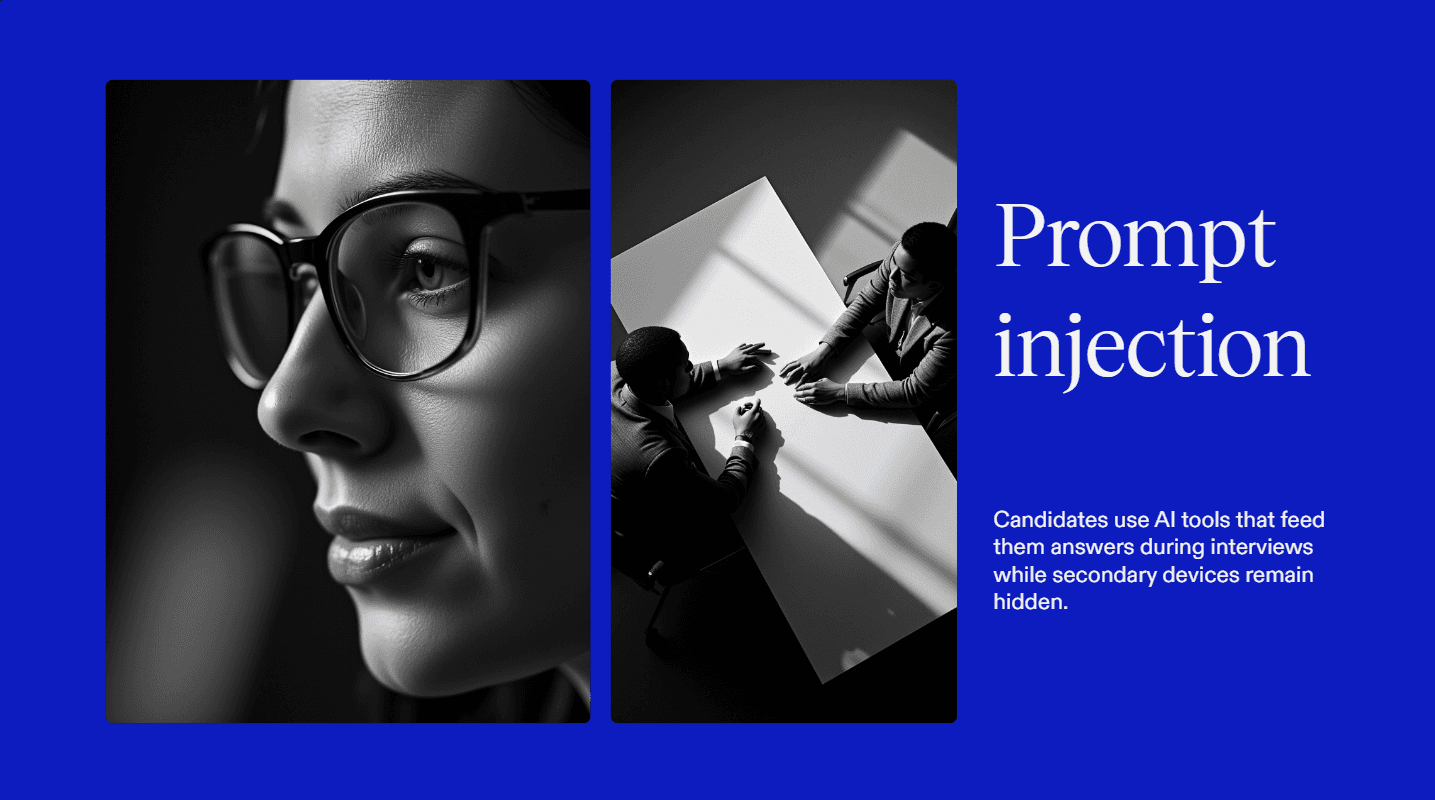
Candidates use hidden devices such as smart glasses, secondary phones, or browser overlays to receive AI-generated prompts and corrections during interviews. This works because remote interviews offer limited visibility into a candidate’s environment. The risk is a complete breakdown of interview integrity and false skill validation.
Sherlock AI helps by monitoring response latency, attention shifts, and behavioral anomalies that indicate external assistance during live interviews.
Final Thoughts
Interview fraud examples in 2026 reveal a clear truth. Hiring risks have evolved, but many hiring processes have not. Fraud is no longer obvious, isolated, or rare. Itis systematic, technology-driven, and costly.
Organizations that rely solely on traditional interviews expose themselves to bad hires, security threats, and compliance failures. By combining structured interviews with intelligent platforms like Sherlock AI, companies can protect hiring integrity and make confident, trustworthy decisions.