Back to all blogs
Interview fraud is rising in remote hiring. Learn how it affects hiring outcomes and how detection tools help identify misrepresentation early.
Abhishek Kaushik
Jan 7, 2026

The interview process, which once was a reliable filter for talent, is increasingly under fire. A recent industry analysis found that 72% of recruiters have encountered fake resumes, portfolios, or credentials, with deepfake interviews and AI-assisted fraud becoming more common than many hiring teams expect.
Mis-hires and hidden skills gap can undermine productivity and skew team outcomes. According to hiring experts, misrepresentation or poor hiring decisions can cost employers up to 30% of the employee’s first-year salary, not including broader operational losses.
These costs don’t stop at recruiting and onboarding. Managers surveyed in a major industry report estimate that hiring fraud has directly cost their companies thousands, with nearly 1 in 4 organizations reporting losses over $50,000 due to fraudulent applicants slipping through traditional screening processes.
Once a fraudulent hire is uncovered, confidence in recruitment processes drops, hiring teams lose credibility, and high-performing staff begin to question the integrity of how talent is selected and vetted. This erosion of trust not only delays future hiring cycles but also degrades overall team morale and cohesion.
What Interview Fraud Really Means
Interview fraud occurs when a job applicant misrepresents themselves or their abilities during the hiring process with the intent to deceive an employer. This can take many forms, from fake or exaggerated resumes and fabricated references to identity impersonation where someone else attends the interview, or even deepfake technology and AI-generated responses used to mask the candidate’s true skills.
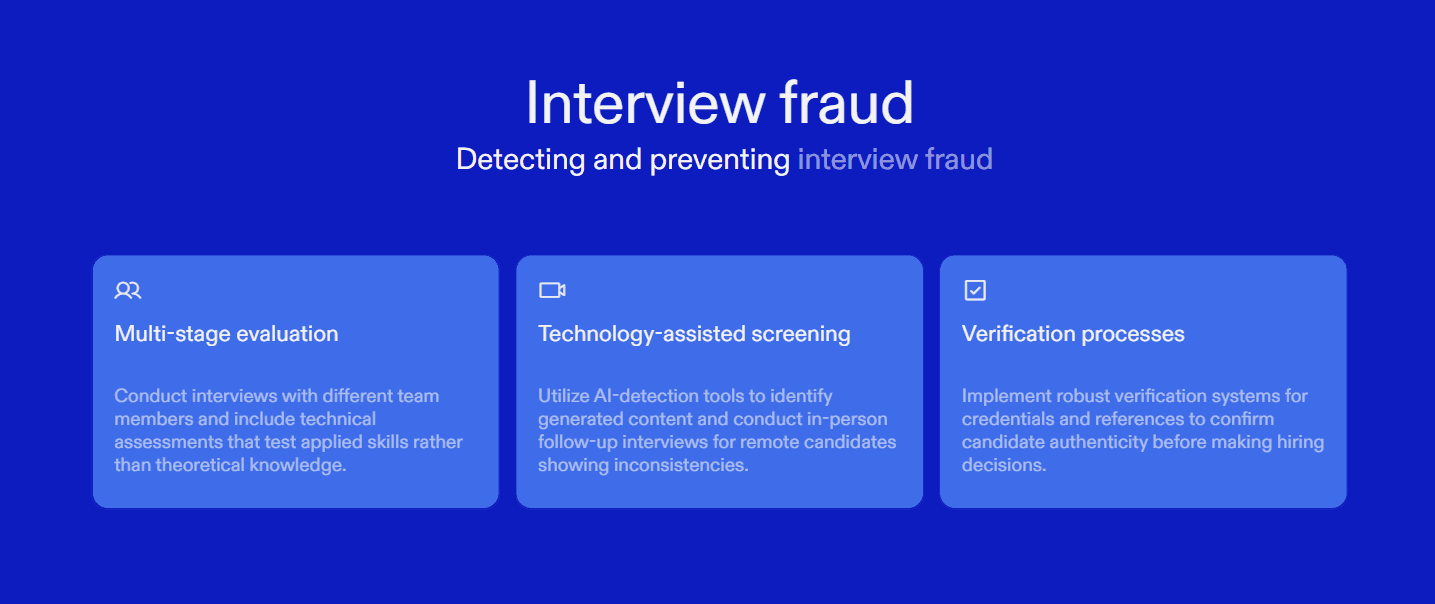
Forms of Fraud in Hiring
Common types include:
Impersonation & Proxy Interviews: A different person joins the interview on behalf of the applicant.
Resume and Reference Fraud: Candidates inflate job titles, skills, or fabricate professional history.
Assessment Cheating: Using hidden assistance or unauthorized tools during tests and interviews.
AI-Assisted Deepfakes: Candidates may use deepfake video or AI responses to impersonate themselves or appear more qualified.
Ethical Preparation vs. Cheating
There’s a clear line between legitimate interview preparation and fraud: preparing for an interview such as researching common questions, rehearsing answers, and polishing presentation skills, is ethical and expected. However, seeking to deceive the interviewer by falsifying identity, qualifications, skills, or using hidden assistance during the interview crosses into cheating and undermines the integrity of hiring. Ethical preparation aims to showcase genuine ability; cheating artificially inflates perceived competence without the corresponding real skill.
Why Interview Fraud Is Becoming More Common
Several factors have made interview fraud more prevalent in recent years:
Remote Hiring & Virtual Interviews: With most interviews happening online, it’s easier for fraudsters to conceal identity or use proxies without in-person verification.
Advanced Technology & AI Tools: Generative AI and deepfake technology have lowered the barrier to producing convincing fake content, from resumes to video interviews.
Competitive Job Markets: High competition pushes some applicants to take shortcuts in hopes of standing out.
Weak Verification Systems: Many organizations lack robust identity and skills validation, making deception easier to execute and harder to detect.
Together, these trends have created a perfect storm where interview fraud not only flourishes but also evolves rapidly, challenging traditional hiring safeguards.
Common Types of Interview Fraud
As hiring moves increasingly online and technology becomes more powerful, so do the methods used to mislead recruiters. Below are some of the most prevalent types of interview fraud that hiring teams are encountering today:
1. AI-Assisted Answers During Coding or Technical Interviews
One of the fastest-growing forms of interview fraud involves candidates relying on AI tools in real time during technical interviews. This includes:
Using generative AI (such as advanced coding assistants or language models) to generate live answers to interview questions, effectively letting software respond instead of the candidate.
Automated coding tools that autocomplete or fully solve programming challenges during live assessments.
These AI systems can make it appear as though a candidate is solving problems when their real knowledge may be minimal. It turns what should be a test of skill into a display of AI proficiency instead of human capability.
2. Rehearsed or Scripted Behavioral Responses
Some candidates prepare for interviews not just with practice but by memorizing or scripting answers word-for-word:
They may use AI-generated scripts or teleprompter-like setups that feed prepared responses during the interview.
These answers often sound polished but lack depth or specific context about real experience, making them misleading.
This type of fraud doesn’t involve another person instead, it substitutes genuine thinking with rehearsed replies that can impress recruiters superficially but fail to reflect true capability.
3. Proxy Interviews and Impersonation
Perhaps the most direct form of fraud, proxy interviewing, is when someone other than the actual applicant participates:
A qualified expert may take the interview on behalf of an unqualified candidate.
This can happen remotely or even in person if identity checks are lax.
“Shadow proxies” might be present off-camera, guiding the candidate via communication tools like earbuds or messages.
Advanced fraud can involve deepfake video or voice synthesis, where a fraudster uses AI to mimic the appearance or sound of a different person, making detection even harder.
4. Use of Secondary Devices or Hidden Resources
A more subtle but widespread fraud tactic is using unauthorized tools or hidden devices during interviews:
Candidates place phones, tablets, or another laptop just outside the camera’s view to search for answers or receive help.
They may use smart devices like earbuds to get real-time assistance from collaborators or AI.
Remote desktop tools or virtual machines may allow an expert to control the candidate’s system behind the scenes.
Because these devices and resources are often out of sight and not tracked by basic video setups, they can significantly skew interview outcomes if not monitored properly.
Each of these fraud types threatens the integrity of the hiring process, distorts talent evaluation, and can lead to costly mis-hires if not detected early. Understanding and identifying them is the first step toward safeguarding your recruitment efforts.
Tools and Techniques for Interview Fraud Detection
As interview fraud becomes more sophisticated, detection can no longer rely on manual observation alone. Modern hiring teams now combine monitoring tools, behavioral analysis, and AI-driven insights to protect interview integrity, without turning interviews into intrusive surveillance.
Monitoring, proctoring and detection tools
These tools are designed to preserve interview integrity by observing interview conditions, tracking candidate behavior, and identifying signals that suggest unauthorized assistance or misrepresentation.
Sherlock AI builds on this approach by combining
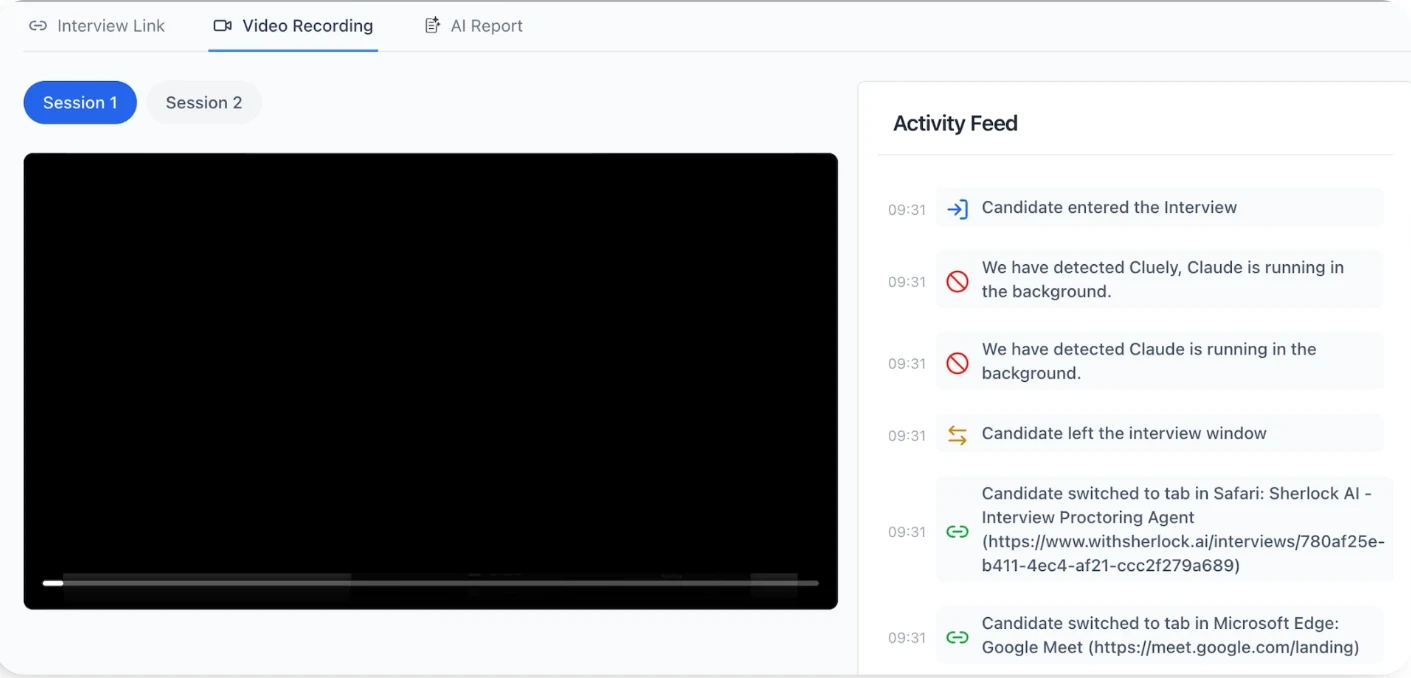
Browser and screen monitoring to detect tab switching, copy-paste activity, or external resources
Environment and device checks to surface the use of secondary devices or hidden assistance
AI analytics that flag unusual response timing, attention shifts, or interaction patterns
Passive, real-time analysis that runs quietly in the background without interrupting the interview flow
Behavioral and pattern-based detection approaches
Beyond technical monitoring, behavioral cues often reveal deeper integrity issues:
Sudden changes in communication style or vocabulary mid-interview
Overly polished answers that lack real-world detail or follow-up clarity
Problem-solving paths that don’t align with the candidate’s stated experience
Repeated patterns across interviews that indicate scripted or assisted responses
Sherlock AI focus on identifying these inconsistencies at scale, helping teams recognize patterns that are easy to miss in one-off interviews.
Supporting interviewers, not replacing judgment
Effective fraud detection tools are designed to augment human decision-making, not automate it:
They surface risk signals instead of making pass/fail decisions
They empower interviewers to ask better follow-up questions
They help validate skills more deeply rather than relying on output alone
They maintain fairness and transparency while reducing interviewer bias
When used correctly, solutions like Sherlock AI function as a second set of eyes, strengthening interviewer confidence and protecting hiring integrity without sacrificing the human element of evaluation.
Read more: 5 Ways to Stop AI Fraud in Interviews Without Harming Candidate Experience
Conclusion
Interview fraud is no longer an edge case, it’s a growing challenge that directly impacts hiring quality, team trust, and business outcomes. As interviews evolve with remote formats and AI tools, detection must evolve as well. By combining thoughtful interview design, behavioral awareness, and modern detection tools, organizations can protect the integrity of their hiring process without sacrificing fairness or candidate experience. The goal isn’t to eliminate technology from hiring, but to ensure it supports genuine skill evaluation and confident decision-making.