Back to all blogs
Learn how to verify candidate authenticity in live interviews, detect AI-assisted answers,safeguard hiring and prevent fraud with Sherlock AI in 2026.

Abhishek Kaushik
Feb 6, 2026
In 2026, the biggest challenge in hiring is no longer volume. It is verifying who the candidate really is and whether their responses are genuine. With remote hiring, AI-generated resumes, and live assistance tools, traditional screening just can’t keep up. Recruiters now need intelligent verification frameworks that prevent impersonation, detect fraud in real time, and validate skill and identity before making hiring decisions.
Recruiters now face a landscape where candidates can use advanced AI tools to generate responses in real time, collaborate with external assistants during live interviews, or even impersonate someone else entirely. These challenges not only threaten the fairness of hiring but also increase the risk of mis-hires, which can be costly for organizations both financially and operationally. A recent industry analysis showed 71% of HR professionals have encountered misleading or false candidate information such as fabricated employment history or credentials.
In this guide, you will learn how to verify candidate authenticity in live interviews using proven methods and how Sherlock AI makes this process smarter, faster, and safer.
Why Candidate Authenticity Matters Today
Remote interviews have opened a new front in talent acquisition. While they provide flexibility, they also introduce risks that traditional hiring was never built to handle.
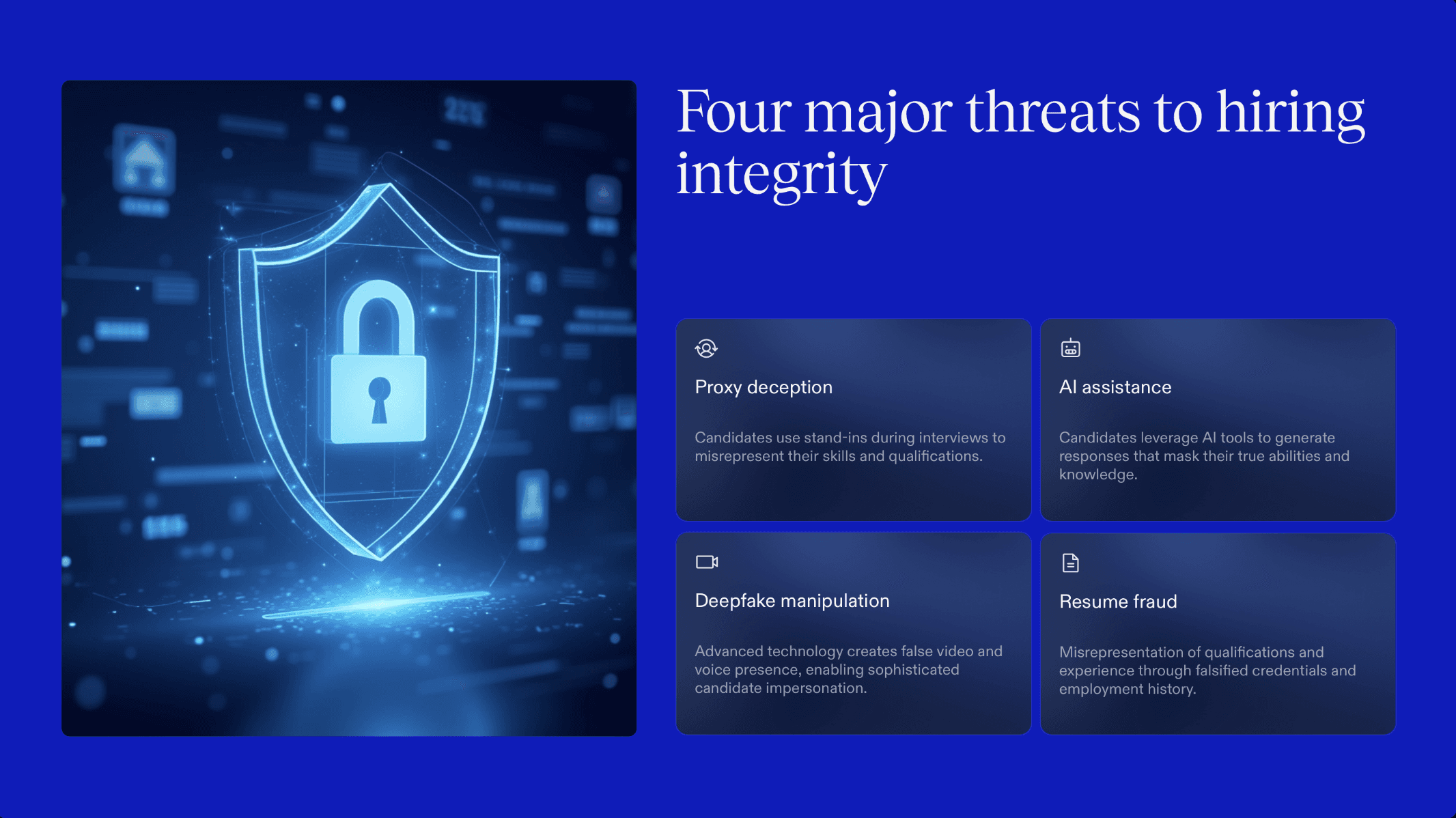
Some of the biggest threats include:
Impersonation or proxy interviewing where someone else appears on behalf of a candidate.
AI-assisted responses that mask true candidate ability.
Deepfake video and voice manipulation disguised as real presence.
Misrepresentation of skills and experience on resumes.
Without strong verification, hiring teams risk poor quality hires, damage to employer brand, and higher turnover.
The Growing Challenge of Candidate Authenticity
Candidate authenticity has become one of the most pressing concerns in modern hiring. As interviews move online and AI tools become widely accessible, recruiters are no longer just evaluating skills and experience. They are also verifying whether the person on screen is the real applicant and whether the answers reflect genuine ability.
Remote interviews make it easier for candidates to misrepresent identity and skills compared to in-person interviews
Proxy or impersonation interviews allow another person to appear on behalf of the actual candidate
AI tools can generate real-time answers, masking a candidate’s true knowledge and experience
AI-generated resumes and profiles exaggerate or fabricate skills, making screening less reliable
Deepfake video and synthetic voice technology can bypass basic visual and audio checks
Screen sharing and hidden assistance tools enable external help during live interviews
High-volume and global hiring reduces recruiters’ ability to manually verify every candidate
Traditional screening methods cannot detect real-time fraud or AI-assisted behavior
Inconsistent verification processes lead to unfair evaluations and hiring bias
Poor authenticity checks increase the risk of mis-hires, productivity loss, and higher attrition
A Framework to Verify Candidate Authenticity
To secure your hiring process, adopt a multi-layered verification strategy that addresses identity, behavior, and authenticity throughout the interview. Here’s how:
1. Pre-Interview Identity Verification
Start strong by confirming identity before the interview begins:
Ask candidates to upload a government-issued ID and perform a quick facial match.
Enable liveness checks to confirm the candidate is a real person and not a video or photo spoof.
Use IP and device signals to detect proxy, VPN, or suspicious access patterns.
This step stops most fraud before interviews even start.
2. Real-Time Authentication During Live Interviews
Once the interview starts, continuous verification prevents impersonation:
Facial recognition and liveness checks ensure the candidate’s face matches previously verified data.
Challenges or visual codes displayed at the start confirm engagement and deters deepfake technology.
Continuous monitoring of video and audio patterns can signal if another person or tool is assisting the candidate.
Continuous real-time checks maintain authenticity integrity throughout the entire session.
3. Behavior and Consistency Analysis
Verifying identity is step one. Next is validating consistency and authenticity of responses. Sherlock AI enhances this by:
Detecting if answers are overly polished or AI-generated.
Checking for contradictions between resumes, pre-screen responses, and live interview answers.
Using behavioral markers and question adaption to make scripted answers less effective.
This means the candidate must prove knowledge, not just presence.
4. Skill Validation Beyond the Interview
Identity and behavior checks must be reinforced with true skill validation:
Real-time coding or task assessments with monitoring.
Scenario-based questions tied to claimed experience.
Panel interviews where multiple interviewers probe deeply for real expertise.
AI cannot easily fake real reasoning and problem solving, which makes these checks critical.
5. Interview Environment and Tool Control
Authenticity can be compromised by uncontrolled interview environments:
Restrict screen sharing to approved tools only.
Detect multiple screens or parallel device usage during the interview.
Monitor for unusual eye movement or interaction patterns that indicate off-screen assistance.
Controlling the interview environment reduces opportunities for hidden AI tools or human helpers.
6. Continuous Presence and Session Integrity Checks
Identity verification should not be a one-time event:
Ensure the candidate remains continuously present on camera.
Flag interruptions, camera drop-offs, or repeated reconnects that may indicate proxy switching.
Monitor session continuity to confirm the same participant remains active throughout.
This prevents mid-interview substitution or coordinated fraud.
7. Cross-Interview Pattern Analysis
Fraud often reveals itself across multiple interactions:
Compare behavior, response style, and confidence across different interview rounds.
Identify sudden performance jumps between screening and technical interviews.
Detect repeated patterns that align with known AI-assisted or coached behavior.
Pattern analysis helps recruiters spot inconsistencies that are not obvious in a single interview.
8. Recruiter Review and Auditability
Verification must support confident and defensible hiring decisions:
Generate clear authenticity indicators instead of raw technical data.
Maintain an audit trail of identity checks, behavioral flags, and review outcomes.
Enable recruiters to escalate or review flagged interviews with context.
This ensures fairness, transparency, and compliance in hiring decisions.
9. Candidate Transparency and Trust Signals
Clear communication reduces friction and deters misuse:
Inform candidates upfront about identity and authenticity verification steps.
Explain how verification protects fair evaluation for all applicants.
Apply verification consistently across roles and hiring stages.
Transparency increases candidate trust while discouraging fraudulent behavior.
10. Scalable Verification for High-Volume Hiring
Manual checks do not scale in modern hiring:
Automate verification workflows without increasing recruiter workload.
Apply risk-based verification for sensitive or high-impact roles.
Maintain consistent standards across geographies and hiring teams.
Scalability ensures authenticity without slowing down recruitment.
By combining all this organizations can build a resilient framework that protects interview integrity and ensures genuine hiring outcomes.
How Sherlock AI Improves Candidate Verification
Sherlock AI strengthens hiring integrity by applying multiple verification layers that work together throughout the interview lifecycle. This ensures recruiters evaluate real candidates, not assisted or impersonated performances.

Continuous candidate presence validation
The platform ensures the same individual remains on screen for the entire interview, reducing the risk of proxy switching or mid-interview replacement.Real-time fraud signal detection
Sherlock AI analyzes audio, video, and behavioral signals to flag suspicious activity such as unusual gaze patterns, delayed responses, or off-screen prompts.AI-assisted response detection
Behavioral pattern analysis identifies overly structured, instant, or repetitive responses that may indicate real-time AI usage.Behavioral integrity checks
Sherlock AI evaluates consistency in tone, reasoning depth, and response structure across the interview to identify rehearsed or externally assisted behavior.Environment and device monitoring
Sherlock AI flags potential risks such as multiple device usage or unusual interaction patterns that suggest unauthorized assistance.Actionable recruiter insights and flags
Recruiters receive clear indicators and review signals rather than raw data, enabling faster and more confident hiring decisions.
Together, these capabilities help hiring teams verify candidate authenticity at scale while maintaining a fair, professional, and compliant interview experience.
How Traditional Screening Fails in the Modern Hiring Landscape
Old screening methods are no longer sufficient because they were designed for in-person hiring and assume candidate honesty. In today’s remote, AI-driven environment, these approaches leave critical gaps.
Keyword resume scanning cannot verify authenticity
Resume parsers match keywords and job titles but do not validate whether experience is real. AI-generated resumes make it easy to exaggerate or fabricate skills while still passing automated ilters.Standard interviews do not confirm candidate identity
Traditional interviews assess responses but rarely verify that the person speaking is the actual applicant. In remote settings, this allows impersonation or proxy interviewing to go undetected.Manual identity checks are inconsistent and error prone
Brief ID checks over video depend heavily on human judgment. Poor camera quality, rushed verification, or edited documents make these checks easy to bypass.No visibility into real-time AI assistance
Traditional screening cannot detect candidates using AI tools to generate answers, solve problems, or receive prompts during live interviews.Remote interview environments create hidden loopholes
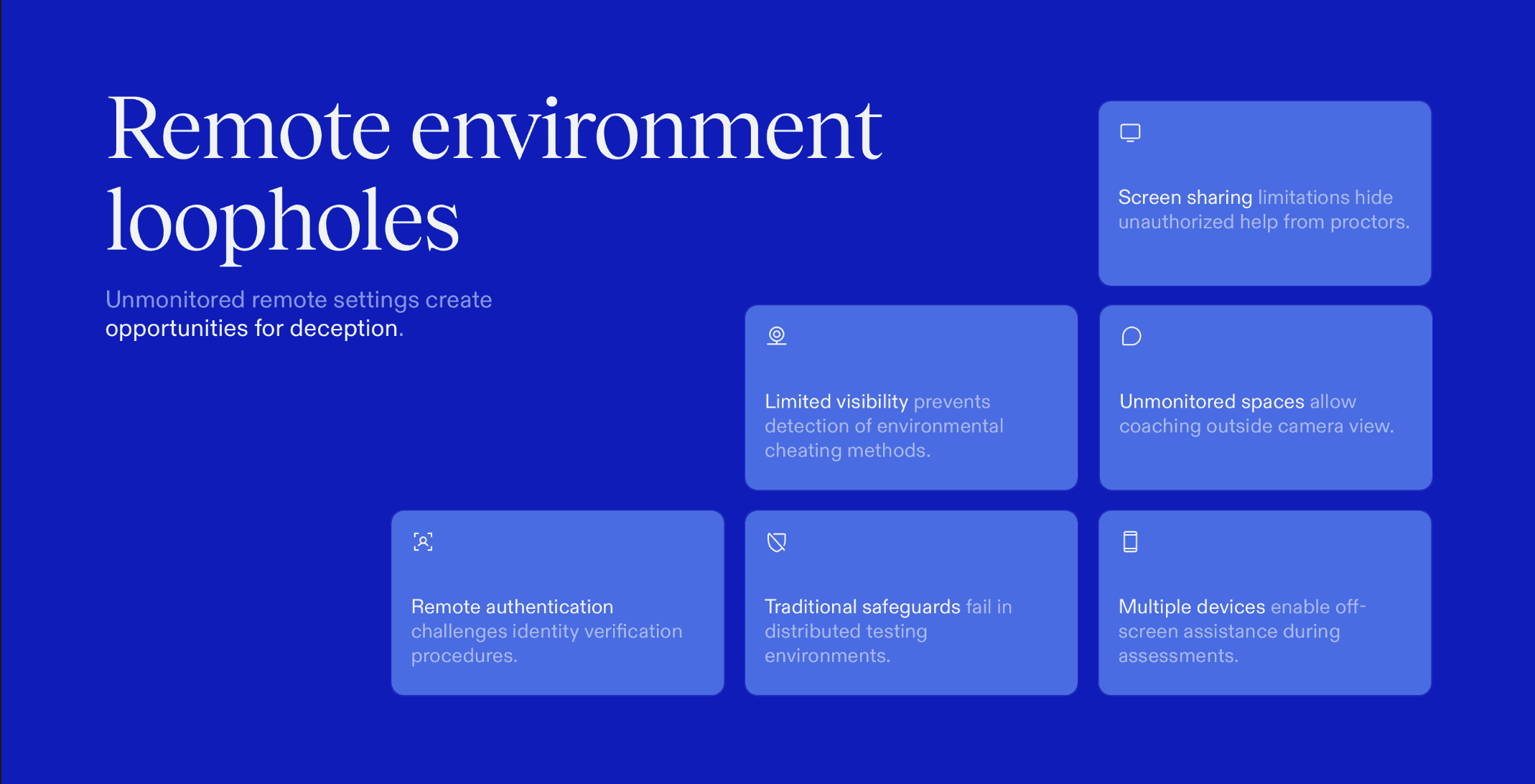
Multiple devices, screen sharing, and unmonitored spaces allow unauthorized help without triggering traditional safeguards.Lack of continuous verification throughout the interview
Even when identity is checked once, traditional methods do not ensure the same candidate remains present for the entire interview.
For recruiters, these limitations increase the risk of mis-hires and unfair evaluations. Modern hiring requires screening methods that verify identity, behavior, and skill authenticity in real time, not just at the surface level.
Why 2026 Is the Turning Point for Authentic Hiring
By 2026, remote hiring has become the default rather than the exception. Interviews that once happened in controlled, in-person environments now take place across distributed locations, devices, and networks. This shift has removed many natural verification cues, making identity confirmation and real-time authenticity checks a core requirement rather than a nice-to-have.
Hiring Shift | What Has Changed | Impact on Recruiters |
|---|---|---|
Remote-first hiring | Most interviews now happen online across geographies | Recruiters lose in-person verification cues and need digital identity validation |
Widespread AI usage | Candidates can use AI tools during live interviews | Traditional interviews cannot distinguish real skill from AI-assisted responses |
Sophisticated fraud methods | Deepfake video, voice cloning, and proxy interviews are easier to execute | Manual checks fail to detect impersonation or external assistance |
High-volume recruitment | Faster hiring cycles and larger pipelines | Manual verification does not scale without automation |
Cost of mis-hires | Poor hires impact productivity and retention | Recruiters need stronger authenticity signals before making decisions |
Conclusion
Candidate authenticity has become a critical pillar of modern hiring. As remote interviews, AI-assisted tools, and sophisticated fraud techniques continue to evolve, recruiters can no longer rely on traditional screening methods to evaluate candidates accurately. Verifying who the candidate is, how they behave during interviews, and whether their skills are genuine is now essential to making confident and fair hiring decisions.
In 2026, authentic hiring is not just about preventing fraud. It is about protecting hiring quality, reducing mis-hires, and building trust across the recruitment process. Organizations that invest in structured, real-time verification gain clearer insights into true candidate capability and create a level playing field for all applicants.
Sherlock AI enables this shift by bringing identity verification, real-time fraud detection, and behavioral integrity checks into a single, recruiter-friendly platform. By helping hiring teams verify real candidates and real performance at scale, Sherlock AI ensures interviews remain fair, credible, and focused on what truly matters: hiring the right talent with confidence.