Back to all blogs
Learn how to train interviewers to focus on reasoning and decision-making, not storytelling. Improve hiring accuracy and reduce bias with these effective strategies.

Abhishek Kaushik
Dec 26, 2025
TL;DR
Most interviewers are trained to listen for:
Strong delivery
Persuasive storytelling
Fluent communication
Confidence and clarity
But communication style does not predict job performance.
Performance comes from:
Reasoning
Decision-making logic
Handling uncertainty
Adapting when things change
To evaluate that, interviewers must learn to listen for thinking, not listen for narrative polish.
Why Stories Mislead Interviewers
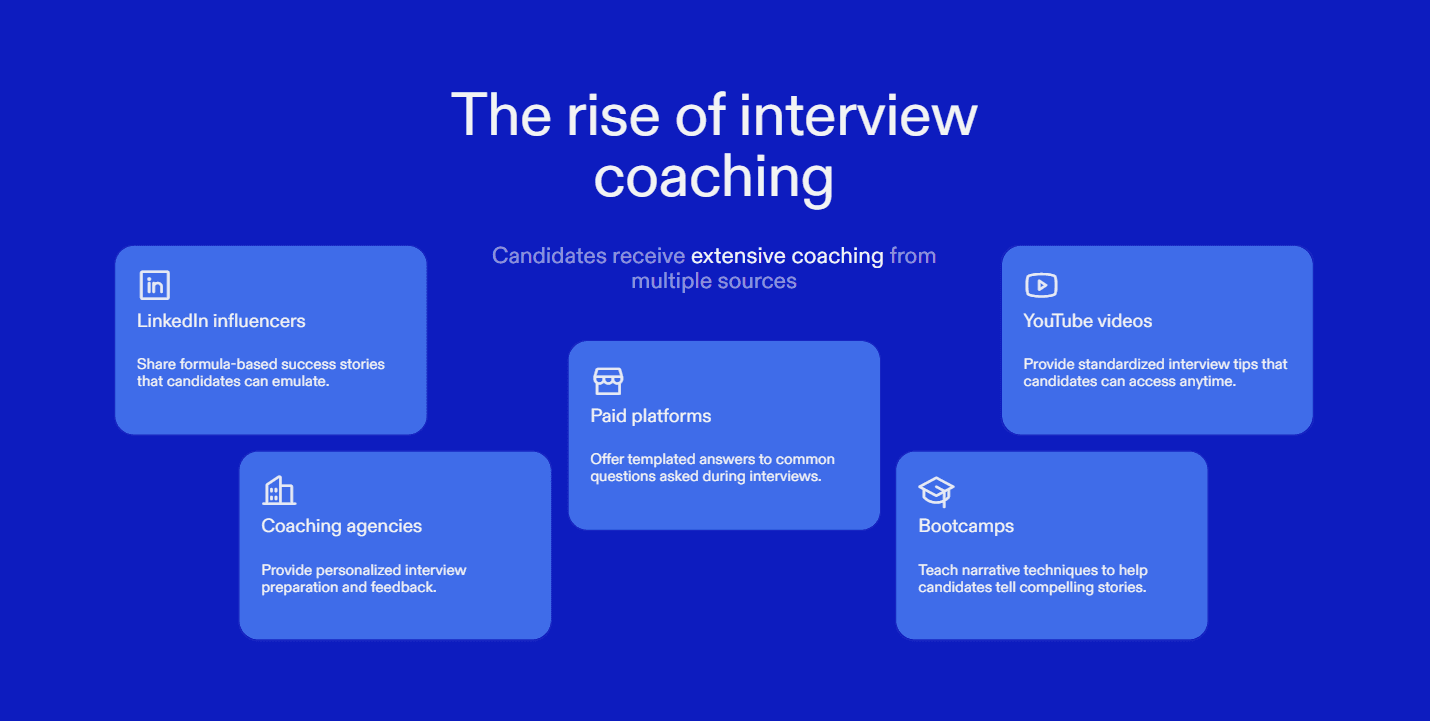
Candidates are now coached everywhere:
YouTube
LinkedIn influencers
Paid prep platforms
Bootcamp playbooks
Coaching agencies
They learn to present beautiful, clean, linear success narratives.
But real work is never clean. So hiring teams must shift how they listen.
What Interviewers Currently Listen For (But Should Ignore)
Common Listening Focus | Why It Misleads |
|---|---|
Confidence | Confident people can still be wrong |
Smooth storytelling | Often memorized or coached |
Perfect project arcs | Real work always involves messy adaptation |
Charisma or presence | Biases towards extroverted communication styles |
Role titles | Does not tell us about ownership depth |
This is how teams accidentally reward performance theater instead of problem-solving skill.
What Interviewers Should Listen For Instead
Reasoning Signal | Why It Matters |
|---|---|
Decision-making logic | Shows how they think under uncertainty |
Tradeoffs considered | Reveals maturity and judgment |
Constraint awareness | Indicates real-world experience |
Adaptation when conditions changed | Confirms lived, not learned, experience |
Personal ownership | Verifies that the work was actually theirs |
These signals directly map to performance in real jobs.
The One Coaching Shift
Instead of asking:
What did you do?
Train interviewers to ask:
How did you decide?
This moves the conversation from:
Action listing
ToCognitive reasoning
And that is where seniority and authenticity appear.
The “Reasoning Chain” Model
Teach interviewers to listen for the sequence, not the story.
A reasoning chain always has:
Context
Goal
Constraint
Decision
Tradeoff
Outcome
Learning / Adjustment
If any part is missing, probe.
The Three Follow-Up Prompts That Reveal Reasoning
1. Ownership
Which part of this was your decision?
2. Tradeoff
What were your other options, and why did you choose this one?
3. Adaptation
What changed and how did you adjust your approach?
These three prompts turn storytelling into thinking aloud.
Once the candidate is thinking aloud, you can see the real skill level.
Recruiter decisions during hiring can be improved by focusing on epistemic reasoning, such as establishing criteria, comparing alternatives, and selecting the optimal candidate, rather than relying on subjective impressions or narratives alone
The Interviewer Listening Exercise (Simple, Effective, 10 Minutes)
Give the team this drill:
Play two 50-second recorded interview clips:
One rehearsed
One real
Ask interviewers to highlight only the decision points, not the story arc.
Discuss:
Where reasoning was visible
Where narrative replaced logic
This builds pattern recognition faster than any written guide.
How to Document Reasoning in Notes (Bias Safe)
Avoid:
“Good storyteller”
“Seemed confident”
“Might fit culture”
“Not convincing”
Those describe vibes, not evidence.
Conclusion
Strong storytellers can sound strong. Strong thinkers can explain how they think.
Your interviewers must learn to:
Probe for reasoning
Ignore performance polish
Document cognitive evidence
Align evaluation to real skill signals
If hiring teams learn to listen for decisions, not narratives, your company will:
Hire better
Hire faster
Reduce mis-hires
Increase performance culture
Raise the overall talent bar
Reasoning is the real interview signal.